WK4DS Amateur Radio Blog
Search Posts
Overcast POTA activation strikes gold!
So today was a good day for POTA. I did some small work related items, grabbed the Ten Tec Argonaut 5 and headed to Cloudland to get an activation in before lunch. Before I even setup on frequency I was dial-ing around on 17 meters to check the band and found G3VBS calling CQ with no takers! So I figure, why not see if he can hear me… turns out 20 watts was plenty to make a contact with England and we had a great chat for quite a few minutes with only a little QSB.

Today I setup at the frisbee golf course parking area as it is the highest part of the park as well as the quietest RF wise. The lower lot has a nicer view but with the proximity to the campground and so many more people in general, it tends to be noisy comparatively.

Something else I like about the upper lot is I can either deploy the setup in the photo above or I can string a wire in a tree as well. Rigging the hamsticks in the lower lot is more difficult to say the least. So I was a little worried about the impending rain that was on the radar, I normally use the setup you see as I can sit in the truck and operate even in the rain. This is really nice as even inclement weather cant stop my POTA activations! Haha.

Well sure enough when I got home, it started raining so I made a good call here.

I did setup on the bed cover though, which is a little exposed but I figured I could move it into the truck pretty fast should it start to rain.

Today’s radio is the Ten Tec Argonaut 5 which is a wonderful little portable HF transceiver. It is larger than the TR-35 but it also has multiple modes and has every HF band available as well. Today I started on 17 meters because… why not? And that is where I heard G3VBS. I figured I would secure the activation with ease after having a great QSO with the UK. I couldn’t have been further from the truth. I only made one more contact on 17 before giving up and moving to 20 meters. Once on 20 meters things started to pick up for me.


There were a couple of pretty strong pile ups at times and it was fairly difficult to dig out a sinlge call. Mainly because most of the stations were zero beat with me. This makes all the signals turn into one large tone and I get garbled info. Luckily, I have learned a couple of tricks around this and can work with most people now. I will simple call W? Or if I get part of a Canadian call, VE? You get the point. This is a tried and true trick of pile up runners (did I just make up a new term? LOL) around the world. When you cant make out anything, just ask for the most common prefix you know and someone will reply. It worked well for me today as I was able to break apart the pile up and get every one into the log that I could hear. I even worked 4 or 5 stations after calling QRT as they were asking and I had time. I ended up with 36 QSOs toward my day as I had one dupe so it was a great day for POTA. If you want to know more about POTA just give it a google search and head over to their website. Until later, 73 de WK4DS
My activation with 9/10th of a watt… on CW.
Today marks a new milestone for me. I did a complete POTA activation with less than 1 watt of transmitter power. This is only 18% of my normal power of 5 watts. The numbers seem impressive now but just wait.

I went to K-2169 to get a quick activation in before they closed the park gate as I had almost two hours of time to do it.
I have several things that would be considered road blocks to this being possible.
The first one is the power obviously. The second is I am running that power into a hamstick antenna, which is not known for there efficiency. Lastly I setup at the foot of a mountain, literally… so let’s see what happened.

Spoiler alert…it went really well. I did have a bit of a rocky start as I wanted to get on 40 meters first but no one was there from what I could tell. After a solid 5 minutes of calling CQ I got zero answers, so I checked the spot page and saw there was a bunch of activators on 20 meters, so I changed the antenna to 20 meters and got on there.
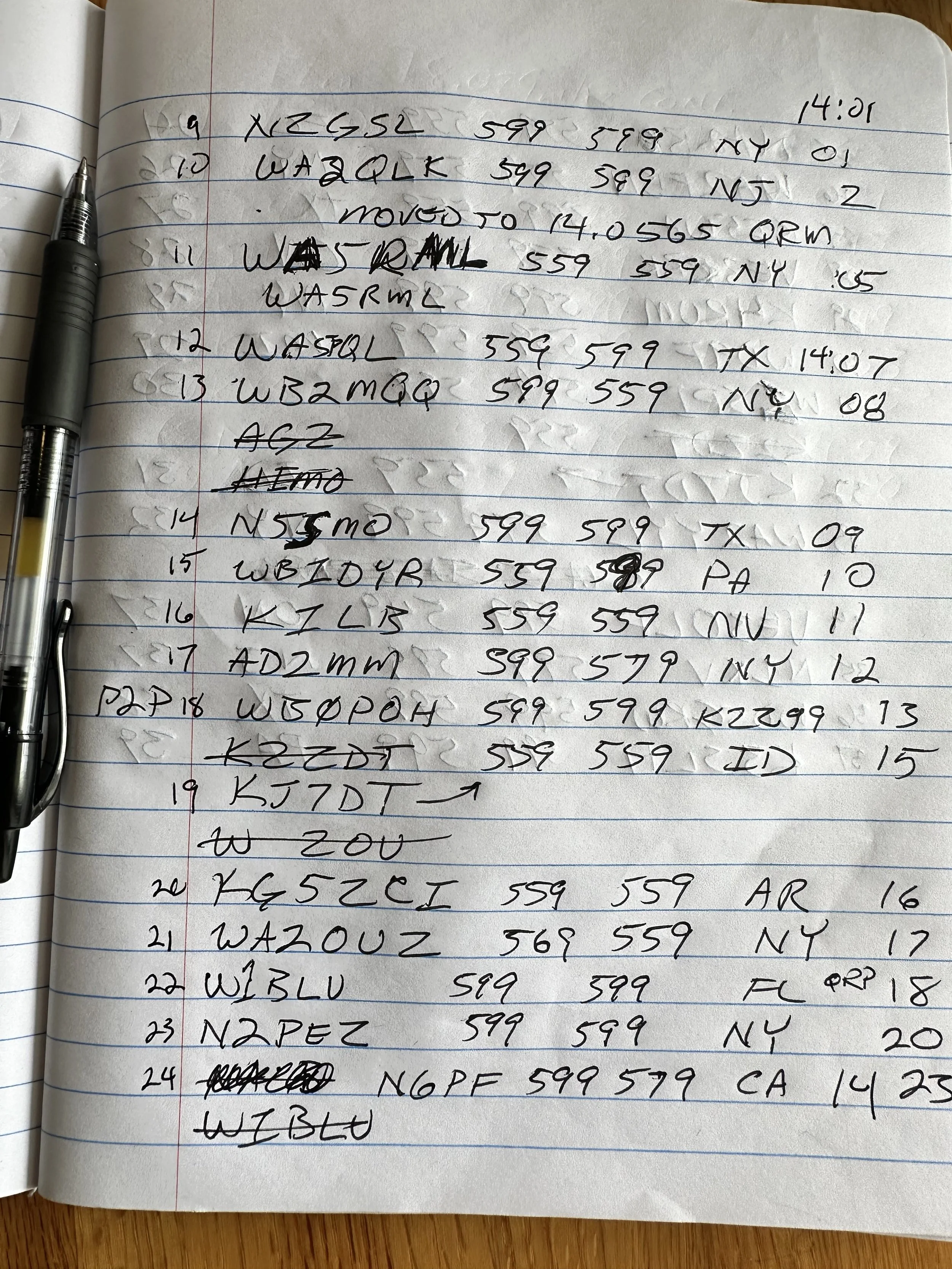
Things changed when I did this. My first contact was with Paul KJ7DT in Idaho! That is right at 1780 miles on 9/10ths of a watt! He even gave me a 559 report, which I couldn’t believe! Wow, this just might work!!!
Well, as you see in the logbook, it went surprisingly well and I was able to complete the activation and get back home well before dark too. This was a pleasant surprise to be honest about it. I have turned down my power before but never this much. Now, I am going to do a series of self challenges to see how low I can take the Icom IC-705 for output power and still get the activation.
There is an award from the QRP-ARCI called the 1000 miles per watt award. I won this award at least six times today (if I were to actually apply for it that is). That just boggles my mind. I think my furthest contact was VA7AQ in British Columbia at about 2120 miles. That comes out to 2355 miles per watt!!! That is crazy!!!


Radio waves are a strange thing sometimes. If the sun is cooperating and the earth is also happy, it is easy to get across oceans with just a watt or two of radiated power. I plan to test this theory more this summer as the solar cycle improves even more towards the maximum.
What really impressed me is with POTA you normally send more honest signal reports than in say a usual DX pile up or a contest. If you will notice, 20 meters was going strong at that moment and almost everyone was booming into my IC-705 in the rain that day. (I was inside the truck but it was raining). 9/10ths of one watt is what most hf rigs would consider the pre-amp stage. Lol. So the next time you have 100 watts and 2:1 SWR, dont sweat it too much, you still have something like 90+ times the radiated power I was using today. That should make you feel a little better about it. Haha. Until next time, warm up that atmosphere!!!
Addendum: Well I now have to get crazy low as Thomas (K4SWL) has a video where he activates with 100mW of output power… more to come…
POTA in the rain, it is still fun if you go prepared for it.

The fog was incredible on this day.
If you knew that I had already written this post once already…my rapid fire mouse press killed the first one. So here goes again…

Looking at this now, I look like an old wet hen in this photo…lol.
This day started off with a lot of rain and a ton of fog at the top of the mountain. I got to the location and found it to be thoroughly inundated with water and it actively raining making it even soggier…if that is even a word. Once I found the parking space I like… right smack dab in the middle of the parking lot, I proceeded to setup my antenna.

The antenna is the 20 meter hamstick but since it was raining so much I added my drip proofing kit to it with the empty peanut pack. This peanut pack is metal foil so it is probably interacting with the antenna somehow, but I don’t know if it is as I have not checked yet…

Even with the rain, setup is fast and the system just plain works. Even with it slightly detuned, I still was able to work a little over 40 stations in about an hour. This antenna (a hamstick) with tuned radials just works really well, even with QRP power levels. It takes about 3 or 4 minutes to screw the sections together and spread out the radials and then it is back into the dry truck for the rest of the operations.

Here we have one of the counter weights that holds my radials taught without having to use ground stakes or ropes or anything. Also of note is that it is raining so much that the grass is literally flooded around the truck with a couple of inches of standing water in the grass. I was hoping this would help my antenna, and it may have, but it being detuned hurt me more I am sure…

Just lay the radial in the water, it will be fine…
As you can see here I tested the system once I got into the truck to see what the center of the SWR null was and is it at 13.9mhz, which is about 150khz below where I set it when I first tuned the antenna. Once it stops raining, I plan to have a session where I hook up the antenna and check it again, and probably retune it with new radials and possible tune it to 14.1mhz to get the antenna closer when deployed wet.

The radio of choice for today’s adventure is the Penntek TR-35. I chose it because of the compact size and the fact that it is just plain fun to use. The compact size allows me to set everything up on the console of my front seat in the truck and I still have room to log. That is a big perk of this radio, it is so small that it literally just sits in the corner of the space out of the way and it has a dedicated knob for everything I like to change while operating. What a dream little radio… I cant wait to get a shot at operating the TR-45L at some point, that is gonna be sweet.

My mobile POTA setup currently, as of 2022.
Another big deal about this radio is this feature pictured below, this is the menu for the memory keyer. Yes, it has two memories and that is the perfect amount to have for an activation. More would be better, but two gets me a CQ memory and a closing memory. By having these memories I can do some house keeping between contacts at times like add times or park numbers and such to the logbook. This is super helpful when there is a pile up as I like to document time, band, call, and signal report. This is just my preference though and is not needed for POTA, but it does help when someone sends me a QSL card as I can confirm the contact properly.

The take away from this activation is that you need to check your resonant antennas if you plan to operate in inclement weather as they can change and your radio could see high SWR and not get out very well or worse, it could be damaged from excessive SWR… So I like to check the SWR occasionally now to make sure things have not changed and if they have, that they are still within operational parameters so I can activate with out fear of damaging my radio. All in all it was a great day as I netted 42 contacts in about an hour and this is a great trip for me. I operate alone almost exclusively so I have to do everything myself, this is why I paper log while activating and then I enter the log into the HAMRS app once I get home. I have a wireless Bluetooth keyboard that I use with my iPhone and it goes really fast that way. Thanks for taking the time to read my blog and please hit the like button if you liked it.
Get out there and get on the air!
David
WK4DS
72