
Solo Street Photography with Leica CL: Finding Joy Shooting Alone (Not Following the Rules)
I really like the 50mm perspective of these lenses on a crop sensor camera like my Leica CL. If I use a full frame machine then Iwill usually opt for something in the 50 to 58mm range as well.
After years of feeling pressure to do street photography "the right way," I finally figured something out: solo street photography photowalks with my Leica CL and a 50mm lens bring me more joy than following anyone else's rules. This is the story of how I stopped trying to shoot like Peter McKinnon, quit worrying about YouTube success, and rediscovered why I fell in love with photography in the first place—just grabbing my camera and hitting the streets alone.

My go-to setup: Leica CL with Voigtlander 35mm Nokton—this gives me a 50mm perspective on the crop sensor.
Why I Love Solo Street Photography (And You Might Too)
There's something incredibly freeing about solo photowalks that I didn't appreciate until I tried them consistently. When you're alone, there's no one to impress, no one waiting on you, and no one questioning why you're standing in the same spot for ten minutes watching the light change. You can be completely present with your camera and your surroundings without any social pressure.
I'll admit, at first the idea of walking around with a camera alone felt a bit weird. But then I realized—nobody cares. People are absorbed in their own lives, and you're just another person walking down the street. The freedom this brings is immense. If I see something interesting, I can stop and shoot it from ten different angles without feeling like I'm holding anyone up. If nothing inspires me, I can just enjoy the walk. There's zero pressure to "perform" or justify your creative choices to anyone.
My Leica CL Street Photography Setup: 50mm Perspective on Crop Sensor
It is just plain fun to grab a camera, a spare battery and hit the streets to see what I can find to photograph. My weapon of choice is the Leica CL mirrorless camera with one of several lenses. Usually though, my Leica CL is wearing a Voigtlander 35mm Nokton or a TTArtisan 35mm f/1.4, you never know which.
I really like the 50mm perspective of these lenses on a crop sensor camera like my Leica CL. The 1.5x crop factor means that 35mm lens gives me a 52.5mm field of view—basically a classic 50mm perspective. This is perfect for my shooting style because it gives me comfortable working distance from my subjects while still creating nice compression and subject isolation. If I use a full frame machine then I will usually opt for something in the 50 to 58mm range as well.
The Leica CL itself is the perfect camera for solo photowalks. It's small enough to not be intimidating, quiet enough to be discreet, and produces image quality that rivals cameras three times its size. The electronic viewfinder is bright and clear, the controls are simple and intuitive, and the whole package fits easily in my hand or jacket pocket. I can carry it all day without fatigue, and more importantly, I can carry it without thinking about it—which means I'm thinking about photography instead of gear.
I will take my 28mm lenses for the occasional stroll, but my staples are the 50mm lenses. Shoot, I even have the Leica APO Summicron SL 50mm for my Leica SL2 mirrorless camera as well because I like them so much. That is an insane package to be just strolling around town with slung around your neck…as well as heavy. Haha.
Breaking the Street Photography Rules: Why 50mm Works Better for Me Than 28mm
This literally took me years if not decades to truly figure it out. That is a hard pill to swallow at times too. Looking back, things could have gone a very different way had I followed my real passion instead of thinking I could be like Peter McKinnon… Live and learn I guess.
Before Pete came along and made me think I could be this ultra successful YouTube personality, I did things that other people said were what you should do. Like do street photography with wide glass and get close to people and stuff like that. That works for some people, but not me, I seem to have a real problem getting close to other people. Invading their personal space is such a red flag for me that I will just let the photo go before I attempt something like that.
Here's what nobody tells you about the "get close with a wide lens" approach: it's not just about technical skill, it's about personality. Some photographers are naturally extroverted, comfortable in stranger's personal space, and can pull off that close-up street style. I'm not one of those people. And you know what? That's completely okay. Using a 50mm or even longer lets me capture authentic moments from a respectful distance where neither I nor my subject feels uncomfortable. The photos are different than 28mm shots, but they're not worse—they're just mine.
This made for some truly terrible photos just to be honest about it. Mostly, it made me not want to go out and shoot though… so my very first Nikon DSLR would sit in the closet for months at a time with me not so much as looking at it. Who wants to go to a job and be stressed about that all day THEN make your hobby about "getting out of your comfort zone" and being stressed about that too?!? I almost gave up photography at one point because of this to be honest.

A typical scene from my solo photowalks—natural moments, comfortable distance
I have spent so long making YouTube content that I had actually forgotten how much fun it was to just go shoot. I will now get my camera and a battery or two and just hit the bricks. What I had to learn to do was to make a video about one every so often to share what I am doing with the viewers. I took a “sabbatical” the last two years in the first part of the year so I could do this. It helped dramatically too with my well being and my creativity.


Simple gear for photowalks: one camera, one lens, spare batteries. That's all I need.
From YouTube Pressure to Photography Joy: My Personal Journey
I finally found some joy when my daughter began competing in rock climbing. She joined a team and they would go all over for these events and I got my camera out and started photographing these gatherings and realized that there was more to this hobby than just what others said is good photography. I found a lot of joy in capturing interesting angles of the climbers and going to the trouble of sharing the photos with the team when done. It was really rewarding to be honest.
Then I broke my ankle and at about the same time, Sierra "aged out" of the team and stopped attending the events as life got in the way. Well, I needed a new avenue to focus on and found it in my YouTube channel. I learned over the years that a good YouTube content creator is not a good photographer—they are two very different things and I wandered down that rabbit hole for a while before realizing that it wasn't going to work for me.
The YouTube algorithm rewards consistency, spectacle, and engagement over artistry. It wants you to post weekly, chase trends, and create content that keeps people watching. That's fine if you want to be a content creator, but it's exhausting if you just want to be a photographer. I found myself thinking more about thumbnails and titles than I did about light and composition. I was shooting for the camera review, not for the creative satisfaction. That's when I knew something had to change.
The Joy of Street Photography Photowalks Without Pressure
This is where I am at now… just a guy with a camera out taking some pictures. No YouTube schedule to maintain, no algorithm to please, no gear to review, no style to emulate. Just me, my Leica CL, and whatever catches my eye. Some days that's dramatic light on a building. Other days it's a person waiting for the bus. Sometimes it's nothing at all, and that's fine too.
I have spent so long making YouTube content that I had actually forgotten how much fun it was to just go shoot. I will now get my camera and a battery or two and just hit the bricks. What I had to learn to do was to make a video about one every so often to share what I am doing with the viewers. I took a "sabbatical" the last two years in the first part of the year so I could do this. It helped dramatically too with my wellbeing and my creativity.
The biggest lesson? Photography should add to your life, not drain it. If your hobby is causing you stress instead of joy, you're doing it wrong—not because you're a bad photographer, but because you're following someone else's path instead of your own. Give yourself permission to shoot what you love, how you love, with whatever equipment makes you happy. That's where the good work lives.
Solo Street Photography Tips: Finding Your Own Style
Ultimately I found that I loved to go on photowalks and simply take pictures around me. Here's what I've learned about making solo photowalks work:
Keep your gear simple. I bring one camera, one lens, and two batteries. That's it. No bag, no accessories, nothing to fidget with or second-guess. This simplicity forces you to work within constraints, which actually makes you more creative, not less.
Shoot for yourself first. I used to think about how a photo would perform on Instagram or YouTube before I even took it. Now I shoot what interests me in the moment. Some of my favorite images would probably get three likes on social media, and I don't care. They're mine.
Walk the same routes sometimes. There's this idea that you need exotic locations for good street photography. I've learned more shooting the same three-mile radius around my house than I did traveling to "photogenic" cities. Familiarity breeds understanding. When you know a place well, you start to see the light differently, notice the rhythm of the day, and find moments you'd miss as a tourist rushing through.
Don't force it. Some walks I come home with fifty keepers. Other times I get nothing. Both are valuable. The walks where I don't press the shutter much are still feeding my creative eye, teaching me to see, and giving me time to think. Photography is as much about observation as it is about capture.
Frequently Asked Questions About Solo Street Photography
Is it okay to do street photography alone?
Absolutely! Solo street photography is not just okay—it's often the best way to shoot. When you're alone, you move at your own pace, follow your creative instincts without compromise, and blend into the environment more naturally. I've found that shooting solo actually reduces pressure because there's no one watching, judging, or waiting for you. You can spend five minutes on one corner if that's what feels right, or walk five miles following the light. Some of my best work happens when I'm alone with my camera and my thoughts.
What focal length is best for street photography?
There's no "best" focal length—only what works for your personality and shooting style. The conventional wisdom says 28mm or 35mm, but I prefer 50mm equivalent (which is a 35mm lens on my Leica CL crop sensor). The 50mm perspective gives me comfortable distance from my subjects, creates nice compression, and doesn't make me feel like I'm invading anyone's personal space. If you're uncomfortable getting close to strangers, telephoto focal lengths like 50mm, 85mm, or even 105mm can work beautifully. Don't let anyone tell you there's only one "right" way to do street photography.
How long should a street photography photowalk be?
Your photowalk should be exactly as long as it needs to be. Sometimes I'm out for 30 minutes and come home with great shots. Other times I'll wander for three hours and barely press the shutter. I've learned to follow my energy and creative flow rather than forcing a specific duration. Start with 30-60 minutes if you're new to photowalks, and let it evolve naturally. The goal is joy and creativity, not checking off a time requirement.
Can you do street photography with a Leica CL?
The Leica CL is fantastic for street photography! It's compact, discreet, produces excellent image quality, and the crop sensor actually gives you a nice 50mm perspective with a 35mm lens (or 75mm with a 50mm lens). The quiet shutter, simple controls, and build quality make it perfect for solo photowalks. I love that it doesn't scream "expensive camera" like a big DSLR or even a Leica M, so I can blend in while still getting Leica color and image quality. It's honestly my favorite camera for just grabbing and hitting the streets.
Do I need to follow street photography "rules"?
No! This is the most important thing I've learned: there are no rules, only guidelines that work for some people. You don't have to shoot wide angle, you don't have to get close to strangers, you don't have to shoot in black and white, and you certainly don't have to make yourself uncomfortable to get "good" street photography. Find what brings you joy and shoot that way. The best street photography comes from authentic vision, not from following someone else's rules. If 85mm or 105mm feels right, use it. If you prefer color, shoot color. Make your own rules.
What should I bring on a solo street photography walk?
Keep it simple—that's the beauty of solo photowalks. I typically bring just my Leica CL with one lens (usually my Voigtlander 35mm Nokton or TTArtisan 35mm f/1.4), and one or two spare batteries. That's it. No camera bag, no lens changes, no complicated gear setup. The simplicity is liberating. You can add a small water bottle and maybe your phone for emergencies, but resist the urge to pack heavy. The lighter you travel, the longer you'll walk and the more you'll enjoy it. Less gear equals more photography.
Support this website by using these affiliate links to shop on Amazon:
Leica M11 Digital Rangefinder Camera
Nikon AF-S FX NIKKOR 105mm f/1.4E ED Lens
Voigtlander Nokton 35mm f/1.4 II
Sandisk 128GB Extreme Pro memory cards
Nikon 50mm f1.8 S Lens for Z mount
Thanks for following along on my ramblings here. If you're feeling the same pressure I felt—to shoot a certain way, use specific focal lengths, or build a YouTube following—I hope this gives you permission to just grab your camera and go shoot for the joy of it.
Are you doing solo photowalks? I'd love to hear about your experiences in the comments below. What focal length do you prefer? Do you follow the "rules" or have you found your own path?
Want more honest photography content without the pressure? Subscribe to my photography blog for weekly posts about real creative journeys, not just gear reviews and pixel-peeping.

It is the holiday season again!
In the above photo, I was attempting to capture blue hour in downtown with a 25mm and this shows what I am talking about a little better. The wider angle allows me to get more of a scene and tell more of a story that a tighter lens like the 50mm or 75mm would do. I would have to back up a lot more if I wanted to include all of this in a 50mm lens photo as the field of view is a great deal narrower. Another thing that comes with longer focal lengths is a phenomenon called “compression”. This is where things in the background tend to look closer together than they are in reality from the effect the lens has on the subject. The photo below shows what I am talking about with compression…
When you live in the United States, you get to celebrate certain holidays and they seem to come once a month… In the winters we have Halloween, then a month later you have November and with it comes Thanksgiving where everyone literally over eats on one day and then eats the same meal everyday for the next week at lunch. HaHa.
It also brings colder weather so the photography is different too. I have, of late, been using my 28mm more than anything else it seems. The wider angle giving me more of a ”scene” than a specific subject. It also gives me a lot more depth of field so getting focus is a lot easier too. You see, I tend to shoot these days with vintage manual focus lenses more often than not. I do love my modern lenses with their aftofucus and light weight construction producing wonderful images, but sometimes I just want to use something from a simpler time. I have also found the lenses that work best for me applications too. Mostly Nikkor and Asahi Optical(Pentax) lenses with a sprinkling of some others like Voigtlander and Leica just to name a few.
I will also use these lenses for things like photo walks as well as general photography.
In the above photo, I was attempting to capture blue hour in downtown with a 25mm and this shows what I am talking about a little better. The wider angle allows me to get more of a scene and tell more of a story that a tighter lens like the 50mm or 75mm would do. I would have to back up a lot more if I wanted to include all of this in a 50mm lens photo as the field of view is a great deal narrower. Another thing that comes with longer focal lengths is a phenomenon called “compression”. This is where things in the background tend to look closer together than they are in reality from the effect the lens has on the subject. The photo below shows what I am talking about with compression…

Learning how to use these effects to your own personal advantage will open up so many possibilities for you. You couldn’t get this photo on a 20mm lens, it just wont work, you need the compression of a telephoto lens to be able to “stack” all those light displays together like that. This is why it is important to get out and shoot with different focal lengths at different times of day and also in different places, it is almost impossible to learn well without “doing”…
All this to say, the holidays as a wonderful time of the year to get out and practice your photography.

What Should You Photograph? A Documentary Photographer's Philosophy
Ok, this is going to be a short and sweet kind of post. I normally make YouTube videos about things that involve lots of images playing past the viewer and just lay some music over it to more or less inspire the viewer to do what I say at the end…”Get your camera out and go take a picture with it”
Ok, this is going to be a short and sweet kind of post. I normally make YouTube videos about things that involve lots of images playing past the viewer and just lay some music over it to more or less inspire the viewer to do what I say at the end…”Get your camera out and go take a picture with it”
What Do You Really Like to Photograph?

A couple painting down by the Tennessee River in Chattanooga, using iPhone light as the sun sets. The light was just too good to pass up. This is what I mean by chasing interesting light!
Never before has this been a truer statement than today. But we need to ask ourselves an important question…what do we like to shoot?
With world events being what they are and how the physical world around us is changing constantly as time goes on, I am not ready to just let it pass me by without documenting some of it as I go. Armed with this knowledge, I look for two things to photograph, things that will be gone soon or interesting light. That is what drew me to the photo above of the couple painting down by the river by iPhone light. The light was just too good to pass up.
Documentary Photography vs. Art Photography
Look, I need to be honest about something. I'm not trying to make art. I'm trying to make a record. There's a difference, and it took me a long time to be okay with that difference!
Art photography is about creating something beautiful or meaningful that didn't exist before. It's intentional, it's creative, it's about YOUR vision and YOUR interpretation. And that's great! The world needs art photographers.
Documentary photography is different. It's about capturing what IS, not what could be. It's about preservation, about creating a historical record, about showing things that will be gone tomorrow or next week or next year. When I photograph a building that's about to be demolished, I'm not trying to make it beautiful (though sometimes it is). I'm trying to make sure someone, somewhere, sometime in the future can see what it looked like before it disappeared.
Think about old photos from the 1800s or early 1900s. We don't look at those and judge them as "good photography" or "bad photography." We look at them as historical documents. They show us what streets looked like, what people wore, how buildings were constructed. That's what I'm doing, just with better cameras!
The Kinley hotel construction series below? That's not art. That's documentation. But in 50 years, someone researching Chattanooga's development will be glad those photos exist. The ADAMS sign preservation story? Someone doing historical research will use those images. That's the value of documentary photography, and it's a value I'm proud to contribute to my community.
You see, I am not what I would call an artist. I don’t think my photography is that noteworthy. Once I am gone, maybe someone will find these hard drives and then will think they are filled with the coolest photos and video the world has ever seen, just not today. That being said, I do think that I am a decent documentary photographer and that as time goes on I get better with it.
Things I normally photograph will be buildings that are gone now, that I could tell somehow that were probably headed for the wrecking ball or like the series below where I photo-documented the construction of the Kinley hotel and how there is a Coca-cola sign that is now hidden from view between the buildings because of the hotel. For me this is the sort of thing that is simply fascinating for some reason.
The Two Things I Photograph (And Why)
After years of shooting and trying different subjects and styles, I've boiled down what I actually photograph to TWO core things:
1. Things that will be gone soon This includes buildings scheduled for demolition, businesses that are closing, signs that are coming down, and landscapes that are about to change. The world changes fast, especially in cities. If I don't photograph it now, nobody will, and it'll just be gone forever!
The Kinley hotel construction? I knew that Coca-Cola sign would be hidden forever once the hotel went up. So I documented it. The old buildings on Rossville Avenue? Many of them won't be here in 10 years. I'm making sure we have a record of what they looked like.
2. Interesting light Sometimes the light is just too good to pass up. That couple painting by the river using iPhone light? The light was perfect. The sunset reflecting on the river with street lights spilling across the water? Had to stop and capture it. Night scenes with lit marquees and neon signs? Yeah, that's interesting light right there!
Here's the thing: these two categories overlap more than you'd think. Interesting light often happens during times of change. Dawn, dusk, construction lights at night, the golden hour before a storm. Light and change go together in photography!
How to find YOUR two things: Ask yourself: what do I keep photographing over and over? Not what you WANT to photograph or what you think you SHOULD photograph. What do you ACTUALLY photograph when you just go out with your camera for fun?
Look through your last 100 photos. What patterns do you see? For me, it was always buildings and light. For you, it might be people's faces, or textures, or motion, or something I'd never think of. The point is to be honest about what actually draws your attention in the field!
Documenting Chattanooga's Changing Landscape

The Coca-Cola sign that was visible downtown before the Kinley hotel construction. Once the hotel went up, this sign was hidden forever between buildings. This is exactly why I photograph things that will be gone soon!
The Kinley Hotel Construction Series: A Photography Case Study

The Kinley hotel coming out of the ground. I documented this entire construction project knowing it would change the downtown Chattanooga skyline permanently.

Mid-construction on the Kinley. The building taking shape and starting to hide the Coca-Cola sign that was behind it.

The Kinley with its distinctive blue exterior starting to appear. Each stage of construction tells part of the story of how Chattanooga is changing.

Later stage construction showing the ADAMS building sign across the street. Notice how the sign appears in these later photos once I thought to cross the street for a wider angle. That sign has its own story!
The ADAMS Sign: Hidden History Preserved
As an added bonus in these photos there is also another piece of history that undergoes a change as well. If you will notice that the sign on the corner for the ADAMS building appears in the last 4 photos where I thought to go across the street and get the image. This sign survives into the renovation and it is restored and back in place at the end. The ADAMS building no longer exists but the sign somehow survives into the current day…

The ADAMS building sign in its original weathered condition. The ADAMS building itself no longer exists, but somehow this sign survived into the renovation.
Chattanooga is going through massive change right now, and has been for the past 10-15 years. The downtown area is being redeveloped, new hotels are going up, old buildings are being renovated or torn down, and the whole character of certain neighborhoods is shifting.
This makes it perfect for documentary photography! There's always something changing, always some building in transition, always some piece of history that's about to disappear or transform.
The Kinley hotel construction is just one example. That entire block looked completely different five years ago. The Coca-Cola sign that's now hidden between buildings? That was a prominent downtown landmark for decades. Now you can only see it from certain angles, and soon it'll probably be gone entirely when the building it's painted on gets renovated or demolished.
The ADAMS building sign surviving the renovation? That's actually unusual! Most old signs don't make it through development. The fact that someone cared enough to preserve and restore that sign says something about Chattanooga's relationship with its history. That story is worth documenting!
Other Chattanooga locations I've documented that are now gone or changed: the old Terminal Station before its renovation, several restaurants and businesses that closed during COVID, vintage signage that's been removed or painted over, and entire blocks that look nothing like they did five years ago.
If you live in any city or town that's growing or changing, you have the same opportunity. Start photographing what's there NOW, because it won't be there forever. Future historians and your community will thank you!

The same ADAMS sign after restoration. They actually cared enough to preserve and restore it! This is unusual. Most old signs don't survive development.
Chasing Light: Night Photography in Small Towns
Another aspect of my photography is more artistic where I will shoot at night to capture interesting light in different areas of the city, where ever that might be. I have began to look for movie marques in the town square of small towns and get them lit up at night.

The Marietta Square Theatre at night in August 2023. I've started looking for movie marquees in small town squares and photographing them lit up at night. There's something special about these historic theaters!
But the real thing I have started to do it just take photos. Things that happen around me like the photo here of the smoke from local wildfires because it hasn’t rained in something like 2 or 3 months at this point.

Smoke from local wildfires during a 2-3 month drought. Sometimes documentary photography is just capturing what's happening around you, even if it's not pretty. This is what November 2023 looked like in our region.
These next two photos were not taken on the same night, but were captured about 1/4 mile of each other. One is the river front and I just liked the way the light fell that night on the water as well as the light spill from the street lights across the river and the color of the sunset all just came together for a great photo. The next one is simply a photo of a couple of buildings on Market and 5th street. The signage and the lights just made for a cool photo to me so I stopped for a second and grabbed a few images of it at varying exposure levels so I could get the lit signs to expose properly as well as the rest of the stuff. It is just a cool photo to me.
Night Photography Settings and Approach"
Since a lot of what I shoot involves low light and night photography, let me give you the practical details of how I actually do this.
Camera Settings: For night photography like the movie marquee shot, I'm typically shooting at ISO 400-800, aperture around f/2.8 to f/4, and shutter speeds ranging from 1/30 second to several seconds depending on the scene. The key is having a camera with good high ISO performance (my Leica SL2 handles this well) and either using a tripod or bracing against something solid.
For the river reflection shot, I used a longer exposure (probably 2-3 seconds) to smooth out the water and capture the light trails. This means a tripod is basically required unless you want blur!
Equipment: You don't need fancy gear for night photography, but you do need:
A camera that can handle high ISO without too much noise (or just be willing to make really long exposures to make up for it)
A fast lens (f/2.8 or wider is ideal)
A tripod or something to brace against
Patience to let your eyes adjust and find the light
I shoot with the Leica SL2 and various vintage lenses, often wide open or close to it. The in-body stabilization helps for handheld shots at slower shutter speeds.
Finding the Light: The best night photography happens during blue hour (the 20-30 minutes after sunset before it's fully dark). You get ambient light from the sky plus artificial lights from buildings and streets. This creates depth and color that pure darkness doesn't give you.
Also, look for lit signage! Movie marquees, neon signs, storefronts with their lights on. These create natural focal points and add color to night scenes.

The riverfront at sunset with street lights reflecting across the water. Sometimes all the light just comes together. The sunset color, the street light spill, the reflections. This is why I chase the light!

Buildings on Market and 5th Street in Chattanooga. The lit signage and building lights just made for a cool photo that night. I stopped and grabbed a few images at varying exposure levels to get everything exposed properly.
If you have not figured it out yet, I want you to start taking a long hard look at what it is that you enjoy photographing. i mean REALLY boil it down to the simplest components. For me it was the two things I just mentioned, for you it might be saturated colors or people waving at you or blur in your photo. The point is, don’t just generalize your answer, the only person you hurt in this event is yourself if you are not 100% truthful.
If you like to watch videos too, here is the video I did on the same subject.
Your Style Will Evolve (And That's Good)
Here's something important I want you to understand: your photography style WILL change over time, and that's not just okay, it's actually good!
I started out obsessed with urban decay. Abandoned buildings, peeling paint, broken windows, industrial ruins. I thought that's what I wanted to photograph forever. And you know what? It was a good starting point! It got me out shooting, it taught me about light and composition, and it connected me with other photographers who liked the same aesthetic.
But over time, I realized urban decay wasn't the root of what I liked. It was just a symptom of something deeper: I was drawn to things that were disappearing, to the passage of time, to change and transformation. Urban decay just made that visible in an obvious way!
Once I understood that pattern, my photography opened up. Now I photograph construction (the opposite of decay!), historic signs being preserved, changing skylines, and light at different times of day. All of these connect to that same root interest in time and change.
The lesson: Start with what attracts you right now, but stay open to discovering the deeper pattern underneath. Don't lock yourself into "I'm an urban decay photographer" or "I only shoot landscapes" or whatever. Let your interests evolve!
Ask yourself every six months: what am I actually photographing these days? What patterns do I see? What keeps drawing my attention? Your answers might surprise you, and that's when the most interesting growth happens.
For you, it might not be about time and change at all. Maybe you'll discover you're really interested in human connection, or geometric patterns, or the way weather affects a scene. The point is to keep asking the question and being honest about the answer!
So ask yourself what it is that you like and then go out and make photos of that AND don’t let yourself fall into the trap of not being able to change this with time. I started out wanting to shoot urban decay only, but it turned out that was not the root of what I like to shoot, but it led me to it. Anyway, with that said, get your camera out and go take a picture with it!
If you're struggling to figure out what YOU actually like to photograph, here are some questions that helped me:
1. What photos do you KEEP coming back to look at? Not the ones you think you should like, but the ones you actually open and view again. Those reveal something about your real interests.
2. What do you photograph when nobody's watching or judging? Forget Instagram, forget what's popular, forget what other photographers are doing. What do YOU photograph just because you want to?
3. What makes you stop and say "I need to capture this"? Pay attention to that impulse! What triggers it? Light? A specific subject? A moment in time? That's your style trying to tell you something.
4. What do you get excited to show people? When you're showing photos to friends or family, which ones do you genuinely want them to see? Not the "best" technically, but the ones you're proud of or excited about?
5. If you could only photograph ONE thing for the rest of your life, what would it be? This is a hard question, but it forces you to identify what really matters to you in photography.
For me, the answers kept pointing to documentation, preservation, and light. Your answers will point somewhere else, and that's your path forward!
Support this website by using these affiliate links to shop on Amazon:
Leica M11 Digital Rangefinder Camera
Nikon AF-S FX NIKKOR 105mm f/1.4E ED Lens
Voigtlander Nokton 35mm f/1.4 II
Sandisk 128GB Extreme Pro memory cards
Nikon 50mm f1.8 S Lens for Z mount
Frequently Asked Questions About Finding Your Photography Style
How do I find my photography style?
Start by being brutally honest about what you actually photograph, not what you think you should photograph. Look through your last 100 photos and identify patterns. What subjects keep appearing? What situations make you stop and take photos? For me, it was always buildings that were changing or disappearing, plus interesting light conditions. Your patterns will be different! The key is honest self-reflection, not copying what popular photographers are doing. Your style is already there in your work. You just need to identify it and lean into it intentionally.
What is documentary photography?
Documentary photography is about creating a historical record, not about creating art (though it can be both!). When I photograph a building before it's demolished or document a construction project, I'm preserving something for the future. Documentary photography captures what IS, not what you wish it was or what you imagine it could be. Think about old photographs from the 1800s. We value those not as art but as historical documents. That's documentary photography. It serves your community by preserving visual history that will matter to future generations.
What should I photograph as a beginner?
Photograph whatever genuinely interests you right now, even if it seems boring or obvious. Don't worry about finding your "style" immediately. Just shoot! I started photographing urban decay because that's what looked cool to me at the time. Years later, I realized the deeper pattern (things disappearing, interesting light), but I couldn't have discovered that without first spending time shooting what initially attracted me. Start with what interests you, shoot a LOT, and let your patterns emerge naturally over time.
How do you photograph at night without a tripod?
You need a camera with good high ISO performance and the fastest lens you can get (f/2.8 or wider is ideal). I typically shoot at ISO 400-800 for night photography, sometimes higher if needed. Use a wide aperture (f/2.8 or f/4) to let in more light, and brace yourself against something solid like a wall or pole. The Leica SL2's in-body stabilization helps me handhold at slower shutter speeds than I could with other cameras. That said, a tripod is still better for really dark scenes or long exposures! Don't be afraid to carry a small travel tripod.
Can your photography style change over time?
Yes, and it should! My photography style has evolved significantly. I started obsessed with urban decay, then realized I was really interested in things that were disappearing or transforming. That deeper understanding opened up new subjects: construction photography, historic sign preservation, changing skylines. Don't lock yourself into one style forever. Every six months, ask yourself: what am I actually photographing these days? What patterns do I see? Let your style evolve as you grow and learn more about what really interests you.
What makes Chattanooga good for documentary photography?
Chattanooga is going through massive urban development right now. New hotels, renovated buildings, changing neighborhoods, businesses closing and opening. This constant change makes it perfect for documentary photography! There's always something disappearing or transforming. The Kinley hotel covering the old Coca-Cola sign, the ADAMS sign surviving a building renovation, old businesses on Rossville Avenue. These changes are worth documenting because future generations will want to see what Chattanooga looked like during this transformation period. Your town probably has similar changes happening!
How do I know if I'm a documentary photographer or an art photographer?
Ask yourself: when you take a photo, are you trying to capture what's really there, or are you trying to create something new? Documentary photography is about preservation and record-keeping. Art photography is about personal vision and creative expression. Many photographers do both! I'm primarily documentary focused because I care more about preserving history than making beautiful images (though sometimes they're both). There's no wrong answer here. It's just about understanding your own motivations and leaning into what actually drives you to pick up a camera.
What camera do I need for documentary photography?
Any camera works for documentary photography! Documentary is about subject and intention, not gear. That said, certain features help: good low light performance (for night photography), ability to shoot in challenging conditions, and reliability. I use a Leica SL2 with vintage lenses, but I've done documentary photography with everything from DSLRs to smartphones. The best camera for documentary photography is the one you'll actually carry with you when the moment happens. Don't let gear be an excuse for not starting!

Tennessee Fall Color Photography: Finding Colors During Drought
Looking up at the yellow canopy at North Chickamauga Creek WMA, Tennessee. The overcast sky created beautiful soft light filtering through the leaves without harsh shadows. This perspective shows how dense the fall color was in areas where the trees had access to groundwater from the creek.
Well, it sure took long enough, but I finally found a place local to me that had some beautiful fall color photo opportunities.

Looking up at the yellow canopy at North Chickamauga Creek WMA, Tennessee. The overcast sky created beautiful soft light filtering through the leaves without harsh shadows. This perspective shows how dense the fall color was in areas where the trees had access to groundwater from the creek. Just a few hundred yards away from the water, everything was brown and crispy from the drought. The lesson? In dry years, forget the open fields and exposed ridges. Find the water and you'll find the colors! Leica SL2 + Nikkor 28mm f/2.8 AiS handheld.
Tennessee Weather - Fall Color Photography
This is not something I normally have when it is as dry as it has been recently. Let me explain…
I am no scientist but I have stayed in a Holiday Inn before, so here goes. From what I have seen, there are three different scenarios that usually unfold around here in the fall.
The first event is like this, we get plenty of rain in the spring, it dries out a little in the mid summer months and then it starts to rain in late September or early October. This is actually the best possible scenario from what I can tell…
The second scenario is the same as the first one except the rain turns into a thunderstorm storm with heavy rain and usually high winds during peak color season, knocking all the leaves off of the trees.
Then there is option three, this one is where there is rain in the spring but then it is dry for the entirety of summer and fall. This is the type of season we are in now. There has not been enough rain to matter in two months…maybe more. It is so little water that the creek next to my house has no surface water in it as of this writing.
Of the three events, the first one is the preferred for fall color photos as there is sufficient water for the trees to transition normally to their dormant winter state and you get this incredible color display in the fall. This year though, we have event three where everything is a huge tinderbox and the leaves are simply drying out and turning brown then falling off of the trees without passing through their color phase at all…except…in the few places where there is still ground water to water the trees.
Understanding Tennessee's Three Fall Color Scenarios
I mentioned the three fall scenarios briefly, but let me break them down in more detail since understanding these patterns will help you plan your fall photography:
Scenario 1: The Perfect Year (RARE)
What happens:
Spring rains (March-May) give trees plenty of water to grow
Summer (June-August) dries out a little but not too much
Rain returns in late September or early October
Trees get signal to prepare for winter dormancy
Beautiful color transition over 2-3 weeks
Leaves stay on trees long enough to photograph
Photography result:
Incredible color displays everywhere
Colors last for weeks, not days
Can shoot anywhere, not just near water
This is what you see in all the fall color guides!
We get this maybe 1 out of every 4-5 years
Scenario 2: The Stormy Year (FRUSTRATING)
What happens:
Same as Scenario 1 through summer
Rain returns in late September (good!)
But it comes as thunderstorms with heavy rain and high winds
Leaves start to change color (exciting!)
Then a big storm blows through (devastating!)
All the leaves get knocked off before peak color
Photography result:
You get maybe 3-5 days of good color before the storm
Have to act fast when colors appear
After the storm, just bare trees and leaves on the ground
Extremely frustrating if you had plans for the weekend!
This happens maybe 1 out of every 3-4 years
Scenario 3: The Drought Year (CHALLENGING)
What happens:
Rain in spring (so far so good)
Then dry for entire summer and fall (uh oh)
No rain in September or October
Trees are stressed and trying to survive
Leaves dry out and turn brown without color phase
Everything becomes a tinderbox
Exception: Places with groundwater still have colors!
Photography result:
Most locations are brown and crispy, no color
Have to find water sources (creeks, rivers, springs)
Limited locations but concentrated color where water exists
Requires more scouting and research
This is what we had this year (2023)
How to adapt:
Scenario 1: Shoot anywhere, you can't go wrong!
Scenario 2: Have a plan ready, shoot as soon as colors appear
Scenario 3: Follow the water (like I did at North Chickamauga Creek)
The key is recognizing which scenario you're in and adjusting your strategy accordingly. Don't wait for "perfect conditions" that might not come!

A red maple tree standing out in a sea of yellow at North Chickamauga Creek WMA near Soddy Daisy, Tennessee. This was the first scene that greeted me when I started looking for fall colors! After weeks of drought with everything turning brown, finding this color contrast felt like discovering gold. The key during dry years? Follow the water. This gorge has a creek running through it (barely flowing, but still there!), which gave the trees enough water to transition to their fall colors normally. Shot handheld with Leica SL2 + Nikkor 28mm f/2.8 AiS. The overcast light saturated the colors without creating harsh shadows!
Fall Color Photography Secret… Follow the Water
Enter North Chickamauga Creek WMA near Soddy Daisy Tennessee. This is a small WMA (Wildlife Management Area) situated in a gorge next to Mowbray mountain and is a popular spot for the locals to cool off in the summertime in the river. Well, the river is just a brook at this point and is barely moving at all, BUT it is there! If you watch my YouTube video on it you will see what I mean. Even so, there is still enough water to feed the trees so they had a fall color change.
Since I found some colors this year, I now had to figure out what I wanted to use to capture all this color with. I finally settled on my camera being the Leica SL2 as it has a high resolution sensor and several other features that lend itself to being a wonderful landscape photography camera. You see the Leica SL2 is a mirrorless camera so it can be adapted to various vintage lenses really easily and we all know how I love using vintage lenses! So today’s lens of choice for the Leica is the Nikkor 28mm f2.8 AiS. This is one of Nikon’s crowning achievements in lens design as it was as close to optical perfection as they had ever gotten to that point. So naturally I used this lens.
The magic of the Leica SL2 as well is that it has IBIS on the sensor. This basically turns all my vintage lenses into stabilized lenses. I know there are a ton of other cameras that also have these same features but I just like the Leica SL2 for some reason.
Now that the camera setup is settled, next is finding the photo I want. I started out looking for macro level images, vistas and scenes, then I moved in closer to get more detailed image ideas. The first one is shown above of the red maple tree in a sea of yellow. Then I moved to the river bed and found some wonderful colors out in the open.
Looking upstream at North Chickamauga Creek near Soddy Daisy, Tennessee. This is literally what greeted me when I entered the river bottom. Not much water (you can see how low the creek was during this drought!), but the color splash from the trees was incredible! The boulders in the creek bed created great foreground interest, and the overcast sky provided soft, even light that made the colors pop without blown highlights. Shot handheld with Leica SL2 + Nikkor 28mm f/2.8 AiS at f/8. I love the texture and color in this image! So much detail from the rocks to the leaves to the trees. The 28mm wide angle let me include the entire scene from the creek bed up to the canopy. This is why I walked down into the creek rather than shooting from the trail!
This was literally what I was greeted with when I looked upstream from where I entered the river bottom. Not much water, but I got such a color splash from the trees that I didn’t even care. I would have liked for it to not be overcast, but you take what you can get and work with it. I really love this image too, so much texture and color in one image that is is almost overwhelming. I was really starting to embrace the look that the 28mm lens was giving me and then I decided to move upstream to that large boulder you see in the above photo and get a different perspective from that spot.

The valley perspective looking upstream at North Chickamauga Creek WMA, Tennessee. That little smidgen of sky showing the overcast clouds almost makes it otherworldly or something like that! I was blown away with this image when I got it into Lightroom and could see it better. It almost doesn't look real back up in the valley next to the sky. The clouds were epic! Shot handheld from a large boulder I scrambled up to for this perspective. Leica SL2 + Nikkor 28mm f/2.8 AiS, no tripod. The IBIS (in-body image stabilization) let me shoot this at 1/15s handheld and get sharp results. There's something to be said for simplicity - one camera, one lens, no backpack or tripod. Just me and the landscape!
Fall Color Photography and Moody Skies
The little smidgen of sky showing the over cast clouds almost makes it otherworldly or something like that. I was blown away with this image when I got it into Lightroom and was able to see it better. It almost doesn’t look real back up in the valley next to the sky. The clouds were epic! This is also shot hand held with the 28mm lens. What is nice is that it allowed me to be very agile and not have the burden of the back pack and a tripod with me at all. There is something to be said for simplicity…
Frequently Asked Questions About Fall Color Photography in Tennessee
When is peak fall color season in Tennessee?
It depends on where you are in the state! In East Tennessee (mountains), peak fall colors usually hit mid-to-late October. In Middle Tennessee (Chattanooga area and surrounding), you're looking at late October into early November. But here's the thing that most people don't realize: the actual timing depends more on rainfall and temperature than it does on the calendar! If we get a drought like we had this year, the trees just skip the color phase entirely and go straight to brown. If we get too much rain with high winds during peak season, all the leaves get knocked off before you can shoot them. The "perfect" fall color year requires rain in spring, a slightly dry summer, then rain returning in late September or early October. That's when you get the incredible color display that lasts for a couple weeks!
Why do some years have better fall colors than others?
Water! It all comes down to water and how the trees are stressed. I'm no scientist, but I have stayed in a Holiday Inn before, so here goes, lol. Trees need sufficient water to transition normally to their dormant winter state. When they have the right amount of water, they go through that beautiful color change we all love photographing. But when it's too dry (like this year with two months or more of no rain), the leaves just dry out and turn brown without passing through the color phase at all. It's basically a huge tinderbox and the trees are just trying to survive, not put on a show for photographers! That's why you need to find the water sources during dry years. Wherever there's still groundwater feeding the trees (creeks, rivers, springs), those trees will still change color even when everything else is brown.
Where can you find fall colors in Tennessee during a drought?
Follow the water! During dry years like this one, you need to find places where there's still water feeding the trees. Creek beds, river gorges, wildlife management areas near water sources, anywhere with groundwater. For me, North Chickamauga Creek WMA near Soddy Daisy Tennessee saved the day! The creek was barely flowing (just a brook at that point), but there was enough water to keep the trees happy. They had a beautiful fall color change while everything else around the area was brown and crispy. Other good bets: Ocoee River area, any of the gorges in the Cumberland Plateau, state parks with creeks or waterfalls, and anywhere in the Smoky Mountains (they usually have better water retention). Just look for blue on the map and you'll probably find color!
What camera settings work best for fall color photography?
I shot this whole session handheld with the Leica SL2 and Nikkor 28mm f/2.8 AiS lens, so here's what worked for me: aperture priority mode (let the camera pick the shutter speed), probably f/5.6 to f/11 for landscape depth of field, ISO auto (camera adjusted based on light), and I relied heavily on IBIS (in-body image stabilization) since I wasn't using a tripod. For fall colors specifically, you don't want to overexpose or you'll blow out the bright yellows and reds. I tend to expose for the highlights and let the shadows fall where they may, then I can lift them a bit in Lightroom if needed. Shoot RAW so you have flexibility with white balance (overcast days can look weird if you don't adjust). And honestly? Just set it and forget it so you can focus on composition rather than fiddling with settings!
Do you need a tripod for fall color photography?
Not if you have IBIS! I deliberately left the tripod and backpack at the truck because I wanted to be agile and explore without the burden of extra gear. The Leica SL2 has in-body image stabilization which basically turns all my vintage lenses into stabilized lenses. This means I can shoot handheld at slower shutter speeds without camera shake. There's something to be said for simplicity, especially when you're walking a creek bed or scrambling around on boulders like I was doing. That said, if you don't have IBIS or you're shooting in really low light, a tripod will give you sharper images. But for bright overcast days like this? Handheld is totally fine and way more enjoyable!
What's the best lens for fall color photography?
Wide angle! I used the Nikkor 28mm f/2.8 AiS for this session and it was perfect. Wide angle lenses (24mm, 28mm, 35mm) let you include the environment and context around the colors. You can get the creek bed, the trees, the sky, the boulders, everything in one frame. Plus, when you're in a gorge or tight space, a wide lens is the only way to get the whole scene. That said, bring a longer lens too if you want to isolate individual trees or compress distant ridgelines. But if I had to pick just one lens for fall color photography? 28mm is my sweet spot. It's wide enough for landscapes but not so wide that you get too much distortion on the edges.
Is vintage lens photography good for landscape work?
Absolutely! The Nikkor 28mm f/2.8 AiS I used is one of Nikon's crowning achievements in lens design. It was as close to optical perfection as they had ever gotten to that point. Vintage lenses often have character that modern lenses lack (slightly warmer rendering, interesting flare characteristics, smooth bokeh), and they're sharp enough for landscape work when you stop them down to f/5.6 or f/8. The best part? They're cheap! You can get incredible vintage glass for $100-300 that would cost you $1,000+ in a modern equivalent. Just make sure your camera can adapt them (the Leica SL2 is perfect for this with its short flange distance), and you're good to go. Oh, and IBIS makes vintage lenses even better since they don't have built-in stabilization!
What time of day is best for shooting fall colors?
Honestly? Overcast days like I had are actually ideal for fall color photography! Direct sunlight creates harsh shadows and blown highlights on the bright leaves. Overcast light is soft, even, and it lets the colors really saturate without fighting crazy contrast. That said, early morning and late afternoon (golden hour) can be magical if you want warm light on the trees. Avoid midday harsh sun if you can. For this shoot, the overcast clouds were epic and made the colors pop without any harsh shadows. It almost looked otherworldly! So don't skip shooting just because it's cloudy. Embrace it!
How do you compose fall color photos without them looking like every other fall photo?
Great question! I try to find specific elements to anchor the composition rather than just pointing at a bunch of colorful trees. For this session, I looked for: (1) the red maple tree in a sea of yellow (color contrast!), (2) the creek bed with boulders as a leading line through the frame, (3) the valley perspective looking upstream with that little smidgen of sky, and (4) textures and layers (water, rocks, leaves, trees, sky). The key is to have a subject or a story, not just "look, it's colorful!" Find a foreground element, use the colors as supporting cast, and compose with intention. Also, get low! I was walking in the creek bed and scrambling on boulders to get different perspectives. Don't just stand on the trail and shoot at eye level like everyone else!
What are the three fall color scenarios in Tennessee?
From what I've seen, there are three different scenarios that usually unfold around here:
Scenario 1 (BEST): Plenty of rain in spring, dries out a little mid-summer, then rain returns in late September or early October. This gives you incredible color displays that last for weeks! The trees have enough water to transition normally to dormancy and you get the full spectrum of reds, oranges, and yellows.
Scenario 2 (WORST): Same as Scenario 1 except the rain turns into thunderstorms with heavy rain and high winds during peak color season. This knocks all the leaves off the trees before you can photograph them. Super frustrating!
Scenario 3 (CHALLENGING): Rain in spring but then dry for the entirety of summer and fall. This is what we had this year. Everything becomes a huge tinderbox and the leaves simply dry out and turn brown without passing through their color phase at all... except in the few places where there's still groundwater to feed the trees. That's when you have to get creative and find the water!
BONUS QUESTION: What's North Chickamauga Creek WMA like for photography?
North Chickamauga Creek WMA near Soddy Daisy Tennessee is a hidden gem! It's a small Wildlife Management Area situated in a gorge next to Mowbray Mountain. Locals use it to cool off in the river during summertime, but in fall it's perfect for photography! The gorge creates interesting light and the creek provides water for the trees even during drought years. When I shot this, the river was barely moving (just a brook, really), but there was still enough water to feed the trees so they had beautiful fall color change. Easy to access, not too crowded, and if you walk the creek bed you'll find tons of compositions. Just be careful on the rocks, they can be slippery! If you watch my YouTube video about it you'll see what I mean.
So in summary, if you want to find fall colors even when it has been really dry, find the water. Where ever there is water, there will be fall colors. At least that is what I have seen, your mileage may vary.
Support this website by using these affiliate links to shop on Amazon:
Leica M11 Digital Rangefinder Camera
Nikon AF-S FX NIKKOR 105mm f/1.4E ED Lens
Voigtlander Nokton 35mm f/1.4 II
Sandisk 128GB Extreme Pro memory cards
Sigma 65mm f/2.0 Review: 98% of Leica Quality for $700 (L-Mount)
The Goldilocks Focal Length: 65mm sits right between the standard 50mm and the classic portrait 75mm. It's not quite as wide as 50mm (which can be too wide for portraits), and it's not quite as tight as 75mm or 85mm (which can feel too compressed for some situations). It's just right!
So a good friend loaned me his lens. One of my subscribers that I have grown to know over the years offered to send me a couple of his Sigma lenses and let me use them for a while as review samples for you guys.
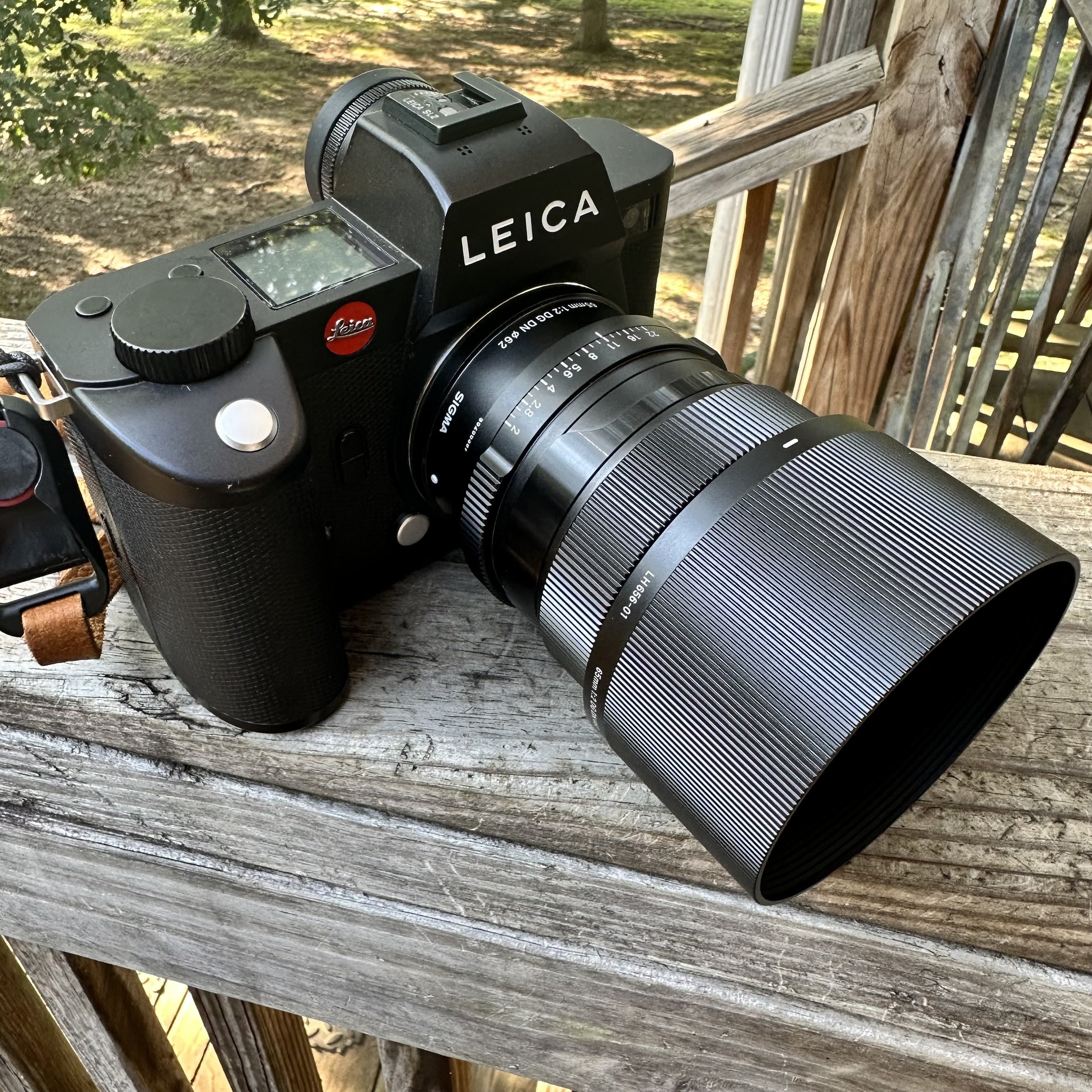
The Sigma 65mm f/2.0 mounted on my Leica SL2. You can see the physical aperture ring with 1/3 stop detents (one of my favorite features!). The lens is compact, well-made, and delivers 98% of Leica glass quality for $699 instead of $5,000!
Technical Specifications and Pricing
Before we dive deeper, here are the specs for the Sigma 65mm f/2.0 DG DN:
Optical Design:
Focal length: 65mm
Maximum aperture: f/2.0
Minimum aperture: f/22
Aperture blades: 9 (rounded for smooth bokeh)
Optical design: 14 elements in 11 groups
Physical Specs:
Mount: L-mount (Leica SL/CL, Panasonic S-series)
Filter size: 62mm
Length: 2.8 inches (72mm)
Weight: 14.3 oz (405g)
Minimum focus distance: 21.7 inches (55cm)
Construction:
All-metal barrel
Weather-resistant construction
Aperture ring with 1/3 stop detents
AF/MF switch on lens barrel
Smooth focus ring (encoder design)
Price:
Sigma 65mm f/2.0 DG DN: ~$699
Leica APO-Summicron-SL 75mm f/2 ASPH: ~$4,995
Yeah, you read that right. The Leica costs seven times more than the Sigma. And yet, as I'll explain, the Sigma delivers 98% of the image quality! Let's dig into that comparison.
Why 65mm? The Perfect In-Between Focal Length
If you're not familiar with 65mm as a focal length, let me explain why this is such a sweet spot:
The Goldilocks Focal Length: 65mm sits right between the standard 50mm and the classic portrait 75mm. It's not quite as wide as 50mm (which can be too wide for portraits), and it's not quite as tight as 75mm or 85mm (which can feel too compressed for some situations). It's just right!
Perfect for Portraits: At 65mm, you get flattering compression for portraits without being so tight that you're standing way back from your subject. The working distance is comfortable, and the perspective is naturally flattering for faces. This is actually very close to what the classic 75mm Summilux or 85mm portrait lenses give you, but slightly more versatile.
Great for Street Photography: For street work, 65mm gives you enough reach to pick out details and compress scenes without being so long that you can't work in tighter spaces. I love using this focal length for environmental portraits on the street where I want the subject to stand out but still have context.
Comparison to Other Focal Lengths:
50mm: Wider, more environmental, great for general use but can be too wide for portraits
65mm: Perfect balance, flattering for portraits, good for street, versatile!
75mm/85mm: Tighter compression, classic portrait lenses but less versatile for general use
90mm: Even tighter, requires more working distance, more specialized
The 65mm focal length is honestly underrated. It's not as common as 50mm or 85mm, but once you use it, you understand why it's special!
I really appreciate your offer Hassan and look forward to the day when we finally get to link up and go out on a photowalk together!
Hassan packed up two of his beautiful Sigma primes and sent them up for a look. He sent his 65mm f2 DG DN and his 90mm f2.8 DG DN. Both of these are in Leica’s L mount as Hassan has a Panasonic Lumix camera that is also in L mount due to the L mount alliance between Leica, Sigma and Panasonic.
The first impression of this lens is the darn thing is tiny. This lens is really small, this is awesome as it means it makes the system really compact. The next thing I noticed right away is how nice the build is, all metal construction for the major parts, including the lens hood from what I can tell. Really nice fitment of the lens components so there really is no play in the mating parts. Parts designed to move, like the aperture ring, move only in the direction they are designed to move in. The machine work and fitment is nicely executed from what I can tell.
The next thing I noticed is how fast the focus works, just understand this…it is fast. How fast? Well, it is fast enough to get the shot for me. it is not as fast as my native Leica glass, but it is plenty fast enough for my personal use. I don’t have a way to measure the focus speed, but it works great and I have no complaints about it.
Sample Photos: What This Lens Can Do
Let me show you what this lens actually produces in real-world use. This is shot with the Sigma 65mm f/2.0 on my Leica SL2 during a photowalk around Chattanooga:
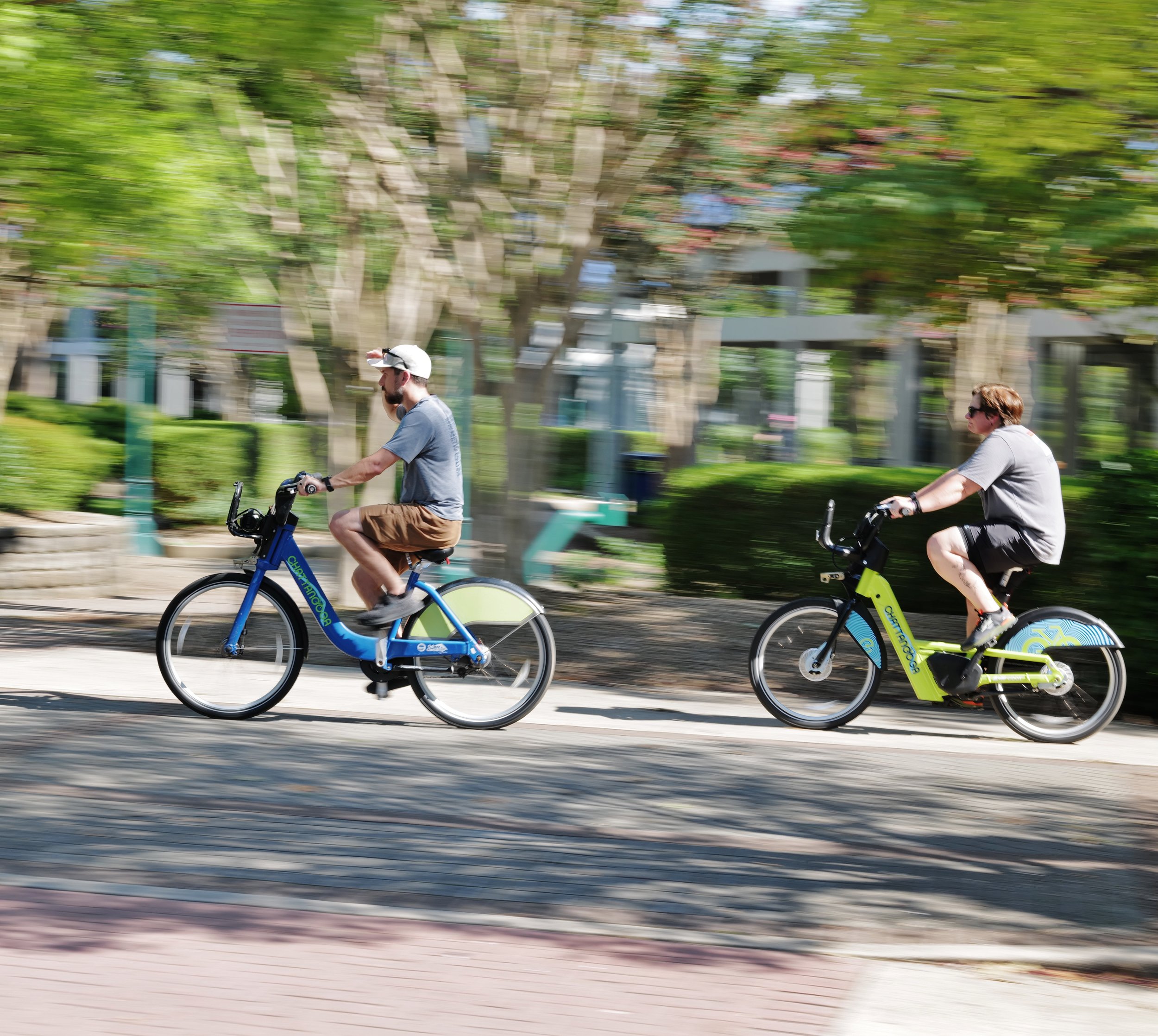
Panning blur shot of bicycle riders at Coolidge Park in Chattanooga. This demonstrates how fast and accurate the Sigma 65mm autofocus is! Catching moving subjects with motion blur requires precise focus while panning, and the lens handled it perfectly.
This photowalk sample shows what I meant by "98% of Leica glass." Look at the sharpness, the rendering, the color! This is what you're getting for $699. Not "budget lens performance." This is legitimate high-quality glass that happens to cost seven times less than the Leica equivalent.
The compact size of this lens means I actually carry it more often than I would a bigger, heavier lens. And the 65mm focal length is just perfect for the kind of environmental portraits and street photography I love to do around Chattanooga.
Sigma vs Leica: 98% of the Quality at 14% of the Price
Let me be really clear about something: I said this lens is 98% of my Leica glass in every conceivable way. That's not marketing speak. That's my honest assessment after using both extensively.
The Price Difference is Staggering:
Sigma 65mm f/2.0 DG DN: $699
Leica APO-Summicron-SL 75mm f/2 ASPH: $4,995
That's a $4,296 difference. The Sigma costs 14% of what the Leica costs. Let me repeat that: you're paying seven times less for the Sigma!
What Does the Leica Give You?
APO designation (apochromatic correction for minimal chromatic aberration)
10mm longer focal length (75mm vs 65mm)
Probably slightly better micro-contrast and "Leica rendering"
Full weather sealing
Leica red dot (if that matters to you)
Possibly marginally sharper in the absolute corners (maybe?)
What Does the Sigma Give You?
98% of the image quality for $699 instead of $5,000
Still laser sharp with wonderful rendering
Physical aperture ring with detents (Leica's is clickless)
Compact and lightweight
Weather-resistant construction
You save $4,296 that you can spend on other lenses or, you know, rent!
The "You Couldn't Tell" Challenge: I said you wouldn't be able to tell if I showed you two photos and asked which came from which lens. I stand by that! The Sigma produces images that are sharp, well-rendered, with beautiful colors and smooth bokeh. Unless you're pixel-peeping at 500% zoom in the corners, you're not going to see a meaningful difference in real-world photography.
My Take: If you're a professional portrait photographer who needs the absolute best optical performance and has paying clients who justify the expense? Maybe the Leica makes sense. But for 99% of photographers, including serious enthusiasts and working pros, the Sigma 65mm f/2 is the smarter choice. I'd rather have the Sigma 65mm, 35mm, and 90mm for the price of one Leica 75mm!
The Sigma isn't "almost as good as Leica." It's "actually just as good for any practical purpose, and you save $4,300."
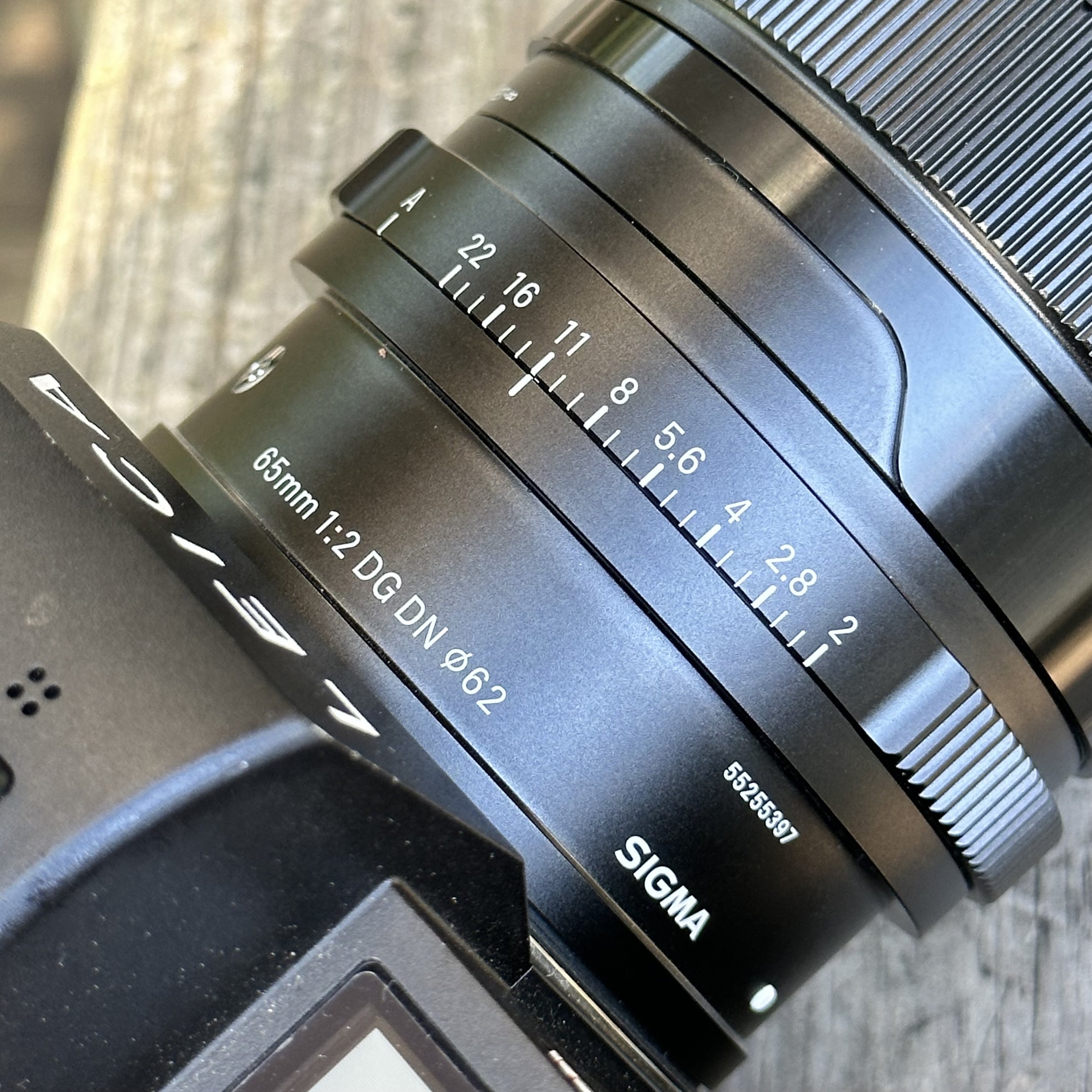
The Sigma 65mm f/2.0 mounted on my Leica SL2 with the aperture ring showing the 1/3 stop detents (one of my favorite features!). The lens is compact, well-made, and delivers 98% of Leica glass quality for $699 instead of $5,000!
Another thing I want to mention here is that the interaction with the lens is different than my Leica glass. Sigma approaches the aperture and the manual focus modes differently that Leica. I will be honest here, I kinda like the Sigma approach to aperture better too. The Leica lens is all software controlled, there are no external controls on Leica L mount glass except for the focus ring, so you use the camera’s controls to adjust everything. On the Sigma, the aperture control is on the lens, which is nice in my opinion. It has aperture choices in 1/3 stop clicks from f2 to f22 and then you can roll the aperture ring around to “A” for auto mode and the camera now has full control of the aperture just like the SL primes.
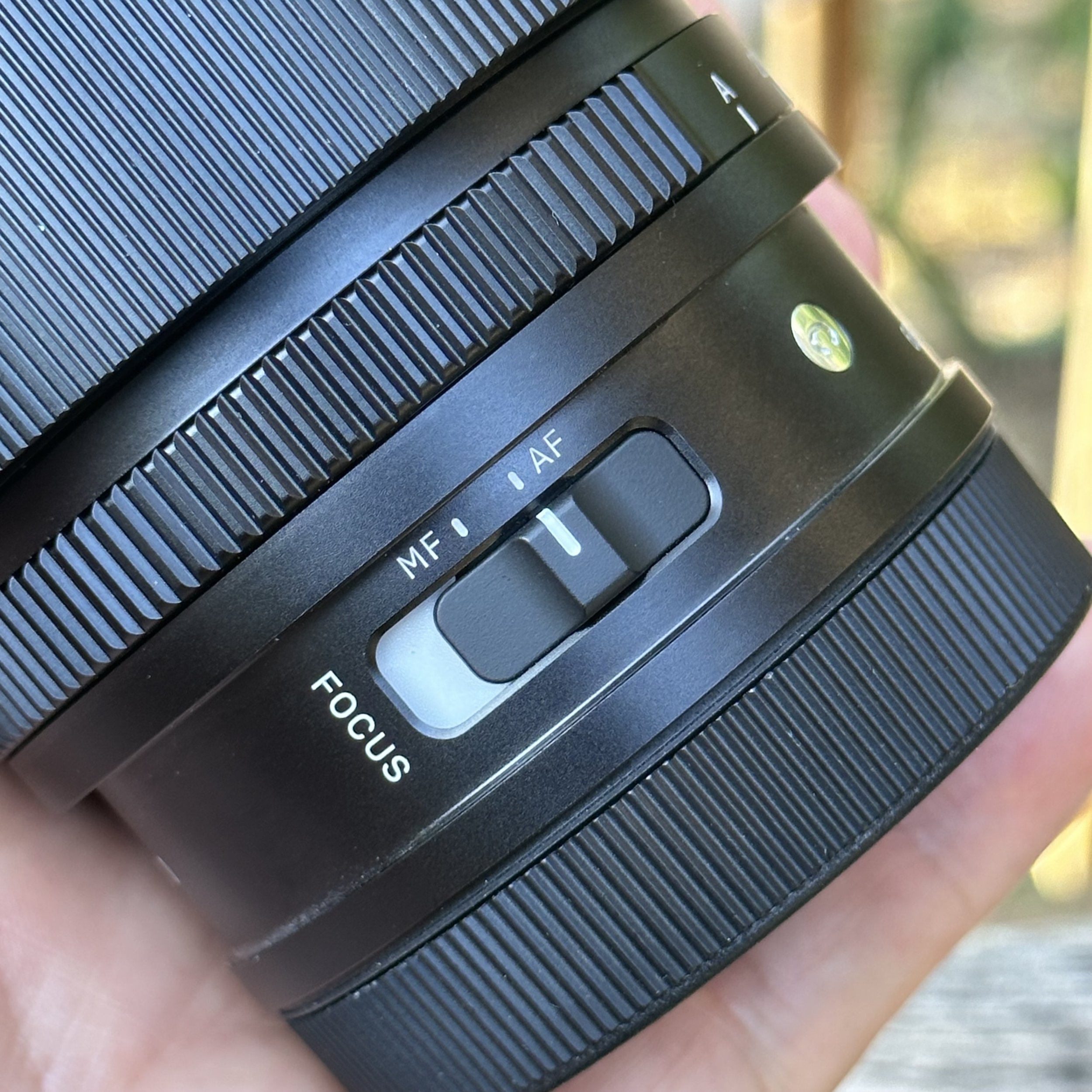
The manual /. auto focus switch is not one of my favorite features, but it works none the less.
The other thing that Sigma does is something I am on the fence about. The manual focus is a switch selection on the lens itself. I dont know why they chose this way to control this function and to be honest, it is not my favorite way of doing this function. It might be that Leica’s firmware prevents Sigma from exploiting manual focus without it. I really don’t know why, but the focus ring is an encoder design which means it is not mechanically connected to the focus helicoid in the lens. One would think this would be how it would be designed if there was a mechanical switch separating the two modes. All that to say my thoughts of this lens are that it is a great lens, especially for the money and you can get them about anywhere. Well done Sigma, well done.
Pros, Cons, and Who Should Buy the Sigma 65mm
Let me break down the good and the not-so-good about this lens:
What I Love (Pros):
Image quality is 98% of Leica: Laser sharp, wonderful rendering, you couldn't tell the difference
Compact size: "Darn thing is tiny" makes the system really portable
Aperture ring with detents: I prefer this over Leica's all-software control
All-metal construction: Feels solid and well-made
Price: $699 vs $4,995 for the Leica equivalent (seven times less!)
Fast autofocus: Fast enough for real use, no complaints
Build quality: Nice fitment, no play in parts, professional feel
65mm focal length: Perfect sweet spot between 50mm and 75mm
What I Don't Love (Cons):
AF/MF switch on lens: I'm on the fence about this vs Leica's software-only approach
Slightly slower AF than native Leica: Not as fast as Leica glass (but still plenty fast!)
Focus ring is encoder design: Not mechanically connected to focus helicoid
No dedicated "Art" line features: This is the DG DN "Contemporary" line, not Art
Who Should Buy This Lens:
Leica SL2 or Panasonic S-series shooters on a budget
Portrait photographers who want 65mm/75mm without spending $5,000
Street photographers who love the 65mm focal length
Anyone building an L-mount kit and prioritizing value over badge
Photographers who appreciate physical aperture rings
People who want Leica-quality images without Leica prices
Who Should Skip This Lens:
People who absolutely need the fastest autofocus for sports
Photographers who already own the Leica 75mm f/2 (obviously!)
Anyone who values brand prestige over practical performance
People who need weather sealing for extreme conditions (Sigma is weather-resistant, not fully sealed like Leica)
Frequently Asked Questions About the Sigma 65mm f/2.0 DG DN
Is the Sigma 65mm f/2.0 really 98% as good as Leica glass?
Yes! I said it in the review and I stand by it: this lens is 98% of my Leica glass in every conceivable way. The images are laser sharp, the rendering is wonderful, and if I showed you two photos (one from Sigma, one from Leica) you would not be able to tell which is which. The Sigma 65mm f/2 costs $699 versus $4,995 for the Leica APO-Summicron-SL 75mm f/2. You're getting 98% of the performance at 14% of the price. Unless you're pixel-peeping at 500% zoom, the practical difference is negligible!
Does the Sigma 65mm work with Leica SL2?
Absolutely! The Sigma 65mm f/2.0 DG DN is made specifically for L-mount, which includes Leica SL, SL2, SL2-S, CL, and Panasonic S-series cameras. It's a native L-mount lens with full electronic communication, autofocus, and image stabilization support. No adapter needed. I've been using it on my Leica SL2 and it works perfectly. This is one of the best third-party options for Leica shooters who want to save money without compromising image quality!
Why 65mm instead of 50mm or 75mm?
65mm is the perfect in-between focal length! It sits right between the standard 50mm and the classic portrait 75mm. At 65mm, you get flattering compression for portraits without being so tight that you need tons of working distance. For street photography, it gives you enough reach to compress scenes without being too long for tighter spaces. Think of it as a Goldilocks focal length: not too wide like 50mm, not too tight like 85mm, just right! Once you use 65mm, you'll understand why it's special.
How is the Sigma 65mm autofocus speed?
The autofocus is fast! I said in the review "it is fast enough to get the shot for me." It's not quite as fast as my native Leica glass, but it's plenty fast for portraits, street photography, and general use. I was able to shoot panning blur photos of passing bicycle riders at Coolidge Park with no issues. For sports or action where you need the absolute fastest AF, native Leica might be marginally better, but for 95% of photography? The Sigma is more than fast enough!
What's the difference between Sigma Contemporary and Art lenses?
The Sigma 65mm f/2.0 DG DN is part of Sigma's "Contemporary" line, which focuses on compact size and portability while maintaining excellent optical quality. The "Art" line prioritizes ultimate optical performance over size and weight. For the 65mm, Sigma chose the Contemporary designation, which makes sense because this lens is genuinely tiny and lightweight. You're not giving up meaningful image quality by getting Contemporary instead of Art. This lens punches way above its weight!
Does the Sigma 65mm have an aperture ring?
Yes, and it's one of my favorite features! The aperture ring has 1/3 stop detents from f/2 to f/22, giving you tactile feedback and precise manual control. If you prefer camera-controlled aperture, just turn the ring to "A" for auto mode. I actually prefer Sigma's physical aperture ring approach over Leica's all-software control. It's faster to adjust and you get physical feedback. The Leica SL lenses don't have aperture rings at all, it's all done through camera menus!
Is the Sigma 65mm sharp?
Laser sharp! I said it in the review and the sample photos prove it. The Sigma 65mm f/2.0 is sharp wide open at f/2, and stopped down to f/4 or f/5.6 it's incredibly sharp across the entire frame. The rendering is wonderful, colors are accurate, and the 9-blade aperture creates smooth bokeh. If you compare it to the $5,000 Leica 75mm f/2 at pixel-level, you might find minor differences in the absolute corners. But for real-world photography? You won't see a difference. This lens is sharp enough for any professional application!
Should I buy the Sigma 65mm or save up for the Leica 75mm?
Buy the Sigma unless you have $4,300 burning a hole in your pocket! The Leica APO-Summicron-SL 75mm f/2 costs $4,995. The Sigma costs $699. That's a $4,296 difference! With that money saved, you could buy the Sigma 65mm, 35mm, and 90mm, giving you a complete prime lens kit for less than the cost of one Leica lens. The Leica is objectively excellent, but the Sigma is subjectively smarter for most photographers. Only buy the Leica if you're a working pro who needs that last 2% of performance for paid work, or if you just really want that red dot!
How compact is the Sigma 65mm?
It's tiny! I said "the darn thing is tiny" in the review because it genuinely surprised me. At 2.8 inches long and 14.3 ounces, it's significantly more compact than comparable lenses. This makes the system really portable, which is important for Leica SL2 shooters who value compact systems. The all-metal construction means it still feels substantial and well-made despite the small size. It's the perfect travel lens because it doesn't weigh down your bag!
What's the AF/MF switch issue you mentioned?
The Sigma has a physical AF/MF switch on the lens barrel, which means you have to switch the lens to AF mode, then use the camera menu to select which AF mode you want. Leica lenses do everything in software with one step. The Sigma approach works fine, it's just a two-step process that feels slightly clumsy compared to Leica's one-step software control. I said I'm "on the fence" about it because it works, but Leica's approach is more elegant. It's a minor user interface quirk, not a deal-breaker!
Pros, Cons, and Who Should Buy the Sigma 65mm
Thank you for reading my thoughts on the Sigma 65mm f2 DG DN lens that Hassan loaned me for my Leica SL2. It has been an adventure for me.
Here's my bottom line: The Sigma 65mm f/2.0 DG DN is 98% of Leica glass quality at 14% of the price. That's not hyperbole. That's my honest assessment after extensive use.
Hassan, thank you for trusting me with your beautiful lenses! This 65mm has honestly made me reconsider my lens buying strategy. Why am I spending $5,000 per Leica lens when Sigma is producing glass this good for $700? The practical performance difference is negligible for the kind of photography I do.
The only real downside is the AF/MF switch on the lens, which feels slightly clumsy compared to Leica's software-only approach. But that's a minor user interface quibble, not a deal breaker. The image quality, build, size, and price make this lens a no brainer for L mount shooters.
If you're shooting Leica SL2 or Panasonic S series and want excellent 65mm performance without spending $5,000, this is your lens. Period. Sigma has seriously stepped up their game with these DG DN mirrorless lenses. They're not just "good for the price." They're genuinely excellent, full stop.
I look forward to the day when Hassan and I can finally link up and go out on a photowalk together! Maybe by then I'll have bought my own copy of this lens because honestly? It's earned a permanent spot in my bag…or should I say “on my shelf” lol.
Now get your camera out and go take a picture with it!
Support this website by using these affiliate links to shop on Amazon:
Sigma 65mm f2.0 DG DN Lens L mount
Nikon AF-S FX NIKKOR 105mm f/1.4E ED Lens
Voigtlander Nokton 35mm f/1.4 II
Sandisk 128GB Extreme Pro memory cards
Sometimes, when I go for a photowalk, I don’t want to be a loner…
When I go out to shoot photos I normally go alone as it fits my time table perfectly and I dont have to do any coordination with anyone else. I just grab my kit and go. Well, today is different.

So on this day I linked up with Tim Childers at Mean Mug coffee on Main street in Chattanooga TN and started out with a cup of coffee and some chatting about our youtube channels. Then it was off to find interesting photos and explore some of the old industrial part of the city.
We begin by making our way down to the old foundry turned farmers market. On the way I noticed some interesting stuff at a local processing plant before getting to the farmers market. After grabbing a couple of shots there we headed over to the market space and make some photos of the skate park.

The skate park was basically abandoned so once we worked the scene over as best we could we decided to head over towards the river. From the skate park we make our way to the riverfront industrial area where we grab some photos occasionally while walking down to the aquarium. This is a unique are as it is being converted to modern condominiums and there is a huge development project slated later to construct a park and such as well.

Once we got downtown, we decided to get out of the heat for a little while and grab some lunch at Taco Mac before making our way back to our cars on Main Street. The longer we walked, the hotter it got on this day and by the time we got to Taco Mac I was soaked. We stayed there till I dried out and then went back out in it for more. Haha. Market street has a fair bit of shade fortunately so we was able to avoid most of the sun while heading back to the car.

Some notable stops along the way for me were the intersection of Main and MLK, the HWY 27 bridge, the skate park and the processing plant for me. I hope you enjoyed this little AAR about our photowalk and if you haven’t done it yet, go check out both of our videos from this day at the links below.
Links to both videos are here:
Also, wanted to thank you for following my blog as well as my videos, It means the world to me.
What Shooting a Zeiss Ikon Contina Taught Me About Modern Cameras
I picked up a vintage Zeiss Ikon Contina while on a trip to the UK and had it sent straight to Zack's Camera for a full CLA when I got home, because the shutter was dragging badly. Once it came back in good working order I loaded it with Ilford HP5, grabbed my old Sekonic handheld light meter, and hit the streets of Chattanooga to find out what shooting a fully manual film camera with no rangefinder and no automatic anything actually feels like. The short answer is that our modern cameras are far more remarkable than most of us give them credit for.

Me with my freshly CLA Zeis Ikon Contina ready for some fun on the streets of Chattanooga TN.
I picked up a vintage Zeiss Ikon Contina while on a trip to the UK and had it sent straight to Zack's Camera for a full CLA when I got home, because the shutter was dragging badly. Once it came back in good working order I loaded it with Ilford HP5, grabbed my old Sekonic handheld light meter, and hit the streets of Chattanooga to find out what shooting a fully manual film camera with no rangefinder and no automatic anything actually feels like. The short answer is that our modern cameras are far more remarkable than most of us give them credit for.
Zeiss Ikon Contina…a vintage fully mechanical camera.
I bought this camera while on my trip in the UK and when I got back home I sent it to Zack’s Camera for a CLA as the shutter was dragging pretty bad. Once back from Zack’s, (who did a phenomenal job BTW) I loaded it up with some HP5 and grabbed my old Sekonic light meter and hit the streets of Chattanooga to play with my “new” toy.

The Zeiss Ikon Contina after returning from a full CLA at Zack's Camera. Everything is fully mechanical, no batteries required anywhere in the system.
It didn’t take long to realize that we as photographers in the 21st century are so spoiled with our cameras that have auto…everything. I am currently 54 years old and even when I was younger we already had cameras with automatic focus and exposure and even auto film advance. This machine is the grandfather to those cameras.
Shooting photos with the Zeiss Ikon Contina Camera
The day I went out to shoot had partly cloudy skies so as I would walk the streets I would take light meter readings and adjust the camera accordingly for the light on hand. This almost turned into a chore as the clouds would move in front of the sun and lower the light by 2 stops then the cloud would move out of the way and the meter would jump back up those two stops. Also, I learned dark shade is 3 stops lower than direct sun, so keep that in the back of your mind while looking for street scenes too.

A good light meter like the Sekonic pictured here will make getting the exposure set correctly a lot easier.
So now I see why some people like having those tiny little hot shoe mounted light meters. The handheld one was nice but it sure was inconvenient to carry around. Having a free hand to adjust and hold the camera would have been nice at times. Plus the light meter is just in the way all the time. I don’t have a lanyard on it so I either had it in my pocket or my hand, neither of which are really desirable.
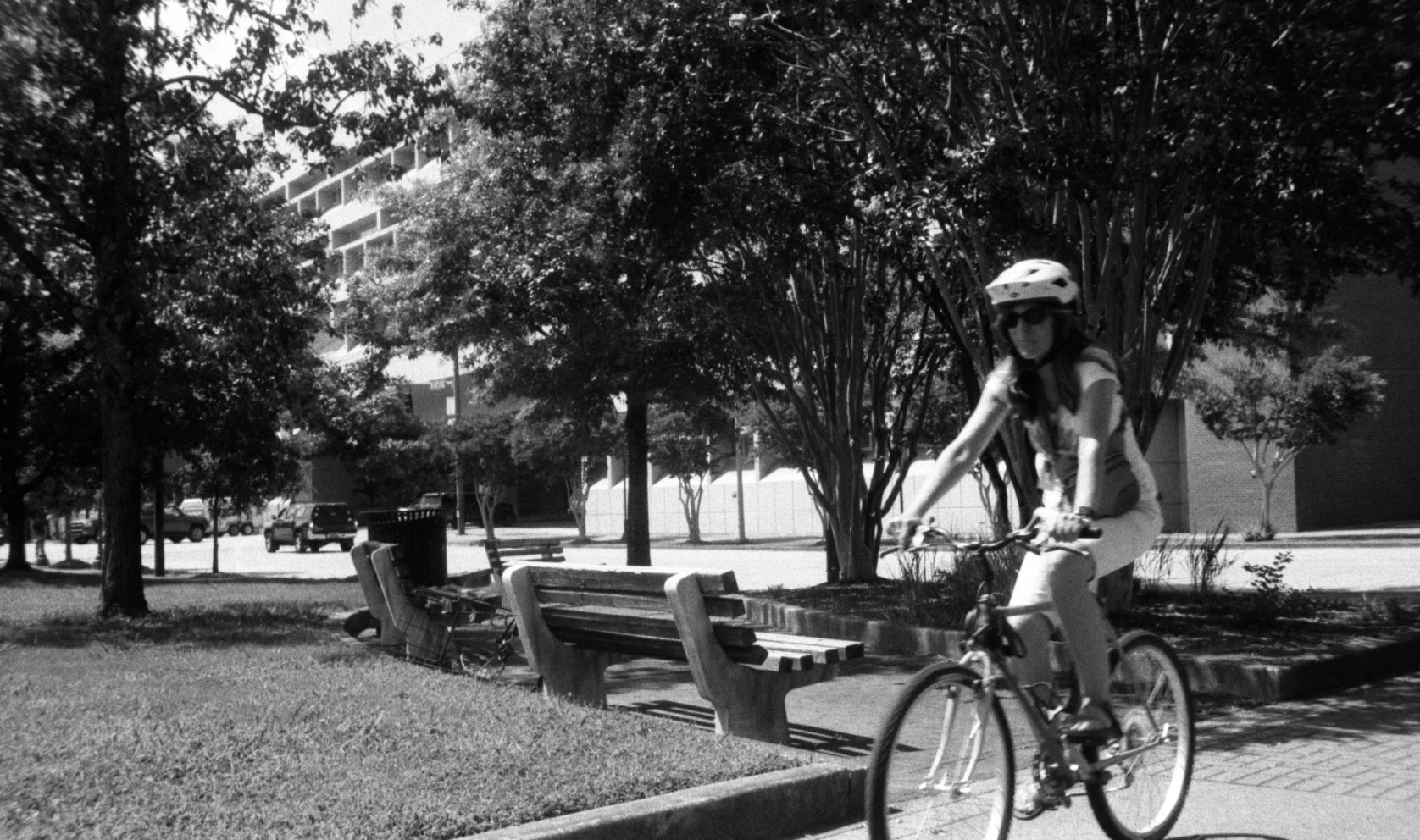
Motion blur in full sun… Zeiss Ikon Contina vintage camera with Ilford HP5 film.
Once I started to get the exposure settings figured out, I start thinking, I am ready to hit the trail and get some sweet street photos. Nothing could be further from the truth. I now have to learn how to focus the camera. Yes, you heard that right, I… a photographer, had to learn how to focus a camera. That was strange to me as I have been accustomed to simply looking through the viewfinder and focusing and then pressing the shutter. Not so on the Contina! You have to engage in the fine art of range estimation with this camera. Yeah, you literally either get out a tape measure and put your camera on a tripod OR just guess as best you can. Seriously, those are the choices here…spitballing it or measuring tools! The viewfinder is literally used only for composing the image. The taking lens is a completely separate system. Unlike the rangefinder cameras such at the Leica M series of legend where the view finder has a calibrated “patch” from the rangefinder that is mechanically coupled to the taking lens, where you see what appears in the viewfinder as an aligned image when it is in focus, you just throw the dice with the Zeiss Ikon Contina. It is quite humbling to he honest about it.

You quickly learn about f stops and how to change depth of field so you have a hope of getting something in focus. Notice on the lens the distance scale and the depth of field scales? You better, because you are going to be using those alot if you plan to shoot with the aperture opened up at all.
The film for the day… Ilford HP5 B&W Film
On my first roll of film I used Ilford HP5 400 speed and quickly realized this was actually a mistake. This camera is so old that the highest ISO on the built in meter is 320 and the fastest shutter speed is 1/300 second. Yeah, in a world where I personally have cameras right now that will shoot at 1/32000 second, I just bought a camera that maxes out at 1/300… Luckily, the aperture goes down to f22 so in full sun it is correctly exposing (I think) at 1/300 second. This did help with the other problem though…focus. Since at f22 everything from 1 meter to infinity is in focus I just had to make sure that I had not bumped the focus ring and moved it.
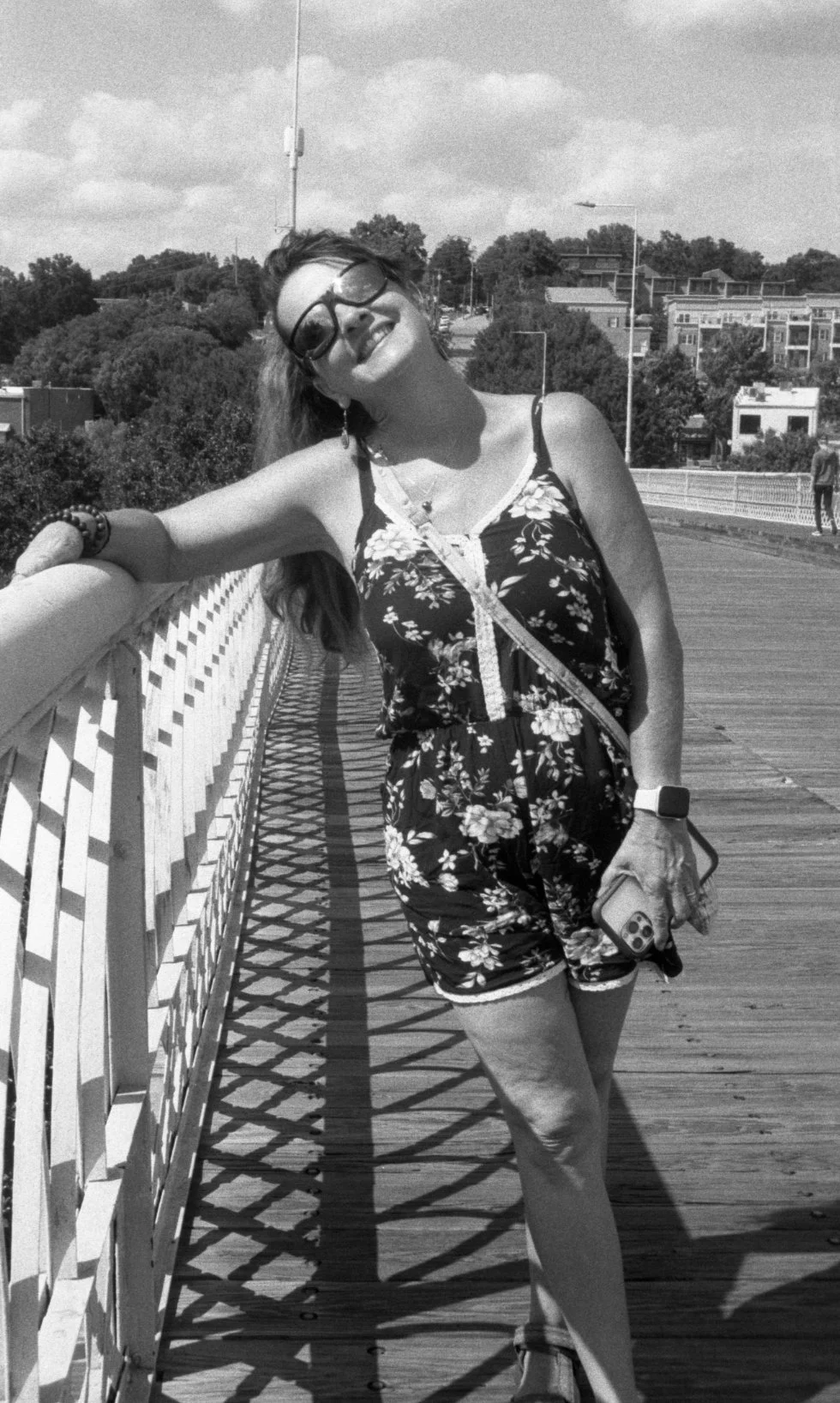
Teresa on the Walnut Street Pedestrian Bridge in Chattanooga TN shot on the Zeiss Ikon contina camera. Ilford HP5 Film
Once I used it for about an hour I would start to choose estimated focus distances to try to land better focus. We will see once I get the film developed and scanned…

All three exposure controls are on the lens itself. The narrow front ring is focus, the middle ring is shutter speed, and the large rear ring is aperture. The depth of field scale between the focus and shutter rings is essential for zone focusing.
Another thing you will notice in this photo is that all three major functions of the camera are on the lens, the focus is the first and smallest ring, then the shutter speed is the middle ring and the rear most and largest ring is the aperture ring. All the controls on the top are used to control film exposure and movement. The shutter release button, the film advance, frame counter, and rewind knob are in this area. There is a cold shoe and a light meter in the center area on top. That’s it. I love the simplicity, but wow, photos made in that period were worked for.
Going forward I will now have a brand new appreciation for my modern cameras with all their conveniences. I have learned that our forefathers had it much harder and that we should be more appreciative of the photos from that period. I will continue to use this warhorse of a machine but plan to get some lower ISO film first and we will see what we get over time.
Frequently Asked Questions About the Zeiss Ikon Contina
What kind of camera is the Zeiss Ikon Contina? The Zeiss Ikon Contina is a fully manual 35mm viewfinder camera produced in West Germany in the 1950s. It has no rangefinder and no automatic exposure system. All focus, shutter speed, and aperture settings are set manually by the photographer. The built-in selenium light meter is a reference tool only and is not connected to the camera's exposure system in any way.
Does the Zeiss Ikon Contina need batteries? No. The Contina uses a selenium light meter which generates its own small electrical current from ambient light. There are no batteries required anywhere in the camera, which is one of its great practical advantages as a vintage shooter.
What film should I use in a Zeiss Ikon Contina? Because the Contina's built-in meter only goes up to ISO 320 and the fastest shutter speed is 1/300 second, lower ISO films work better in most lighting conditions. Ilford HP5 at ISO 400 is usable but can be tricky in bright sun. A 100 or 200 speed film like Kodak T Max 100 or Ilford Delta 100 gives you more flexibility with aperture and shutter settings in daylight.
How do you focus a Zeiss Ikon Contina? The Contina uses estimated zone focusing rather than a rangefinder. You set the distance on the focus ring based on your best estimate of how far away your subject is, then use the depth of field scale on the lens to confirm your focus zone. Stopping down to f8 or f11 significantly increases depth of field and makes zone focusing much more forgiving. At f22, everything from about 1 meter to infinity is in focus, which effectively eliminates the need to focus at all.
What is a CLA and does the Zeiss Ikon Contina need one? A CLA stands for Clean, Lubricate, and Adjust. It is a service performed by a camera repair technician that cleans the internal mechanisms, replaces dried lubricants, and adjusts the shutter speeds and aperture blades to factory spec. Most vintage cameras benefit from a CLA before heavy use, especially if the shutter feels sluggish or sticky. Zack's Camera is a well regarded shop for vintage camera service.
Is the Zeiss Ikon Contina good for street photography? It can be, but it requires patience and practice. The lack of a rangefinder means you need to get comfortable with zone focusing before you can shoot quickly and confidently. Once you learn the camera's quirks and develop a feel for estimating distances, it produces sharp images with the characteristic look of mid-century German optics. It is better suited to slower, more deliberate street photography than fast-moving candid work. Unless, once again, you stop down to f22 where everything is essentially in focus and you can simply point the camera and take photos.
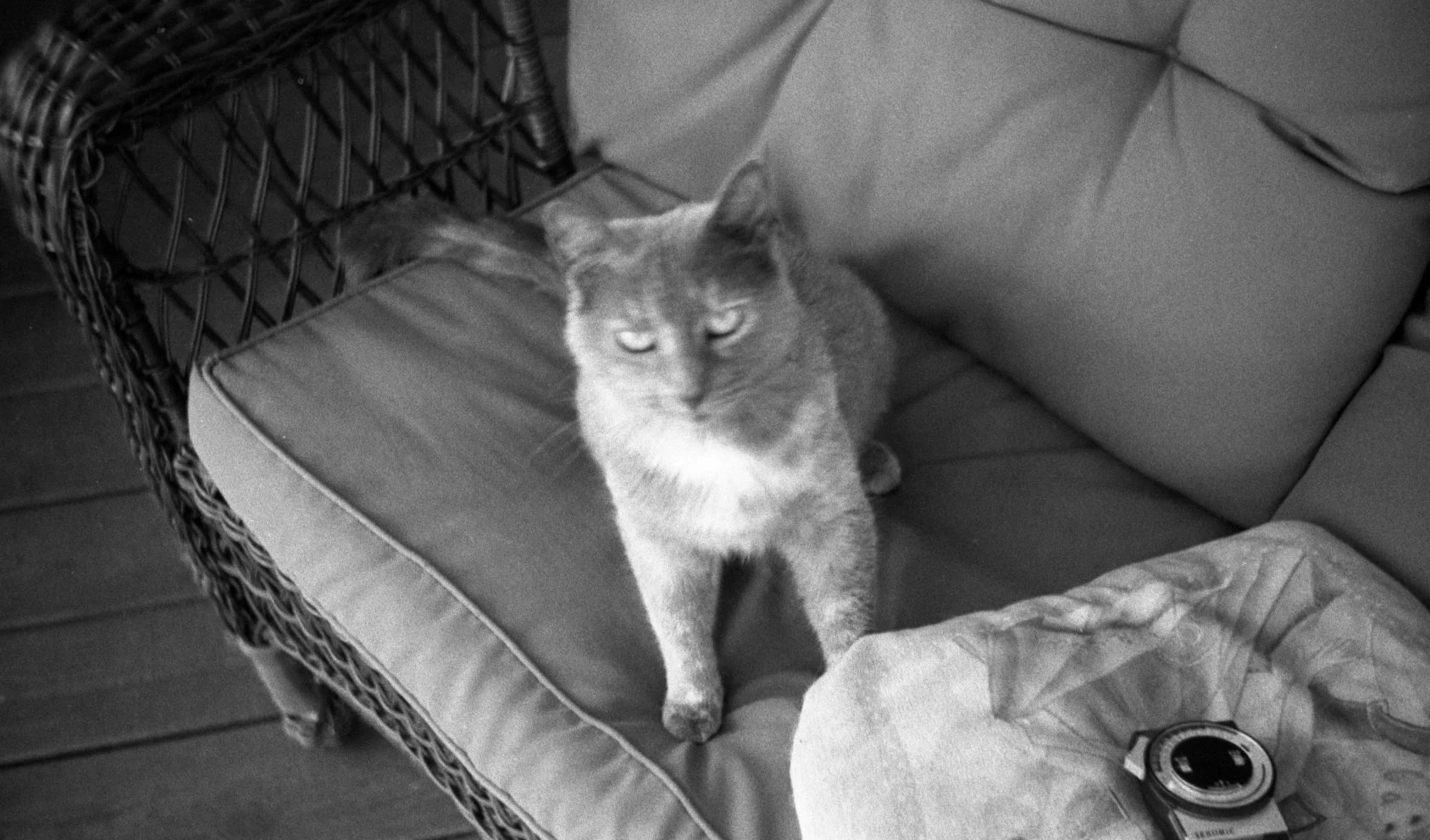
Zeiss Ikon Contina vintage camera missed focus of the cat…
Support this website by using these affiliate links to shop on Amazon:
Nikon AF-S FX NIKKOR 105mm f/1.4E ED Lens
Voigtlander Nokton 35mm f/1.4 II
Sandisk 128GB Extreme Pro memory cards
Nikon 50mm f1.8 S Lens for Z mount
So until next time, get your camera out!
Prime lens primer
So you have never used a prime lens before… well let’s change that.

Leica CL with the TTArtisan 35mm f0.95 APS-C prime lens
A prime lens is like a window into another world of photography. They can be had in much larger apertures than zooms usually, they are smaller under most circumstances, and if you get vintage ones…they can produce very unique results.
Another thing that prime lenses are good for is they teach you to compose based on the environment. You have to work within the confines of the focal length which means you will have to either move closer or further away to “zoom” with your feet to get your composition. Sometimes this means not getting a certain shot at all because you would have to stand in the middle of a river to get the composition or something like that. But I rarely run into this problem and once I start seeing in focal length it seems I filter out these problems subconsciously anyway.

Leica CL with the TTArtisan 17mm f1.4 APS-C lens.
You will also learn to see in your chosen focal length over time as well. That is, once you shoot a while with just one focal length… You hear street photographers talk about the 28 or the 35 and they know what the photo is going to look like based on experience.
I will be honest here, it is really liberating to have such a small and potent setup when I run prime lenses. Zoom lenses give you versatility, but I see people that use zoom lenses still carrying a camera bag. This seems overly redundant to me, I use the one lens all day and get out in the environment, but I am not everyone. Some people prefer to have all the options on hand so they can setup and shoot whatever comes their way I guess. Maybe they have missed a opportunity in the past while using a prime and now want the versatility of a zoom to give them better odds in the future should that happen again, I don’t know. Those are some of the speculations I have had, but for me, I just like having something dedicated like the prime brings to the table.
Zoom lenses do serve a purpose though, they are the work horses of the professional photography world. Giving the professional the ability to change focal lengths instantly on demand to fulfill the job at hand. Primes force the professional to move around a lot more to build the composition that the zoom makes short work of. This is important when you are on a clock. Anything that saves time also saves money so zooms have their uses.
So what makes a prime appealing over a zoom? That large aperture and the small size are some of the magic that the zoom lens lacks.
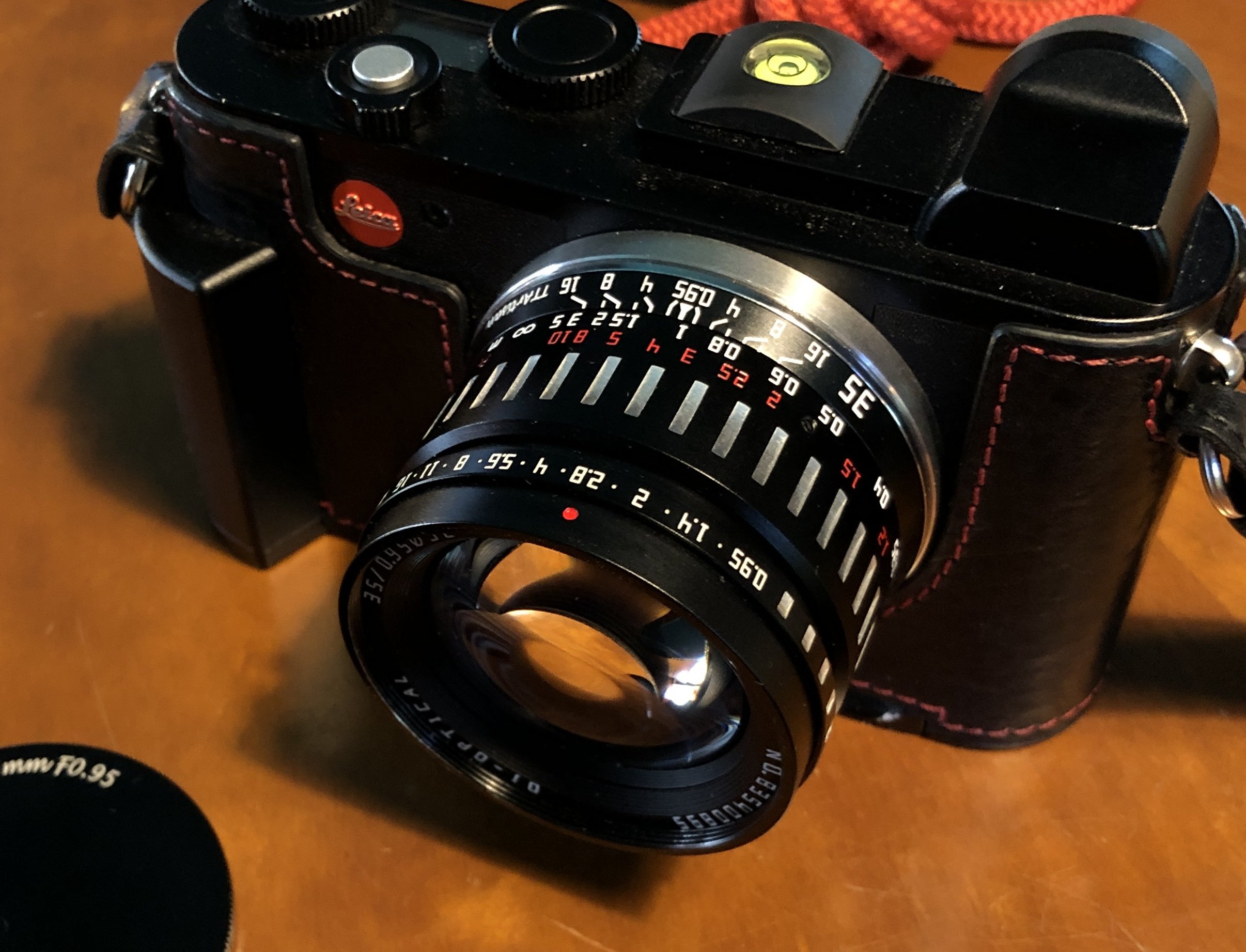
Lenses like the one above with it’s f0.95 maximum aperture can create an effect that nothing else can produce. The “Bokeh” or blurred out background is something that large apertures are well known for. The portrait below is a prime example of the feature. The background was probably 15 feet behind him when I shot this photo.

Primes lenses come into their own when it comes to vintage lenses too. This is where I have found my passion. The old Pentax glass along with the Nikon and early Canon stuff is all phenomenal. I do have some early Leica stuff but the Pentax / Asahi branded glass is just awesome. I also will try about anything to see what the photos are like as well. I have even adapted some glass that should not be able to be adapted like some Argus lenses. I documented that process on my YouTube channel if you want to see how I was able to make that work. Argus had a unusual way to drive the focus on the lens and it posed a challenge to get it to work.

One of my favorite vintage lens brands is Pentax and the Asahi Optical company.
With the advent of the mirrorless camera, we now have a flange distance that is conducive to adapting these vintage lenses to our cameras easily and the electronics in the camera make using these lenses even easier than ever as well. Things like focus magnification and focus peaking as well as exposure preview to see how the image will look before you press the shutter are great for coupling vintage primes to your new shiny mirrorless camera. Some even allow image stabilization via sensor stabilization so you even get that feature with vintage glass sometimes.
So if you have not used prime lenses in the past, I implore you to get a simple one, like the 50mm f1.8 on full frame (affectionately named the “nifty fifty”) or it’s APS-C little brother, the 35mm f1.8 DX (Nikon uses the term DX for their APS-C cameras) and put it on your hobby camera and leave it there for a month. It will either make you hate primes or fall in love with them. For me I got the 35mm f1.8, installed it on my Nikon D7000 and left it for almost a year without removing it. I really loved that lens.
So until next time, get your camera out and go take some photos with it!
Astrhori 18mm F8 Tilt Shift Lens Review
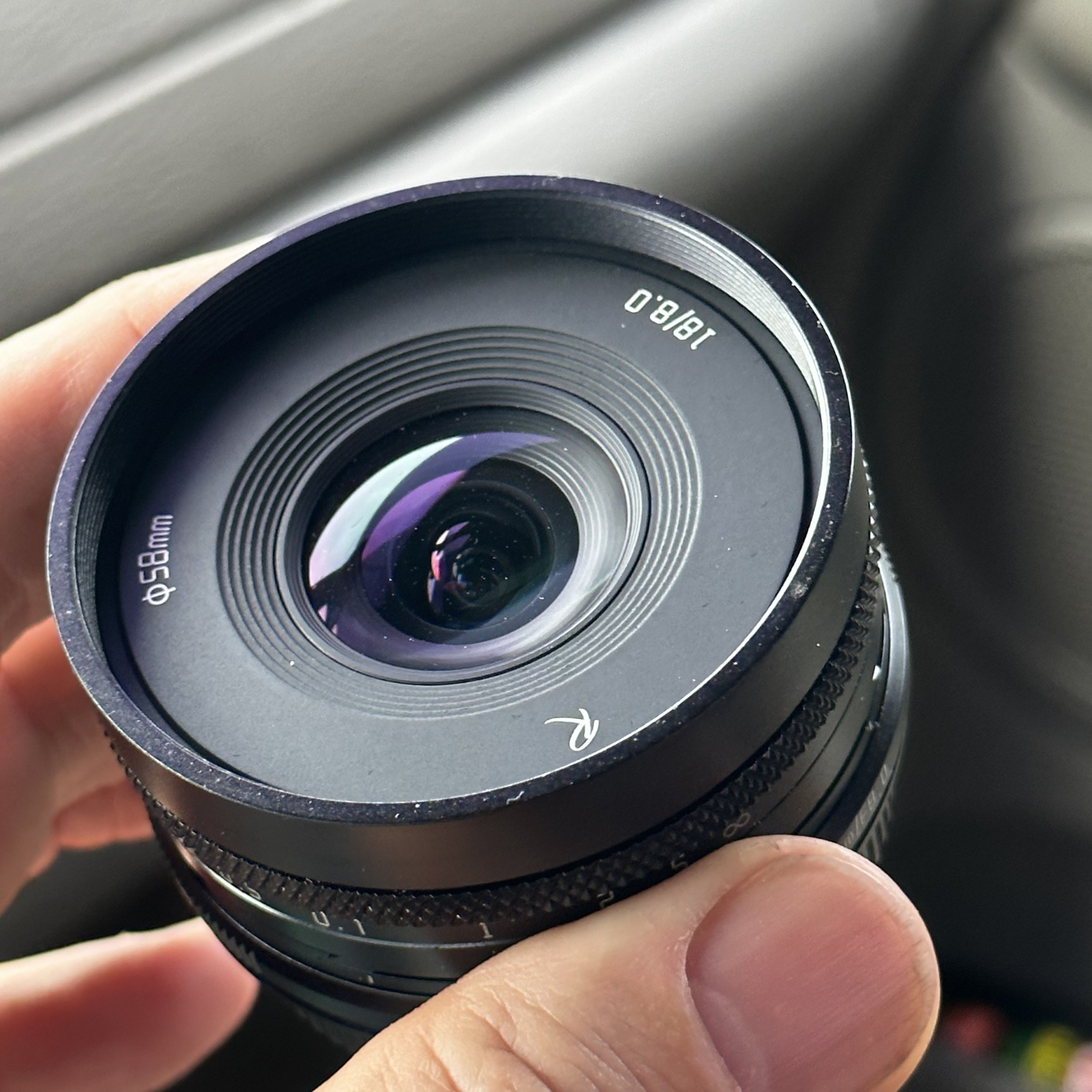
Camera gear is a interesting thing. ESPECIALLY for photographers as they love collecting it for some reason or another. I have reviewed quite a few lenses over the years on this channel, but never a tilt-shift version of anything. This is because these lenses are very specialized and usually very expensive too. Not having a focal length that I normally use is also another reason I have not bought one before.

Well, Phil Thach was contacted by Pergear about a lens they we’re launching and he recommended me to them. Thank you Phil, I appreciate the contact.
So after some emails, they sent me the sample lens for review. This particular unit did not come in a box but rather just a heavy ziplock bag. I am pretty sure the actual retail variant will be in a really nice box, so don’t worry about that. The lens is really neat for what is happening with it. You see, this little guy has a couple of cool features that most other lenses in the range do not have and it lacks on feature that almost all of the others does have.
The lens has the shift feature from “tilt/shift” lenses without the tilt function. It also has a rotation feature that allows the user to index the shift feature in 45 degree increments. So if you need it to correct vertically, you can do that. It will only shift in one axis at a time as well. This isn’t a real problem though as the intended use case for this lens is correcting converging lines on architecture and such. So you set the shift axis to match you framing and there you have it.
It will shift 6mm in each direction from center and this is more than enough for almost all scenarios. It does vignette the corners on full frame at the extreme ends of this range but carerful application of photo editing software should be able to fix this.
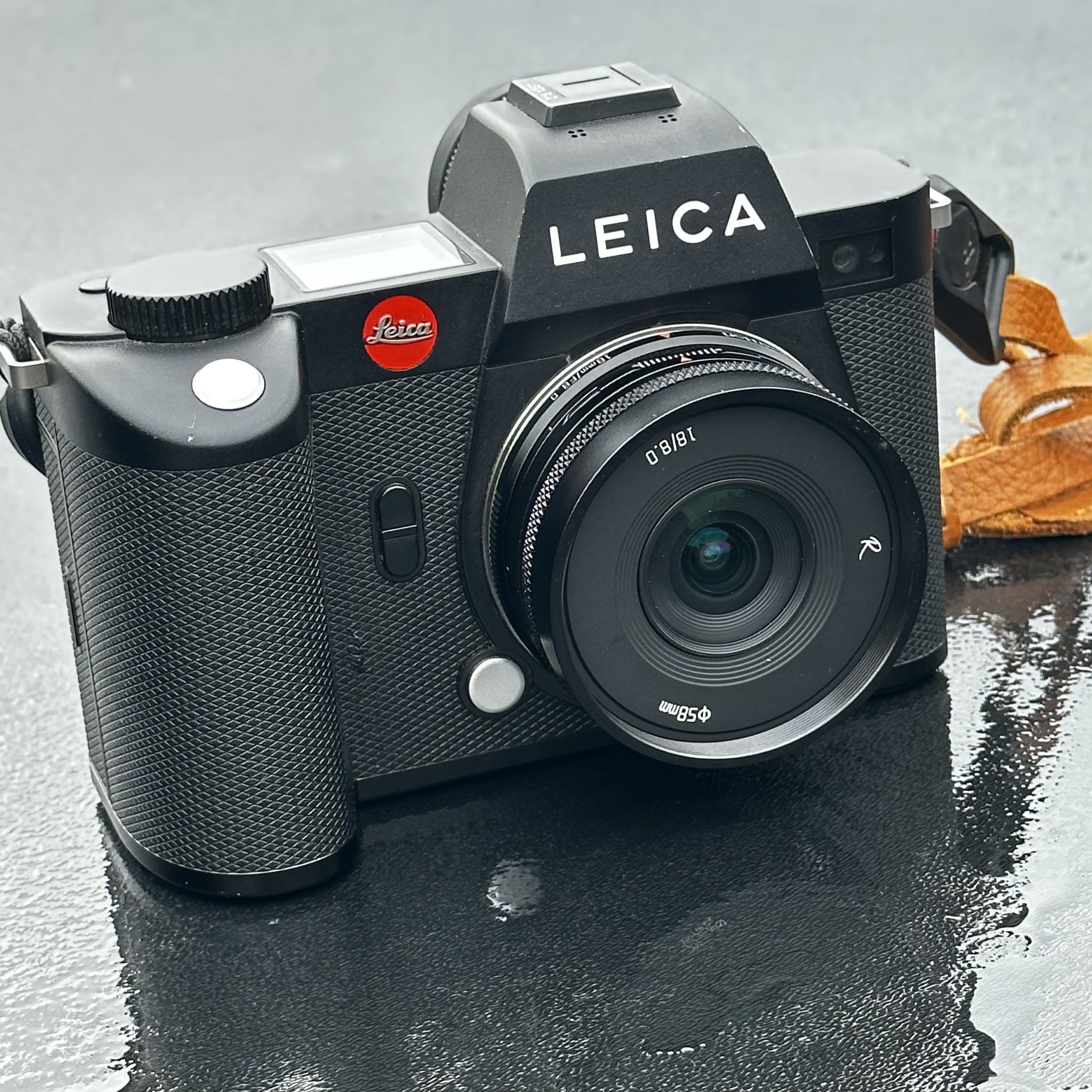
While using this lens, I have learned a few things about it though that I would like to share with you if you are consider getting one of these lenses for architectural photography. Honestly, I cant recommend it. If you plan to be a serious architectural photographer, it is worth the money if you want to dabble in this type of photography, just to see if you are interested because it is a cheaper alternative than a full on tilt/shift lens from any of the major manufacturers. But it lacks certain features that those lenses possess and that makes it more difficult to work with. Also, the build quality is lower than the Nikon and Canon alternatives and makes this lens less desirable in that manner as well. Another problem is that it is a fixed f-stop lens and it is 18 mm only. Traditionally, tilt shift lenses can be had in multiple focal lengths other than 18mm and variable F stops, this one has neither of those functionalities. It is a neat little pancake lens that is easy to use as a street photography lens on a crop sensor camera though, so when I put it on my Leica CL it worked wonderfully for just point shooting.

The F8 aperture and the 18 mm focal length gives you very deep depths of field that makes most everything in focus in your photos. So simple that it only required you to do little more than point the camera at the subject and fire the shutter. This is very beneficial for street photography purposes. A problem kept arising though, when I was shooting street photography with it using my Leica CL was that if I bump the lens, it would shift it or just letting it ride on a camera strap around my neck would be enough inertial force to shift the lens off axis. This is a problem as you could guess. So I really do not recommend this lens unless you were into novelty lenses or you were wanting to dabble in architectural photography with a little correcting shift lens, otherwise I would honestly say do not buy this lens and spend your money on something else.
My loadout for flying with camera gear.
Traveling over the years to locations that require flying commercial has taught me a few things about what to take.
I once carried almost everything I owned when I traveled so I was sure to have whatever I needed for a certain photographic event. Well, with time comes wisdom… I have been adjusting the loadout and searching for the best solution as far as bags go and have finally found the perfect setup…FOR ME. You see, different people have different needs and your loadout will vary depending on your personal needs and wants.
When I traveled early on, I carried a large shoulder bag, very large mind you and a ton of kit in it. I had to fill it up you know! Lol.
Well after a couple of trips like that, I learned that I needed a different bag. So the giant Vanguard bag was retired and replaced with a Thinktank Airport International v2. This was a nice upgrade and allowed me to travel with more confidence in knowing my gear was protected better and it was also a roller bag! No more lugging that massive shoulder bag all over creation!!!
Well, I still use this bag from time to time, but only for roadtrips in my truck. The irony of this statement is not lost on me. I bought a literal aircraft carry own style, camera bag and now I dont even take it when I fly at all.

Thinktank Photo Airport International 2.0
So I learned the hard way something about marketing with this bag. Thinktank Photo will tell you, probably with an asterisk, that this bag will fit in standard overhead spaces. This isn’t so and I learned this the hard way on a trip coming home from Hawaii one year. On the last leg of our long journey, we boarded a small commuter jet and the overhead storage bins were just too small. This is when I got a VERY sick feeling in the pit of my stomach. You see, this meant I had to valet check this bag at this point. If you have never watched baggage handlers loading luggage then you dont know the horror movie I was imagining my expense and fragile camera gear was about to experience. They can be quite rough with check bags, we have had them arrive at baggage claim with wheels missing and such. So I tell the flight attendant my plight and she saves the day by stowing my roller bag of camera gear in what amounts to her broom closet. I almost cried in appreciation. That was the straw the broke the cameras back of roller bags for me.

Pictured here are the Peak Design Everyday Messenger bag and the Thinktank photo street walker backpack.
After the Airport International “incident”, I decided I needed to downsize my kit for multiple reasons. The main one being that I didn’t want to have to valet check my bag because it wouldn’t fit in the overhead bin.
The next reason is the most important though. I was tired of carrying gear I didn’t use or even need.

Taken with the Nikon Z50 handheld and using the kit lens.
So I decided to get something new and smaller. I chose something that had been on the market for just a short time at this point. I chose a Peak Design Everyday Messenger Bag. It is a wonderful way to carry camera gear for the most part with one exception. I cant really carry my big telephoto lens I use for wildlife. I tried it for a couple of years and at the time, I was using a large system consisting of a Nikon D810 with battery grip and the 200-500mm super zoom lens. This combination is very large and would leave me with room for just a couple of smaller lenses. It also came with another problem…pain. Single strap bags are great as long as they are not heavy, which is exactly what mine was at this point in time. So the search continues and I found another Thinktank Photo bag.
The next bag I chose was the Streetwalker v2. This is a smaller bag that is backpack style and is really comfortable. The single shoulder strap on the messenger bag would make my shoulder incredibly sore after just a couple of hours of carry. I tried this for a couple of years and paid the price. The streetwalker solved that problem in short order. It was at this point in my photography journey that I was finding smaller cameras like the Fuji XT3. I took this camera to Israel for a ten day trip and it was on this trip that my eyes were opened to carrying excessive equipment is wasteful. I took three lenses with me and only used one of them. Yes, I used the KIT LENS for the whole trip and it worked gloriously!!! All the while I was carrying around all this other crap and just getting back to the kibbutz tired every day.
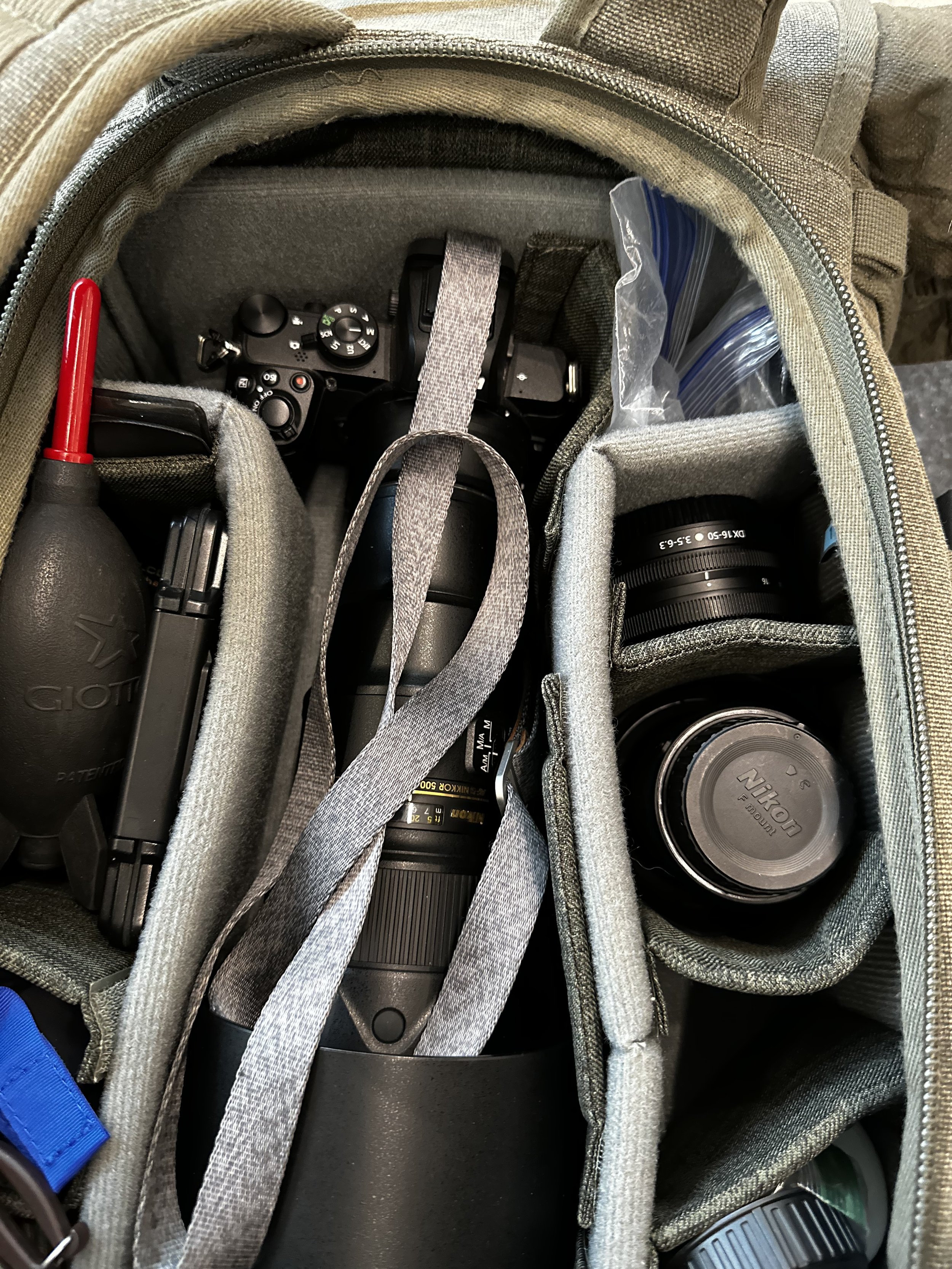
Current travel load out, Z50, 500mm PF, 16-50mm Z Kit, and 10-20mm F mount Nikkor/FTZ adapter.
Well, I finally figured out that the smaller pack was the way to go, but it really didn’t have room for the big wildlife rig I liked to use… It also had one other critical shortcoming that I noticed from regular use. The pack opened to the top when unzipped. What this means is you take off the pack and lay the side that normally sits against your back, on the ground facing down to access the gear area. At this point, I was doing a great deal of photowalks and hikes to waterfalls and such and this caused lots of dirt on the back of my shirt… To say this was frustrating is an understatement but I carried on till…

Enter the Thinktank Photo Retrospective 15L. For my needs, this is as close to perfect for a camera bag as I have ever found. It opens from the back, the side against my body which means you lay to outside one the ground, keeping all the leaves, twigs and dirt off of my shirt. It is slightly larger (15 liters in size) so there is room for my wildlife kit. It is REALLY comfortable and it is made of stone washed canvas. So it has a nice look (it doesn’t look like a nylon camera bag) and has a great feel. This is a hallmark of Thinktank Photo from what I have seen. Their backpacks are very comfortable. So now that I have landed on the perfect camera bag after almost a decade of searching, I can now shift focus to the gear I put in it.

Taken with the Nikon Z50 with the FTZ Adapter and the 500mm PF Amount lens.
The gear loadout for my photography usually involves at least two bodies, three general purpose lenses and then my special purpose lenses and all the support gear too. Like a whole cleaning kit complete with blower bulb, dry wipes, wet wipes and solution and sensor swabs… way too many batteries, like I must have thought I was going to take 10,000 photos per day or something. I never needed most of this crap either. I mean almost none of it. What I had was a case of “fill’er up” syndrome. If there was bag space I felt compelled to put something in that space for some reason. This is a terrible way to operate if I must say. You end up tired, sore and resentful of the hobby as you brought all this kit for nothing.

The Nikon Z50 with kit lens makes for a powerful little general photography kit.
So this trip, the bag is scaled WAY back. I mean, there is room in the bag for stuff and nothing is in those pockets. This is a milestone for me, as I am a prepper at heart and want to cover every conceivable contingency under my normal mindset. To be honest, I probably brought at least one lens more than I will need and could have lightened the load some more there, but we will see. So my takeaway from all this is, your hobby is a journey and you will have to figure out your kit for that hobby as you go. For me, it is still an ongoing journey to be honest. Hopefully I can stop spending tons of money on it and just enjoy it. Let’s be realistic though, probably not…Lol.
Tips for Low Light Street Photography in Chattanooga TN
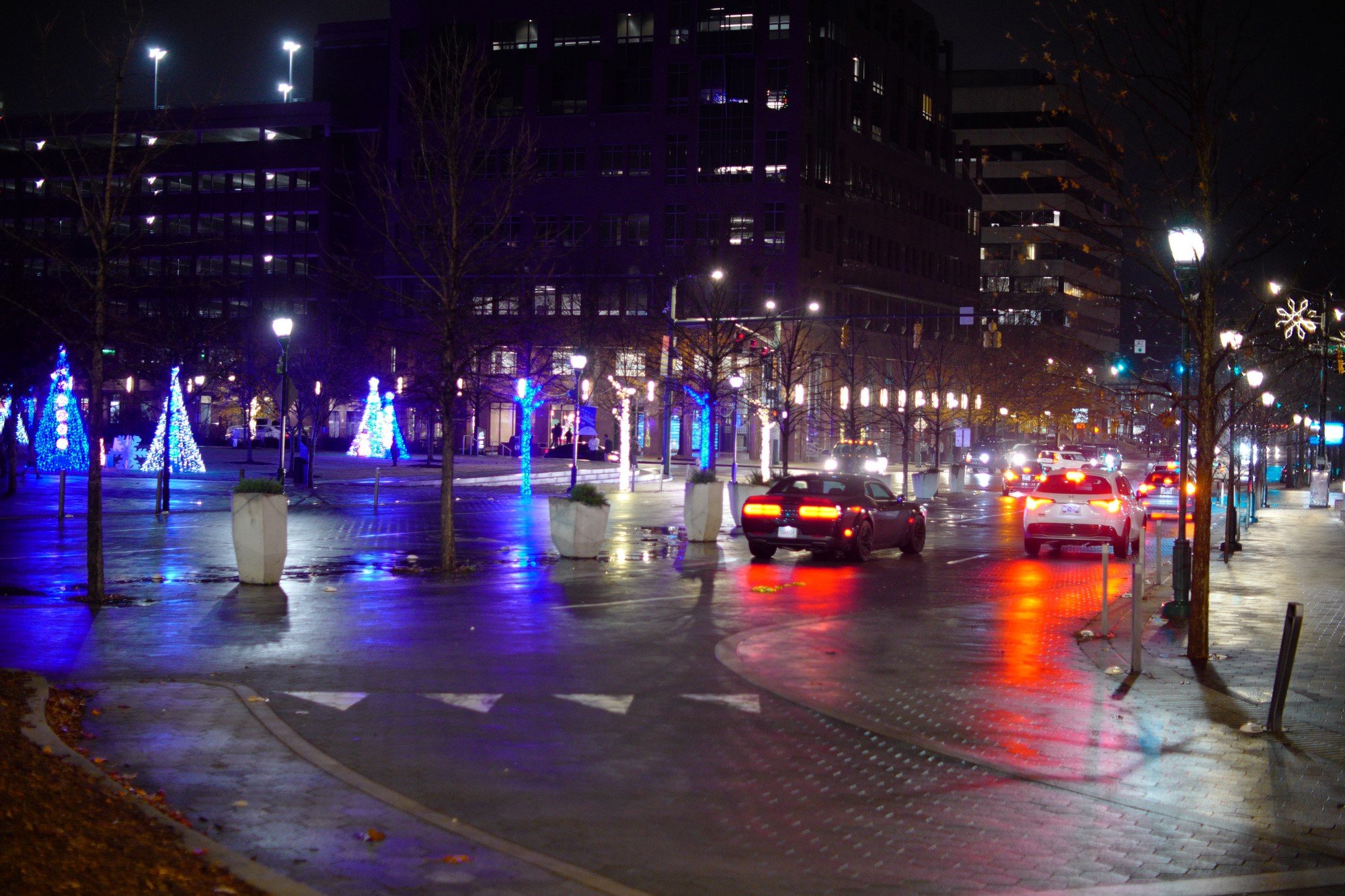
I love low light street photography in Chattanooga, TN because it allows me to capture the city's vibrant and diverse culture in a unique and exciting way. With its diverse architecture, colorful murals, and bustling nightlife, Chattanooga offers endless opportunities for me to experiment with different techniques and styles. In this blog post, I want to share some tips and techniques that I've found helpful for capturing stunning low light street photography in Chattanooga.
First and foremost, it's important to have the right equipment for the job. I always make sure to have a camera with a fast lens and good low light performance. I look for a lens with a wide aperture, ideally f/2.8 or lower, which allows more light to enter the camera and helps me capture sharp, detailed images even in low light conditions. I also prefer to use a full frame camera because it has a larger image sensor, which performs better in low light compared to a crop sensor camera.
In addition to a fast lens and a full frame camera, I find it helpful to invest in a tripod to steady my shots and prevent camera shake. A tripod also allows me to use longer exposures, which can be useful for capturing light trails or blurring movement. If I don't have a tripod with me, I try leaning against a wall or using a lamppost or other stable object to support my camera.

One of the most interesting areas for low light street photography in Chattanooga is the city's historic downtown district. I love exploring this area because it's a mix of Victorian-era mansions, Art Deco buildings, and modern skyscrapers, all lit up at night and surrounded by a lively atmosphere. I always try to find interesting angles and perspectives that highlight the city's unique architecture and history.
Another area I enjoy photographing is the city's growing arts and entertainment scene. From live music venues and breweries to art galleries and theaters, there's always something happening in Chattanooga's nightlife. I love to capture candid moments that showcase the energy and vibrancy of the city's entertainment scene.

In addition to the city's landmarks and nightlife, I always make sure to capture the people of Chattanooga in my low light street photography. I look for interesting characters and personalities, whether they're tourists, locals, or street performers. I use the available light to create mood and atmosphere, whether it's a neon sign or a street lamp. I find that photographing people in these settings adds a layer of depth and humanity to my images, and it helps to tell a story about the city and its inhabitants.

Finally, don't be afraid to experiment and play around with different settings and techniques. Low light street photography can be a creative and rewarding form of photography, and there is no one "right" way to do it. So go out there, get creative, and see what you can capture in the dimly lit streets of Chattanooga or where ever you live.
Until next time, get your camera out and go take a picture with it!
I like fiddling with my camera, do you?

My current street and general photo setup.
Well, there, I said it. I like to fiddle with my camera. Sure, I miss some photos because I am playing with the camera, but to me, that is part of the experience! Getting the photo is a result, but to me the time spent with the camera is as important as the final image.
You see, I am what is referred to as kinesthetic. This means I enjoy engaging with the gear as much as getting the photo, getting to interact with the camera on a deeper level brings me a form of satisfaction and joy that is hard to explain.
I know this goes against the convention of the camera “should disappear” or be so intuitive that you no longer know it is there. This is a bunch of hogwash in my mind. I spent a lot of money on my camera and by golly I want to get my money’s worth out of it!!!

This is my “discrete” film camera! LOL
I have read several of the books on the technical aspect of photography and they all keep saying to get the camera to where it runs almost in automatic so you can “get it out of the way” and focus on getting the shot instead. This is not what brings me joy in photography for some reason. I am just not wired that way. I like to play with the machine and then command it to produce what I ask of it and have it comply. That is a oversimplification, but the point is that I want to have the interaction with the camera as much as getting the photo. I figure it like this too, you get the shot, great, you do your edits say this takes another hour, maybe two if you really want to dial it in. (most people spend way less time than this on the editing process) and then you export it and share it on some website somewhere and wait for the little number to appear by the heart symbol. Then it is basically forgotten and the hunt is on for the next image. I like to get the image I had in my mind, but I ALSO like the interaction with the camera too, it is just fun to mess with it.
I mean, c’mon! Look at my “street photography” rig for crying out loud! All I hear is get a small, unassuming camera like a X100V or a Leica Q2 or some such, and here I was with a Nikon D810 with battery grip and 50mm f1.4 lens or my current rig…the Leica SL2 with 50mm Summicron L…even my film rig is larger than life!!!. HaHa

Back years ago, this was my main goto rig, Nikon D810 with a 50mm f1.4 Nikkor lens.
I do have a smaller camera that I like to use as well, but it is not to “get the camera out of the way” but rather to have a simple camera to grab and have as a backup to my SL2 rig. I have even kitted it out with a focal length lens to simulate the same field of view as my SL2/50mm rig. I do this so the experience using them is similar and I also know pretty much what I am going to be getting when I use them and that they will produce very similar results. It doesn’t allays work out that way, but that is the intention…lol.

This little Leica CL with the 35mm f1.4 M mount lens from Voigtlander makes a great “grab n go” rig.
Something else I have learned is that I like manual mode the best. I once was an aperture priority kind of guy, but I have evolved into a full blown manual shooter now. I just like the fact that the EVF in my camera will show me what the image will be ahead of pressing the shutter and I am able to just dial in the sky till it is blue or up the shadows till I am happy with them. The light meter in the display gives me a point of reference as to how much over or under exposed the image is and I will know then if the highlights are gone or the shadows will be recoverable. most of the time though, I don’t care about either.

My Leica SL2 top display.
As you will notice in this photo, I have set the camera as follows: Manual mode, there is some negative exposure compensation, f8, 1/125 sec shutter, auto ISO at the time (this varies from manual in a static scenario to auto if the light is going to change around constantly), and the rest is “state of the camera” info like both cards are present and set to overflow, there is room for 1937 frames left on the first card, the blue tooth is on so I can connect my phone to the camera, and the battery meter. This is how I run my camera most of the time when I am shooting street photos. Point is, don’t follow conventional wisdom if it doesn’t suit your ideology or normal operational parameters, simplified…you do you. Stop letting other people tell you how to engage in your own hobby. Be like William Eggleston and go against the grain. You are in charge of your life, live it on your terms.
Now, get your camera out and go play with it…I know, I know, I just broke my own advice by telling you what to do, but maybe some of you need a nudge…lol.
What to do with all these pictures I have taken and don't ever look at?

As I was sitting here listening to my ham radio and looking for POTA contacts on 20 meters, I took a look over at my camera gear on the other side of the room and got to thinking about all the photos I had taken with those cameras and how I am sitting on literally several terabytes of photos and video from the last several years of making YouTube videos, shooting street photography, landscape photography, motion blur photography, vacations, wildlife and all sorts of other things…
I have saved all these photos over the years and for no real reason other than you are supposed to keep them… but why? I never look at them, shoot for that matter, I never plug in the hard drives that they are stored on. They are just stacked in a storage bin next to the computer. What is the point in doing that? I could delete all the YouTube channel crap that is stored on the hard drives and would immediately have many terabytes of hard drive space available again.
But…
I have this nagging desire to keep them, until the hard drive fails on it’s own accord and not from my own hand. For some reason we can accept that fate instead of the fate coming from our own hand for some reason. “Oh darn! My hard drive has failed…” is an acceptable fate, why? Because we are absolved of responsibility for the loss of this data? I don’t know, but I am in that group. I just find it really strange how we cope with different things that happen to and around us at times.
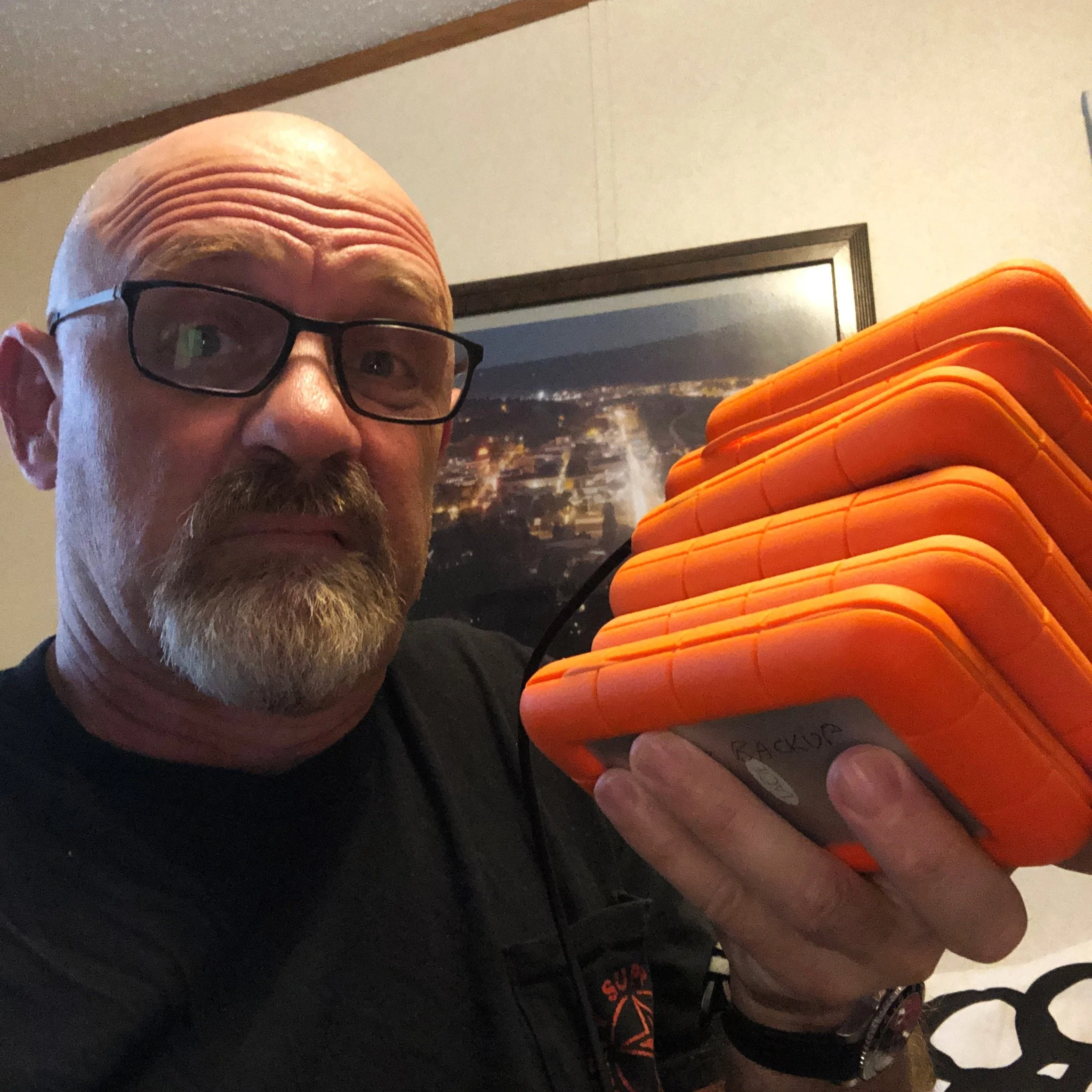
What are your thoughts on this? I have been pondering what I should do with all these hard drives I have and I cant decide if I should just take the oldest one and format it when I need another drive, or should I just save it? You see, I am super bad at cataloging my work and back then I was even worse, there is some hint as to what is in each folder, but it is still pretty cryptic. I collected these images over several years and to go through them now seems like an insurmountable mountain of stuff to sort through. To the point, I look at the hard drives and then let procrastination take over and forget about it till later.
Anyway, this is a nagging problem that gnaws at the back of my mind all the time. I just thought I would see what you guys thought about it and maybe get some sort of solution. As an aside, I have no other backup of these drives either, so if one went bad, it is just lost data. Thanks you following along today and like this blog post and if you want sign up for the RSS feed so you will get the next one too…at least that is how I think it works, to be honest I don’t have any idea how that works…
Altering the world around us with strobes and a camera...

There is an alter ego that I have and sometimes I have to do things as this other person that dont seem quite so glamorous… This is the job of product photographer. I have a business that makes and sells little devices and I have to take photos of these for the website and then edit them to be “floating” on a white background. This is pretty standard stuff to be honest, not “cool” but still very much needed and important.

Anyway…I also get to do some of the social media photos and on occasion, I will go to the trouble of setting up a light and trying to make something artistic instead of the usual Instagram snapshot.
For product photos, I have bought some studio strobe kits from amazon and these run on wall power and have sync ports to fire them, they also sympathetically fire from a light sensor if you turn that feature on as well. Simple strobe with a power knob and you plug in a sync cable and plug that cable into your camera.
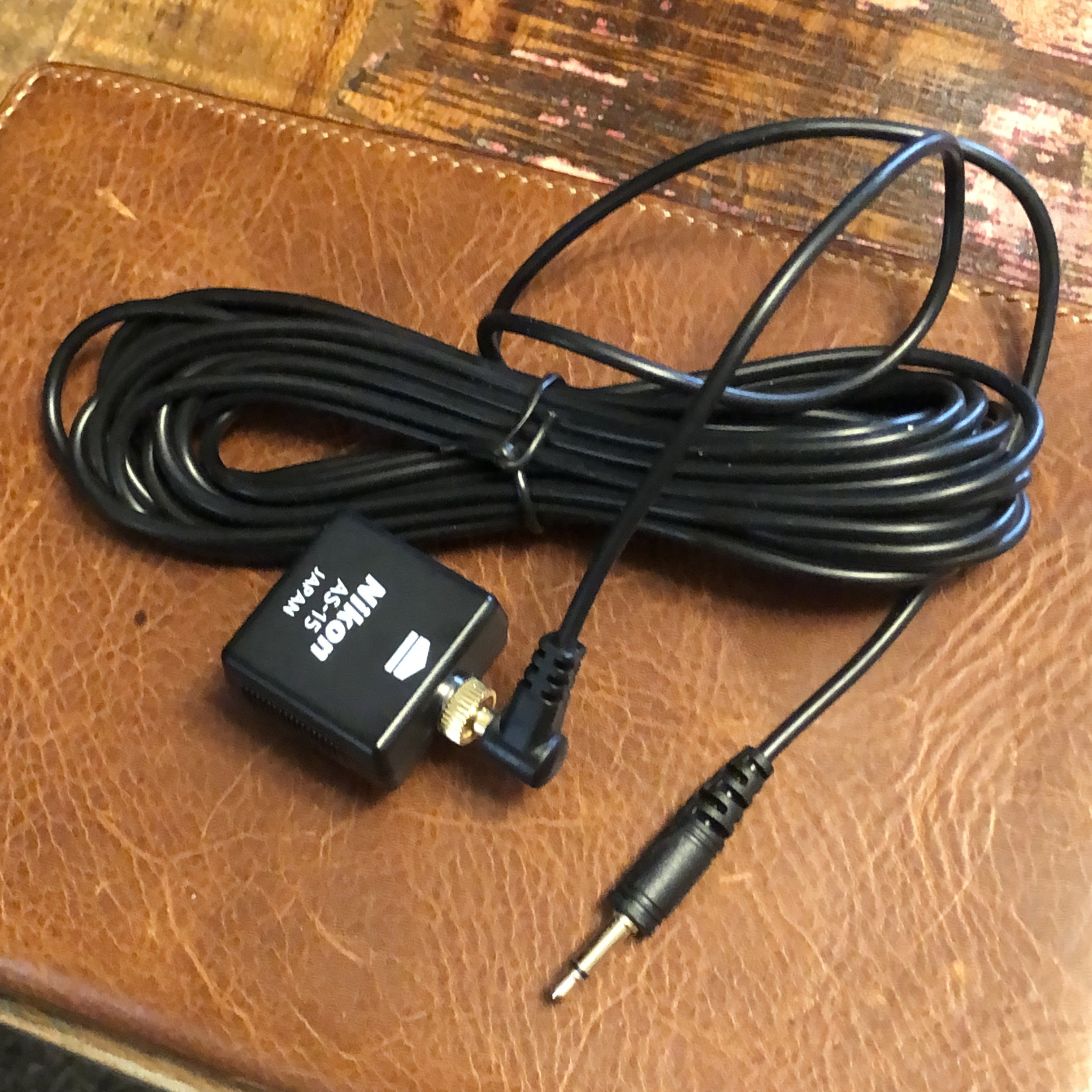
Your camera doesn’t have a sync port you say? No problem, I also use an adapter from Nikon to allow a sync cable to be connected to any camera with a hot shoe on it, which is almost all cameras. So if you want to use a studio strobe and it requires a sync cable, then fear not, I have a solution for you!

I really like to use the sync cable and wall powered strobes as I really dislike batteries and avoid them whenever possible. It just seems that EVERY SINGLE TIME I go to do something with my radio trigger (I have owned several pocket wizards in the past), they would be dead, needing charged batteries. This really is annoying in the commercial setting when time is of the essence and hunting batteries or having to charge them before I can do a project is frustrating to say the least. Hence the sync cable…not batteries and works EVERY TIME…

So this is the photo I got the other day. It was late morning and the machine shop was in full operation. Knowing what I know about strobes and aperture, it was a non-issue though.. I grabbed one of the lights and take it out to the shop floor and rig it to shine down from overhead. I am fortunate in the Sierra thought to grab a photo of the setup for me by the off chance she wanted to see what I got versus what she got. Sierra was blown away by the difference in our images, she had to have the one I captured to show her friends so they would understand why I had such a silly setup just for a photo! LOL.
I wanted a spot where the background was still fairly clear of clutter and we moved a couple of items out of the way to make it a cleaner “in camera” image, but for the most part, you will see in Sierra’s photo that the shop has a lot of stuff sitting everywhere.

To keep the light positioned like that, I just wedged the high leg under a rolling cart that is just outside of frame. This way I could get the light down low and parallel to the floor. This stand is budget and doesn’t have a feature to do this built in. Improvised and got the shot.
I laid down in the floor and manually focused a vintage 75-150mm Pentax zoom lens and got this SOOC photo. I did a few images at different flash powers to get the carbine exposed the way I wanted.

You can see the soft box in the top part of the photo, but since I was going to fade the background to black anyway, it is a non-issue. I next imported the image into GIMP and cropped it to get rid of the excess floor and ceiling, then just painted out the light that was left over. Simple as that. The next step was to take it into my phone and run it through an app I have there called Afterlight. This app allows for several adjustments that I enjoy using, but it also has a framing feature as well and that is my primary desire for the app, so I framed it and then put it on the Gram… Done. You cant see the frame on here because the background is white on this webpage, but on Instagram it shows up just fine, and gives it a very clean appearance.
My takeaway from this whole article is this: you are not tied to the light you see around you. If you have a strobe then all bets are off as to what you can do with your camera. Don’t let yourself get caught up in the mindset that you can only shoot “available light”, that limits you greatly. Build the light in the scene yourself and you will never be beholding to the sun again!
Now get your camera out and go take a picture with it!
Photographing Sacred Harp singings with a Leica/Nikon hybrid system

First, yes, you read that right. I shoot my Sacred Harp singings with a Nikon lens adapted to the Leica SL2. This is for 4 reasons, well maybe 5 but the fifth is trivial in my book.
I really like the images from my Leica SL2 camera plus the interaction with the camera is just plain fun.
I did some experimenting and found that I shoot most of the photos at these events at about 105mm give or take a little.
In my opinion, the Nikon 105mm f2 DC Nikkor lens is one of the finest portrait lenses available in this focal length.
The f2 maximum aperture on the 105mm lens also gives me another stop of light in dimly lit buildings too.
Trivial, but I like to use manual focus, it is part of that interaction with the camera that I just plain enjoy.

Let’s expand on these a little and see if there is someting in here that will help you when you shoot certain events or subjects.
The image quality of the Leica SL2 is hard to beat. The features in that camera that I REALLY like are things like the EVF, the IBIS works better than any other I have ever used, the colors are amazing right out of camera, I can confidently handhold this camera, with a vintage 105mm lens mind you, and shoot at 1 second confidently and get sharp photos. That in itself is s a feat of engineering. The Electronic View Finder is the next reason I love this camera. The EVF has such high resolution that it doesn’t seem like a display but more like a window, it just has to be seen to understand. The 47 megapixel sensor also gives me plenty of image to do some creative cropping to adjust compositions at times to correct for things like having to hurry to get the moment captured and knowing that I can cut a significant amount of the image away and it will still look great is always a bonus. I have really come to understand why people like certain devices when they engage in an activity, if it is the right tool for the job AND you enjoy using it, the product of this will be stellar!
In days gone by I have used an array of cameras and lenses to photograph these singings. Some were large rigs like the Nikon D810 with battery grip and the 70-200mm f2.8 telephoto zoom, and some were small, like the Fuji XT3 with a vintage 55mm f1.8 Asahi Optical prime lens. I looked back over several of these singings and started noticing that I was ending up on the 105mm focal length more and more when I would be using zoom lenses. Now of course this is not possible when using a prime lens, but I was still favoring longer focal lengths instead of wide angle lenses. So I decided to do some experimenting and used my 24-90mm Leica zoom and found that I shot most of the images with the lens racked fully out and wanted to have even more zoom… I even ran this giant lens on the Leica CL once and still found I had most photos at the longer end of the range. So I started using the 105mm and it is the right focal length for capturing the actual song leaders as well as the candid photos in the breaks between sessions as well.
Another reason I really like the 105mm f2 is that it is a stellar lens to pair with the SL2. The performance of this lens is really good with minimal artifacts and it has three features not available on many other lenses (well not on many NEWER lenses). The Defocus Control, an aperture ring AND the large aperture (more on this in a minute). The Defocus Control really is a trivial item to be honest. It only changes the out of focus areas of the photo ever so slightly, but it does add for a smoother background when shooting wide open (which I tend to do for two reasons). I normally set the defocus control to “2B” and just leave it there, this adds a little to the image that is hard for people to describe and it keeps me from having to remember to check it if I go outside on a break or at lunch or the sun starts spilling though the window and I end up stopping down for some reason. You see, if the defocus control is set higher than the aperture on the lens, it does strange things to the photo and it is not appealing, so less is more here.
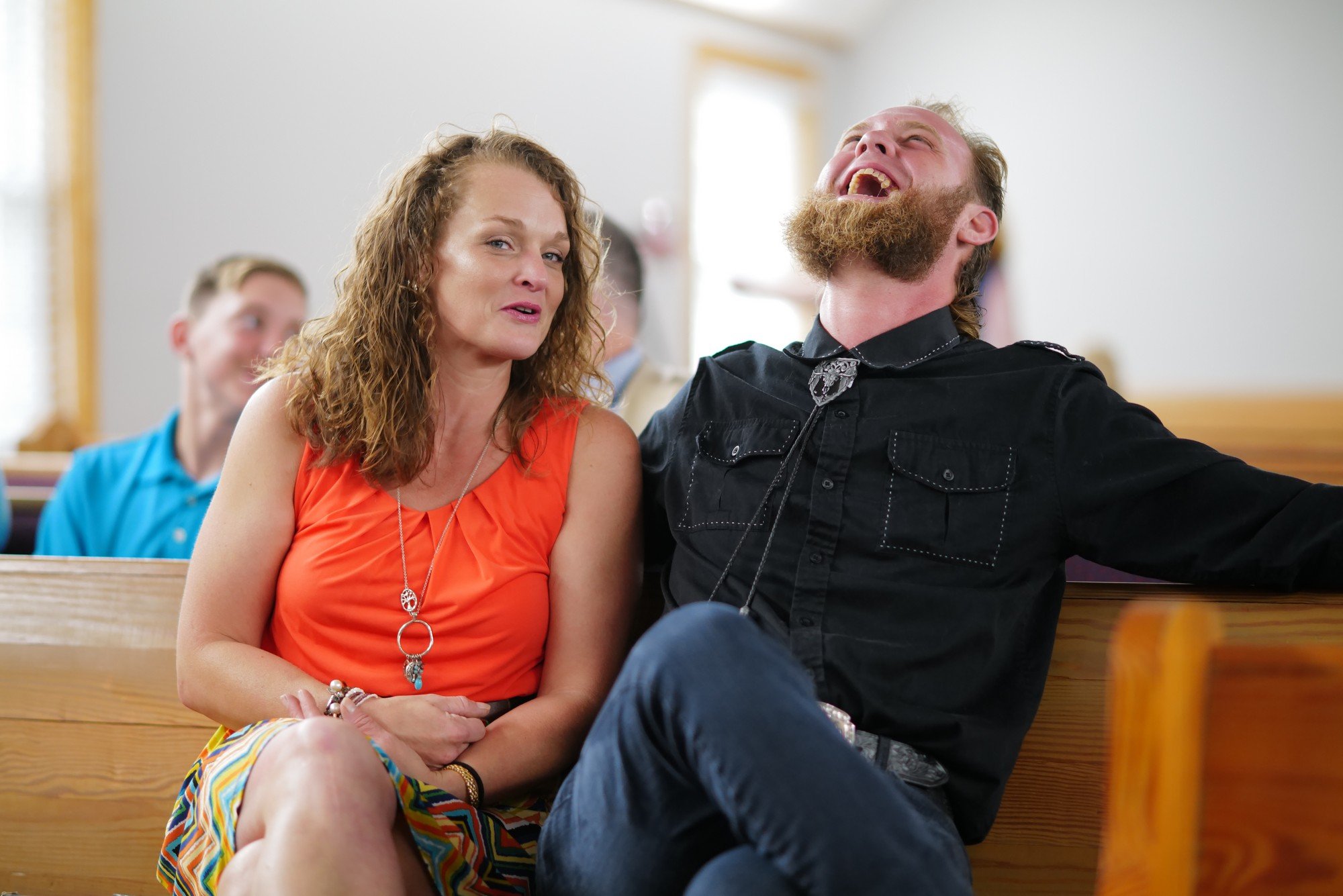
Aperture is a big deal, just ask anyone who shoots photos indoors, the bigger the better. This is not for those blurry backgrounds either, although this is a byproduct, it is more because the rooms are normally very dimly lit and this helps keep the ISO down below 1Trillion…I normally shoot wide open for this reason alone, but if the building has windows and there is a good bit of light in the room , I will stop down to f4, but that is about it. Actually, I don’t think I have ever deliberately stopped down past f4 indoors ever. There just isn’t enough light…
This is going to be controversial but I like manual focus. I don’t know why exactly. but I like it. It is something to do with the interaction with the equipment, I just enjoy tinkering and this is something to tinker with. The fact that the focus isn’t looking for what I want to grab and then grabbing someone else, is a comforting feeling. The 105mm f2 is also manual aperture, so I get to control that manually too, although I rarely change this for reasons mentioned above. This rig is a fairly heavy system too, with the camera being a pro camera and the lens also being of the pro variety these are built very well and will last a lifetime with minimal maintenance.

All photos in this blog were taken at the 2022 United Sacred Harp Convention at Antioch Baptist Church in Ider, Alabama. These events are usually held at churches and the acoustics are usually really good because of this, but the light is dim…
Another thing I try to do is capture the “atmosphere” of the event as well. This means that I am taking photos of everything, not just the song leaders. I will get photos of the kids playing, people talking, the food tables (this is a rule or something that the photog HAS to get the food tables LOL) so it tells a more complete story than just song leading. A particularly special thing to record is the children and the elderly as these statistically are the ones that will change the most in just a few years. So I really try to get these people photographed so people will be able to remember them more easily. Also something I have learned to photograph at ALL events is ANY candid opportunity that involved emotion. The photo of Cass and Isaac above is a great example of this. These types of photos are honestly very hard to capture unless you spend a lot of time just watching and then you can get them fairly easily. They are fleeting moments and sometimes they are also “built” on a scene that you can predict as you watch it develop. You will learn to get these kinds of photos if you just watch the scene around you for a while.


If you have not found a niche genre of photography for you, I implore you to do some exploration and find something that you like a lot and then get your camera out and do some photos to see if it is your niche.
If you want to learn more about Sacred Harp or you want to try to find a singing to go hear it, follow this link to the FaSoLa.org website.
Why I have been slacking on my blog till now...
Why have I been slacking on my blog until now?
In a word…Youtube… Let me explain.
You see I have a channel on YouTube and over the past few years I have been trying to get it off the ground and one thing I have found is that you cant do YouTube and practically anything else at all…

The algorithm is such that you have to basically spend all your free time “feeding the monster” to get it to show your videos, this creates a cycle of content creation for views that leaves little time for anything else, and not being creative to bring joy to my life or anyone else for that matter took a while to realize... SO back in June I decided to take a break from making YouTube videos and to focus on just enjoying shooting photos and it has been wonderful! I have taken so many photos of things I love and have honestly learned what it is that I really like to shoot when I pick up my camera.

I don’t really enjoy photographing people up close all that much and with the new environment post 2020, people are real apprehensive about getting real close on the street anyway. I have found I really like the 50mm focal length, I have other lenses, but this lens has been on my camera for months now with almost no change. I also learned that I like to photograph Sacred Harp singings with a 105mm focal length, I just love the effect this lens gives me...

Isaac Green leading his song at a local singing.
Wanna know what a singing is? go here: FaSoLa Website or click on the photo above.
So going forward, my main outlet for my creative and hobby stuff will be this blog and my YouTube channel will probably get a monthly update video talking about what has been going on. I thought that “video” was the way forward for ALL creatives, but it doesn’t seem like that is the path for me, so I am going to shift my focus to my blog and get this photography blog moving like I should have from the beginning. I kinda enjoy doing this more anyway, so lets have some fun! Now get your camera out and go take a picture with it!
Chattanooga Life #5
Tonight I was waiting on a phone call from the wife about bringing some food to her and thought I would grab a few photos while I was there. I used my Leica CL and the 35mm Elmarit lens and tried to capture what it felt like to be out tonight while it started to rain. This is an example of seeing the setup and taking the time to get the photos while the conditions were right, the time passed pretty quickly and once it was dark, I had to completely change the way I was looking at the scene and come up with new compositions that didnt involve the sky. These photos are not technically in Chattanooga, but Trenton Ga is in the greater Chattanooga area so I consider it basically a suburb of Chattanooga. I had to work the scene pretty hard as the light diminished pretty rapidly due to it being blue hour when I started. Raining is part of street photography and these moody clouds really helped set the mood. What is your favorite time and conditions to capture street photos?

Chattanooga Life #4
Well, some days, the people are outside and some days they are not. This day the people were outside… it is nice to see the people getting back to life as usual and that waiting on the world to “turn back on” is just wasteful. I really enjoyed being out among the people of Chattanooga with my camera and getting street photography style photos. It can be tough in Chattanooga with street photography since the city is more spread out, but some days it just works. I finally got a little longer lens (85mm effective field of view) so I should be able to get a little more going forward.


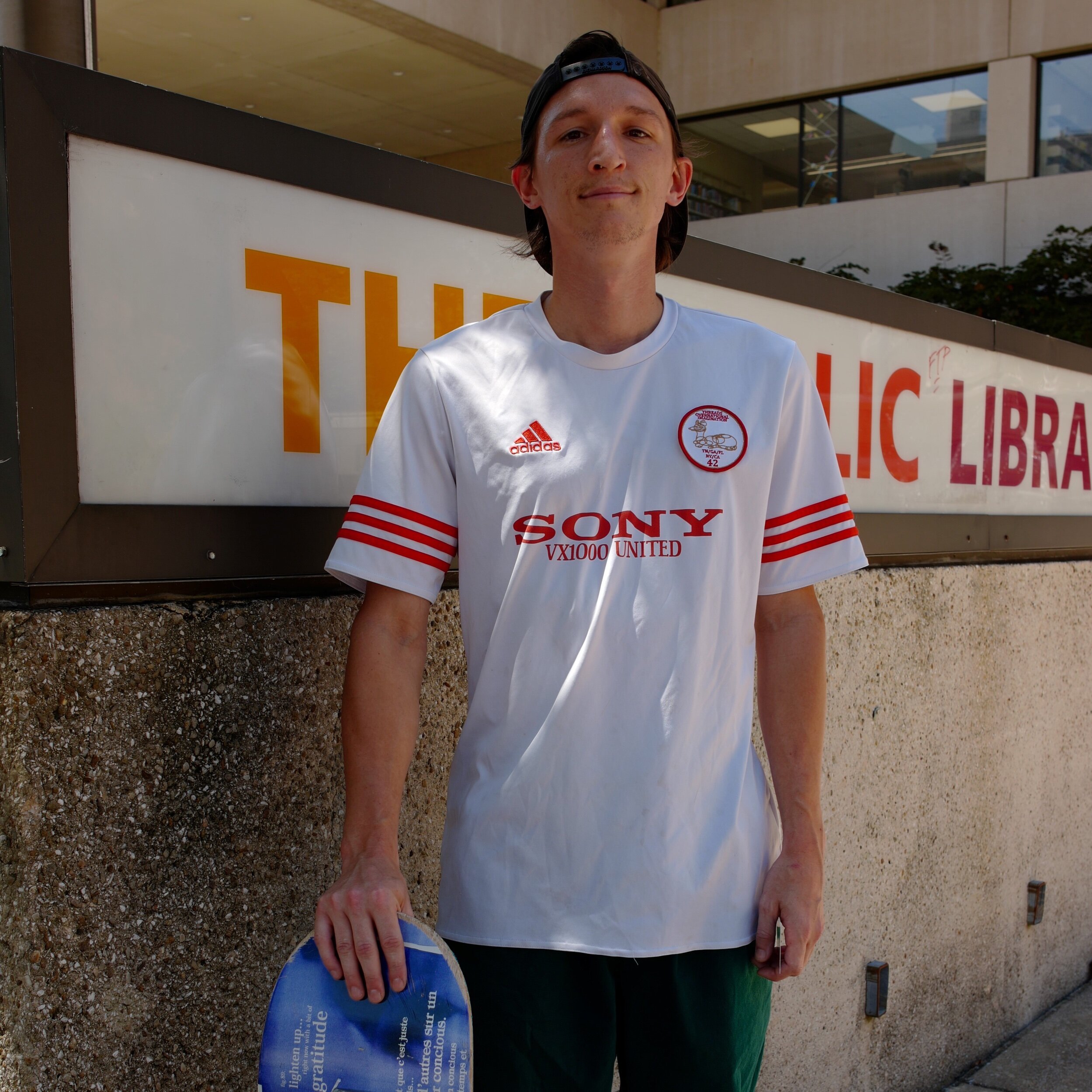

The people here are good people for the most part with a good message… get your camera out and take a picture with it. #streetphotography #photography #chattanooga #camera
Chattanooga Life #3
With the coming of fall in the air, people are starting to get outside a little more, even though the pandemic is far from over… I honestly think people are simply getting tired of being scared of it and are just going back to daily life with the added inconvenience of wearing face coverings. Horse and buggy rides are back in operation and people are enjoying the time spent with them. I’m personally glad to see people getting on with life…#streetphotography #photography


Chattanooga Life #2
“Windowshopping with dad” This image was taken on Market Street 31 JUL 2020
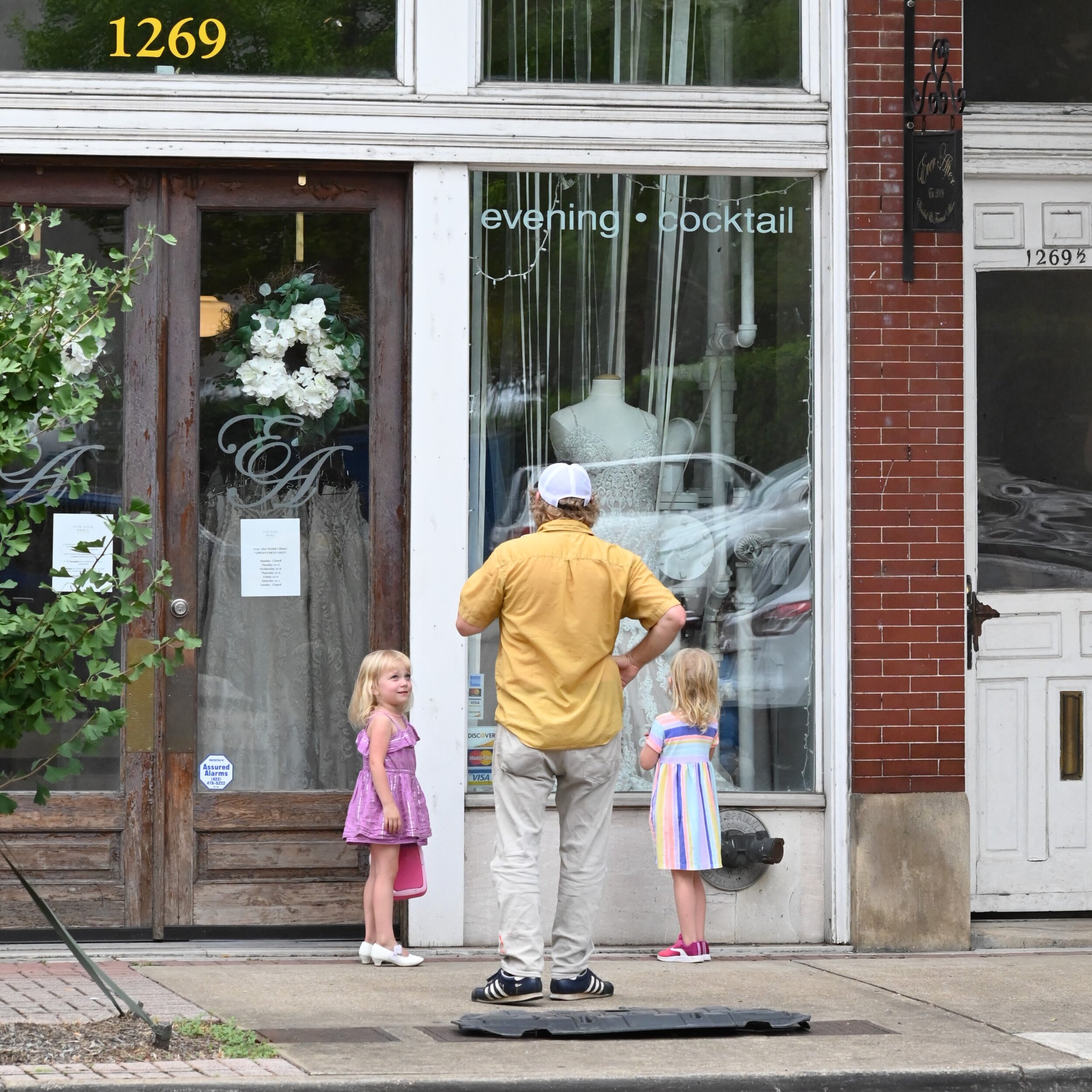
I wonder what she is telling him… Chattanooga street photography is a lot of fun.