
Nikon Zf Review: Why I Switched from Leica CL for Travel Photography
When I got into the Leica cameras I use, I had built a kit around street photography, urban photography, urbex photography, and travel photography. The next thing I started doing was adapting vintage lenses to them. Then I started using TTArtisan glass on the Leica CL and loved it! My Leica SL2 now carries the 50mm APO Summicron L pretty much all the time as well. I love the SL2, but for a backpacking trip, it is probably not the best choice.
After years of using the Leica CL for travel photography, I finally switched to the Nikon Zf—and I should have done it sooner. The breaking point? Getting caught in English rain on the Pilgrims Way with my non-weather-sealed Leica CL. In this Nikon Zf review, I'll explain why I chose this retro-styled mirrorless camera over the Leica CL for hiking trips and travel photography, covering weather sealing, IBIS, battery life, and real-world performance.
Why I Needed a Weather Sealed Travel Camera
When I got into the Leica cameras I use, I had built a kit around street photography, urban photography, urbex photography, and travel photography. The next thing I started doing was adapting vintage lenses to them. Then I started using TTArtisan glass on the Leica CL and loved it! My Leica SL2 now carries the 50mm APO Summicron L pretty much all the time as well. I love the SL2, but for a backpacking trip, it is probably not the best choice.
That experience changed everything for me. I realized I was babying my camera instead of using it. Every time clouds rolled in, I'd pack it away. Every time I saw a stunning scene but it was drizzling, I'd pass on the shot. That's not why I bought a camera—I bought it to use it, to capture moments, to not miss opportunities because I'm worried about weather. That's when I knew I needed weather sealing as a non-negotiable feature in my next travel camera.

The Leica CL served me well for years, but lack of weather sealing was a deal-breaker for hiking trips in unpredictable weather.
Why the Leica CL Didn't Work for Hiking Trips
The Leica CL, while perfect in size for travel, is not weather sealed… I came to this realization while hiking the Pilgrims Way in England a while back. (I did a small series of videos on this trip if you are interested) and this is when I came to realize that while the Leica CL is really small and lightweight, it is also not my favorite for hiking trip travel. Rain is a real threat in England and I was fortunate that my camera did not get caught in a cloud burst.
So knowing all of this, I started down the path of finding a new travel camera to shoot with…
My Requirements for the Perfect Travel Photography Camera
So knowing all of this, I started down the path of finding a new travel camera to shoot with. I looked at several factors to guide my choice:
The first was it had to be weather sealed or it was a no go for me.
The next is it had to have IBIS as I love shooting with vintage glass and this allows me to shoot at much slower shutter speeds while handheld.
I also wanted a full frame, 24MP sensor if possible as these (in 2024) have much better low light performance due to the larger photo sites on the sensor.
It also needed good battery life as these Leica mirrorless cameras just don't have great battery life for me.
These weren't just nice-to-have features. These were requirements based on real frustrations I'd experienced in the field. Weather sealing because of England. IBIS because I shoot vintage glass and hate carrying a tripod on hikes. Full-frame 24MP for those low-light church interiors and evening shots. Battery life because running out of power halfway through a hiking day is unacceptable.
Nikon Zf Features That Changed My Travel Photography
After searching for a year or so with no luck, Nikon drops a bomb on me with the launch of the Nikon Zf retro styled camera. You could have just as easily called it the "Nikon Special Custom Built Camera For Dave" and the name would have been accurate. HaHa!
I immediately fell in love with it…before I even laid eyes on one in person. When I see a new camera that I am interested in, I will search all about it that I can and see if it will fit my needs and do that at a price point that I am comfortable with.
The Nikon Zf mirrorless camera is a camera that checks all those boxes and more. You see I am in love with the retro-style camera design aesthetic like the Fujifilm XT-3 and now the Nikon Zf (as well as to a lesser degree the Nikon Zfc too). I owned the Fujifilm XT-3 for several years and it had two main shortcomings that made me want to move away from it over the years.
The crop sensor had pretty bad low light performance (it was 26 mega pixels so it was doing a lot of work to get it all in there) and the lack of IBIS in a mirrorless camera. Cameras at this time were coming standard with IBIS (In Body Image Stabilization) and I felt this was a huge misstep for Fujifilm on this camera. I, none the less, used it for several years anyway and to great effect too, but the lack of these two features was a nagging thought at the back of my mind the whole time.
Then Nikon came out with the Zfc and I initially was in love with it, but upon closer inspection, it was simply an XT-3 in a Nikon shell. Yeah, it had a few things that were newer and (debatably) better, but it still lacked certain things I wanted. I had resigned myself at this point to wait for a replacement to the Nikon Df or maybe something by Leica that was closer to what I was wanting. Well as fate would have it, Nikon saw the demand for the retro camera design and came out with the Zf—a full frame, IBIS, 24 megapixel, mirrorless camera loaded with all the magic that they could cram into the beautiful Nikon retro shell.
Nikon Zf vs Leica CL: Key Differences for Travel Photography
Let me break down the key differences between these two cameras for anyone facing the same decision I did:
Weather Sealing: The Nikon Zf is fully weather sealed; the Leica CL is not. This was the deal-breaker for me. If you're hiking in unpredictable weather or traveling to places with rain, dust, or humidity, the Nikon Zf gives you peace of mind. The Leica CL requires constant babying in anything but perfect conditions.
IBIS: The Nikon Zf has 5-axis in-body image stabilization; the Leica CL does not. This makes a massive difference when shooting with vintage manual focus lenses or in low light. I can handhold shots at 1/15th second with the Nikon Zf that would be impossible with the Leica CL. For travel photography where you can't always use a tripod, IBIS is a game-changer.
Sensor Size: The Nikon Zf has a full-frame 24MP sensor; the Leica CL has an APS-C crop sensor. The full-frame sensor gives you better low-light performance (larger photosites), shallower depth of field control, and generally more flexibility. The crop sensor on the Leica CL is excellent, but the full-frame advantage is real when you're shooting in challenging light.
Battery Life: The Nikon Zf's battery lasts significantly longer than the Leica CL. With the Leica CL, I'd carry 3-4 batteries and still worry about running out. With the Nikon Zf, two batteries get me through a full day of shooting with power to spare.
Size and Weight: This is where the Leica CL wins. It's noticeably smaller and lighter, which matters on long hikes. The Nikon Zf is not a huge camera, but it's definitely more substantial. For me, the practical advantages of the Nikon Zf outweigh the size disadvantage, but this is a personal choice.
Price: The Leica CL (when it was still in production) was more expensive than the Nikon Zf. Now that it's discontinued, you'd be buying used. The Nikon Zf offers better value for the features you get.
The Nikon Zf's weather-sealed body and IBIS make it ideal for unpredictable travel conditions and hiking with vintage lenses.
Real World Nikon Zf Performance: Travel and Hiking
So to be honest, I was still skeptical that this would be the next camera for me. I have gotten really comfortable using my Leica cameras and the thought of learning a new camera was really not that appealing to me. But the more reviews I watched on YouTube and the more I just looked at the camera in general, the more I liked it.
Since getting the Nikon Zf, I've put it through its paces on several trips, and it's delivered every time. The weather sealing proved itself on a rainy morning shoot where I would have packed the Leica CL away. The IBIS let me shoot handheld in a dimly lit museum with a vintage 50mm f/1.4 lens at 1/15th second and still get sharp images. The battery lasted an entire day of hiking without needing the spare.
The retro physical dials are more than just aesthetic—they're genuinely useful in the field. Being able to glance down and see my shutter speed and ISO without turning on the screen saves battery and makes adjustments faster. On a hike, every second counts when you're trying to catch changing light or a fleeting moment.
The full-frame sensor's low-light performance is noticeably better than the Leica CL's crop sensor. I can comfortably shoot at ISO 3200 or even 6400 when needed, and the files are clean. With the Leica CL, I tried to stay under ISO 1600 whenever possible. That flexibility matters when you're traveling and can't always control the light.
So for now, this is my new travel/street machine. It has wonderful rendition and is a joy to shoot with. I look forward to taking it on outings now and I have the 50mm f1.8 S lens if I want auto focus and to be able to access all the special features that have to do with the auto focus system. So going forward, there will be more about this machine as well as the two Leica camras I use as well. You see, those two machines are also wonderful cameras and I still enjoy using them too, I use them for certain things as I have found. But I still love getting them out and using them.
Nikon Zf vs Leica CL: Which Should You Choose?
Choose the Nikon Zf if:
You need weather sealing for hiking, travel, or unpredictable conditions
You shoot with vintage manual focus lenses and want IBIS
You value battery life and don't want to carry multiple batteries
You want better low-light performance (full-frame advantage)
You're comfortable with a slightly larger/heavier camera for the features
Choose the Leica CL if:
Size and weight are your absolute top priorities
You primarily shoot in good weather or controlled conditions
You're already invested in the Leica L-mount ecosystem
You prefer the Leica color science and rendering
You can find one used at a good price (it's discontinued)
For me, the practical advantages of the Nikon Zf outweigh the size advantage of the Leica CL. But I still appreciate what the Leica CL offers for lightweight urban photography.
Recommended Gear for Travel Photography
Support this website by using these affiliate links to shop on Amazon:
Leica M11 Digital Rangefinder Camera because the Leica CL is out of production now.
Nikon AF-S FX NIKKOR 105mm f/1.4E ED Lens
Voigtlander Nokton 35mm f/1.4 II
Sandisk 128GB Extreme Pro memory cards
Nikon 50mm f1.8 S Lens for Z mount
Frequently Asked Questions About the Nikon Zf for Travel Photography
Is the Nikon Zf good for travel photography?
Yes, the Nikon Zf is excellent for travel photography. After switching from the Leica CL, I've found the Nikon Zf addresses all the key requirements for serious travel work: weather sealing protects it in rain and dust, IBIS (In-Body Image Stabilization) allows handheld shooting with vintage lenses and in low light, the full-frame 24MP sensor delivers outstanding image quality even at high ISOs, and the battery life is significantly better than my Leica mirrorless cameras. The retro design with physical dials makes it quick to adjust settings on the fly, which is crucial when you're hiking and need to shoot fast.
How does the Nikon Zf compare to the Leica CL for travel?
The Nikon Zf and Leica CL serve different needs. The Leica CL is smaller and lighter (perfect for ultralight backpacking), but lacks weather sealing and IBIS, which are deal-breakers for hiking trips where rain is a possibility. The Nikon Zf is heavier but offers weather sealing, IBIS, a full-frame sensor with better low-light performance, and much longer battery life. I switched from Leica CL to Nikon Zf specifically because I got caught in English rain on the Pilgrims Way and realized I needed weather protection. If you're doing casual city travel, the Leica CL's compact size is nice. For serious hiking and unpredictable weather, the Nikon Zf is the better choice.
Is the Nikon Zf weather sealed?
Yes, the Nikon Zf is weather sealed. This was one of my primary requirements when searching for a travel camera to replace the Leica CL. The weather sealing on the Nikon Zf protects against rain, dust, and moisture - essential for hiking trips and travel photography where you can't always control the conditions. After hiking the Pilgrims Way in England with my non-weather-sealed Leica CL and worrying about rain the entire time, having weather sealing gives me peace of mind to shoot in any conditions.
Does the Nikon Zf have IBIS?
Yes, the Nikon Zf has 5-axis In-Body Image Stabilization (IBIS). This was another critical requirement for me. IBIS allows me to shoot with vintage manual focus lenses at slower shutter speeds while still getting sharp handheld images. It's also invaluable for travel photography when you're shooting in low-light situations like churches, museums, or evening street scenes where you can't use a tripod. The Leica CL lacks IBIS, which was one of the main reasons I switched to the Nikon Zf.
What is the battery life like on the Nikon Zf?
The Nikon Zf has significantly better battery life than my Leica mirrorless cameras. While Leica mirrorless cameras have notoriously short battery life (I always carried 3-4 batteries), the Nikon Zf's EN-EL15c battery provides enough power for a full day of travel photography on a single charge. This is a huge advantage for hiking trips where you might not have access to power for recharging. I typically carry two batteries for the Nikon Zf and rarely need the second one, whereas with the Leica CL I'd go through multiple batteries in a day.
Can you use vintage lenses on the Nikon Zf?
Absolutely! The Nikon Zf is fantastic for vintage lenses, which is one reason I love it. With the FTZ II adapter, you can use Nikon F-mount lenses, and with various adapters you can mount Leica M, M42, Canon FD, and many other vintage lenses. The combination of focus peaking, IBIS, and the high-resolution EVF makes manual focusing a joy. I regularly shoot with vintage glass on my Nikon Zf when traveling, and the IBIS compensates for the lack of optical stabilization in older lenses. This was impossible with the Leica CL which lacks IBIS.
Is the Nikon Zf worth it over the Leica CL?
It depends on your priorities. The Nikon Zf is worth it if you need weather sealing, IBIS, better low-light performance (full-frame vs crop sensor), and longer battery life. These were all critical requirements for my hiking and travel photography. The Leica CL is worth considering if you prioritize extreme portability, the Leica color science, and compact size above all else. For me, the practical advantages of the Nikon Zf (weather sealing especially) outweighed the Leica CL's size advantage. After nearly losing my Leica CL to rain in England, the choice became clear.
What focal lengths work best for travel photography on the Nikon Zf?
For travel photography on the Nikon Zf, I primarily use the Nikon 50mm f/1.8 S lens because it's lightweight, sharp, and versatile. The full-frame sensor means you get the classic 50mm field of view, which works for everything from street scenes to portraits. I also adapt vintage lenses, particularly 35mm focal lengths, when I want a wider perspective for landscapes or architecture. The beauty of the Nikon Zf's IBIS is that I can handhold even at slower shutter speeds, so I'm not limited by the lack of stabilization in vintage glass. For hiking trips, I keep my kit minimal - usually just the 50mm f/1.8 S and maybe one adapted vintage lens.
So for now, this is my new travel and street machine. It has wonderful rendition and is a joy to shoot with. I look forward to taking it on outings now and I have the 50mm f1.8 S lens if I want auto focus and to be able to access all the special features that have to do with the auto focus system.
Going forward, there will be more about this machine as well as the two Leica cameras I use. You see, those two machines are also wonderful cameras and I still enjoy using them too—I use them for certain things as I have found. The Leica CL still comes with me on city trips where weight matters. The Leica SL2 is my studio and portrait camera. But for travel photography where weather and versatility matter? The Nikon Zf is now my go-to.
Are you considering the Nikon Zf for travel photography? Or have you made a similar switch from one camera system to another? I'd love to hear about your experiences in the comments below!
Want more honest camera reviews and travel photography tips? Subscribe to my photography blog for weekly posts about real-world gear testing, not just spec sheets and studio tests.
Support this website by using these affiliate links to shop on Amazon:
Leica M11 Digital Rangefinder Camera
Nikon AF-S FX NIKKOR 105mm f/1.4E ED Lens
Voigtlander Nokton 35mm f/1.4 II
Sandisk 128GB Extreme Pro memory cards
Photographing Belize: Nim Li Punit Mayan Ruins, San Pedro Street Photography, and Local Culture
To get a feel for a country, you have to step away from the glitz and glamour of the tourist areas (isn't that true for all tourist destinations though). In some places this can be life threatening but in others it can be very rewarding. Belize seems to be a lot like Costa Rica in this regard. Just about anywhere you go the people are nice and helpful from what I have seen.
To get a feel for a country, you have to step away from the glitz and glamour of the tourist areas (isn't that true for all tourist destinations though). In some places this can be life threatening but in others it can be very rewarding. Belize seems to be a lot like Costa Rica in this regard. Just about anywhere you go the people are nice and helpful from what I have seen.
This is part 2 of my Belize photography journey. If you missed part 1, read about my minimalist camera gear setup and travel philosophy first.
Exploring Rural Belize: The Journey to Nim Li Punit

Rural southern Belize - traditional homes and local life on the way to Nim Li Punit ruins
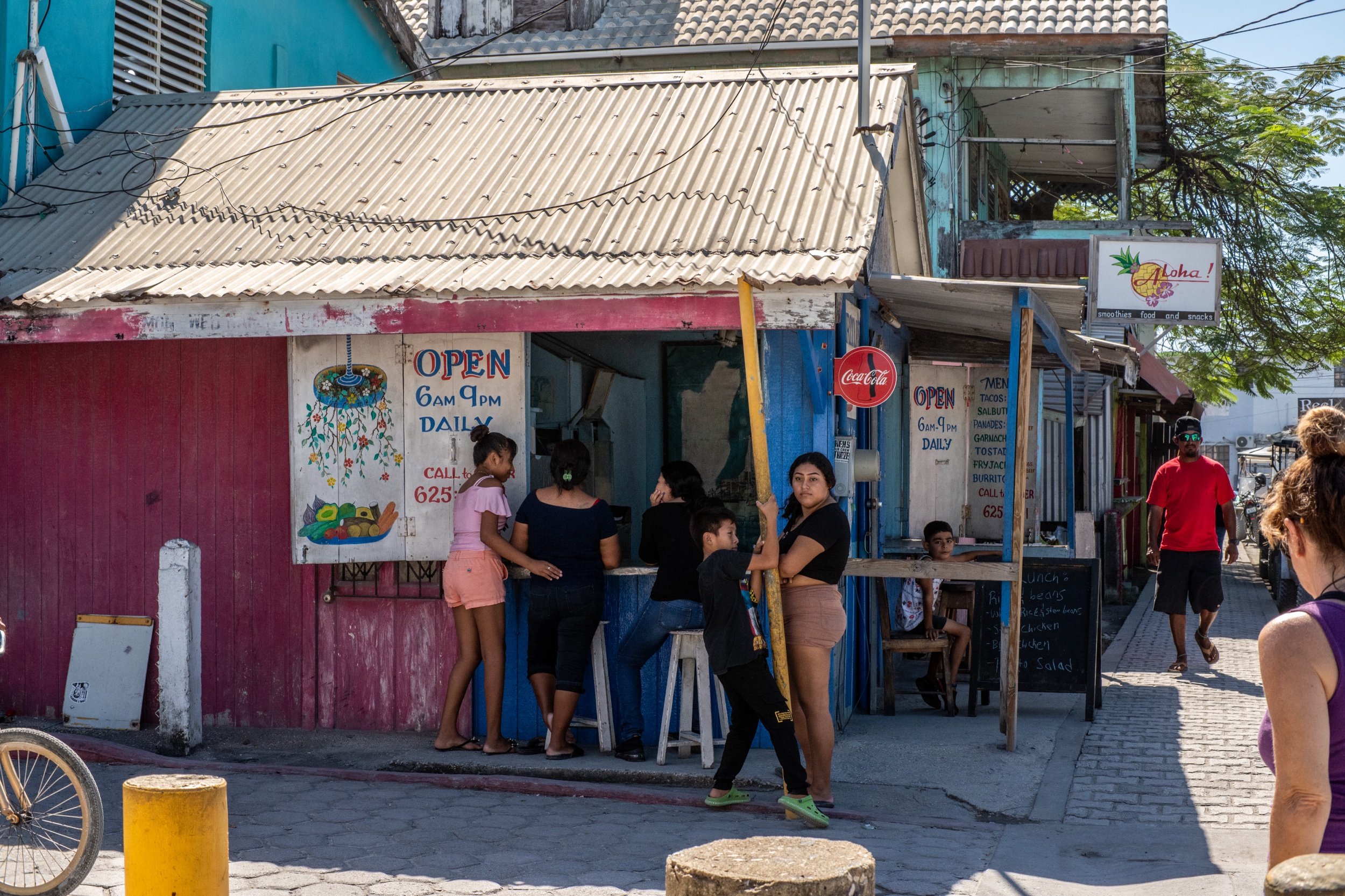
We saddled up and headed first to the Mayan ruins (it is an active archaeological site) and we got a wonderful "tour" of the rural part of southern Belize on the way over including things like the main modes of transportation being motorcycles and buses as well as seeing many traditional homes made with thatch roof construction. Many of these homes had no electricity or water service to them that I could see while others did. It is always interesting to learn how other parts of the world live.
Why photographing rural areas matters: The journey to the ruins showed me more about Belizean life than any resort could. This is where real documentary photography happens—not in the polished tourist zones, but in the authentic spaces between destinations. Motorcycles and buses dominate the roads. Thatch-roof homes mix with more modern construction. It's this contrast that makes travel photography compelling.
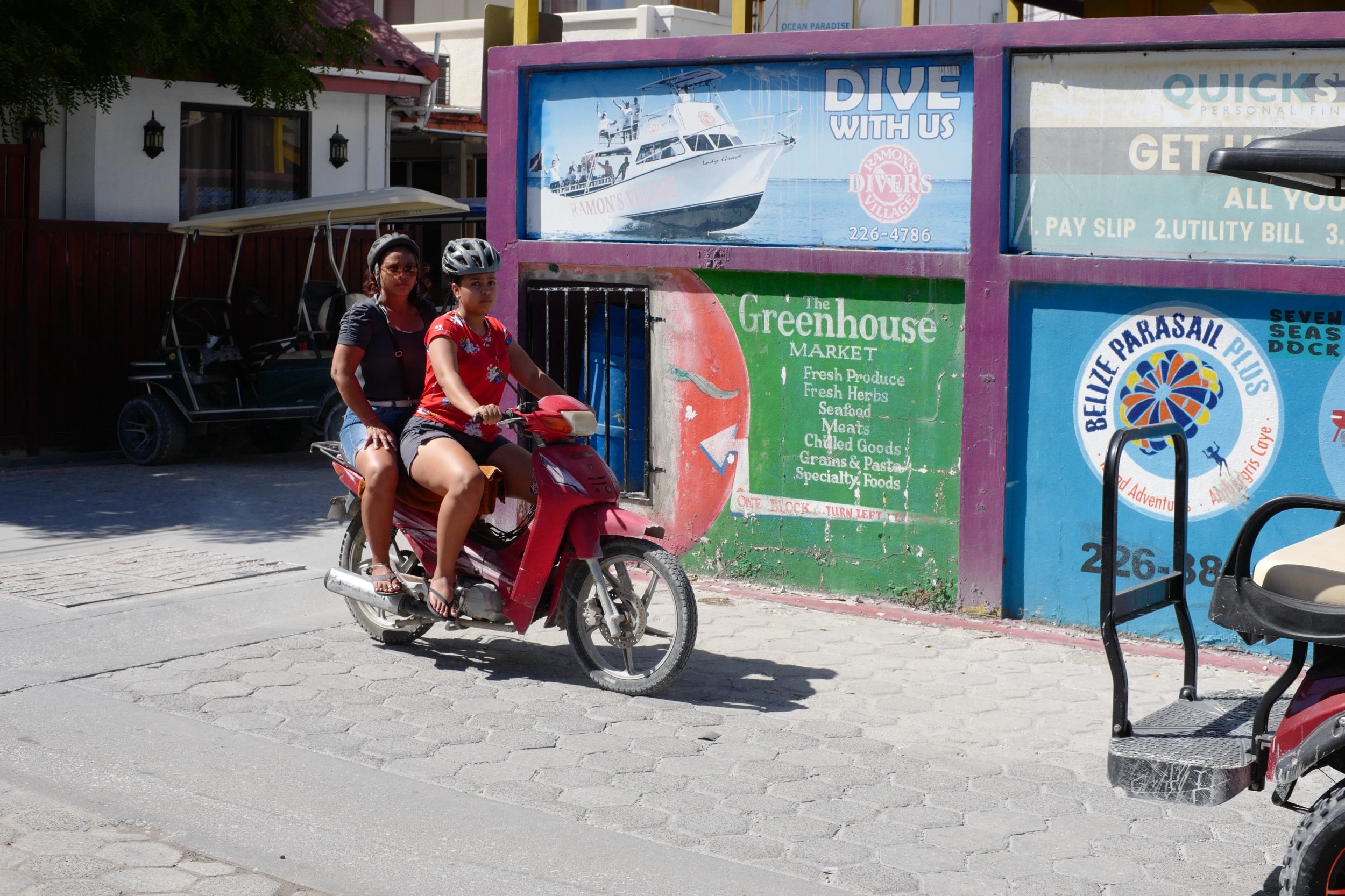
Motorcycles and buses dominate rural Belize transportation - a different world from the tourist zones
Nim Li Punit Mayan Ruins: A Photographer's Hidden Gem
We arrived at the ***Nim Li Punit*** site and get a class on decoding some of the Mayan glyphs that were carved into several stela that were found on the site. We learned how they counted and their numbering systems and how they marked their calendars as well. It was really awesome to see how all this worked on an actual artifact that you can touch.
This site is a smaller site that is easier to access with less crowds and therefore more freedom to navigate yourself without the pressures of large tour groups moving through. There were some tour groups but they were much smaller and didn't choke off the entire area while there.
Why Nim Li Punit beats the famous ruins for photography: Unlike Tikal or Chichen Itza, Nim Li Punit is uncrowded. You can take your time composing shots without tourists walking through your frame. You can touch the actual stelae. Small tour groups mean you can shoot freely without feeling rushed. For travel photographers who want authentic archaeological site photos without the crowds, this is a secret weapon.
I am not sure if the remains that were intact were original or if they were reconstructed for tourism, but it was really interesting to see it nonetheless. I know some was reconstructed as there was mortar in places holding a couple of stones together but the bulk looked original so I let my mind play that game.

Nim Li Punit - an uncrowded Mayan ruins site perfect for photographers who want freedom to shoot
Photography tip for ruins: Look for the details. The carved glyphs on the stelae tell stories. The weathered stone textures. The jungle encroaching on ancient structures. These details make compelling photographs that wide shots of the whole site can't capture.
The Spice Farm: Unexpected Photography Opportunities
On the return trip we stopped for lunch at a spice farm and toured the farm. It was incredibly interesting to see how many different spices they had at one place. Another thing that was interesting was seeing the spices in their natural form in nature. Things like black pepper vines and vanilla as well as other spices I had never heard of before. It was really informative as well as entertaining. After that it was a fairly long drive back to the accommodations for supper and a nap. Haha.

Spice farm tour - seeing vanilla, black pepper, and other spices in their natural form
Pseudo macro photography without a macro lens: The spice farm was perfect for close-up photography, and I only had my 17mm and 35mm primes. The lesson? You don't need specialized gear for every situation. Getting close and using creative framing can produce compelling images even with "normal" lenses.
Moving to San Pedro: A Different Side of Belize
After our stay in Placencia we traveled to another small community called San Pedro on an island. You can get there by plane or ferry.
Flying Tropic Air between Belizean destinations - 10-12 passenger planes flying at low altitude
We flew Tropic Air which uses this fleet of 10 or 12 passenger planes as seen in the photo above. Every plane they have is this particular make and model as well as their competitor, Mayan Air. It is kinda neat to do low altitude flights from town to town. You can see a lot of things normally not within your view. I also pack my camera gear in my pack for travel and stow all of it except my action camera in my pack for safe keeping. This way I don't leave something behind when changing locations. Another side effect though is that I get no high quality photos when the gear is in this condition so it isn't a perfect system by no means… Once on the ground in San Pedro, I will recover it for the evening. I have high hopes that San Pedro will have more photography opportunities than where we stayed in Placencia. Actually, there was a ton of things I wanted to photograph but didn't have time due to the schedule being so full. Lol.
San Pedro Reality Check: Tourist Trap or Photography Paradise?

San Pedro's tourist-focused atmosphere - beautiful but heavily commercialized
Well, I really dont care for San Pedro to be perfectly honest about it. The whole atmosphere is geared towards liberating money from tourist's wallets… this is not enjoyable at all to me. I dont mind paying a fair price for things that cost money but if you are not very careful, you will overpay significantly for the same activities offered just a few hundred meters away. I just want to be left alone to enjoy my time in peace. I really don't know how I feel about this yet to be honest… one thing is I am here in their country kind of in the way and on the other hand the infrastructure is literally being built to support that attendance… tough call to be honest.
Honest travel photography truth: Not every destination lives up to expectations. San Pedro is heavily commercialized, which can be frustrating if you're looking for authentic experiences. But this tension—between tourism infrastructure and local life—is itself worth documenting. The photography opportunities exist, but you have to work harder to find them.
Finding Authentic San Pedro: Early Morning Photography Walk
The first day we went into town for coffee as our villa doesn't have any means to make coffee in it…(not cool)… but it did afford us an opportunity to see some stuff in the early morning that we would not normally see. Like the "Central Park" of San Pedro which is where they put up all the big Christmas and New Year's decorations. It also has the giant sign at this park as well. It is common in Central American culture to have this kind of sign in each city for some reason. I kinda like it though as it is a cool photo opportunity.

San Pedro's Central Park - the classic Central American city sign photo opportunity
Best time for travel photography: Early morning. Before the tourist crowds. Before the heat. When locals are going about their daily routines. This is when you'll find the authentic moments worth photographing.
The sheer number of golf carts on this island is staggering to say the least. Golf carts are the primary means of transportation here and really are convenient to be honest about it. We have a golf cart too so l can't complain but wow, there are a lot of them. There are enough that they become a focal point of some photos.

Golf cart culture in San Pedro - they're everywhere and they're the main way to get around
Street Photography in San Pedro: Capturing Local Life
It was fairly interesting to me to see the Belizean people in their day to day lives more than to see all the tourists two streets over. I found them to be wonderful subjects for simple street photography and I saw several more that would have been great photos if I had been able to spend more time out with my camera.

Street life in San Pedro - shot at f/11 with zone focusing for fast, decisive moments

Street life in San Pedro - shot at f/11 with zone focusing for fast, decisive moments

Street life in San Pedro - shot at f/11 with zone focusing for fast, decisive moments
My street photography approach in San Pedro: I shot at f/11 with zone focusing. This means I pre-focused the lens at a certain distance, stopped down for depth of field, and simply composed and shot. Fast. Decisive. No chimping. This technique is perfect for street photography when you want to capture fleeting moments without missing the shot while fiddling with autofocus.
Above are some photos from our 3 mile photowalk that I was able to capture. The locals are so much more interesting to me than the tourists for some reason. Almost the whole photowalk was shot at f11 and range focus so I simply composed the photo and pressed the shutter. This makes for fast photos if you are attempting to capture a fleeting moment.
Another thing you will notice is how a lot of them are looking at me. This is the reason I don't do more street photography in Chattanooga, I stick out like a sore thumb due to my physical stature. Here though, I play the tourist card and get away with it. I just photograph all the things and sort it out later since my time here is limited.
Why manual focus beats autofocus for street photography: With zone focusing at f/11, everything from about 5 feet to infinity is sharp. No focus hunting. No missed moments. Just composition and timing. This is how street photographers worked for decades before autofocus existed, and it still works brilliantly today. For more on my street photography philosophy, check out my post on solo street photography with the Leica CL.
Night Photography in San Pedro: Central Park After Dark
Central Park at night - the decorations stayed up longer than they would in the US
This was taken in Central Park at night…obviously, but it was neat to find these displays still setup and under power a week later. Lots of municipalities in the USA would already be taking all this down.
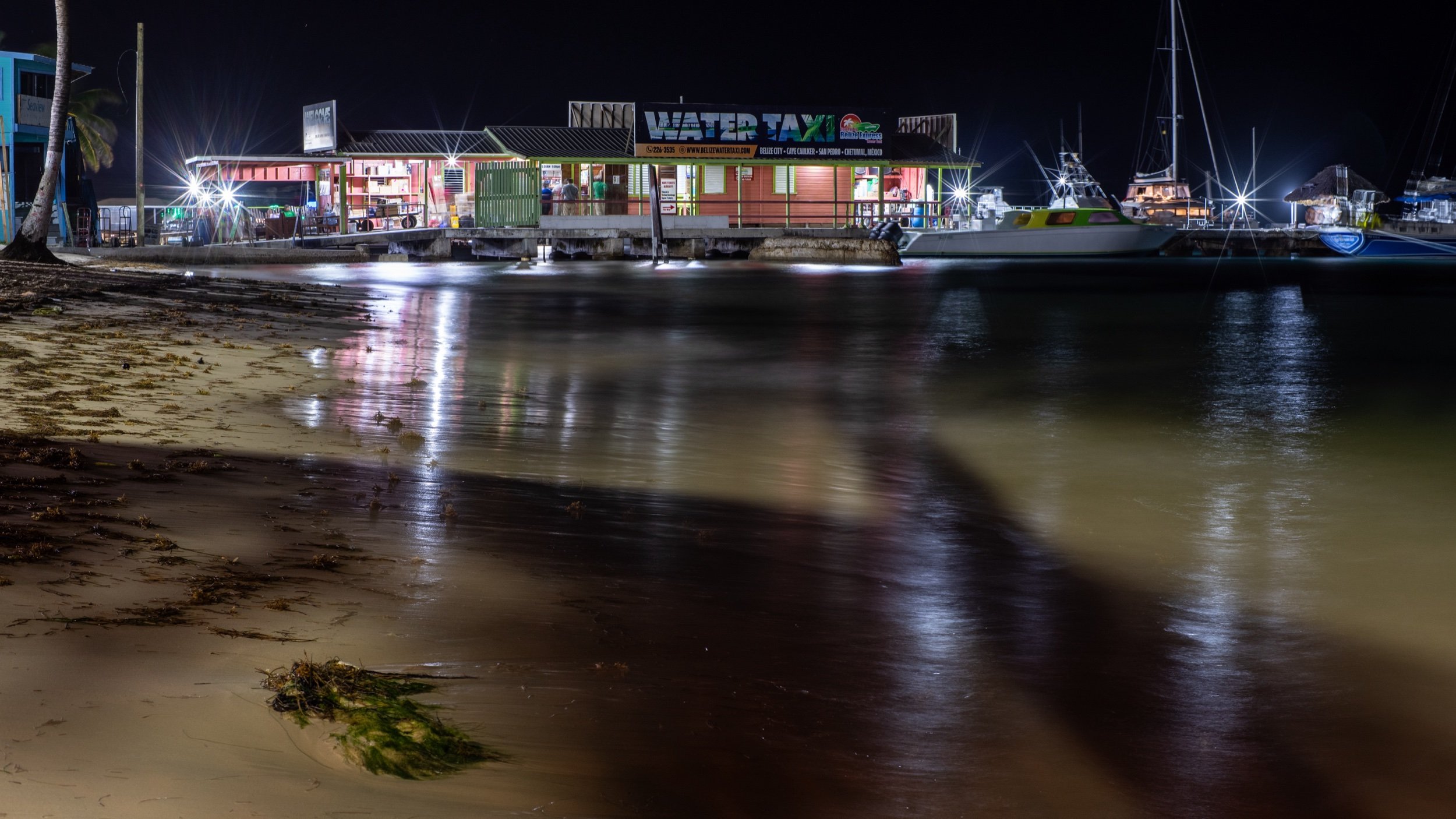
Below is a photo I captured while waiting on supper to come out of the kitchen at a beachside restaurant. I simply sat the camera on a rock wall and leveled it with my iPhone under one corner since it is a 20 second exposure. My goal here was to get ocean smoothed out some for a cool foreground element. I also had to level the image a little and also set it to 16:9 crop as there was a lot of black sky above the buildings. Would it be better at blue hour? Only if you wanted some color in the sky. I like what I got and I was there at this time too so it worked out well for me.

20-second exposure improvised with rock wall as tripod - sometimes you make do with what you have
Long exposure without a tripod: Sometimes you make do with what you have. A rock wall, an iPhone as a shim for leveling, and a 20-second exposure. This is the kind of creative problem-solving that travel photography demands when you're traveling light without a tripod.
Construction and Culture: Documenting Belizean Building Methods
On our last day we just rode around and looked at the island in general and I found many things that were really interesting to me. The first photo below was interesting to me since I am American and in the USA you would never see this on an official construction site. These poles are locally cut sapling trees and they are holding up the concrete forms for the second floor of this building that is under construction. It was crazy, just how many poles were inside this building like this.

Belizean construction methods - using local saplings as supports, something you'd never see in US construction
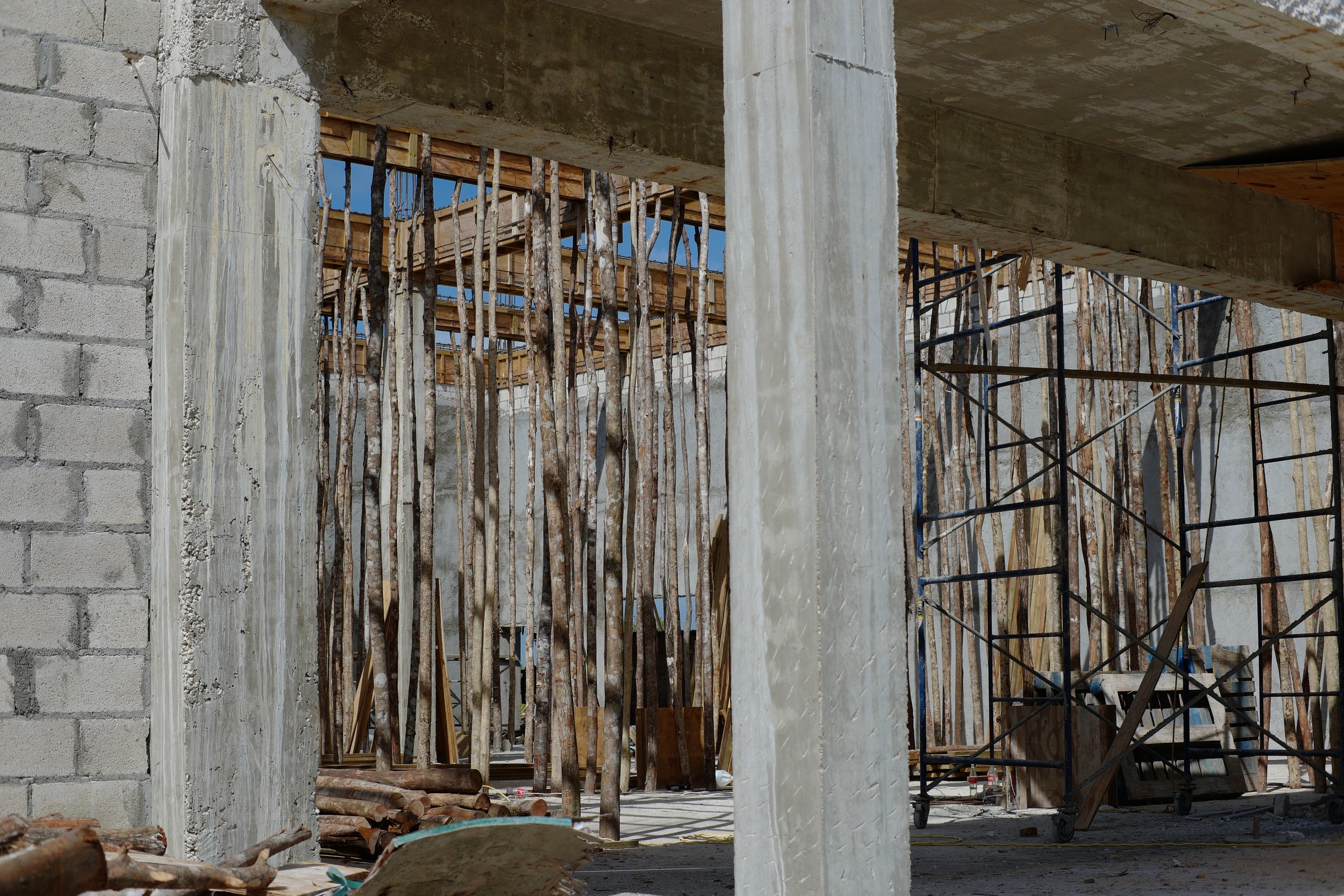
Belizean construction methods - using local saplings as supports, something you'd never see in US construction

Belizean construction methods - using local saplings as supports, something you'd never see in US construction
Documentary photography gold: This construction site shows how different building methods can be from country to country. In the US, this would never pass inspection. In Belize, it's standard practice. These cultural differences are exactly what makes travel photography compelling—you're documenting not just places, but different ways of living and working.
Final Thoughts: Real Talk About Belize Travel Photography
Thanks for tagging along here and I hope to share something new with you soon. Until then, get your camera out and take a picture with it.
Was Belize worth it for photography? Absolutely. But it's important to set realistic expectations. Placencia offered more authentic experiences than San Pedro. The ruins at Nim Li Punit were a highlight precisely because they were uncrowded. The street photography opportunities existed, but required effort to find them away from the tourist strips.
The gear worked perfectly. My minimalist Leica CL setup with just two prime lenses covered everything I needed. The 17mm for landscapes and architecture, the 35mm for street photography and portraits. Zone focusing at f/11 made street photography fast and reliable. Traveling with only a backpack eliminated stress and gave me freedom to move quickly.
Would I go back? Yes, but I'd skip San Pedro and spend more time in the rural areas and smaller sites like Nim Li Punit. The best photography in Belize happens away from the tourist infrastructure.
For more details on the camera gear I used on this trip, check out my minimalist Belize packing guide or see my current gear on my gear page
Frequently Asked Questions
Where are the best places to photograph in Belize?
The best Belize photography locations are Nim Li Punit Mayan ruins (uncrowded, accessible), rural areas between major destinations (authentic local life), early morning in San Pedro's Central Park (before tourist crowds), and Placencia (more laid-back than San Pedro). Skip the heavily touristy areas of San Pedro unless you're documenting commercialized travel culture.
What camera settings work best for street photography in Belize?
For Belize street photography, I used f/11 with zone focusing on my Leica CL and 35mm lens. This technique gives you 5 feet to infinity in sharp focus, eliminating autofocus lag. Pre-focus, compose quickly, and shoot. It's faster than autofocus for candid street moments and works in variable lighting without constant adjustment.
Is San Pedro Belize worth visiting for photographers?
San Pedro is heavily commercialized and tourist-focused, which can be frustrating if you want authentic experiences. The best photography happens early morning before crowds arrive, or by seeking out local neighborhoods away from the main tourist strips. Placencia offers better opportunities for authentic Belizean culture photography. If you do visit San Pedro, lower your expectations and focus on the contrast between tourism and local life.
How do you photograph Mayan ruins without crowds?
Visit lesser-known sites like Nim Li Punit instead of famous ruins like Tikal. Arrive early morning or late afternoon when tour groups are fewer. Nim Li Punit allows you to touch the actual stelae and photograph without constant interruptions. The trade-off is less dramatic architecture, but for photographers, the freedom and access more than compensate.
What's the best lens for travel photography in Central America?
For Belize and Central America, I recommend two focal lengths: a wide lens (17-24mm equivalent) for architecture, landscapes and environmental portraits, and a normal lens (35-50mm equivalent) for street photography and people. My Leica CL with 17mm f/1.4 and 35mm f/0.95 covered 95% of situations. Skip the zoom lenses—prime lenses are lighter, sharper, and force you to think more carefully about composition.
Can you do street photography in Belize safely?
Yes, Belize is generally safe for street photography. The locals in Placencia and San Pedro are accustomed to tourists with cameras. I photographed openly and never had issues. The "tourist card" works here—people expect tourists to take photos. That said, use common sense: avoid photographing in sketchy areas, ask permission when possible, and be respectful. Early morning photography sessions feel safer than late night.
Support this website by using these affiliate links to shop on Amazon:
Leica M11 Digital Rangefinder Camera
Nikon AF-S FX NIKKOR 105mm f/1.4E ED Lens
Voigtlander Nokton 35mm f/1.4 II
Sandisk 128GB Extreme Pro memory cards

Final street scene from San Pedro - capturing authentic moments before departure

Belize Travel Photography Guide: Minimalist Camera Gear and Packing Tips
Something we learned from the trip to England last year that was a basic revelation to us was that we don't need as much stuff as we think we do. This was because we had decided to hike the Canterbury trail in England. This forced us to leave everything behind that wasn't essential for the hike since we had to carry everything we wanted in our backpack.
When I started planning my Belize trip, I knew one thing for certain: I wasn't going to make the same mistake I'd made on countless other trips. No massive camera bag. No roller suitcase full of gear I'd never touch. This time, I was going minimalist.
This is a trip log of sorts, but it's also a lesson in how traveling light with your camera gear can actually improve your photography experience.
The Minimalist Travel Photography Philosophy
Something we learned from the trip to England last year that was a basic revelation to us was that we don't need as much stuff as we think we do. This was because we had decided to hike the Canterbury trail in England. This forced us to leave everything behind that wasn't essential for the hike since we had to carry everything we wanted in our backpack. Let me tell you, you can get brutally honest with yourself when it comes to hiking and weight in your pack. To the point of removing packaging from items to simply cull the dead weight.
This led me to also take a very hard look at my camera kit. I normally would take all sorts of lenses in the off chance I would get to do this or that kind of photography. I learned over the years though that I would end up carrying all this gear and never touch it.
The hard truth about travel photography gear: Most of what we think we "need" stays in the bag. Every extra lens is dead weight. Every "just in case" accessory is a burden you'll resent carrying. The Canterbury trail taught me this lesson through physical pain and exhaustion.
My Belize Camera Kit: Leica CL + Two Prime Lenses
Well, I looked at what we would be doing and what I figured I wanted to capture and I took just one camera and two small prime lenses. A crop sensor camera and a 17mm along with a 35mm lens is all I needed. This would cover 99% of what I would be shooting and I would be able to carry it easily in my backpack.
Now, I am on another trip out of the country and I am applying the same principle again. The kit is just as small as last time but with less charging gear. I only brought chargers for USB only this time. This may prove to have been a mistake but we will see. I am also carrying only the back pack again as well.
My complete Belize camera kit:
- Leica CL (crop sensor camera body)
- 17mm f/1.4 lens (for landscapes and general photography)
- 35mm f/0.95 lens (for street photography and low light)
- 3 spare batteries (I usually only use two per day)
- One USB charger and cable (works for both camera and action cam)
- DJI Osmo Action (for video/vlogging)
- Lume Cube Panel Mini (portable fill light)
- No lens cloths, no rocket air, no card wallet, no spare lens caps, no tripod
That's it. Everything fits in a small belt dump pouch that serves as my camera "bag." What doesn't fit goes in a ziplock bag. Total weight? Maybe 3-4 pounds including the action camera and accessories.

The complete Travel photography Camera Kit in one photo!
Why Backpack-Only Travel Changed Everything
The reason I like to travel with a backpack now is that there is no baggage to check or pickup…or lose, since I have it with me at all times. Plus the airport maneuverings is also much easier too. Much easier since you just go in and get your boarding passes (we still haven't transitioned to using our phones yet), pass through security (which you still do even if you check a bag) and go straight to your gate. Easy. Not to mention that I dont have to drag my roller bag around with me AND both of my hands are free as well.
Benefits of backpack-only travel photography:
- No checked baggage fees
- No waiting at baggage claim
- Zero risk of lost luggage with your expensive camera gear
- Both hands free for navigating airports
- Faster through security checkpoints
- More mobility when shooting on location
- Forces you to be selective about what you really need
You see, I despise airports and air travel to be quite honest about it. That is a blog post all it's own though... Haha.
The Journey: Chattanooga to Belize via Small Planes
Day 1 - We wake up at 4:30 and get ready to leave and pack the last few items we think we will need and head off to the airport.
Flying out of Chattanooga is also better to me since it is a smaller airport, the whole vibe is just lower key. This also gets me past the long lines at the big airports at check in as well as the long lines at the TSA checkpoint too. I don't normally bother with photos at the airport like others do but here are a couple for fun. All photos of travel are taken with my phone so I don't have to break out the camera. The below photo is of note though, this is what overcast skies looks like from the other side of the clouds. Looks almost looks like a desert somewhere, doesn't it?

Flying above the clouds - it almost looks like a desert from up here
Why I love small regional airports for travel photography: Chattanooga's airport lets you move through the whole process in minutes, not hours. Less stress means you arrive at your destination with more creative energy for photography. For more on my travel photography philosophy, check out my other photography insights on the blog.
The camera kit is shown below. I didn't bother with lots of items I normally carry to the point of probably a fault. Lol. No lens cloths, no rocket air, no card wallet, no spare lens caps, no tripod plates (or tripods either for that matter), not even a camera bag… officially. The bag you see is actually a lens "dump pouch" that goes on your belt. It happens to be big enough to hold almost all of the camera equipment I brought. What doesn't fit is in a ziplock bag, like the battery charger and cable and the DJI Osmo Action that I usually vlog with. I didn't even bring all of my spare batteries as I only used two a day at the most so I brought three. Lol…couldn't help myself.
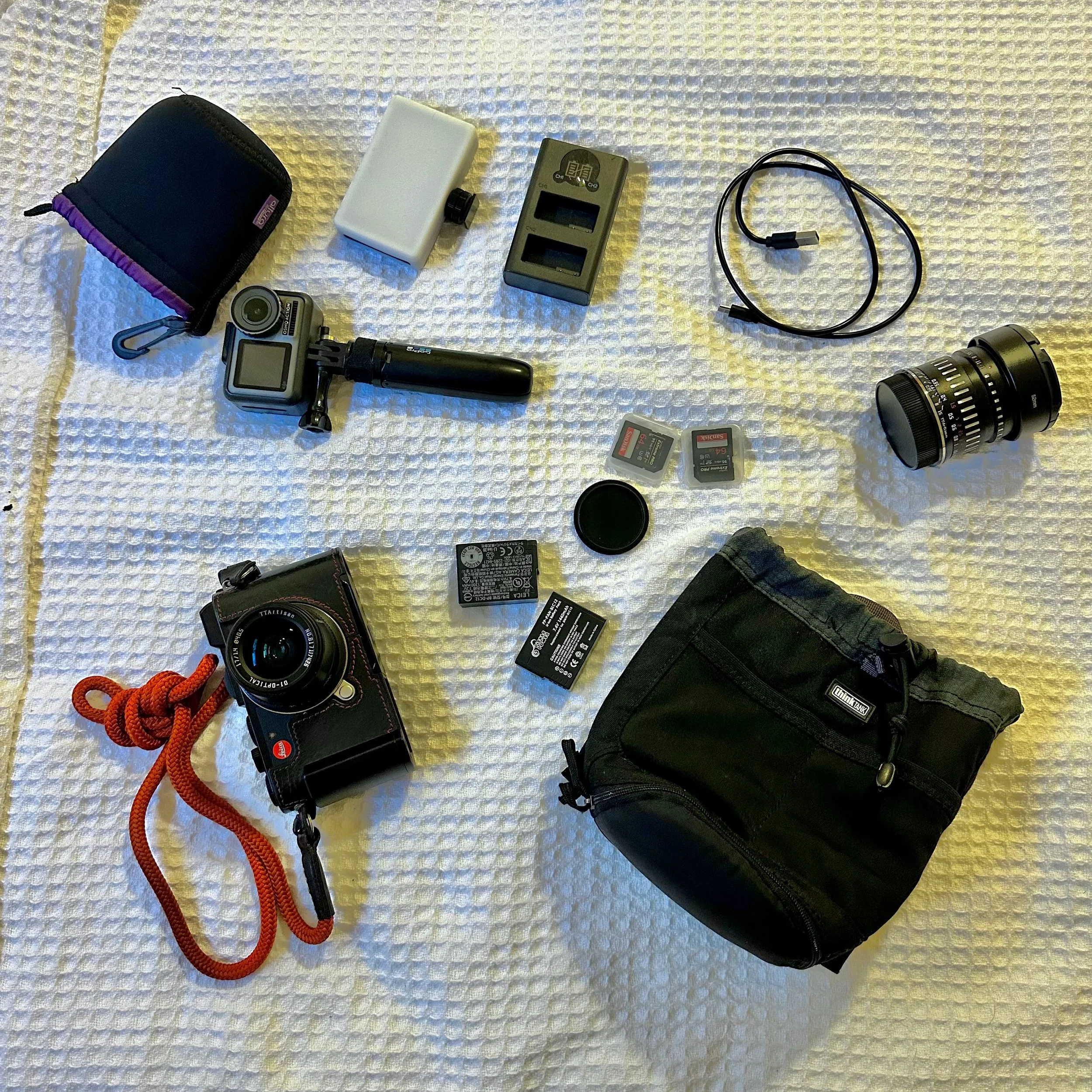
My entire Belize camera kit - Leica CL, 17mm f/1.4, 35mm f/0.95, and minimal accessories
I didn't bother with a spare battery for the Osmo as I never ran one down on my normal days anyways and it USB charges so the same cable will charge the action camera as my camera charger.
The inventory is longer than I had originally planned with me adding the DJI Osmo Action and the Lume Cube Panel Mini (fill light) was a couple of luxuries I really wanted for vlogging but fit in the pack easily enough. I have almost decided that I can vlog on my phone just about as good as the Osmo Action…almost.
Arriving in Belize: First Impressions and the Small Plane Experience
Once on the ground in Belize we pass through customs and then board a smaller plane to Placencia where we will be staying for a couple of days.

Flying Tropic Air's small planes down to Placencia - a completely different experience from commercial jets
You can also tell that they play by different rules in Belize. Notice how there is no copilot, I wonder what the protocol is for a incapacitated pilot? Makes you wonder… anyway, he did just fine and we arrived in fine order. It was actually kind of nice to take the little plane down to Placencia as it flies at a much lower altitude and I could see the towns along the way really well.

Notice something missing? No copilot. Welcome to small plane travel in Central America.
I also noticed that our plane had a copy of Microsoft Flight Simulator installed…haha. It is actually neat how technical the instruments have become but still display like the old ones did. It displayed EXACTLY like the old instruments but just on a digital display. I just thought it was really neat to see that.
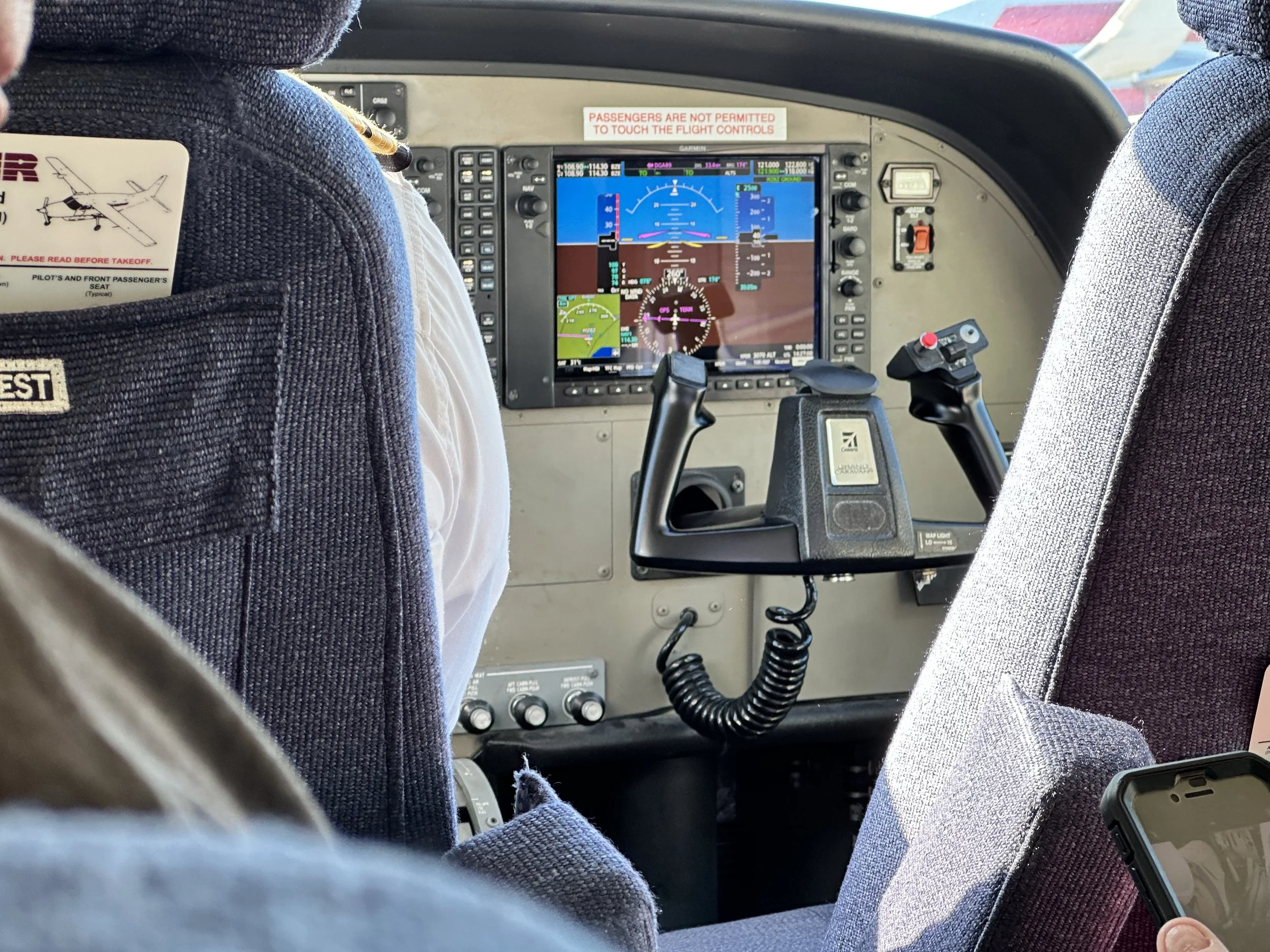
The instruments look like Microsoft Flight Simulator - modern digital displays mimicking traditional gauges
Small plane photography tip: These low-altitude flights offer incredible aerial photography opportunities. Keep your phone or camera ready for unique perspectives of coastlines and villages you can't get from commercial jets at 30,000 feet.
First Day in Placencia: Testing the 17mm f/1.4
After we arrived and got settled in, we went to the beach and walked in the ocean. It was really surreal to wake up and the outside temperature be 29 degrees and that evening it be almost 80 degrees.

First evening in Placencia - from 29°F at home to nearly 80°F at the beach
Once settled in, we went to the beach for a bit to relax a little and for this I took my 17mm f1.4 lens on the Leica CL. This is a great focal length for general photography as well as some landscapes. After our beach excursion it was time for some great food and fellowship.

First dinner in Belize - incredible local food and fellowship

Testing the 17mm f/1.4 at the beach - perfect focal length for landscapes and environmental shots
Successfully shooting at f/0.95 - the 35mm lens proved its worth in low light
We ate a wonderful meal for supper and hung out a while then it was off to bed. I used the 35mm at f0.95 for a change just to see if I could get some photos in focus at f0.95 and it was a success!
Shooting wide open at f/0.95: This was a test to see if I could nail focus at such a shallow depth of field while traveling. The answer? Yes. The Leica CL's focus peaking and magnification made it possible even in low light situations. This is why I love shooting with manual lenses—you stay engaged with every shot.
Living in the Moment: Day 2 Without a Camera
Day 2 was an off day from photo and video collection as I wanted to just be in the moment. This meant no camera gear of any kind. It was really nice to "unplug" for a while.
The best travel photography advice I can give: Not every day needs to be a photo day. Some experiences are better lived through your eyes instead of your viewfinder. This is something I learned through my photography evolution from gear-obsessed to minimalist, and it's transformed how I travel.
Next installment will be the "ruins"…I DID take my camera this time. Continue reading about my Belize photography adventures at Mayan ruins and San Pedro.
Frequently Asked Questions
What camera gear should I bring to Belize?
For Belize travel photography, I recommend a lightweight setup: one camera body and two prime lenses. A wide lens (17-24mm equivalent) for landscapes and beach scenes, and a normal to short telephoto (35-50mm equivalent) for street photography and portraits. The Leica CL with 17mm and 35mm lenses covered everything I needed. Skip the zoom lenses—the weight isn't worth it.
Is it safe to travel to Belize with expensive camera gear?
Yes, but be smart about it. I kept my Leica CL in a nondescript belt pouch rather than an obvious camera bag. In tourist areas like Placencia and San Pedro, camera gear is common and generally safe. Away from resorts, I was more discreet. The bigger risk is losing checked luggage—this is why I travel backpack-only with all my gear as carry-on.
Can you really travel with just a backpack for photography trips?
Absolutely. I did a week in Belize with just a backpack containing all my clothes and camera gear. The key is choosing versatile, lightweight equipment. My entire Leica CL kit (camera + 2 lenses + accessories) weighed less than 4 pounds. This left plenty of room for clothes and toiletries in a standard backpack. See my complete packing list in [my gear page](/my-gear-page).
What's the best focal length for travel photography?
For travel photography, I prefer two focal lengths: a wide lens (17-24mm equivalent) for environmental shots and landscapes, and a normal lens (35-50mm equivalent) for people and street scenes. This combination covers about 95% of travel situations. On my Belize trip, I used a 17mm f/1.4 and 35mm f/0.95 on a crop sensor camera, which gave me roughly 25mm and 52mm equivalent fields of view.
How do you pack camera gear for international travel?
Always pack your camera gear in carry-on luggage—never check it. I use a small belt dump pouch that fits my Leica CL and two lenses. It's nondescript and doesn't scream "expensive camera." Everything else (chargers, batteries, cables) goes in ziplock bags inside my backpack. This system has worked flawlessly for multiple international trips. The key is limiting yourself to what truly fits in a carry-on while staying under airline weight limits.
Support this website by using these affiliate links to shop on Amazon:
Leica M11 Digital Rangefinder Camera
Nikon AF-S FX NIKKOR 105mm f/1.4E ED Lens
Voigtlander Nokton 35mm f/1.4 II
Sandisk 128GB Extreme Pro memory cards

Micro Nikkor 55mm f/3.5 Review: The Best $50 Vintage Lens for Leica SL2
What if one of the sharpest lenses you could put on your Leica SL2 cost less than $50 and was made in 1976? That's exactly what I discovered when I adapted a vintage Micro Nikkor 55mm f/3.5 to my Leica SL2—and the results genuinely surprised me. This isn't just a macro lens review. It's the story of how a nearly 50-year-old Nikon F-mount lens became one of my favorite walkaround lenses on one of the best modern mirrorless cameras available.
What if one of the sharpest lenses you could put on your Leica SL2 cost less than $50 and was made in 1976? That's exactly what I discovered when I adapted a vintage Micro Nikkor 55mm f/3.5 to my Leica SL2—and the results genuinely surprised me. This isn't just a macro lens review. It's the story of how a nearly 50-year-old Nikon F-mount lens became one of my favorite walkaround lenses on one of the best modern mirrorless cameras available.

The Micro Nikkor 55mm f/3.5 AI variant on the Leica SL2 via F-to-L adapter — an unlikely but exceptional pairing.
Micro Nikkor 55mm f/3.5: What Makes This Vintage Lens Special
I have found over the years that there are a couple of Nikkor lenses in this family that work really well for the task of general purpose photography and this is one of them. This particular copy is an AI variant made somewhere in the late 1976 to early 1977 time frame, so this lens is almost 50 years old—and just look at the image quality it produces. Lens manufacturers were on their A game at this point and Nikon was a force to be reckoned with in this area. This lens isn't even their best macro lens either, which is something that to this day surprises me a little.
What makes the Micro Nikkor special compared to other vintage 50mm lenses is that it was designed for exacting scientific and reproduction photography. That design intent required flat-field sharpness, minimal distortion, and consistent performance from close focus all the way out to infinity. Most vintage 50mm lenses were optimized for portrait distances and can get a little soft or lose contrast at other distances. The Micro Nikkor doesn't play that game—it's sharp everywhere.
It has an external aperture ring that is detented in whole stops, except the very first one where it goes from f/3.5 to f/4 for some reason. Who knows why Nikon did this, but they did, so it is there if you want to use it.
Adapting Nikon F-Mount Lenses to the Leica SL2
Before we get into performance, a quick word on adapting this lens. The Leica SL2 uses the L-mount, and to run Nikon F-mount glass on it you need an F-to-L adapter. I use the Urth version and it works well for fully manual lenses like this one—there's nothing electronic to pass through, so any mechanically precise adapter will do the job. If you want to get fancy, Novoflex makes precision German-engineered adapters that are the gold standard, but they cost considerably more than the budget options and for a manual vintage lens, the results are essentially identical.
What makes the Leica SL2 particularly great for adapted vintage glass is the combination of focus peaking and magnified live view in the EVF. You can dial in focus with real confidence even at close distances, and the IBIS works completely independently of the lens—the camera has no idea what glass is mounted and compensates for shake regardless. This makes lenses that might have been borderline usable in low light suddenly practical for handheld shooting. More on that in a moment.

The external aperture ring with whole-stop detents — classic 1970s Nikon build quality.
Minimum focus distance is a surprising 9 1/2” from the image plane. So this is right at 4.25 inches in front of the lens when mounted on my Leica SL2 camera. This also gives you a reproduction ratio of 1:2 on the image sensor, that is to say that if you have an object that is 1 inch across in reality, it will be 1/2 inch across the sensor. To get to 1:1 reproduction ratio you need help… The PK-3 extension ring will get you half that distance and to the true 1:1 reproduction ratio at minimum focus distance. All of this is conveniently engraved on the lens barrel for you should you need to look it up in the field… Also notice in these two images that the lens “pumps” air which means it has external focus movement, the lens grows and shrinks when you adjust focus, it is common belief that this is where dust gets into the lens from, when you open the lens fully to minimum focus distance the lens intakes a full charge of air and doesn’t have dust seals to prevent dust from entering the lens mechanism, so you get a little internal dust…
The lens 'pumps' air as it extends to close focus — a common trait of this era of optics.
One last thing to note about this focus mechanism is that the reason I like using these lenses for general purpose photography like travel and such is that as you can see in the above photo, the focus throw from infinity to less than 1 meter is short, so focus is fast with this lens. It also has a range focus scale, but since it is 55mm, the scale is rather small and not easy to use, it will give you rough numbers to work with but that is all.
Enough with all this tech talk, let’s take it for a spin and see what the photos look like on my Leica SL2 mirrorless camera since it has IBIS on the sensor and I can hand hold photos at unheard of shutter speeds with it.
First thing I notice when using this lens is how good it feels in the hand. The location and feel of the controls are literally in the perfect location.
Another thing I noticed was that it is sharp, like incredibly sharp. To this point, it makes sense that it would be this good due to the design intent of the lens but it has a really nice general purpose focus throw too. This lends itself to being a wonderful walk about lens. The following photos were shot on my Leica SL2 using this lens as a walkable lens. I have used another Nikon macro lens before in this same capacity, the 60mm Micro Nikkor once lived on my D810 as a general purpose lens. It works flawlessly in this capacity.
Using the Micro Nikkor 55mm as a Walkaround Lens on Leica SL2
The following photos were shot on my Leica SL2 using this lens as a walkable lens. I have used another Nikon macro lens before in this same capacity—the 60mm Micro Nikkor once lived on my D810 as a general purpose lens and it works flawlessly in that role. The 55mm is similar in character.
For street photography and travel, the 55mm field of view on full frame is about as classic as it gets. You're not cramped like you can be with a 35mm in tight spaces, and you're not zooming in on subjects from far away like you would with 85mm or 105mm. It sits right in the middle of the world as you see it, which makes composition intuitive. The short focus throw means you can adjust focus quickly as subjects move, which is more important for this kind of use than it would be in a controlled macro environment.
Where it struggles a bit is in low light. The f/3.5 maximum aperture isn't going to win any awards for low-light capability compared to fast primes. But combined with the Leica SL2's excellent high-ISO performance and the IBIS, you can push it further than you'd expect—as you'll see in the next section.

Shot handheld at 1/30 second — the Leica SL2's IBIS makes this kind of exposure possible with a vintage manual focus lens.
In the above photo you can see what I love about a camera with stabilization in it. The camera sensor is rock steady so I can capture shutter speeds like in the photo above where I was running something like 1/30 second and some of my water blur shots were 1/4 second!!! Like the one below is a 1/4 second handheld exposure and if you will look, the rocks are crisp and the water has a really nice blur to it. This is at f32 as well so there will be some diffraction in the image from that but all in all, it looks really nice.

Shot handheld at 1/30 second — the Leica SL2's IBIS makes this kind of exposure possible with a vintage manual focus lens.
1/4 second handheld at f/32 — diffraction softens things slightly but the IBIS still produces usable results.
Below is a crop from this image. As you can see, the spider webs are even visible and this is handheld no less! As long as you have some decent light this combination is really nice. When you move to a mirrorless camera body that has IBIS on the sensor, it unlocks so many possibilities with lens / camera combinations. I dont know why hobbyists dont see this sooner but a lot dont.

100% crop showing spider web detail — handheld with IBIS. This lens resolves more than you'd expect for its age and price."
Leica SL2 IBIS + Vintage Glass: A Game-Changing Combination
In the above photo you can see what I love about a camera with stabilization in it. The camera sensor is rock steady so I can capture shutter speeds like in the photo above where I was running something like 1/30 second, and some of my water blur shots were at 1/4 second! The one below is a 1/4 second handheld exposure and if you look, the rocks are crisp and the water has a really nice blur to it. This is at f/32 as well, so there will be some diffraction in the image from that, but all in all it looks really nice.
I don't know why hobbyist photographers don't recognize this sooner, but when you move to a mirrorless camera body that has IBIS on the sensor, it unlocks so many possibilities with vintage lens combinations. You're essentially giving a 50-year-old lens a set of capabilities it was never designed to have. Nikon didn't design this lens to be hand-holdable at 1/4 second—but the Leica SL2 makes it so.
Think about what this means practically. That f/3.5 maximum aperture that looks modest on paper suddenly becomes much more workable. Instead of needing a tripod for anything in shade or indoors, you can hand-hold at much slower shutter speeds and let the IBIS do the work. In a museum, a church, a dimly lit market—anywhere a tripod isn't practical—this combination keeps you shooting. It's the kind of capability that used to require carrying a tripod and a fast prime. Now you can do it with a $50 vintage lens and good technique.
Image Quality: What to Expect from a 50-Year-Old Lens
Below is a crop from one of my sample images. As you can see, the spider webs are even visible and this was handheld. As long as you have some decent light, this combination is really nice.
Let me put some numbers to what you're seeing. The Leica SL2 has a 47 megapixel sensor—a genuinely demanding sensor that will expose any lens weakness. Lesser vintage glass can look acceptable at web resolution but fall apart when you pixel-peep on a sensor this resolute. The Micro Nikkor 55mm f/3.5 doesn't fall apart. Center sharpness is exceptional at every aperture, and corner performance is very good stopped down. The color rendering has that warm, slightly organic character that vintage Nikon glass is known for, which pairs nicely with Leica's color science.
The one area where you see the lens's age is bokeh at close focus distances. When shooting macro-close, out-of-focus areas can look a bit busy—it's not the smooth, creamy blur you'd get from a modern lens optimized for portrait work. But for general photography at normal distances, the rendering is pleasant and natural, never clinical or harsh.
Who Should Buy the Micro Nikkor 55mm f/3.5 for Leica SL2?"
This lens is a fantastic choice for:
The budget-conscious Leica shooter. Leica glass is expensive—there's no way around that. The Micro Nikkor 55mm f/3.5 gives you exceptional optical performance for a fraction of the cost of any L-mount prime. If you're building a kit and want quality glass that doesn't break the bank, vintage adapted lenses like this one are the answer.
Travel photographers who want a dual-purpose lens. One lens that handles landscapes, street photography, and close-up detail shots? That's what this is. Pack light and still have versatility.
Vintage lens enthusiasts. If you enjoy the tactile experience of manual focus and appreciate the history of classic glass, this lens is deeply satisfying to use. It's mechanically solid, beautifully made, and feels like a precision instrument.
Anyone curious about adapted lenses on the SL2. If you haven't explored the world of adapted vintage glass on your Leica SL2, this lens is an inexpensive, low-risk way to discover what IBIS + manual focus vintage glass can do. You might find, as I did, that you love it.
Frequently Asked Questions About the Micro Nikkor 55mm f/3.5
Is the Micro Nikkor 55mm f/3.5 good for general photography (not just macro)?
Yes — and this is the thing most people don't realize about this lens. While it was designed as a macro lens, the Micro Nikkor 55mm f/3.5 is an outstanding general-purpose walkaround lens. The focus throw from infinity to under one meter is short and smooth, making it fast to use in the field. The 55mm focal length gives you a classic "normal" field of view, and the sharpness holds up beautifully at all distances — not just close focus. I've used mine for street photography, travel, landscapes, and waterfall shots, and it handles all of them with ease. The f/3.5 maximum aperture is slower than dedicated portrait lenses, but for anything in decent light, this lens is genuinely excellent.
Can you adapt Nikon F-mount lenses to the Leica SL2?
Yes, and it works very well. The Leica SL2 uses the L-mount, and with an F-to-L mount adapter you can use almost any Nikon F-mount lens on the camera. Since the Micro Nikkor 55mm f/3.5 is a fully manual lens with an external aperture ring, you control the aperture on the lens itself and the camera handles exposure metering in aperture-priority mode. The Leica SL2's focus peaking and magnified live view make manual focusing accurate and enjoyable. There are no electronic connections needed for this vintage lens — it's a fully mechanical pairing that works remarkably well.
Does Leica SL2 IBIS work with adapted vintage lenses?
Yes, and it's one of the best reasons to use vintage glass on the Leica SL2. The 5-axis IBIS works independently of the lens — the camera compensates for camera shake regardless of whether the lens communicates electronically. With the Micro Nikkor 55mm f/3.5, I've successfully hand-held shots at 1/30 second and even 1/4 second, which would be nearly impossible without stabilization. This opens up a whole new world for vintage lens shooters — lenses that were borderline impractical in low light suddenly become viable handheld options. The combination of Leica SL2 IBIS and vintage Nikon glass is genuinely one of my favorite pairings in photography.
What adapter do I need to use Nikon F lenses on the Leica SL2?
You need a Nikon F to Leica L-mount adapter (sometimes listed as "F to L" or "Nikon F to L-mount"). Several brands make these including Urth, K&F Concept, and Novoflex (premium option). For fully manual vintage lenses like the Micro Nikkor 55mm f/3.5, an inexpensive adapter works perfectly well since there are no electronic connections to pass through — you just need a mechanically precise fit. Novoflex is the gold standard for precision, but budget options from Urth or K&F Concept work fine for manual glass.
How sharp is the Micro Nikkor 55mm f/3.5 on a modern mirrorless camera?
Extremely sharp — almost surprisingly so given the lens is nearly 50 years old. The Micro Nikkor 55mm f/3.5 was designed for close-focus scientific and reproduction photography, which required exceptional flat-field sharpness and minimal distortion. Those same qualities make it outstanding on a modern high-resolution sensor like the Leica SL2's 47MP chip. At middle apertures (f/5.6 to f/11) this lens is genuinely difficult to fault. Wide open at f/3.5 it's already very good, and the sharpness only improves as you stop down. The one caveat is that at f/32 you'll see diffraction softening, but that applies to any lens at very small apertures.
What is the PK-3 extension ring for the Micro Nikkor 55mm f/3.5?
The PK-3 extension ring is a Nikon accessory that mounts between the lens and camera body, moving the lens further from the sensor and allowing it to achieve true 1:1 macro magnification. Without the PK-3, the Micro Nikkor 55mm f/3.5 reaches a 1:2 reproduction ratio at minimum focus — meaning a 1-inch subject appears as half an inch on the sensor. With the PK-3 ring, you get 1:1 reproduction, where a 1-inch subject fills 1 inch of sensor. If you need true life-size macro shots, the PK-3 is the answer. Without it, the lens is still excellent for general macro work like flowers, insects, and small objects — just not true 1:1.
Recommended Gear for Adapting Vintage Lenses to Leica SL2
Support this website by shopping through these affiliate links:
Leica M11 Digital Rangefinder Camera
Nikon AF-S FX NIKKOR 105mm f/1.4E ED Lens
Voigtlander Nokton 35mm f/1.4 II
Sandisk 128GB Extreme Pro memory cards
Nikon 50mm f1.8 S Lens for Z mount
So in conclusion...
The Micro Nikkor 55mm f/3.5 is genuinely one of the best bang-for-buck vintage lenses you can adapt to the Leica SL2. For under $50 on the used market, you get a lens that handles macro work beautifully, doubles as a sharp general-purpose walkaround, and—paired with the SL2's IBIS—lets you hand-hold exposures that should be impossible.
Is it perfect? No. The f/3.5 maximum aperture limits your low-light shooting compared to faster primes, and you won't get smooth, creamy bokeh at close focus distances. But for sharpness, color rendering, close-focus capability, and sheer character? This nearly 50-year-old lens punches well above its weight class on a modern mirrorless body.
Get out there and grab one. You won't regret it.
Have you tried adapting vintage Nikon lenses to your mirrorless camera? Drop your experiences in the comments below—I'd love to hear what combinations you're running.
Want more vintage lens reviews and Leica SL2 content? Subscribe to my photography blog for honest, real-world gear testing without the fluff.

It is the holiday season again!
In the above photo, I was attempting to capture blue hour in downtown with a 25mm and this shows what I am talking about a little better. The wider angle allows me to get more of a scene and tell more of a story that a tighter lens like the 50mm or 75mm would do. I would have to back up a lot more if I wanted to include all of this in a 50mm lens photo as the field of view is a great deal narrower. Another thing that comes with longer focal lengths is a phenomenon called “compression”. This is where things in the background tend to look closer together than they are in reality from the effect the lens has on the subject. The photo below shows what I am talking about with compression…
When you live in the United States, you get to celebrate certain holidays and they seem to come once a month… In the winters we have Halloween, then a month later you have November and with it comes Thanksgiving where everyone literally over eats on one day and then eats the same meal everyday for the next week at lunch. HaHa.
It also brings colder weather so the photography is different too. I have, of late, been using my 28mm more than anything else it seems. The wider angle giving me more of a ”scene” than a specific subject. It also gives me a lot more depth of field so getting focus is a lot easier too. You see, I tend to shoot these days with vintage manual focus lenses more often than not. I do love my modern lenses with their aftofucus and light weight construction producing wonderful images, but sometimes I just want to use something from a simpler time. I have also found the lenses that work best for me applications too. Mostly Nikkor and Asahi Optical(Pentax) lenses with a sprinkling of some others like Voigtlander and Leica just to name a few.
I will also use these lenses for things like photo walks as well as general photography.
In the above photo, I was attempting to capture blue hour in downtown with a 25mm and this shows what I am talking about a little better. The wider angle allows me to get more of a scene and tell more of a story that a tighter lens like the 50mm or 75mm would do. I would have to back up a lot more if I wanted to include all of this in a 50mm lens photo as the field of view is a great deal narrower. Another thing that comes with longer focal lengths is a phenomenon called “compression”. This is where things in the background tend to look closer together than they are in reality from the effect the lens has on the subject. The photo below shows what I am talking about with compression…

Learning how to use these effects to your own personal advantage will open up so many possibilities for you. You couldn’t get this photo on a 20mm lens, it just wont work, you need the compression of a telephoto lens to be able to “stack” all those light displays together like that. This is why it is important to get out and shoot with different focal lengths at different times of day and also in different places, it is almost impossible to learn well without “doing”…
All this to say, the holidays as a wonderful time of the year to get out and practice your photography.

Tennessee Fall Color Photography: Finding Colors During Drought
Looking up at the yellow canopy at North Chickamauga Creek WMA, Tennessee. The overcast sky created beautiful soft light filtering through the leaves without harsh shadows. This perspective shows how dense the fall color was in areas where the trees had access to groundwater from the creek.
Well, it sure took long enough, but I finally found a place local to me that had some beautiful fall color photo opportunities.

Looking up at the yellow canopy at North Chickamauga Creek WMA, Tennessee. The overcast sky created beautiful soft light filtering through the leaves without harsh shadows. This perspective shows how dense the fall color was in areas where the trees had access to groundwater from the creek. Just a few hundred yards away from the water, everything was brown and crispy from the drought. The lesson? In dry years, forget the open fields and exposed ridges. Find the water and you'll find the colors! Leica SL2 + Nikkor 28mm f/2.8 AiS handheld.
Tennessee Weather - Fall Color Photography
This is not something I normally have when it is as dry as it has been recently. Let me explain…
I am no scientist but I have stayed in a Holiday Inn before, so here goes. From what I have seen, there are three different scenarios that usually unfold around here in the fall.
The first event is like this, we get plenty of rain in the spring, it dries out a little in the mid summer months and then it starts to rain in late September or early October. This is actually the best possible scenario from what I can tell…
The second scenario is the same as the first one except the rain turns into a thunderstorm storm with heavy rain and usually high winds during peak color season, knocking all the leaves off of the trees.
Then there is option three, this one is where there is rain in the spring but then it is dry for the entirety of summer and fall. This is the type of season we are in now. There has not been enough rain to matter in two months…maybe more. It is so little water that the creek next to my house has no surface water in it as of this writing.
Of the three events, the first one is the preferred for fall color photos as there is sufficient water for the trees to transition normally to their dormant winter state and you get this incredible color display in the fall. This year though, we have event three where everything is a huge tinderbox and the leaves are simply drying out and turning brown then falling off of the trees without passing through their color phase at all…except…in the few places where there is still ground water to water the trees.
Understanding Tennessee's Three Fall Color Scenarios
I mentioned the three fall scenarios briefly, but let me break them down in more detail since understanding these patterns will help you plan your fall photography:
Scenario 1: The Perfect Year (RARE)
What happens:
Spring rains (March-May) give trees plenty of water to grow
Summer (June-August) dries out a little but not too much
Rain returns in late September or early October
Trees get signal to prepare for winter dormancy
Beautiful color transition over 2-3 weeks
Leaves stay on trees long enough to photograph
Photography result:
Incredible color displays everywhere
Colors last for weeks, not days
Can shoot anywhere, not just near water
This is what you see in all the fall color guides!
We get this maybe 1 out of every 4-5 years
Scenario 2: The Stormy Year (FRUSTRATING)
What happens:
Same as Scenario 1 through summer
Rain returns in late September (good!)
But it comes as thunderstorms with heavy rain and high winds
Leaves start to change color (exciting!)
Then a big storm blows through (devastating!)
All the leaves get knocked off before peak color
Photography result:
You get maybe 3-5 days of good color before the storm
Have to act fast when colors appear
After the storm, just bare trees and leaves on the ground
Extremely frustrating if you had plans for the weekend!
This happens maybe 1 out of every 3-4 years
Scenario 3: The Drought Year (CHALLENGING)
What happens:
Rain in spring (so far so good)
Then dry for entire summer and fall (uh oh)
No rain in September or October
Trees are stressed and trying to survive
Leaves dry out and turn brown without color phase
Everything becomes a tinderbox
Exception: Places with groundwater still have colors!
Photography result:
Most locations are brown and crispy, no color
Have to find water sources (creeks, rivers, springs)
Limited locations but concentrated color where water exists
Requires more scouting and research
This is what we had this year (2023)
How to adapt:
Scenario 1: Shoot anywhere, you can't go wrong!
Scenario 2: Have a plan ready, shoot as soon as colors appear
Scenario 3: Follow the water (like I did at North Chickamauga Creek)
The key is recognizing which scenario you're in and adjusting your strategy accordingly. Don't wait for "perfect conditions" that might not come!

A red maple tree standing out in a sea of yellow at North Chickamauga Creek WMA near Soddy Daisy, Tennessee. This was the first scene that greeted me when I started looking for fall colors! After weeks of drought with everything turning brown, finding this color contrast felt like discovering gold. The key during dry years? Follow the water. This gorge has a creek running through it (barely flowing, but still there!), which gave the trees enough water to transition to their fall colors normally. Shot handheld with Leica SL2 + Nikkor 28mm f/2.8 AiS. The overcast light saturated the colors without creating harsh shadows!
Fall Color Photography Secret… Follow the Water
Enter North Chickamauga Creek WMA near Soddy Daisy Tennessee. This is a small WMA (Wildlife Management Area) situated in a gorge next to Mowbray mountain and is a popular spot for the locals to cool off in the summertime in the river. Well, the river is just a brook at this point and is barely moving at all, BUT it is there! If you watch my YouTube video on it you will see what I mean. Even so, there is still enough water to feed the trees so they had a fall color change.
Since I found some colors this year, I now had to figure out what I wanted to use to capture all this color with. I finally settled on my camera being the Leica SL2 as it has a high resolution sensor and several other features that lend itself to being a wonderful landscape photography camera. You see the Leica SL2 is a mirrorless camera so it can be adapted to various vintage lenses really easily and we all know how I love using vintage lenses! So today’s lens of choice for the Leica is the Nikkor 28mm f2.8 AiS. This is one of Nikon’s crowning achievements in lens design as it was as close to optical perfection as they had ever gotten to that point. So naturally I used this lens.
The magic of the Leica SL2 as well is that it has IBIS on the sensor. This basically turns all my vintage lenses into stabilized lenses. I know there are a ton of other cameras that also have these same features but I just like the Leica SL2 for some reason.
Now that the camera setup is settled, next is finding the photo I want. I started out looking for macro level images, vistas and scenes, then I moved in closer to get more detailed image ideas. The first one is shown above of the red maple tree in a sea of yellow. Then I moved to the river bed and found some wonderful colors out in the open.
Looking upstream at North Chickamauga Creek near Soddy Daisy, Tennessee. This is literally what greeted me when I entered the river bottom. Not much water (you can see how low the creek was during this drought!), but the color splash from the trees was incredible! The boulders in the creek bed created great foreground interest, and the overcast sky provided soft, even light that made the colors pop without blown highlights. Shot handheld with Leica SL2 + Nikkor 28mm f/2.8 AiS at f/8. I love the texture and color in this image! So much detail from the rocks to the leaves to the trees. The 28mm wide angle let me include the entire scene from the creek bed up to the canopy. This is why I walked down into the creek rather than shooting from the trail!
This was literally what I was greeted with when I looked upstream from where I entered the river bottom. Not much water, but I got such a color splash from the trees that I didn’t even care. I would have liked for it to not be overcast, but you take what you can get and work with it. I really love this image too, so much texture and color in one image that is is almost overwhelming. I was really starting to embrace the look that the 28mm lens was giving me and then I decided to move upstream to that large boulder you see in the above photo and get a different perspective from that spot.

The valley perspective looking upstream at North Chickamauga Creek WMA, Tennessee. That little smidgen of sky showing the overcast clouds almost makes it otherworldly or something like that! I was blown away with this image when I got it into Lightroom and could see it better. It almost doesn't look real back up in the valley next to the sky. The clouds were epic! Shot handheld from a large boulder I scrambled up to for this perspective. Leica SL2 + Nikkor 28mm f/2.8 AiS, no tripod. The IBIS (in-body image stabilization) let me shoot this at 1/15s handheld and get sharp results. There's something to be said for simplicity - one camera, one lens, no backpack or tripod. Just me and the landscape!
Fall Color Photography and Moody Skies
The little smidgen of sky showing the over cast clouds almost makes it otherworldly or something like that. I was blown away with this image when I got it into Lightroom and was able to see it better. It almost doesn’t look real back up in the valley next to the sky. The clouds were epic! This is also shot hand held with the 28mm lens. What is nice is that it allowed me to be very agile and not have the burden of the back pack and a tripod with me at all. There is something to be said for simplicity…
Frequently Asked Questions About Fall Color Photography in Tennessee
When is peak fall color season in Tennessee?
It depends on where you are in the state! In East Tennessee (mountains), peak fall colors usually hit mid-to-late October. In Middle Tennessee (Chattanooga area and surrounding), you're looking at late October into early November. But here's the thing that most people don't realize: the actual timing depends more on rainfall and temperature than it does on the calendar! If we get a drought like we had this year, the trees just skip the color phase entirely and go straight to brown. If we get too much rain with high winds during peak season, all the leaves get knocked off before you can shoot them. The "perfect" fall color year requires rain in spring, a slightly dry summer, then rain returning in late September or early October. That's when you get the incredible color display that lasts for a couple weeks!
Why do some years have better fall colors than others?
Water! It all comes down to water and how the trees are stressed. I'm no scientist, but I have stayed in a Holiday Inn before, so here goes, lol. Trees need sufficient water to transition normally to their dormant winter state. When they have the right amount of water, they go through that beautiful color change we all love photographing. But when it's too dry (like this year with two months or more of no rain), the leaves just dry out and turn brown without passing through the color phase at all. It's basically a huge tinderbox and the trees are just trying to survive, not put on a show for photographers! That's why you need to find the water sources during dry years. Wherever there's still groundwater feeding the trees (creeks, rivers, springs), those trees will still change color even when everything else is brown.
Where can you find fall colors in Tennessee during a drought?
Follow the water! During dry years like this one, you need to find places where there's still water feeding the trees. Creek beds, river gorges, wildlife management areas near water sources, anywhere with groundwater. For me, North Chickamauga Creek WMA near Soddy Daisy Tennessee saved the day! The creek was barely flowing (just a brook at that point), but there was enough water to keep the trees happy. They had a beautiful fall color change while everything else around the area was brown and crispy. Other good bets: Ocoee River area, any of the gorges in the Cumberland Plateau, state parks with creeks or waterfalls, and anywhere in the Smoky Mountains (they usually have better water retention). Just look for blue on the map and you'll probably find color!
What camera settings work best for fall color photography?
I shot this whole session handheld with the Leica SL2 and Nikkor 28mm f/2.8 AiS lens, so here's what worked for me: aperture priority mode (let the camera pick the shutter speed), probably f/5.6 to f/11 for landscape depth of field, ISO auto (camera adjusted based on light), and I relied heavily on IBIS (in-body image stabilization) since I wasn't using a tripod. For fall colors specifically, you don't want to overexpose or you'll blow out the bright yellows and reds. I tend to expose for the highlights and let the shadows fall where they may, then I can lift them a bit in Lightroom if needed. Shoot RAW so you have flexibility with white balance (overcast days can look weird if you don't adjust). And honestly? Just set it and forget it so you can focus on composition rather than fiddling with settings!
Do you need a tripod for fall color photography?
Not if you have IBIS! I deliberately left the tripod and backpack at the truck because I wanted to be agile and explore without the burden of extra gear. The Leica SL2 has in-body image stabilization which basically turns all my vintage lenses into stabilized lenses. This means I can shoot handheld at slower shutter speeds without camera shake. There's something to be said for simplicity, especially when you're walking a creek bed or scrambling around on boulders like I was doing. That said, if you don't have IBIS or you're shooting in really low light, a tripod will give you sharper images. But for bright overcast days like this? Handheld is totally fine and way more enjoyable!
What's the best lens for fall color photography?
Wide angle! I used the Nikkor 28mm f/2.8 AiS for this session and it was perfect. Wide angle lenses (24mm, 28mm, 35mm) let you include the environment and context around the colors. You can get the creek bed, the trees, the sky, the boulders, everything in one frame. Plus, when you're in a gorge or tight space, a wide lens is the only way to get the whole scene. That said, bring a longer lens too if you want to isolate individual trees or compress distant ridgelines. But if I had to pick just one lens for fall color photography? 28mm is my sweet spot. It's wide enough for landscapes but not so wide that you get too much distortion on the edges.
Is vintage lens photography good for landscape work?
Absolutely! The Nikkor 28mm f/2.8 AiS I used is one of Nikon's crowning achievements in lens design. It was as close to optical perfection as they had ever gotten to that point. Vintage lenses often have character that modern lenses lack (slightly warmer rendering, interesting flare characteristics, smooth bokeh), and they're sharp enough for landscape work when you stop them down to f/5.6 or f/8. The best part? They're cheap! You can get incredible vintage glass for $100-300 that would cost you $1,000+ in a modern equivalent. Just make sure your camera can adapt them (the Leica SL2 is perfect for this with its short flange distance), and you're good to go. Oh, and IBIS makes vintage lenses even better since they don't have built-in stabilization!
What time of day is best for shooting fall colors?
Honestly? Overcast days like I had are actually ideal for fall color photography! Direct sunlight creates harsh shadows and blown highlights on the bright leaves. Overcast light is soft, even, and it lets the colors really saturate without fighting crazy contrast. That said, early morning and late afternoon (golden hour) can be magical if you want warm light on the trees. Avoid midday harsh sun if you can. For this shoot, the overcast clouds were epic and made the colors pop without any harsh shadows. It almost looked otherworldly! So don't skip shooting just because it's cloudy. Embrace it!
How do you compose fall color photos without them looking like every other fall photo?
Great question! I try to find specific elements to anchor the composition rather than just pointing at a bunch of colorful trees. For this session, I looked for: (1) the red maple tree in a sea of yellow (color contrast!), (2) the creek bed with boulders as a leading line through the frame, (3) the valley perspective looking upstream with that little smidgen of sky, and (4) textures and layers (water, rocks, leaves, trees, sky). The key is to have a subject or a story, not just "look, it's colorful!" Find a foreground element, use the colors as supporting cast, and compose with intention. Also, get low! I was walking in the creek bed and scrambling on boulders to get different perspectives. Don't just stand on the trail and shoot at eye level like everyone else!
What are the three fall color scenarios in Tennessee?
From what I've seen, there are three different scenarios that usually unfold around here:
Scenario 1 (BEST): Plenty of rain in spring, dries out a little mid-summer, then rain returns in late September or early October. This gives you incredible color displays that last for weeks! The trees have enough water to transition normally to dormancy and you get the full spectrum of reds, oranges, and yellows.
Scenario 2 (WORST): Same as Scenario 1 except the rain turns into thunderstorms with heavy rain and high winds during peak color season. This knocks all the leaves off the trees before you can photograph them. Super frustrating!
Scenario 3 (CHALLENGING): Rain in spring but then dry for the entirety of summer and fall. This is what we had this year. Everything becomes a huge tinderbox and the leaves simply dry out and turn brown without passing through their color phase at all... except in the few places where there's still groundwater to feed the trees. That's when you have to get creative and find the water!
BONUS QUESTION: What's North Chickamauga Creek WMA like for photography?
North Chickamauga Creek WMA near Soddy Daisy Tennessee is a hidden gem! It's a small Wildlife Management Area situated in a gorge next to Mowbray Mountain. Locals use it to cool off in the river during summertime, but in fall it's perfect for photography! The gorge creates interesting light and the creek provides water for the trees even during drought years. When I shot this, the river was barely moving (just a brook, really), but there was still enough water to feed the trees so they had beautiful fall color change. Easy to access, not too crowded, and if you walk the creek bed you'll find tons of compositions. Just be careful on the rocks, they can be slippery! If you watch my YouTube video about it you'll see what I mean.
So in summary, if you want to find fall colors even when it has been really dry, find the water. Where ever there is water, there will be fall colors. At least that is what I have seen, your mileage may vary.
Support this website by using these affiliate links to shop on Amazon:
Leica M11 Digital Rangefinder Camera
Nikon AF-S FX NIKKOR 105mm f/1.4E ED Lens
Voigtlander Nokton 35mm f/1.4 II
Sandisk 128GB Extreme Pro memory cards
Charit Creek Lodge Off Grid Retreat
Charit Creek Lodge Off Grid Retreat

We decided to spend the night at this wonderful little place and this time, we came when it wasn’t scorching hot like last time.
Yes, we have been here before. This is why we like it. The quiet and serenity makes this place wonderful to get away to on occasion. I did charge my phone prior to leaving the parking area (which is a .8 mile hike from the lodge) so I could take pictures and write some thoughts about this article.

The hike into the grounds is a beautiful walk down into a valley…just remember that all things that go down must also go back up…to get to the card.

This was also an exercise in minimalism as I was planning on bringing a bunch of camera gear but then decided that I wanted to see if I could get good photos with only my iPhone.
The iPhone 14 Pro Max is a wonder of modern engineering and has so many capabilities that it will do a great job as a snapshot camera for trips like this.

The normal rig for forays such as this would normally be my Leica CL and the 35mm lens and possibly the 17mm as well to give me two options for field of view. This worked well in England to be quite honest and I really didn’t need any of the hot rod gear like my full frame Leica SL2 or the host of lenses for it. The little Leica CL has a more than capable 24 megapixel sensor that produces wonderful images. The larger Leica SL2 having a 47 megapixel sensor does give you more to work with as well as allowing you to print larger but at the end of the day I had to be honest with myself. I rarely print my photos and when I do they are in a photo book which isn’t more than 12 inches on the longest side. So I have started downsizing my load outs for trips like this.

Here is the hard facts. The iPhone captures snapshots so well with its measly 12 megapixels that you can print 8x10 just fine and no one will ever be the wiser. So this little overnight trip is a chance to test that as I will be stopping by a Walgreens and making some 4x6 prints as well as maybe even some 8x10 prints as well just to test the idea.

Back to Charit Creek a little. It is in Big South Fork Forest. This is either a state or federal forest, I am not sure which, but it is a huge tract of protected land and Charit Creek is in the middle of it. Hence the “unplugged” nature of the operation.

When you get here, you quickly notice the lack of electricity. Even the kitchen that cooks the huge communal meals doesn’t have much more than some solar power. All of the cabins are rustic styled with wood burning stoves for heat and screen windows for AC. They are more akin to bunk houses than cabins actually but they are nice nonetheless.

There is a plethora of games and outside activities to do (even though I wrote this blog using my well charged iPhone)… There are also copious fire rings and PLENTY of firewood is on hand for all the lodges needs. The firewood does cost you money but it isn’t that much and you get way more than you really need for what you pay. For details like that, contact the lodge as I don’t know when you are reading this and prices could have changed between now and your current time. Suffice it to say that prices are not extreme in any way.


There is also a bathhouse with showers should you want to bring shower gear with you. (I didn’t since I will be home tomorrow afternoon and can just bathe when I get home). The main lodge has the dining hall as well as guest rooms on one end and plenty of porch space containing a metric ton of rocking chairs.

The provided meals are supper and breakfast with lunch being left to you to figure out (with a few exceptions). The meals are huge though so you can probably make it from one to the next easily enough. There is a copious amount of hiking around the lodge with one trail going to a waterfall.


Happened to catch Venus the next morning while stoking the campfire.
Another thing the lodge specializes in is accommodating horseback riders. Complete with hitching posts and a horse barn with stables near the lodge. There are numerous horse back riding trails in the surrounding area as well and there is even a sectioned off parking lot just for equestrian rigs where you leave your vehicle while at Charit Creek Lodge.

I do not know the history of the lodge but the whole property makes me think that this was a homestead at some point in the 19th century what with the construction techniques used to build the buildings. I could be wrong and they could be newer but these logs look period correct for the late 1800s.

The buildings make for really interesting photography subject matter so once we got here and stowed our gear, I made my way around and grabbed some photos of everything. The whole time I was doing this, I was attempting to capture the “feel” of the whole place. I have come to do this more and more as time goes on. There is already a metric ton of photos of Charit Creek Lodge floating around on the web, so I need to do something different if I want something unique and interesting that stands out from the ordinary.

Side note: I found out that I really should have brought my camera as I was informed that the milky way has been visible the last few nights…. Lol. You never know what to expect. I don’t regret not bringing my cameras though as it defeats the purpose of traveling light weight. Sometimes you just need to enjoy the event instead of worrying about documenting it for others.
I saw the following tonight:
The Milky Way
The starlink satellite train
Many other satellites
The glow worms in the grass
We heard the great horned owls calling each other
The barn cat (trust me on this one)

I also learned that the iPhone has a low light mode where it will do a long exposure and get great photos in super low light. I was blown away by what it could do when photographing the campfire. Just take a look!


These are 1/5 second exposures! Yeah, that is cool. They are also ISO 10,000 but it does some sort of noise reduction and it looks good.
Sometimes you don’t have to plan out this huge package of gear for a trip to be successful for photography, you just need to be creative with your smartphone and go have a good time. We as photographers want to over complicate what we need to get good photos. Most people don’t even care what camera was used to get the picture or honestly will assume you used your smartphone anyway.


Isn’t it interesting how we will do that? HaHaHa… Anyway, back to Charit Creek Lodge for a little longer. When you leave you have to return back to your car out on the same trail you came in on, the difference this time is that it is uphill almost the entire way so if your fitness level isn’t high I would suggest taking your time so you don’t over exert yourself.

Once back at the truck you can “reconnect” to the internet via cellular data and get back to the world. That is how I am able to share this story with you. Ironic isnt it? I use the internet to communicate how NOT being on the internet is a good thing. Anyway, I hope you enjoyed the photos and the story and if you want to look into Charit Creek Lodge, follow the links provided. Thank you for following along and I hope to see you in the next one.
Fulaim X5 Wireless Microphone System Review

So a company reached out to me and asked if I wanted to take a look at their wireless microphone system and I agreed. I am really glad I did too. They sent me a review sample for free and I am happy to say it works exactly as advertised…at least it does from what I tested.
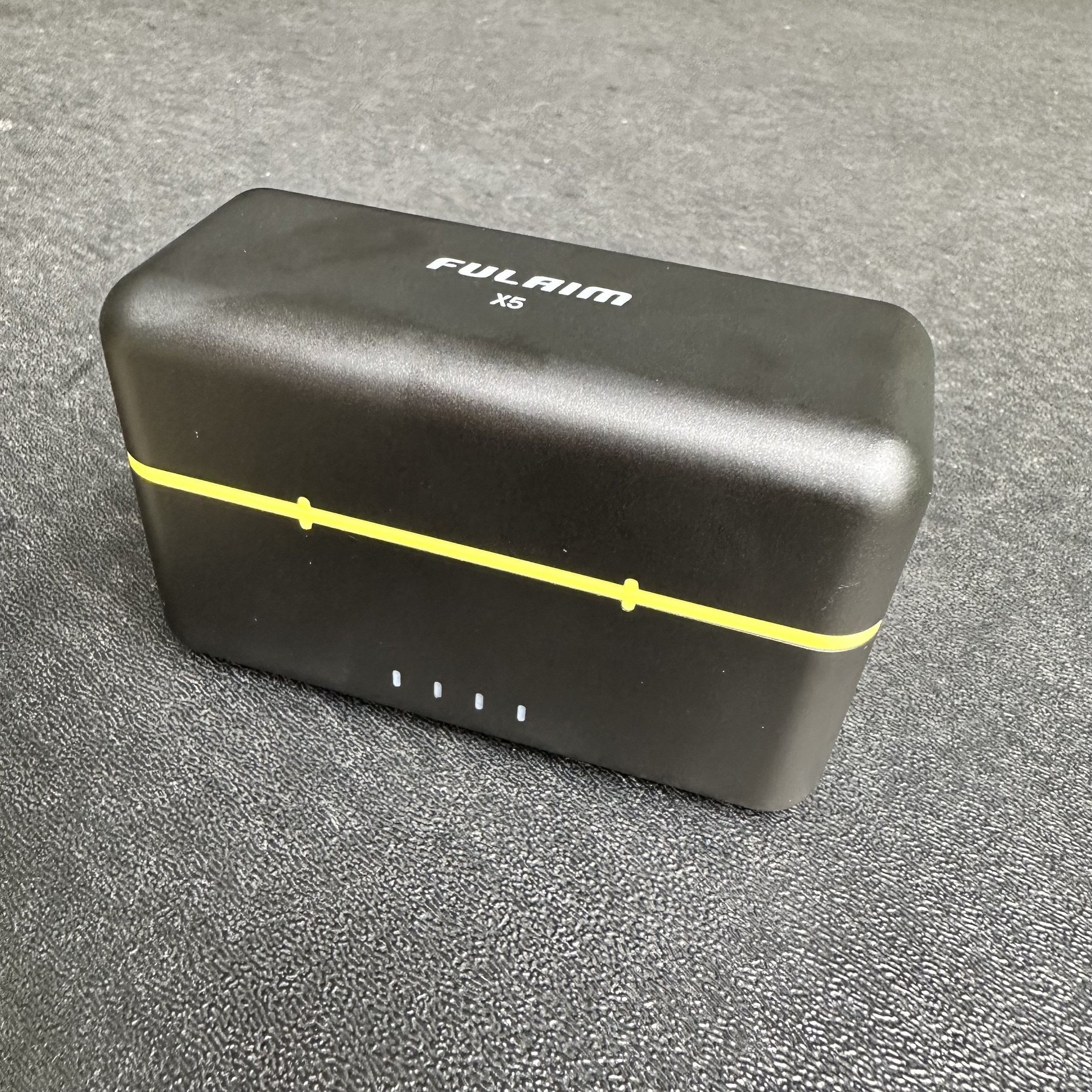
You see these kinds of products usually have some sort of glaring issue that makes them basically unusable for the most part, but this one is different. It actually works as advertised.
So Fulaim sent me the X5 kit to test and write a review on and when it came in I noticed right away that they were really wanting this to have a great presentation. The box is the kind you normally associate with Apple products, the really nice heavy type of card board. So once everything is out of that box, the first thing I noticed was that the charge case is setup for just the microphones and receiver, but the receiver is normally used with the mic cable and there is nowhere to store this cable… Small detail, but frustrating as on the very first outing to test the mics, I forgot this very cable…I attempted to use a AUX cable I had in the truck but it was apparently bad and introduced a ton of noise into the audio, lesson here, check your kit before you leave…

So once I get a good cable and go back out, I tested the Fulaim X5 microphone on my Leica SL2, this camera actually records great video and will record 4k video as well, so I figured I would experiment with the microphones on this camera and also shoot in 4k for a change too.
The charge case is a cool device, when you put the mics and receiver in it and close the lid, it turns them off and starts charging them, when you open the lid, it wakes all three of them up and sets them in motion communicating. That is nice. The battery life on the Fulaim X5 mics and receiver is supposed to be on the order of 9 hours, I would say it is probably closer to 4 or 5 in reality as the 9 hour claim is said for offline recording so if it is powering the radios, then it will be less. But still I have used it for several hours on two different occasions and have not have one die yet in a normal session. The charge case will charge them from dead to full charge twice before needing recharging itself too. This is nice as you are not hunting an outlet after juicing up the mics one time.
In the video above, I test the main factors that matter to me for a microphone I use to make YouTube videos. Distance from the camera that the audio is still good on, extreme distance function, audio fidelity, and offline recording for getting simple audio like wild sounds or when you need dialog for voice over but don’t need video with it too. It passed all of these tests with ease and done very well to be honest. The audio quality is first rate and I couldn’t tell if it was the Zoom F2 (which I have to sync in post) or the Fulaim X5 (which I do not have to sync in post)

There are so many little Easter egg type features built into them that it is hard to keep up, like the spring clip on the mics is made of steel from what I can figure and there is a round rare earth magnet with one so you can magnetically stick it to the lapel of a jacket and hide the mic behind the lapel with only the little black magnet showing. This is brilliant. The spring clips are sized so they will slip directly into a camera hot shoe, so you don’t need a hot shoe adapter at all. There is a port for a lav mic on each transmitter, there is also a port on the receiver for headphones to monitor the audio with, the wind muffs are made with little locks to keep them from falling off the mics, the mics will record in offline mode without the need for memory cards as there is 4GB of internal storage in each mic, You can USB charge them so if the charge case is dead, they can still be charged, they are compatible with smart phones and can be USB connected to laptop computers so you can have wireless mic support for things like zoom meetings…the list goes on but you get the point.

Can I recommend this microphone? Absolutely, the copy I have works perfectly and if this is the production version, you will love it too. They sell them direct on their website but I don’t get anything if you buy one, so don’t worry about using an affiliate link or some such, just get one and use it. Simple as that.
An updated treatise on my travel camera gear.
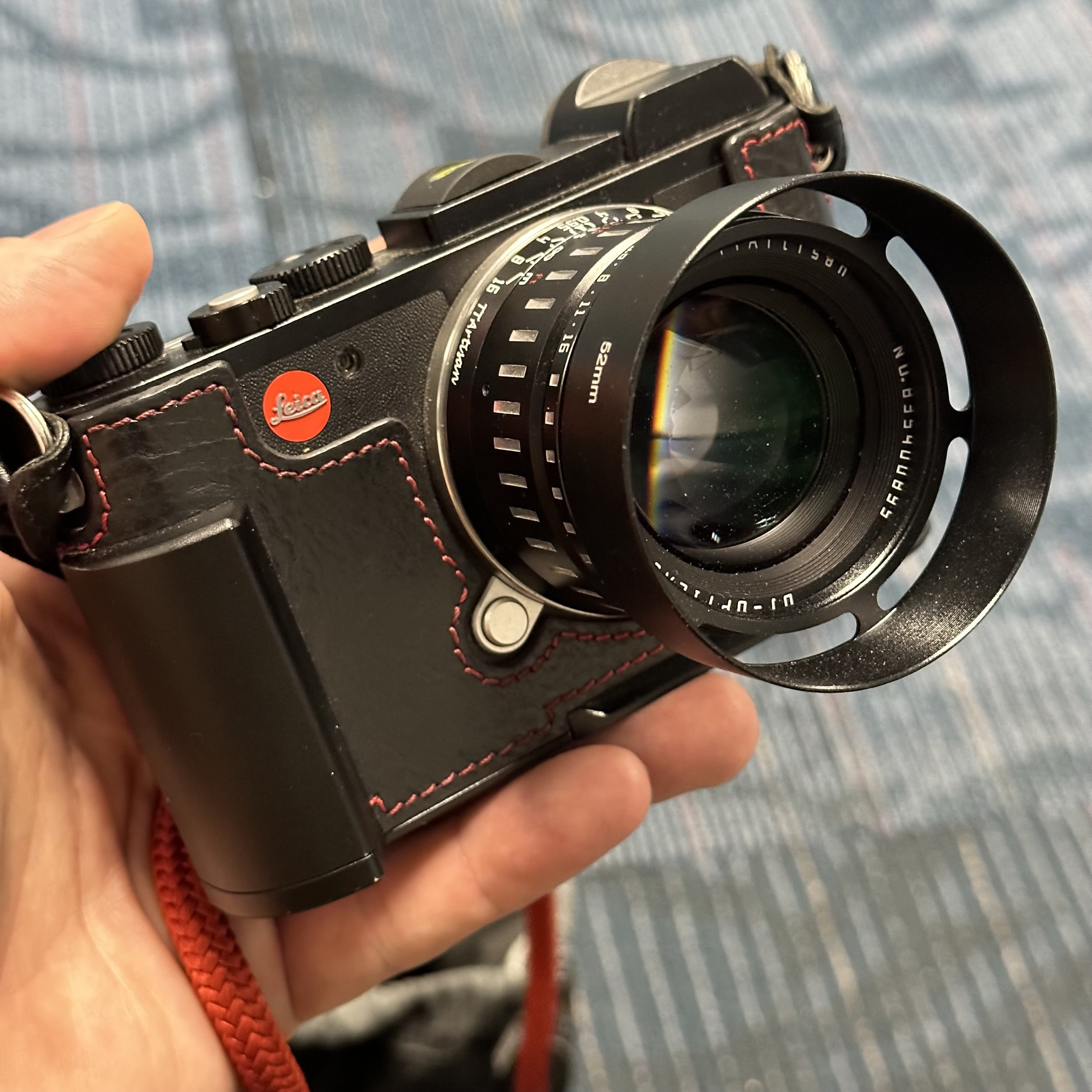
When I wrote the last blog post about flying with cameras gear, I had only considered the airport and airplane overhead space only.
Well, here I am again in a different scenario and this time the kit looks very different. The overarching theme here is apparently that you should tailor the kit to suit the trip. Lol. I have done just that.
For this trip we are being tourists more or less, so the camera kit will reflect that. I am taking the Leica CL and just two prime lenses. The 17mm and the 35mm lenses are perfect for tourist type photography and there is two more reasons for taking two primes over a single zoom… read on to learn why.
When choosing kit for trips now, I start with the premise of the trip. For a long time, I would have these illusions of grandeur and would take all this gear for events that never happened. You see, I dont plan the trips, the wife does so she plans on things the I don’t consider. She will arrange tours and such and I am just too busy with other things to pay much attention. Well, I finally learned and now I dont bring hardly any of that stuff and this makes travel SO much easier. Some types I have encountered are tourist, wildlife, street, and such as that. Once this is nailed down then I choose a camera that best fits that type of trip. Usually between crop sensor and full frame first as this gets me the right camera. For wildlife I prefer my crop sensor Z50 but for architectural purposes I prefer a full frame sensor. Things like street photography can be shot with either but on long days, the little crop sensor Leica CL is a much better choice over the much heavier Leica SL2.
Now that I have a camera picked out, I will decide what is the most likely scenario I will be shooting in and choose a lens for that. Next I will look at what else there is and choose a lens that will work for this as well as loosely backup for the main lens.
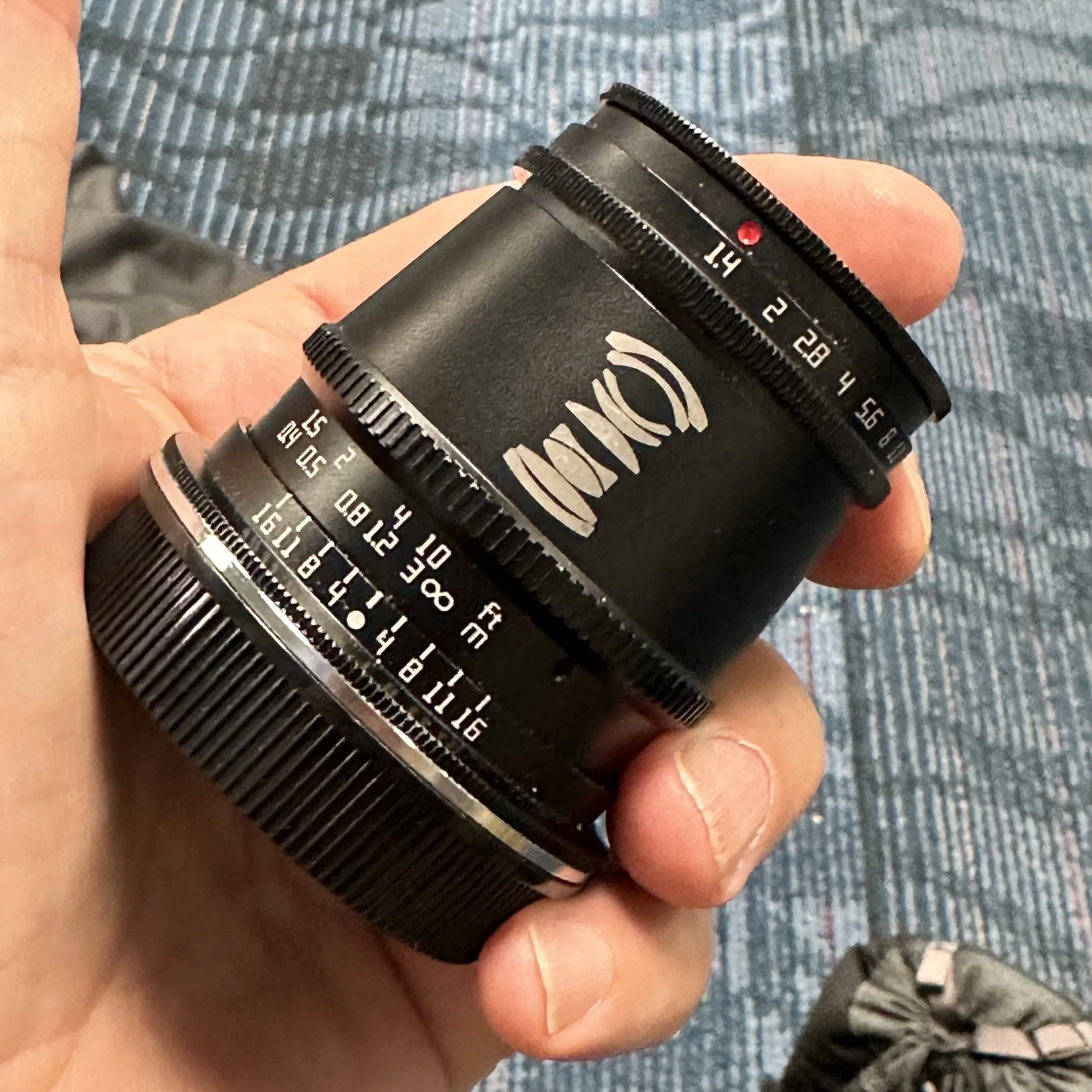
Using this process, I chose the 35mm f0.95 TTArtisan lens as my main lens and the TTArtisan 17mm f1.4 lens as the backup. These are designed for the Leica CL which is a crop sensor camera so the equivalent field of view for these lenses is 50mm and 28mm respectively. These are two VERY useable focal lengths for a travel kit. These will also both work just fine if one or the other gets damaged at some point. I might have to adjust my shooting style a little but the trip is not a loss…
I want to take a moment here to mention TTArtisan and how they are making some amazing lenses for crazy low prices. The quality of all three of the lenses I currently have that they made are just stellar. I have one they gave me as a review sample but I bought the other two on my own. They are great little manual lenses.

Another reason I like using prime lenses for trips is the maximum aperture is much larger than on general purpose zoom lenses. General purpose lenses work great in broad daylight but the lack of large apertures make them less than desirable for me in the evening and early morning.
What this means is I will end up with a really compact kit with this camera and two lenses. These being native L mount lenses also means they are smaller than adapted lenses as well. (This is something that I do regularly and dont sweat it and that is how I know.) Native mounted glass means they are more compact though and that is what I wanted.
Since we are hiking this trip, I wanted to make sure that rain didn’t ruin my camera gear. This is why I put all my camera gear into a dry bag and then put that inside my backpack.

Once inside the dry bag, they are divided into three different lens “dump” bags I used for this trip to organize this gear loadout. These are made by Thinktank Photo and are great for street photography photo walks as you can stick batteries and a spare lens, business cards and lens wipes and such in them and they are still small and lightweight.
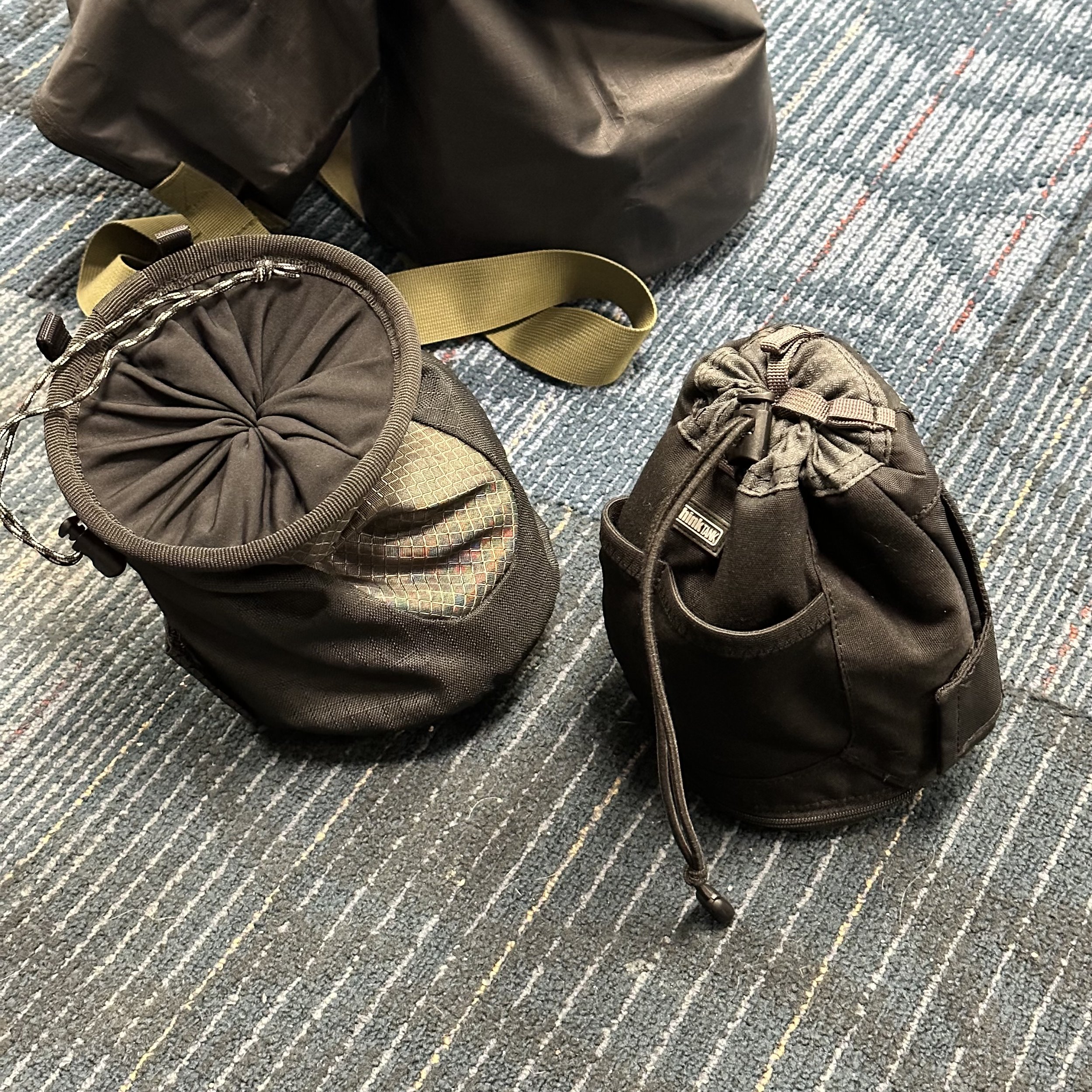

I realize now that I desperately need to clean my lens! Will do that asap!!!
Armed with this kit I am ready to take on just about any tourist, street, or even landscape type photo with hood confidence that I will come away with something reasonable. The next blog post in regards to this kit will be a photo spread describing what I found to photograph.
Until next time, get your camera out!!!
What matters more? Gear or skill?

I raise this question because there is no shortage of people from both camps on YouTube.
The odd thing is that the overwhelming majority of my channel views come from my gear review videos. Not from skill building type videos where we talk about things that you can use with the gear to get better photos.
The underlying theme with people using youtube seems to be “the right gear will make me the photographer I hope for”. I’m sorry if that stings a little as I am just calling it like I see it.
I am not 100% certain about this determination though as I have no way of proving this assumption. It may be that my skill building videos are just way worse than my gear reviews videos. That could be a fair point to be honest as it is common knowledge that I am not very good at video.
My observation though is overwhelming leaning in this direction. The reason for this is that other youtubers also make this observation as well. You hear them talk about how the gear doesn’t make the photographer over and over. Why is that?

I think it is because people dont place as much value on skill learning as they do on tangible items like cameras and lenses. Have you tried to sell your skill to someone in tough times? How about some item you had that was tangible… like say your camera? Deep down I think people place value on tangible items because they know they can cash in on them later, but once they pay for and attend a workshop, that money is gone forever in their eyes. Even though they came away with an amazing experience and new skills, we in the western culture have been trained to place value on the tangible. How many times did I hear as a kid about not “blowing” my money on cheap trinkets or things like going to the fair and playing the games? It was all to common in my little corner of the planet.
Lots of people don’t have much disposable income to spend on things like workshops, or so they believe. I see it more in the realm of Leica more so than other brands because I will see a lens come up for sale that is literally like brand new but they HAVE used it some. They just want to retain as much resale value as possible so they are very careful with it so as to not scratch it up from use. It will basically be new even though it had been used to capture images in the past. This is telling in that they never planned to keep the equipment and placed more importance on resale value than using the gear. Otherwise there would be signs of use on the gear and a lot more photos in the catalog. Now, I know that is a little bit hyperbole as well, but you get the point.
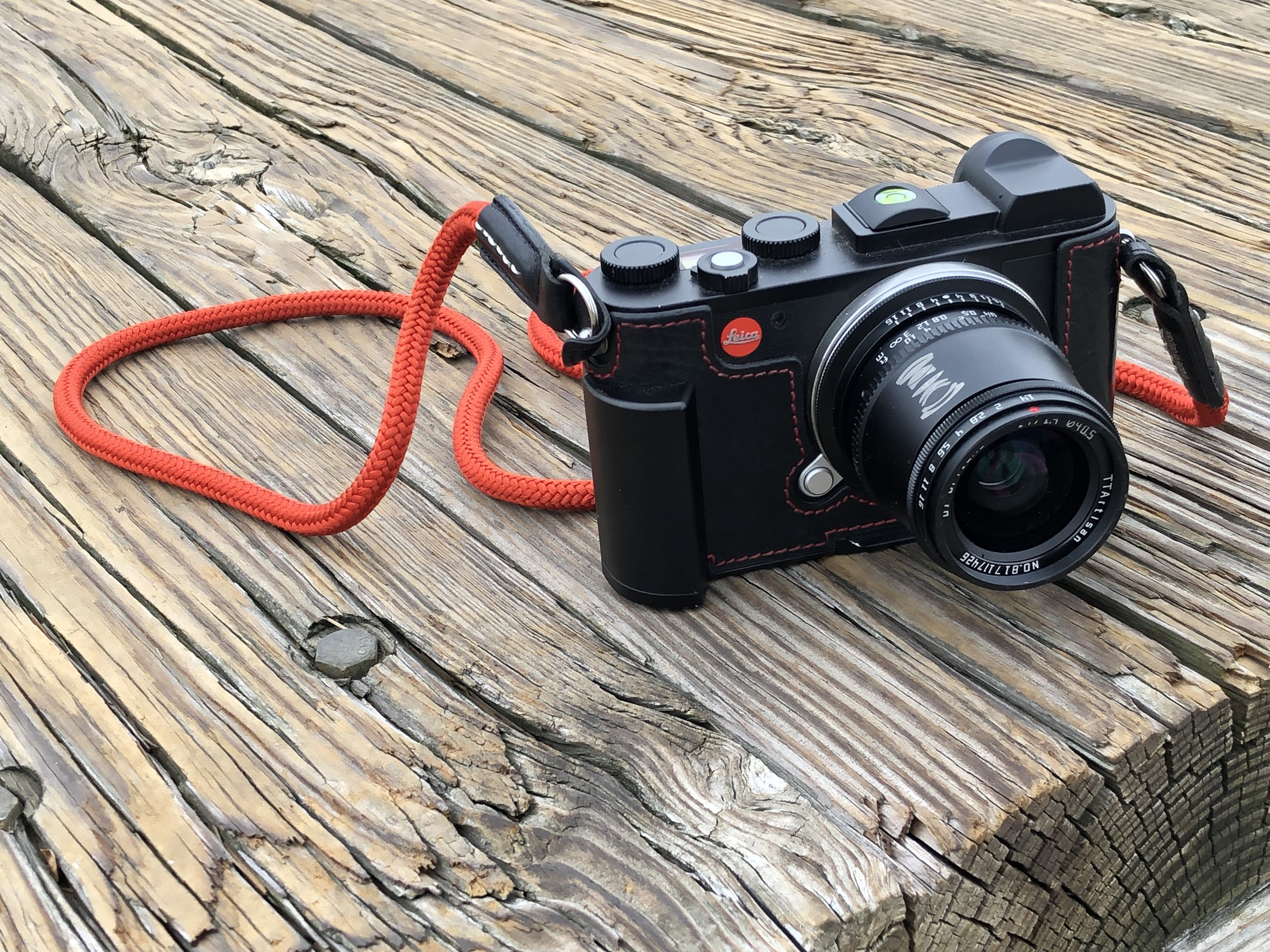
The point is that it seems like for YouTube viewers, the gear matters more. I can’t figure it out either, why not go shoot street in London for a weekend? How cool would that be? It is reachable, just use the same lens you have been using and spend the “new lens money” on the trip instead. Precious few of us will do that though…And that is sad.
Just some food for thought, not really being critical…much…just thought it was interesting to see that and wanted to share my thoughts on it.
Photography on a movie set
What do you photograph when on a movie set to capture the essence of the set? I felt my job was more to do that than to capture the movie per say. That’s the movie makers job, not mine.

Here I started at the front gate. If you will notice, it’s nondescript and you really have no idea what is here at all. This is by design for obvious reasons but I still found it interesting to see how bland it was.
The sound stage is a controlled space where “sets” are built to look like locations but the film makers can control literally everything in the environment such as sound, light and weather. It was important to me to get this “side” of the set to tell the whole story.
This is what the other side of that rough framed wall has on it. A complete first century Roman executive office ready for the official to go to work. As you can see, this set of photos is not what you would normally see when watching the movie.
Another aspect I wanted to capture was the people that were there both as tourist and as employees of the location. This shows all of that in one photo as well as how the “more permanent” set features, and then a tarp to protect something not weather resistant too.

Here we have visitors, film crew, actors, film production gear, in a period setting all in one photo. This is what a behind the scenes photo should look like to me. Capturing what is NOT on camera rather than trying to see what is being filmed. This is where the interesting part is at for me. Of course most other people don’t see things like me. They want to see things like the photos below.
Notice how I framed out anything not period correct…
This is fine if you are wanting to maintain the aesthetic of the period in your photos, but that is not my goal.
This is more my speed. Here we have a prop stored in an out of the way spot that is in stark contrast to the modern building in which it is located. Below is another image I quite like. You have a Roman quarter with a prop guy working on decorating the area for an upcoming scene. His presence brings a contrast to the image that makes you wonder about it.

Above is a great example. Here we have gear carts stored in the shade for filming in a nearby area. The juxtaposition is intriguing to me for some reason.
The above image is more subtle though. At a glance it is period correct, but upon closer inspection things will start to appear that should not be there. Like the wheel of a cart or a tarp in the back ground.
As you can see it is fun trying to tell a different story from what the set was built to be used for. The set has become a different part of the actual story which is the behind the scenes life and not first century AD. I hope this has inspired you to do something similar with your photography and thanks for following along!
Prime lens primer
So you have never used a prime lens before… well let’s change that.

Leica CL with the TTArtisan 35mm f0.95 APS-C prime lens
A prime lens is like a window into another world of photography. They can be had in much larger apertures than zooms usually, they are smaller under most circumstances, and if you get vintage ones…they can produce very unique results.
Another thing that prime lenses are good for is they teach you to compose based on the environment. You have to work within the confines of the focal length which means you will have to either move closer or further away to “zoom” with your feet to get your composition. Sometimes this means not getting a certain shot at all because you would have to stand in the middle of a river to get the composition or something like that. But I rarely run into this problem and once I start seeing in focal length it seems I filter out these problems subconsciously anyway.

Leica CL with the TTArtisan 17mm f1.4 APS-C lens.
You will also learn to see in your chosen focal length over time as well. That is, once you shoot a while with just one focal length… You hear street photographers talk about the 28 or the 35 and they know what the photo is going to look like based on experience.
I will be honest here, it is really liberating to have such a small and potent setup when I run prime lenses. Zoom lenses give you versatility, but I see people that use zoom lenses still carrying a camera bag. This seems overly redundant to me, I use the one lens all day and get out in the environment, but I am not everyone. Some people prefer to have all the options on hand so they can setup and shoot whatever comes their way I guess. Maybe they have missed a opportunity in the past while using a prime and now want the versatility of a zoom to give them better odds in the future should that happen again, I don’t know. Those are some of the speculations I have had, but for me, I just like having something dedicated like the prime brings to the table.
Zoom lenses do serve a purpose though, they are the work horses of the professional photography world. Giving the professional the ability to change focal lengths instantly on demand to fulfill the job at hand. Primes force the professional to move around a lot more to build the composition that the zoom makes short work of. This is important when you are on a clock. Anything that saves time also saves money so zooms have their uses.
So what makes a prime appealing over a zoom? That large aperture and the small size are some of the magic that the zoom lens lacks.
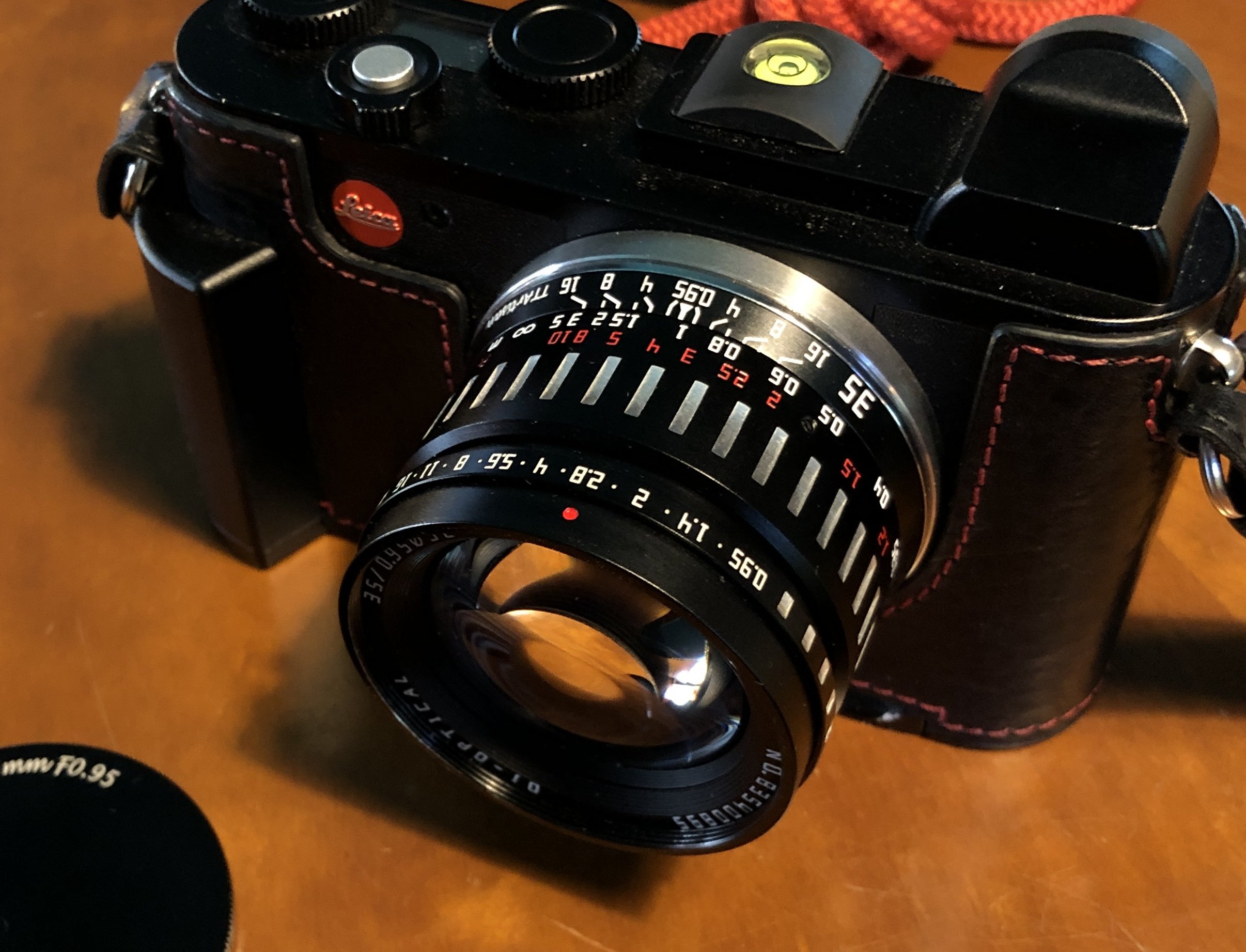
Lenses like the one above with it’s f0.95 maximum aperture can create an effect that nothing else can produce. The “Bokeh” or blurred out background is something that large apertures are well known for. The portrait below is a prime example of the feature. The background was probably 15 feet behind him when I shot this photo.

Primes lenses come into their own when it comes to vintage lenses too. This is where I have found my passion. The old Pentax glass along with the Nikon and early Canon stuff is all phenomenal. I do have some early Leica stuff but the Pentax / Asahi branded glass is just awesome. I also will try about anything to see what the photos are like as well. I have even adapted some glass that should not be able to be adapted like some Argus lenses. I documented that process on my YouTube channel if you want to see how I was able to make that work. Argus had a unusual way to drive the focus on the lens and it posed a challenge to get it to work.

One of my favorite vintage lens brands is Pentax and the Asahi Optical company.
With the advent of the mirrorless camera, we now have a flange distance that is conducive to adapting these vintage lenses to our cameras easily and the electronics in the camera make using these lenses even easier than ever as well. Things like focus magnification and focus peaking as well as exposure preview to see how the image will look before you press the shutter are great for coupling vintage primes to your new shiny mirrorless camera. Some even allow image stabilization via sensor stabilization so you even get that feature with vintage glass sometimes.
So if you have not used prime lenses in the past, I implore you to get a simple one, like the 50mm f1.8 on full frame (affectionately named the “nifty fifty”) or it’s APS-C little brother, the 35mm f1.8 DX (Nikon uses the term DX for their APS-C cameras) and put it on your hobby camera and leave it there for a month. It will either make you hate primes or fall in love with them. For me I got the 35mm f1.8, installed it on my Nikon D7000 and left it for almost a year without removing it. I really loved that lens.
So until next time, get your camera out and go take some photos with it!
My loadout for flying with camera gear.
Traveling over the years to locations that require flying commercial has taught me a few things about what to take.
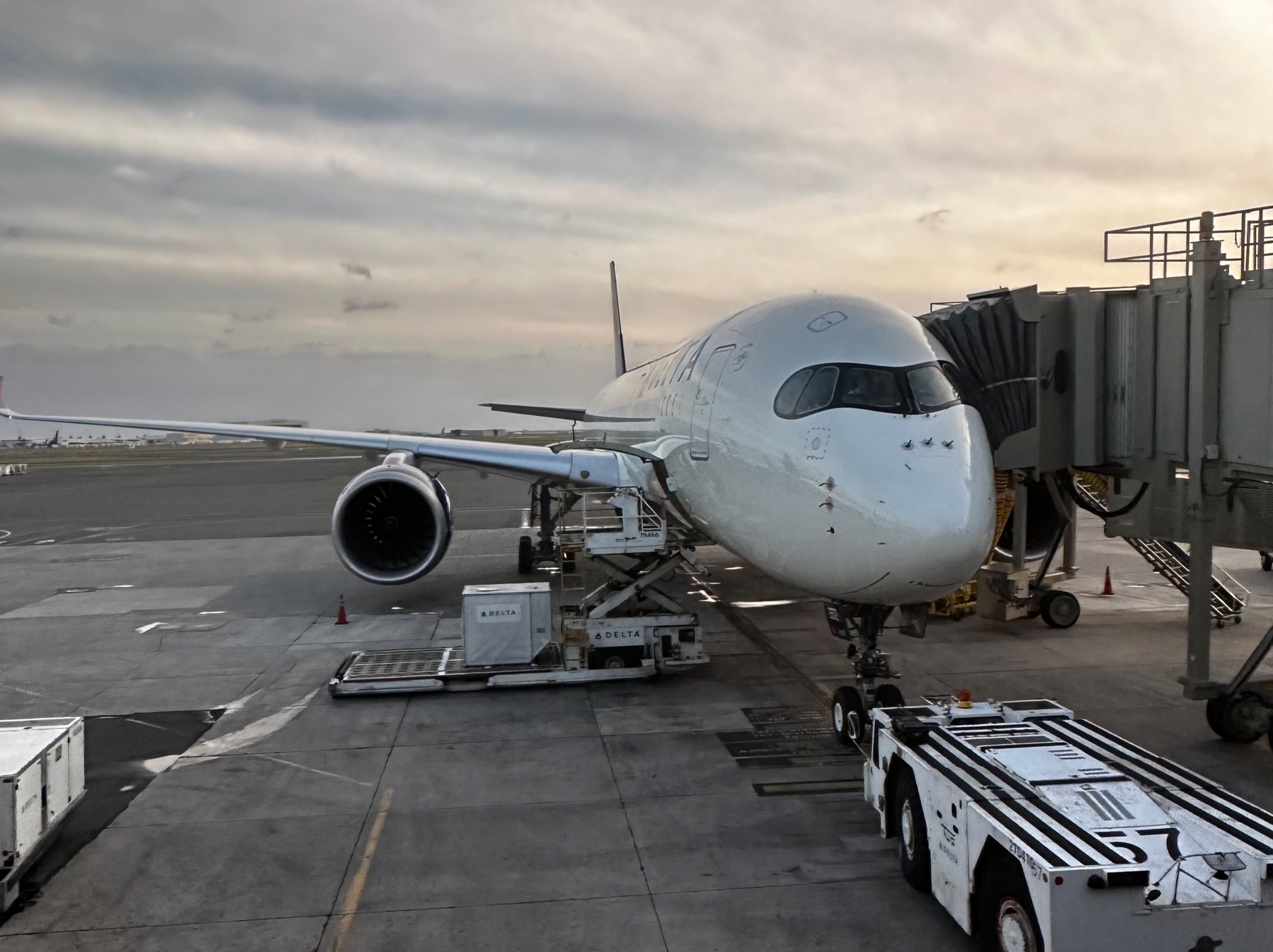
I once carried almost everything I owned when I traveled so I was sure to have whatever I needed for a certain photographic event. Well, with time comes wisdom… I have been adjusting the loadout and searching for the best solution as far as bags go and have finally found the perfect setup…FOR ME. You see, different people have different needs and your loadout will vary depending on your personal needs and wants.
When I traveled early on, I carried a large shoulder bag, very large mind you and a ton of kit in it. I had to fill it up you know! Lol.
Well after a couple of trips like that, I learned that I needed a different bag. So the giant Vanguard bag was retired and replaced with a Thinktank Airport International v2. This was a nice upgrade and allowed me to travel with more confidence in knowing my gear was protected better and it was also a roller bag! No more lugging that massive shoulder bag all over creation!!!
Well, I still use this bag from time to time, but only for roadtrips in my truck. The irony of this statement is not lost on me. I bought a literal aircraft carry own style, camera bag and now I dont even take it when I fly at all.

Thinktank Photo Airport International 2.0
So I learned the hard way something about marketing with this bag. Thinktank Photo will tell you, probably with an asterisk, that this bag will fit in standard overhead spaces. This isn’t so and I learned this the hard way on a trip coming home from Hawaii one year. On the last leg of our long journey, we boarded a small commuter jet and the overhead storage bins were just too small. This is when I got a VERY sick feeling in the pit of my stomach. You see, this meant I had to valet check this bag at this point. If you have never watched baggage handlers loading luggage then you dont know the horror movie I was imagining my expense and fragile camera gear was about to experience. They can be quite rough with check bags, we have had them arrive at baggage claim with wheels missing and such. So I tell the flight attendant my plight and she saves the day by stowing my roller bag of camera gear in what amounts to her broom closet. I almost cried in appreciation. That was the straw the broke the cameras back of roller bags for me.

Pictured here are the Peak Design Everyday Messenger bag and the Thinktank photo street walker backpack.
After the Airport International “incident”, I decided I needed to downsize my kit for multiple reasons. The main one being that I didn’t want to have to valet check my bag because it wouldn’t fit in the overhead bin.
The next reason is the most important though. I was tired of carrying gear I didn’t use or even need.

Taken with the Nikon Z50 handheld and using the kit lens.
So I decided to get something new and smaller. I chose something that had been on the market for just a short time at this point. I chose a Peak Design Everyday Messenger Bag. It is a wonderful way to carry camera gear for the most part with one exception. I cant really carry my big telephoto lens I use for wildlife. I tried it for a couple of years and at the time, I was using a large system consisting of a Nikon D810 with battery grip and the 200-500mm super zoom lens. This combination is very large and would leave me with room for just a couple of smaller lenses. It also came with another problem…pain. Single strap bags are great as long as they are not heavy, which is exactly what mine was at this point in time. So the search continues and I found another Thinktank Photo bag.
The next bag I chose was the Streetwalker v2. This is a smaller bag that is backpack style and is really comfortable. The single shoulder strap on the messenger bag would make my shoulder incredibly sore after just a couple of hours of carry. I tried this for a couple of years and paid the price. The streetwalker solved that problem in short order. It was at this point in my photography journey that I was finding smaller cameras like the Fuji XT3. I took this camera to Israel for a ten day trip and it was on this trip that my eyes were opened to carrying excessive equipment is wasteful. I took three lenses with me and only used one of them. Yes, I used the KIT LENS for the whole trip and it worked gloriously!!! All the while I was carrying around all this other crap and just getting back to the kibbutz tired every day.
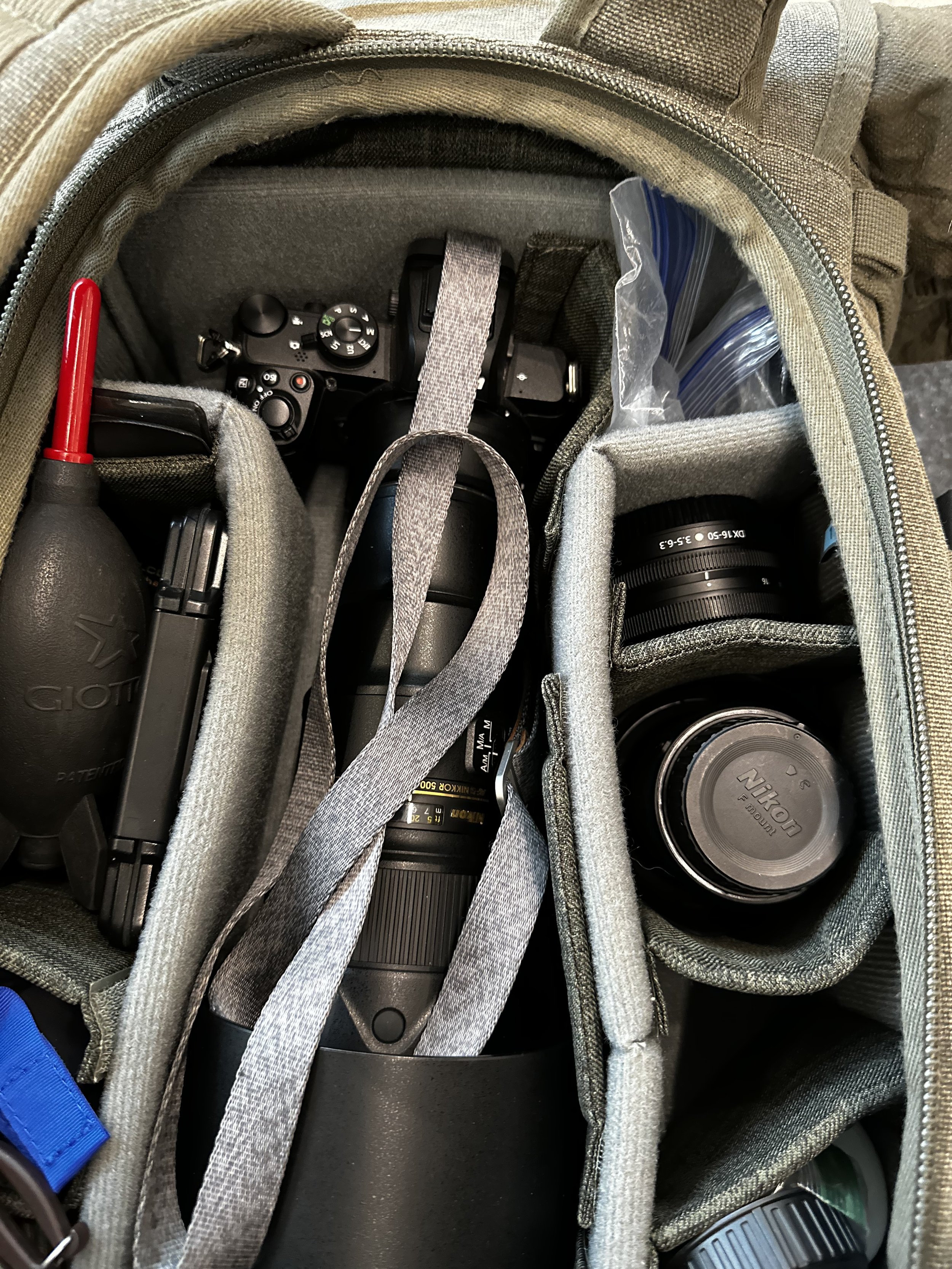
Current travel load out, Z50, 500mm PF, 16-50mm Z Kit, and 10-20mm F mount Nikkor/FTZ adapter.
Well, I finally figured out that the smaller pack was the way to go, but it really didn’t have room for the big wildlife rig I liked to use… It also had one other critical shortcoming that I noticed from regular use. The pack opened to the top when unzipped. What this means is you take off the pack and lay the side that normally sits against your back, on the ground facing down to access the gear area. At this point, I was doing a great deal of photowalks and hikes to waterfalls and such and this caused lots of dirt on the back of my shirt… To say this was frustrating is an understatement but I carried on till…

Enter the Thinktank Photo Retrospective 15L. For my needs, this is as close to perfect for a camera bag as I have ever found. It opens from the back, the side against my body which means you lay to outside one the ground, keeping all the leaves, twigs and dirt off of my shirt. It is slightly larger (15 liters in size) so there is room for my wildlife kit. It is REALLY comfortable and it is made of stone washed canvas. So it has a nice look (it doesn’t look like a nylon camera bag) and has a great feel. This is a hallmark of Thinktank Photo from what I have seen. Their backpacks are very comfortable. So now that I have landed on the perfect camera bag after almost a decade of searching, I can now shift focus to the gear I put in it.

Taken with the Nikon Z50 with the FTZ Adapter and the 500mm PF Amount lens.
The gear loadout for my photography usually involves at least two bodies, three general purpose lenses and then my special purpose lenses and all the support gear too. Like a whole cleaning kit complete with blower bulb, dry wipes, wet wipes and solution and sensor swabs… way too many batteries, like I must have thought I was going to take 10,000 photos per day or something. I never needed most of this crap either. I mean almost none of it. What I had was a case of “fill’er up” syndrome. If there was bag space I felt compelled to put something in that space for some reason. This is a terrible way to operate if I must say. You end up tired, sore and resentful of the hobby as you brought all this kit for nothing.

The Nikon Z50 with kit lens makes for a powerful little general photography kit.
So this trip, the bag is scaled WAY back. I mean, there is room in the bag for stuff and nothing is in those pockets. This is a milestone for me, as I am a prepper at heart and want to cover every conceivable contingency under my normal mindset. To be honest, I probably brought at least one lens more than I will need and could have lightened the load some more there, but we will see. So my takeaway from all this is, your hobby is a journey and you will have to figure out your kit for that hobby as you go. For me, it is still an ongoing journey to be honest. Hopefully I can stop spending tons of money on it and just enjoy it. Let’s be realistic though, probably not…Lol.