
Belize Travel Photography Guide: Minimalist Camera Gear and Packing Tips
Something we learned from the trip to England last year that was a basic revelation to us was that we don't need as much stuff as we think we do. This was because we had decided to hike the Canterbury trail in England. This forced us to leave everything behind that wasn't essential for the hike since we had to carry everything we wanted in our backpack.
When I started planning my Belize trip, I knew one thing for certain: I wasn't going to make the same mistake I'd made on countless other trips. No massive camera bag. No roller suitcase full of gear I'd never touch. This time, I was going minimalist.
This is a trip log of sorts, but it's also a lesson in how traveling light with your camera gear can actually improve your photography experience.
The Minimalist Travel Photography Philosophy
Something we learned from the trip to England last year that was a basic revelation to us was that we don't need as much stuff as we think we do. This was because we had decided to hike the Canterbury trail in England. This forced us to leave everything behind that wasn't essential for the hike since we had to carry everything we wanted in our backpack. Let me tell you, you can get brutally honest with yourself when it comes to hiking and weight in your pack. To the point of removing packaging from items to simply cull the dead weight.
This led me to also take a very hard look at my camera kit. I normally would take all sorts of lenses in the off chance I would get to do this or that kind of photography. I learned over the years though that I would end up carrying all this gear and never touch it.
The hard truth about travel photography gear: Most of what we think we "need" stays in the bag. Every extra lens is dead weight. Every "just in case" accessory is a burden you'll resent carrying. The Canterbury trail taught me this lesson through physical pain and exhaustion.
My Belize Camera Kit: Leica CL + Two Prime Lenses
Well, I looked at what we would be doing and what I figured I wanted to capture and I took just one camera and two small prime lenses. A crop sensor camera and a 17mm along with a 35mm lens is all I needed. This would cover 99% of what I would be shooting and I would be able to carry it easily in my backpack.
Now, I am on another trip out of the country and I am applying the same principle again. The kit is just as small as last time but with less charging gear. I only brought chargers for USB only this time. This may prove to have been a mistake but we will see. I am also carrying only the back pack again as well.
My complete Belize camera kit:
- Leica CL (crop sensor camera body)
- 17mm f/1.4 lens (for landscapes and general photography)
- 35mm f/0.95 lens (for street photography and low light)
- 3 spare batteries (I usually only use two per day)
- One USB charger and cable (works for both camera and action cam)
- DJI Osmo Action (for video/vlogging)
- Lume Cube Panel Mini (portable fill light)
- No lens cloths, no rocket air, no card wallet, no spare lens caps, no tripod
That's it. Everything fits in a small belt dump pouch that serves as my camera "bag." What doesn't fit goes in a ziplock bag. Total weight? Maybe 3-4 pounds including the action camera and accessories.

The complete Travel photography Camera Kit in one photo!
Why Backpack-Only Travel Changed Everything
The reason I like to travel with a backpack now is that there is no baggage to check or pickup…or lose, since I have it with me at all times. Plus the airport maneuverings is also much easier too. Much easier since you just go in and get your boarding passes (we still haven't transitioned to using our phones yet), pass through security (which you still do even if you check a bag) and go straight to your gate. Easy. Not to mention that I dont have to drag my roller bag around with me AND both of my hands are free as well.
Benefits of backpack-only travel photography:
- No checked baggage fees
- No waiting at baggage claim
- Zero risk of lost luggage with your expensive camera gear
- Both hands free for navigating airports
- Faster through security checkpoints
- More mobility when shooting on location
- Forces you to be selective about what you really need
You see, I despise airports and air travel to be quite honest about it. That is a blog post all it's own though... Haha.
The Journey: Chattanooga to Belize via Small Planes
Day 1 - We wake up at 4:30 and get ready to leave and pack the last few items we think we will need and head off to the airport.
Flying out of Chattanooga is also better to me since it is a smaller airport, the whole vibe is just lower key. This also gets me past the long lines at the big airports at check in as well as the long lines at the TSA checkpoint too. I don't normally bother with photos at the airport like others do but here are a couple for fun. All photos of travel are taken with my phone so I don't have to break out the camera. The below photo is of note though, this is what overcast skies looks like from the other side of the clouds. Looks almost looks like a desert somewhere, doesn't it?

Flying above the clouds - it almost looks like a desert from up here
Why I love small regional airports for travel photography: Chattanooga's airport lets you move through the whole process in minutes, not hours. Less stress means you arrive at your destination with more creative energy for photography. For more on my travel photography philosophy, check out my other photography insights on the blog.
The camera kit is shown below. I didn't bother with lots of items I normally carry to the point of probably a fault. Lol. No lens cloths, no rocket air, no card wallet, no spare lens caps, no tripod plates (or tripods either for that matter), not even a camera bag… officially. The bag you see is actually a lens "dump pouch" that goes on your belt. It happens to be big enough to hold almost all of the camera equipment I brought. What doesn't fit is in a ziplock bag, like the battery charger and cable and the DJI Osmo Action that I usually vlog with. I didn't even bring all of my spare batteries as I only used two a day at the most so I brought three. Lol…couldn't help myself.
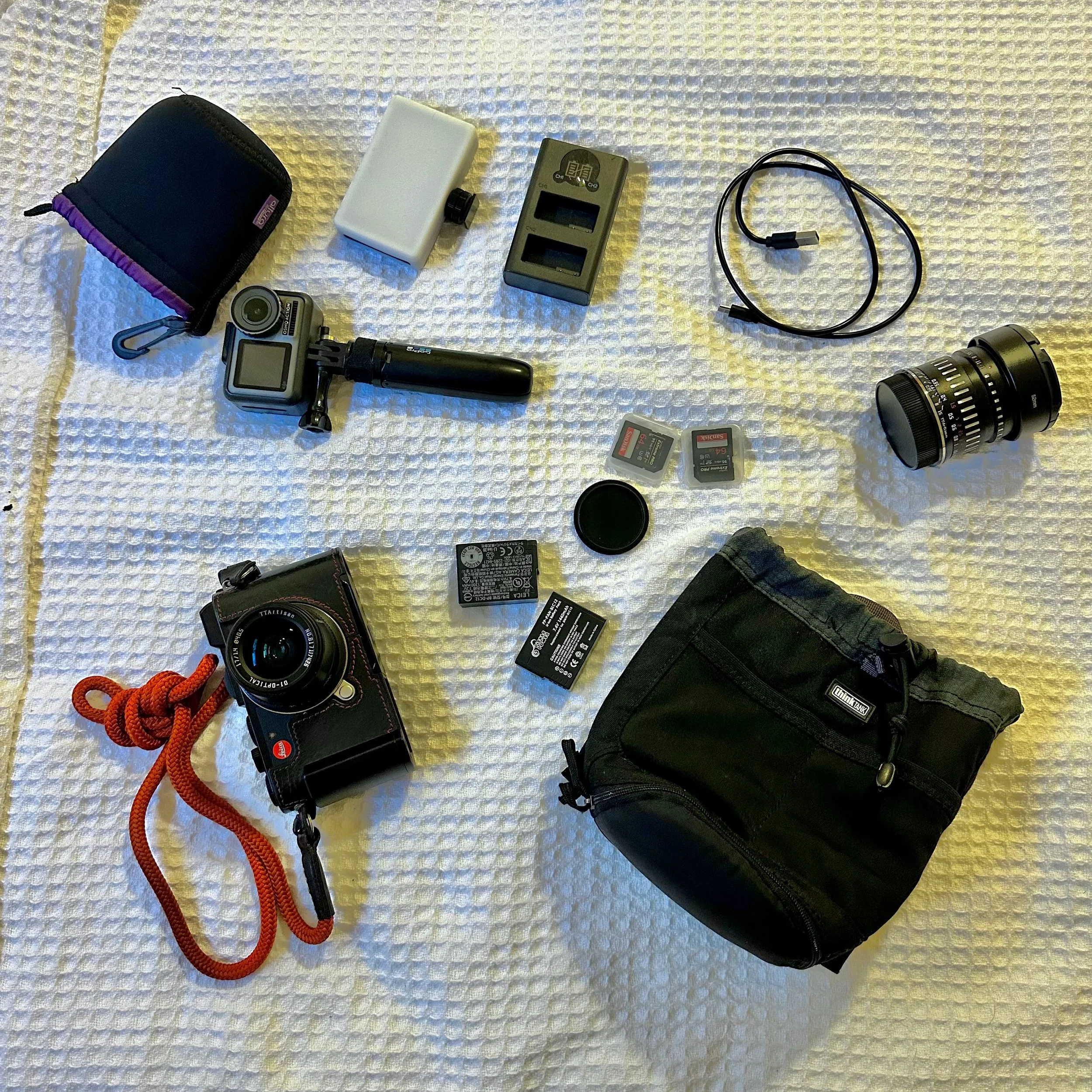
My entire Belize camera kit - Leica CL, 17mm f/1.4, 35mm f/0.95, and minimal accessories
I didn't bother with a spare battery for the Osmo as I never ran one down on my normal days anyways and it USB charges so the same cable will charge the action camera as my camera charger.
The inventory is longer than I had originally planned with me adding the DJI Osmo Action and the Lume Cube Panel Mini (fill light) was a couple of luxuries I really wanted for vlogging but fit in the pack easily enough. I have almost decided that I can vlog on my phone just about as good as the Osmo Action…almost.
Arriving in Belize: First Impressions and the Small Plane Experience
Once on the ground in Belize we pass through customs and then board a smaller plane to Placencia where we will be staying for a couple of days.

Flying Tropic Air's small planes down to Placencia - a completely different experience from commercial jets
You can also tell that they play by different rules in Belize. Notice how there is no copilot, I wonder what the protocol is for a incapacitated pilot? Makes you wonder… anyway, he did just fine and we arrived in fine order. It was actually kind of nice to take the little plane down to Placencia as it flies at a much lower altitude and I could see the towns along the way really well.

Notice something missing? No copilot. Welcome to small plane travel in Central America.
I also noticed that our plane had a copy of Microsoft Flight Simulator installed…haha. It is actually neat how technical the instruments have become but still display like the old ones did. It displayed EXACTLY like the old instruments but just on a digital display. I just thought it was really neat to see that.
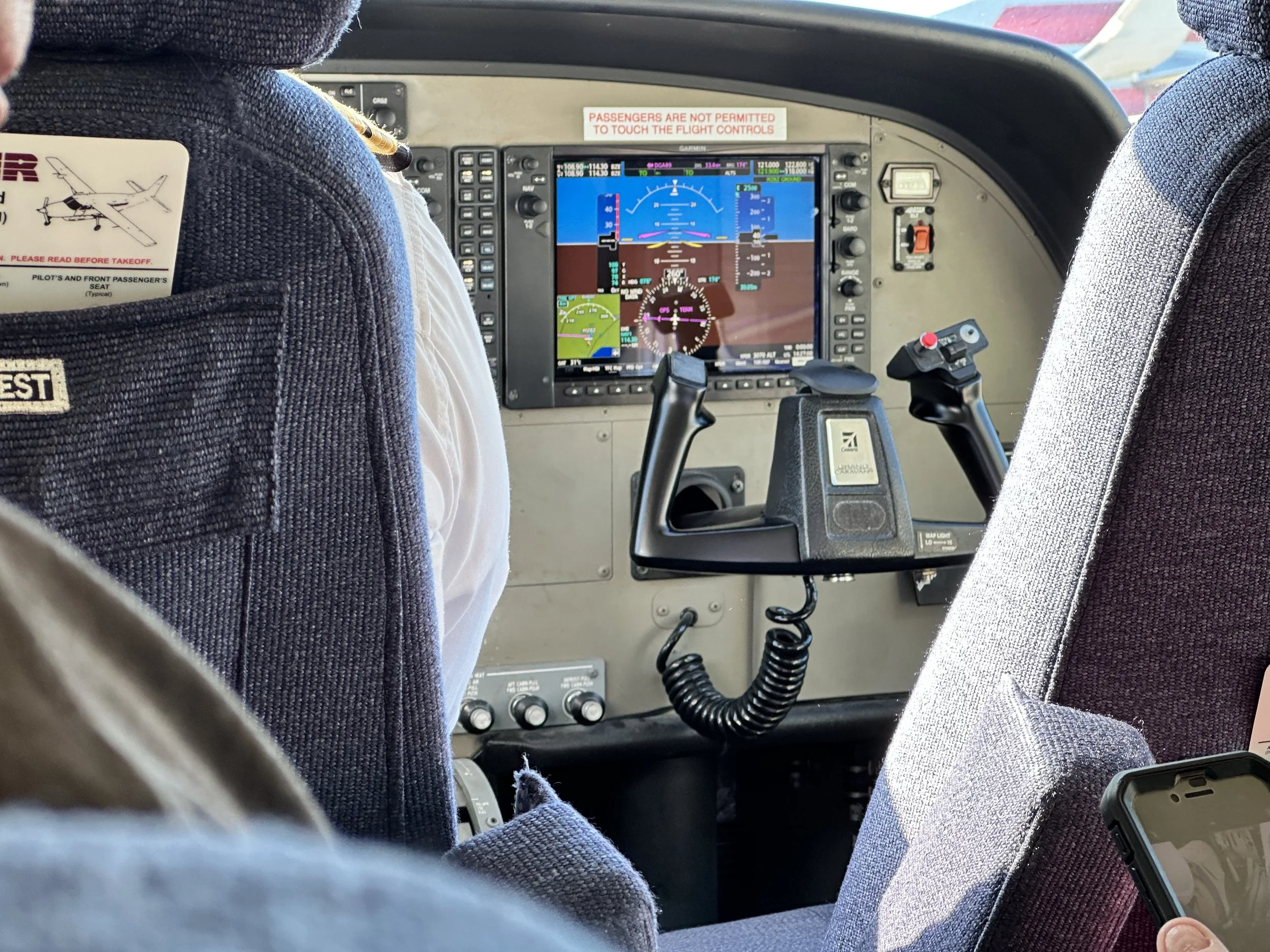
The instruments look like Microsoft Flight Simulator - modern digital displays mimicking traditional gauges
Small plane photography tip: These low-altitude flights offer incredible aerial photography opportunities. Keep your phone or camera ready for unique perspectives of coastlines and villages you can't get from commercial jets at 30,000 feet.
First Day in Placencia: Testing the 17mm f/1.4
After we arrived and got settled in, we went to the beach and walked in the ocean. It was really surreal to wake up and the outside temperature be 29 degrees and that evening it be almost 80 degrees.

First evening in Placencia - from 29°F at home to nearly 80°F at the beach
Once settled in, we went to the beach for a bit to relax a little and for this I took my 17mm f1.4 lens on the Leica CL. This is a great focal length for general photography as well as some landscapes. After our beach excursion it was time for some great food and fellowship.

First dinner in Belize - incredible local food and fellowship

Testing the 17mm f/1.4 at the beach - perfect focal length for landscapes and environmental shots
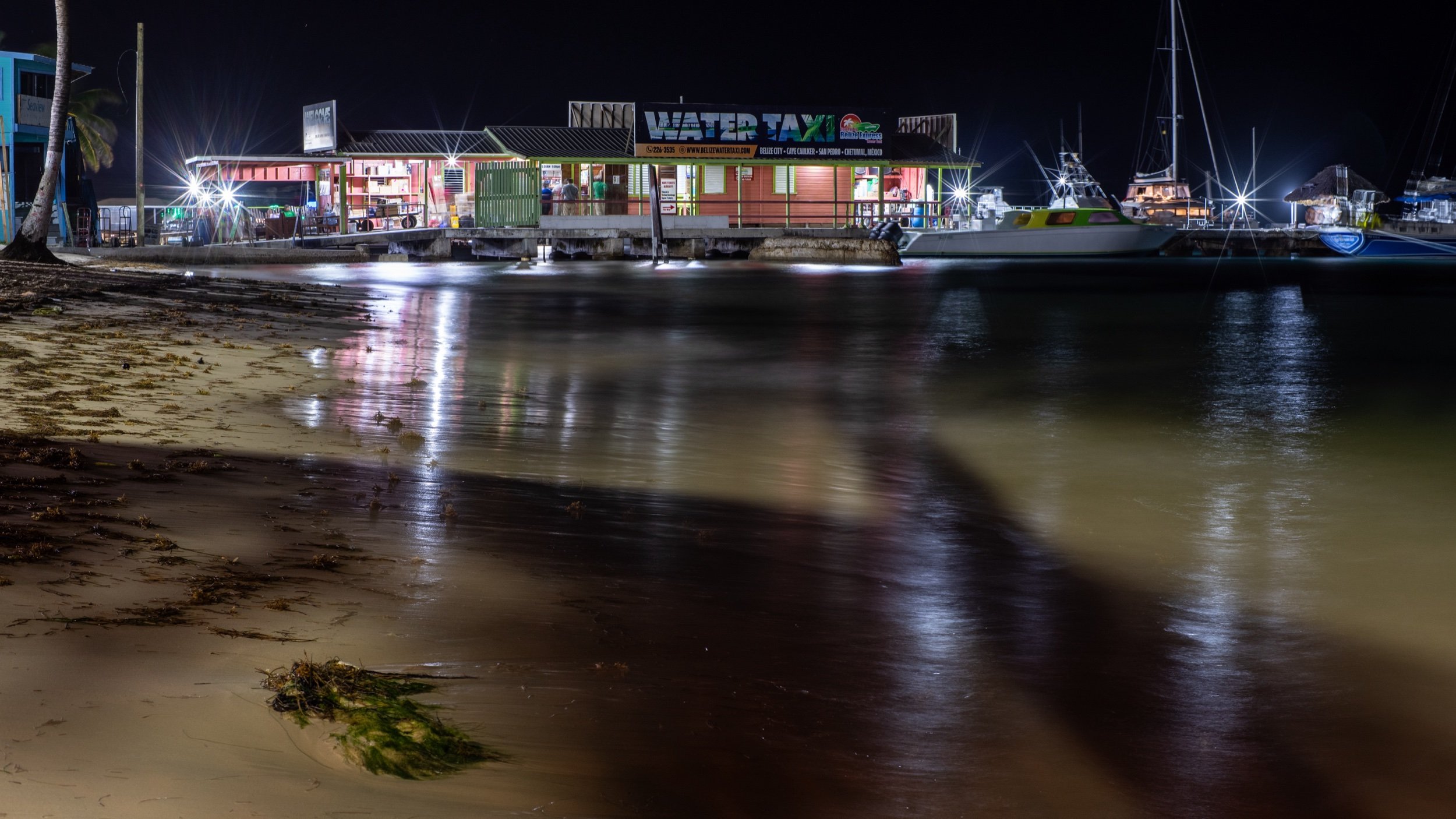
Successfully shooting at f/0.95 - the 35mm lens proved its worth in low light
We ate a wonderful meal for supper and hung out a while then it was off to bed. I used the 35mm at f0.95 for a change just to see if I could get some photos in focus at f0.95 and it was a success!
Shooting wide open at f/0.95: This was a test to see if I could nail focus at such a shallow depth of field while traveling. The answer? Yes. The Leica CL's focus peaking and magnification made it possible even in low light situations. This is why I love shooting with manual lenses—you stay engaged with every shot.
Living in the Moment: Day 2 Without a Camera
Day 2 was an off day from photo and video collection as I wanted to just be in the moment. This meant no camera gear of any kind. It was really nice to "unplug" for a while.
The best travel photography advice I can give: Not every day needs to be a photo day. Some experiences are better lived through your eyes instead of your viewfinder. This is something I learned through my photography evolution from gear-obsessed to minimalist, and it's transformed how I travel.
Next installment will be the "ruins"…I DID take my camera this time. Continue reading about my Belize photography adventures at Mayan ruins and San Pedro.
Frequently Asked Questions
What camera gear should I bring to Belize?
For Belize travel photography, I recommend a lightweight setup: one camera body and two prime lenses. A wide lens (17-24mm equivalent) for landscapes and beach scenes, and a normal to short telephoto (35-50mm equivalent) for street photography and portraits. The Leica CL with 17mm and 35mm lenses covered everything I needed. Skip the zoom lenses—the weight isn't worth it.
Is it safe to travel to Belize with expensive camera gear?
Yes, but be smart about it. I kept my Leica CL in a nondescript belt pouch rather than an obvious camera bag. In tourist areas like Placencia and San Pedro, camera gear is common and generally safe. Away from resorts, I was more discreet. The bigger risk is losing checked luggage—this is why I travel backpack-only with all my gear as carry-on.
Can you really travel with just a backpack for photography trips?
Absolutely. I did a week in Belize with just a backpack containing all my clothes and camera gear. The key is choosing versatile, lightweight equipment. My entire Leica CL kit (camera + 2 lenses + accessories) weighed less than 4 pounds. This left plenty of room for clothes and toiletries in a standard backpack. See my complete packing list in [my gear page](/my-gear-page).
What's the best focal length for travel photography?
For travel photography, I prefer two focal lengths: a wide lens (17-24mm equivalent) for environmental shots and landscapes, and a normal lens (35-50mm equivalent) for people and street scenes. This combination covers about 95% of travel situations. On my Belize trip, I used a 17mm f/1.4 and 35mm f/0.95 on a crop sensor camera, which gave me roughly 25mm and 52mm equivalent fields of view.
How do you pack camera gear for international travel?
Always pack your camera gear in carry-on luggage—never check it. I use a small belt dump pouch that fits my Leica CL and two lenses. It's nondescript and doesn't scream "expensive camera." Everything else (chargers, batteries, cables) goes in ziplock bags inside my backpack. This system has worked flawlessly for multiple international trips. The key is limiting yourself to what truly fits in a carry-on while staying under airline weight limits.
Support this website by using these affiliate links to shop on Amazon:
Leica M11 Digital Rangefinder Camera
Nikon AF-S FX NIKKOR 105mm f/1.4E ED Lens
Voigtlander Nokton 35mm f/1.4 II
Sandisk 128GB Extreme Pro memory cards

A day out with Aaron in Chattanooga
It was time...
We have not gathered to shoot photos in quite some time now so Aaron found there was a beard competition happening in Chattanooga and decided to make his way down for it.
It was time...
We have not gathered to shoot photos in quite some time now so Aaron found there was a beard competition happening in Chattanooga and decided to make his way down for it.
The Setup: What I Shot With
For this day out with Aaron, I kept my setup simple:
Camera: Leica SL2 (full-frame mirrorless) Lens: Leica 50mm APO-Summicron Mode: Aperture priority with -2/3 exposure compensation ISO: Auto (probably ranged between 200-800) Settings: Wide open or close to it (f/2 to f/4 for subject separation)
Aaron was shooting with his new Nikon Z8, and we kept comparing how our cameras metered the scenes differently. The Leica wanted to overexpose about 2/3 stop compared to his Nikon, which meant I had to dial in negative exposure compensation the whole time. This is something you learn when shooting different camera systems together!
The SL2 is heavy (like really heavy compared to smaller mirrorless cameras or rangefinders), but it makes stunning images and the build quality is tank-like. I don't baby it on the streets, which is exactly how a street camera should be used!

Shot with Leica SL2 and 50mm during our Chattanooga day out with Aaron at the beard competition.
When he arrived we spent the evening playing with stuff (his new Z8 in particular) and catching up. But then it was off to bed so we could get up and start our big day of photography.
The next morning comes around and we down some coffee and make a plan to meet up about lunchtime as I had to go to our Church’s Association as a delegate. Seems I made a mistake and assumed I didn’t need to go… lol, I see what that got me. Anyway, I really enjoy Association so it wasn’t like a chore, it meant changing plans a little from the original plans for the day.
So after I finish with business at association, I head over to the Harley Davidson dealership which is where the beard competition is being held. There I find Aaron is short order and it is really crowded. He basically tells me to get my camera out and take a picture with it so I sheepishly do as I am told.

The beard competition at Harley Davidson in Chattanooga. This event was perfect for breaking down personal barriers to photographing strangers! People were there to be seen and photographed, making it easy practice for someone like me who's normally shy with the camera. Shot with Leica SL2 + 50mm.

This fellow was more than happy to pose for me at the beard competition! Events like this are perfect for overcoming shyness in street photography because people expect cameras and are happy to participate. Shot with Leica SL2 and 50mm. The afternoon light gave great contrast for portraits like this!
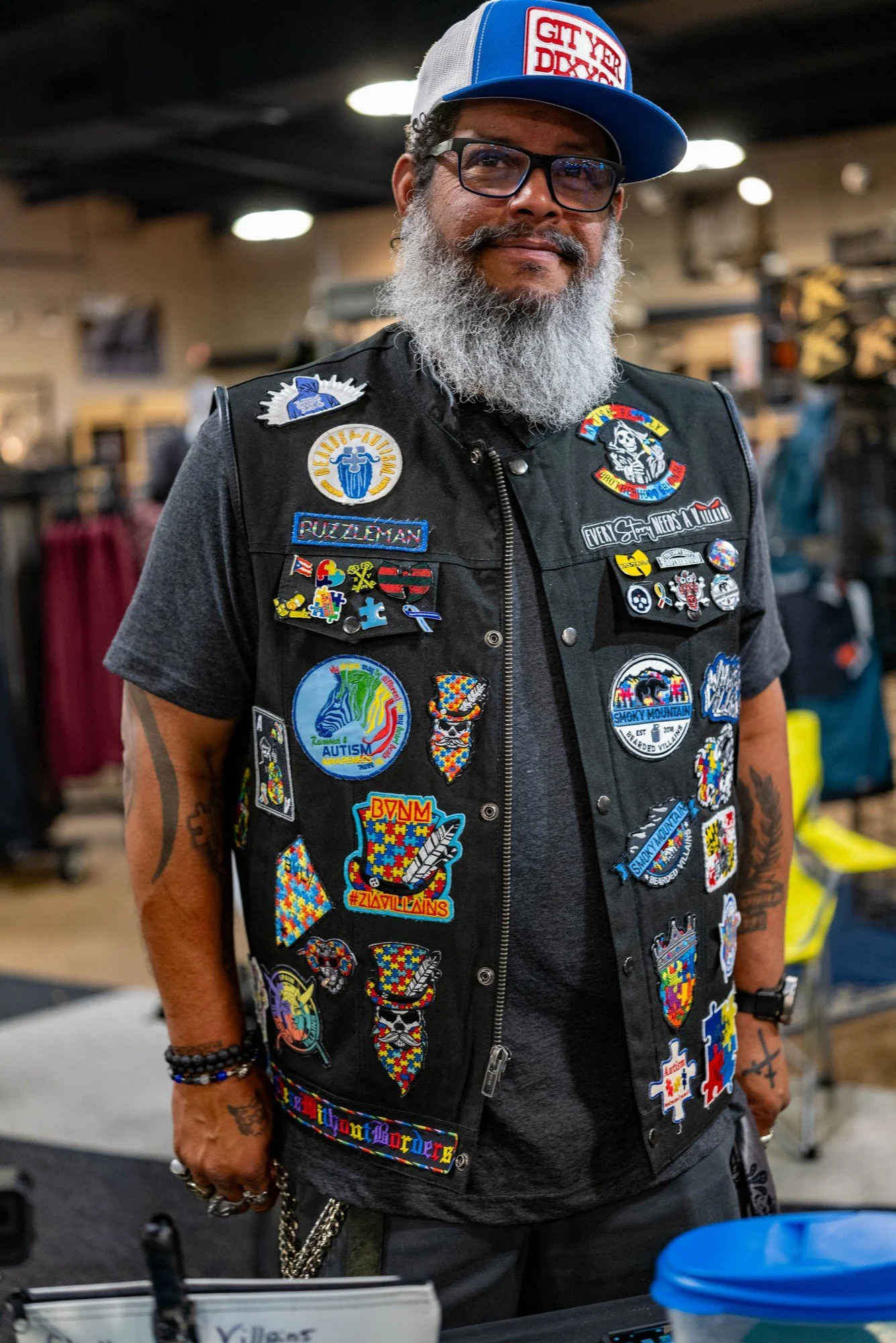
The atmosphere at the beard competition was incredible! Crowded but friendly, with people everywhere happy to get their photos taken. Aaron was right when he told me to just get my camera out and shoot. Sometimes you need that push from a friend! Leica SL2 + 50mm, aperture priority mode.

The atmosphere at the beard competition was incredible! Crowded but friendly, with people everywhere happy to get their photos taken. Aaron was right when he told me to just get my camera out and shoot. Sometimes you need that push from a friend! Leica SL2 + 50mm, aperture priority mode.
You see I am not very aggressive with my photography especially when it involves people. I will ask at times but most of the time, this is why I don’t shoot aggressive street stuff. So now I am starting to get some photos and it is exactly as he mentioned. People happy to get their photos captured are everywhere. Like this fellow below, he was more than happy to pose for me. I will be honest, this kind of event is the perfect thing to break down your personal barriers to shooting photos of people you don’t know.

The Leica SL2 with the 50mm APO Summicron is the perfect camera for a beard Competition!

Even the girls got in on the fun at the beard competition! Not everyone there had a beard, lol. Shot with Leica SL2 + 50mm at Harley Davidson in Chattanooga. This is why I love event photography as practice for street work!
Why Events Are Perfect for Shy Street Photographers
I mentioned I'm not very aggressive with my photography, especially when it involves people. This is something a lot of photographers struggle with! We want to capture candid moments and interesting people, but we don't want to be intrusive or make anyone uncomfortable.
Events like the beard competition are the perfect training ground because:
People expect cameras. They're there to be seen and photographed, so you're not the weird person with a camera. You're just another photographer at an event.
Subjects are willing. Most people will happily pose if you ask, and many will even seek you out to get their photo taken. This builds your confidence!
Low stakes. If someone says no or looks uncomfortable, there are dozens of other subjects around. You're not losing a once-in-a-lifetime shot.
Practice makes perfect. The more you shoot people at events, the more comfortable you get approaching strangers in regular street situations.
Aaron's advice was simple: "Get your camera out and take a picture with it." Sounds obvious, but when you're standing there feeling shy, you need someone to tell you it's okay to just shoot!
Start with events. Work up to regular street photography. Your shyness will fade as your confidence grows! Back to the story in progress…
Well the beard competition winds down about 3 or so in the afternoon and we decide to rearrange the rest of the day to shoot some street photography in downtown and also to go have supper at a great Italian restaurant later on.
The streets of Chattanooga were busier than usual with it being a holiday weekend but it still wasnt really bad where we went for our walk.

We found this mural with light reflecting from the building across the alley and it was just something we couldn't pass up! This is what afternoon light does in downtown Chattanooga. The light spill creates scenes you don't get at other times of day. Leica SL2 + 50mm on our photowalk route through Main and Broad Streets.
We started on Main Street and then headed down Market Street to about 7th where we turned over to Broad Street and then back towards Main eventually diverting over to Cowart street before arriving at the truck.
So now you have the route, let see what we got. I kept joking about channeling my inner Eggleston as I would take photos of the mundane. Another thing I have learned is my Leica wants to shoot about 2/3 stop over exposed compared to my friends Nikon cameras. I kept -2/3 stop exposure compensation dialed in the whole time. I did this to keep the sky from being blown out as the shadows would be dark due to the bright afternoon sun. I will dig into the setup on my camera more to see if I can find out why it is doing that.

The Tivoli Theater is an iconic landmark in downtown Chattanooga Tennessee and never disappoints for a photograph.
Along the way we saw a lot of cool stuff to photograph, like in the images below where it is different light so the images come out different from my usual time of day. With the light further over to the west we kept getting these awesome light spill shots like the one below of the old Rone Regency Jewelers location. This location will be sorely missed by me when they finally do something with this building. I love the gritty nature of the old signage and it wasn’t long ago that the windows were not boarded up so you could actually see inside the store. Even so, the black painted plywood makes a nice contrast to the lighter color of the upper section of the building bringing balance to the image.

The old Rone Regency Jewelers location with afternoon light spilling across the facade. This location will be sorely missed by me when they finally do something with this building. I love the gritty nature of the old signage! The black painted plywood makes a nice contrast to the lighter color of the upper section, bringing balance to the image. Shot with Leica SL2 + 50mm Summicron on our downtown Chattanooga photowalk with Aaron.
We also found a few people to photograph as well. It was not quite as busy as I had figured it would be for a holiday weekend in the downtown area, but there were a few people out and about and I was able to grab a few photos of them. The Leica SL2 is a great camera for this kind of photography as it makes stunning portraits as well as makes for a wonderful, albeit heavy, street camera.
Why Afternoon Light Changed Everything
I usually shoot at different times of day (mid-morning usually), so this late afternoon session was different for me. With the sun further over to the west, we kept getting these awesome, direct sun light spill shots that I don't normally see.
What made afternoon light special:
Hard shadows: The bright afternoon sun created strong shadows and high contrast. Great for black and white or dramatic color shots.
Light spill: Buildings reflecting light into alleys and onto other buildings. This is what made the Rone Regency Jewelers shot work so well!
Window light: Storefronts and windows become light sources, creating interesting reflections and secondary lighting.
Challenge mode: Protecting highlights meant I had to underexpose a bit (-2/3 stop), which made shadows darker. This forced me to look for scenes that worked with that contrast.
Different light means different photos. Don't just shoot at the same time every day! Mix it up and see what you discover.
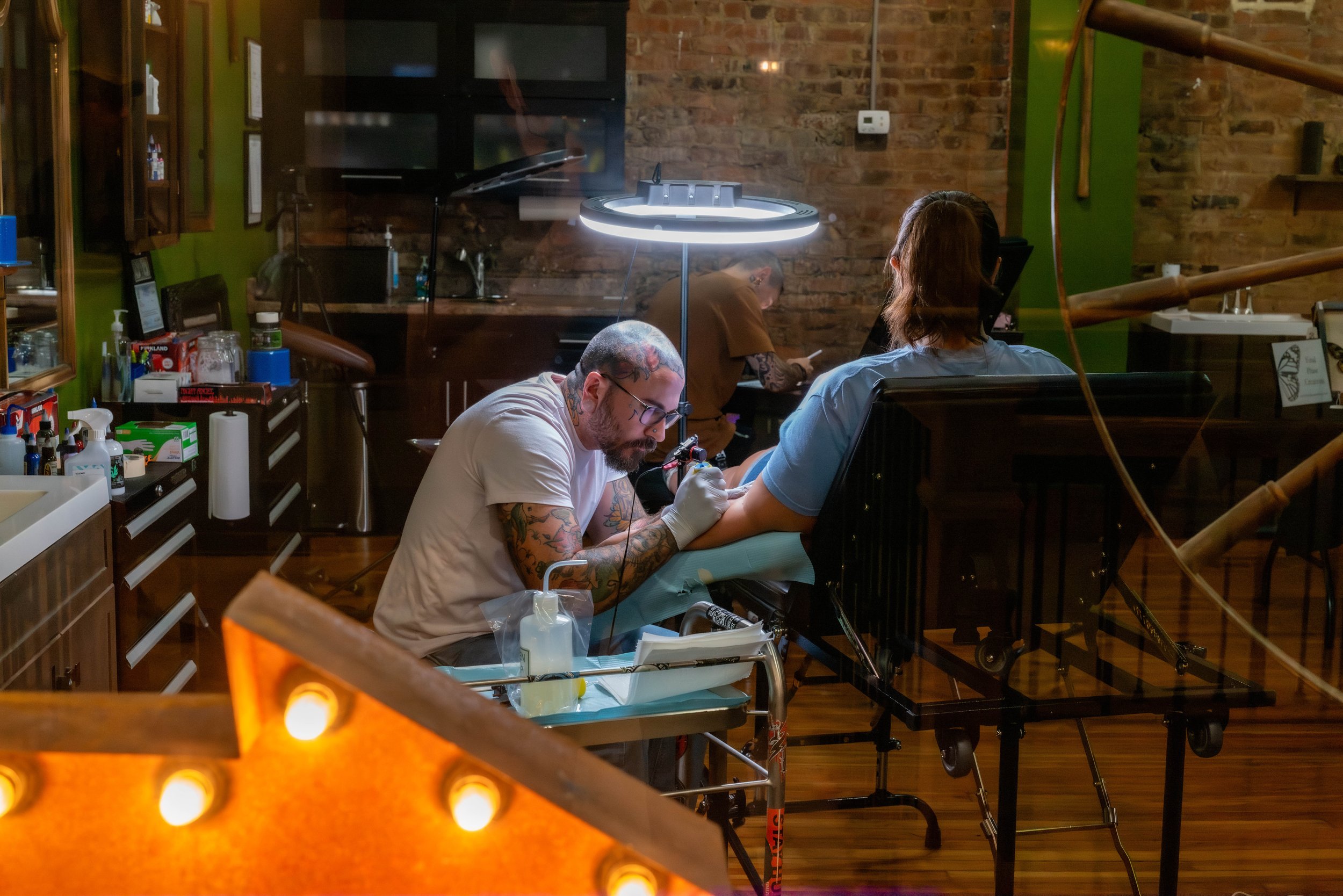
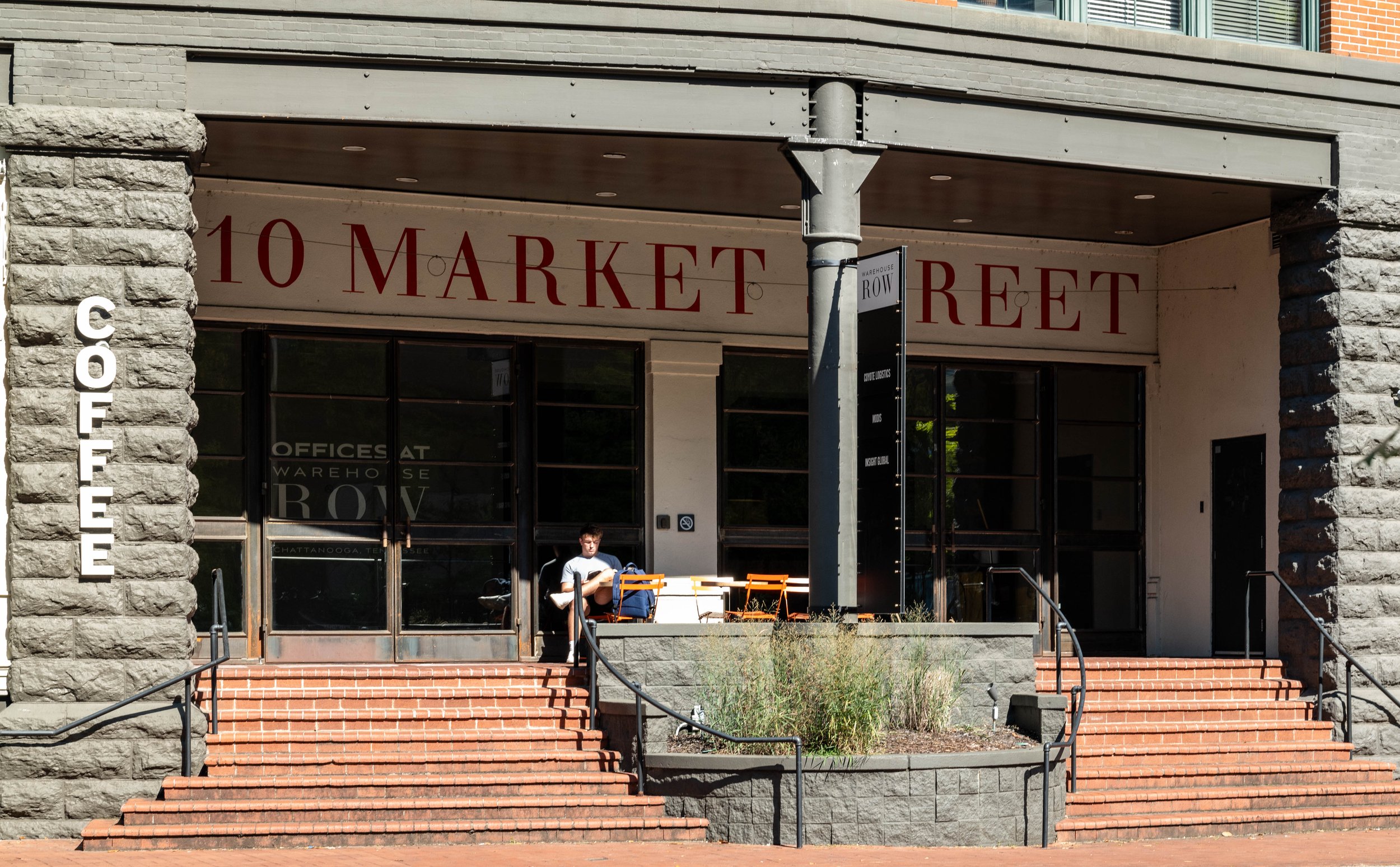
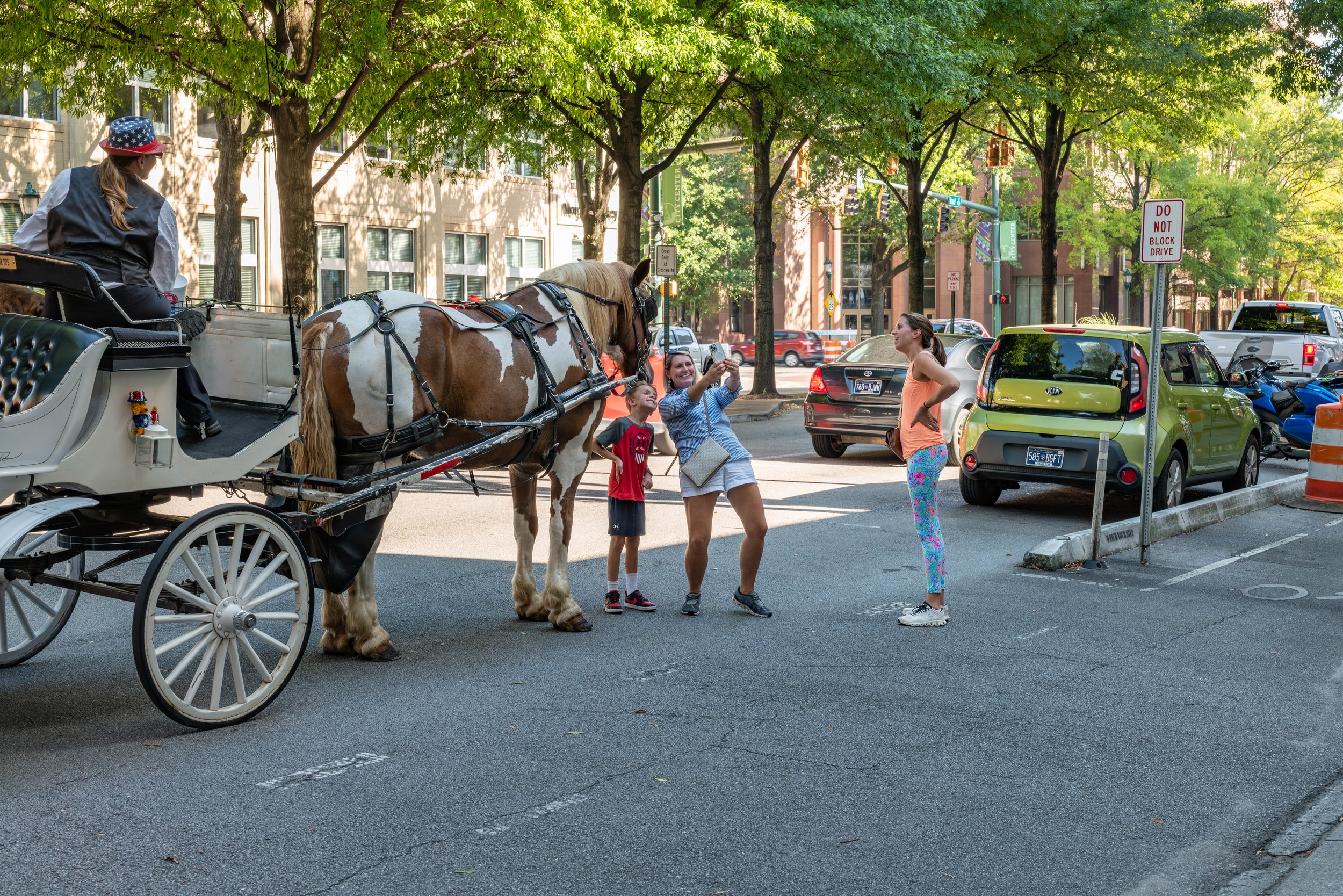
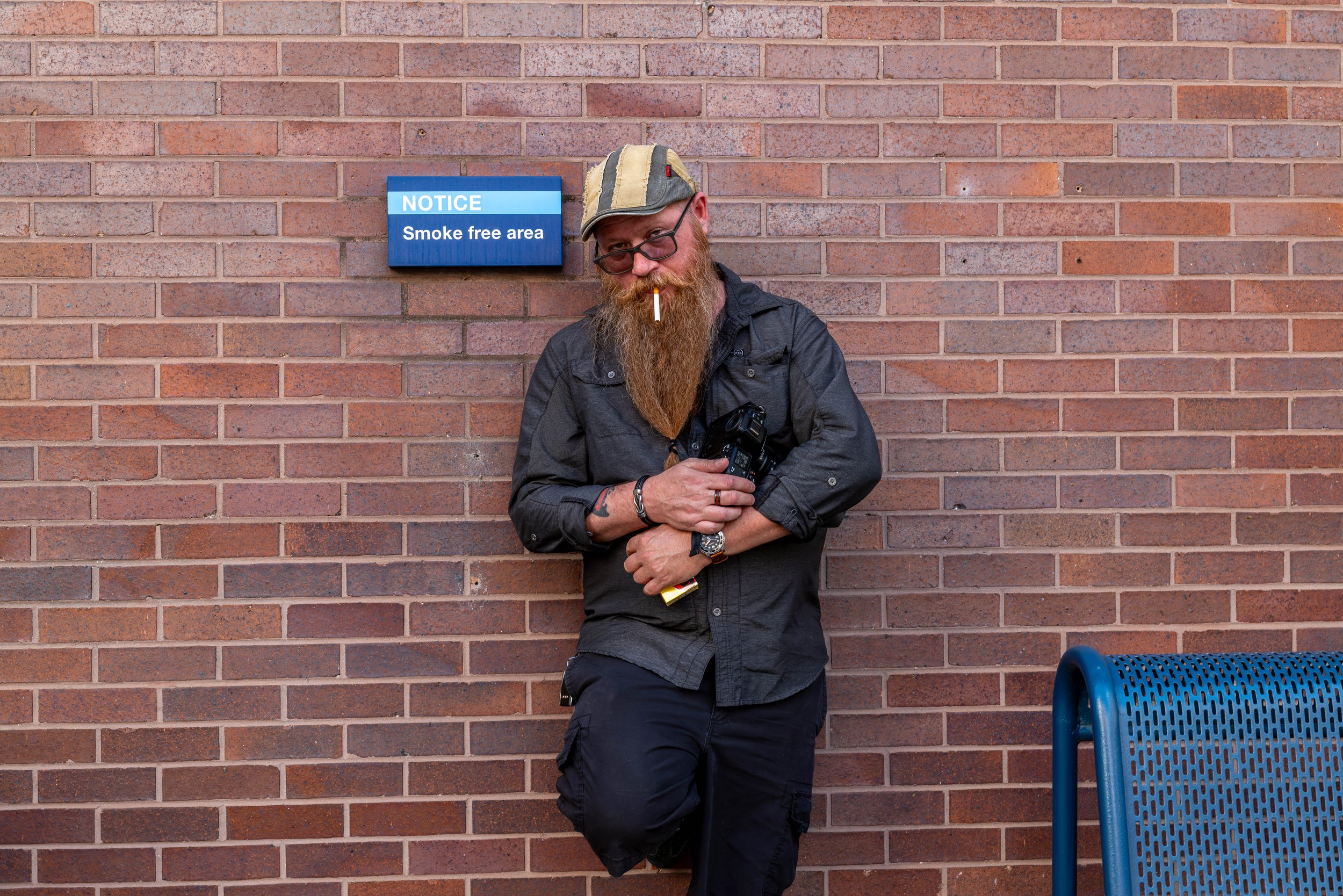
All in all we had a great time and then even got to go eat wonderful Italian cuisine later too. What more could you ask for? Well, there is one more thing I could ask for…
Lightroom Classic… I did it, I went over to the dark side and installed Lightroom back on my system again. It has the power to edit like I need finally and I kept running into problems that Exposure couldn’t easily solve for me so it was time to upgrade…or move over laterally to or what ever you call it…So going forward, I will be learning how to use Lightroom to edit my photos…wish me luck.
If you want to see more abotu this day, I made a vlog cideo about the photowalk portion of the day and it can be watched here.
What I Look For in Street Photography
During the photowalk, Aaron joked about me "channeling my inner Eggleston" as I photographed mundane things. But that's what street photography is about! Here's some of the things that I look for:
Light: Always first. How is the light hitting the subject? Is there interesting shadow play? Is it spilling from one building to another?
Layers: Foreground, midground, background. The best street photos have depth and multiple elements working together.
People: Not always necessary, but human presence adds scale and story. Even just a silhouette or someone walking through the frame.
Color or contrast: Bright colors that pop, or strong black and white contrast. Something that makes the eye stop.
Geometry: Leading lines, patterns, shapes, architecture. The bones of a good composition.
Moments: Candid expressions, interesting gestures, unexpected juxtapositions.
The mundane: Everyday things that become interesting when you isolate them with your camera.
Don't overthink it! Just walk and shoot what catches your eye. You can analyze it later when you're editing. Then you can take inventory of what you shoot the most and see if those images have some meaning or if it is just what you like to shoot…either way, it is good to get out and shoot photos so go have some fun.
Frequently Asked Questions About Street Photography and Chattanooga Photowalks
How do you overcome shyness when photographing strangers?
Honestly, I still struggle with this! I'm not aggressive with my photography, especially when people are involved. I'll ask permission sometimes, but most of the time I just shoot what feels natural without getting in people's faces. What helped at the beard competition was that people were already there to be seen and photographed. They were happy to pose! Events like this are perfect for breaking down those personal barriers to shooting photos of people you don't know. Start with events where people expect cameras, then work your way up to regular street photography. Aaron's advice of "get your camera out and take a picture with it" is the best cure for shyness, even if it feels awkward at first!
What's the best time of day for street photography in downtown Chattanooga?
The afternoon worked great for us! With the sun further over to the west, we kept getting these awesome light spill shots bouncing off buildings. The light was different from my usual shooting times, and it created some really interesting shadows and contrasts. Late afternoon (around 3-5pm) gives you that warm golden light that looks great for both architecture and people. Early morning works too, but afternoons tend to have more people out and about, which is what you want for street photography. Avoid harsh midday sun if you can, unless you're going for high-contrast black and white work!
What's a good street photography route in downtown Chattanooga?
The route Aaron and I took worked really well: Start on Main Street, head down Market Street to about 7th, turn over to Broad Street, then back towards Main, and eventually divert over to Cowart Street. This gives you a good mix of architecture, street scenes, and people. You'll pass old buildings like the Rone Regency Jewelers location (which has great gritty signage), modern storefronts, alleys with interesting light, and public spaces where people gather. The whole loop is maybe 2-3 miles depending on how much you wander, perfect for a couple hours of shooting!
Is the Leica SL2 too heavy for street photography?
Yes and no, lol. The SL2 is definitely heavy compared to smaller mirrorless cameras or rangefinders. But it makes stunning portraits and the image quality is just incredible. I kept it paired with just the 50mm lens to keep things simple. Is it the "ideal" street camera? Probably not if you're walking all day. But does it work? Absolutely! The weight actually helps stabilize handheld shots, and the build quality means I don't baby it. If you've got one, use it for street photography. Don't let the weight stop you. Your shoulders might complain, but the photos will be worth it!
Why was your Leica exposing differently than Aaron's Nikon?
Great question! I noticed my Leica SL2 wants to shoot about 2/3 stop overexposed compared to Aaron's Nikon cameras. I kept -2/3 stop exposure compensation dialed in the whole time to keep the sky from being blown out. The shadows would be dark anyway due to the bright afternoon sun, so I was protecting the highlights. Different camera brands meter scenes differently, and Leica tends to be a bit generous with exposure to preserve shadow detail. This is something you learn when shooting with multiple camera systems. Just dial in the compensation and keep shooting! I need to dig into my camera setup more to see if there's a metering mode that matches my shooting style better.
What camera settings do you use for street photography?
For this photowalk with the Leica SL2, I was shooting mostly in aperture priority mode with the 50mm lens. I kept -2/3 exposure compensation dialed in (as mentioned above). ISO was probably auto, and I let the camera pick the shutter speed. For street photography, I like to shoot wide open or close to it (f/2 to f/4) to get that subject separation, but I'll stop down if I need more depth of field. The key is to keep your settings simple so you're reacting to moments, not fiddling with dials. Set it and forget it, then just focus on composition and timing!
Can you photograph people at public events without permission?
At events like the beard competition where people are specifically there to show off and be seen? Yes! Most people were happy to be photographed and many posed for us. That said, I still try to be respectful. If someone looks uncomfortable or waves me off, I move on. For regular street photography, it's trickier. I generally don't ask permission before shooting (it kills the moment), but if someone objects after I've taken their photo, I delete it. Know your local laws, be respectful, and don't be creepy. Events are the easiest place to start because people expect cameras!
What makes a good subject for street photography?
Honestly? Almost anything! During the photowalk I kept joking about channeling my inner Eggleston as I would take photos of the mundane. Look for interesting light (like that spill on the Rone Regency Jewelers building), patterns, textures, people doing everyday things, architectural details, reflections, shadows... anything that catches your eye. Don't overthink it. I shot everything from bearded bikers to boarded-up buildings to random street corners. The beauty of street photography is finding the interesting in the ordinary. Just walk around and let things reveal themselves to you!
Should I shoot RAW or JPEG for street photography?
I shoot RAW because I like having the flexibility in post-processing. For this shoot, I ended up using Lightroom Classic to edit (I went back to the "dark side" after trying to use Exposure, lol). RAW gives me the power to recover highlights, lift shadows, and adjust colors the way I want them. That said, if you're comfortable with your camera's JPEG processing and you don't want to spend time editing, shoot JPEG! The best format is the one that gets you shooting. Street photography is about being out there capturing moments, not agonizing over file formats!
How do you choose which photos to keep from a street photography session?
I wish I had a good systematic answer for this, lol. Honestly, I just go through them and keep the ones that speak to me. Does the composition work? Is the light interesting? Did I capture a genuine moment or expression? Is there something about the image that makes me want to look at it again? I'm pretty ruthless in culling, especially with street photography where you might shoot hundreds of frames. If it doesn't grab me immediately, it gets deleted. The photos I shared in this post were the ones that stood out when I was editing. Trust your gut, and don't be afraid to delete mediocre shots. Only keep the good stuff!
BONUS QUESTION: What's the best way to learn street photography?
Go out with a friend like Aaron who will tell you to "get your camera out and take a picture with it"! Seriously, having a photography buddy makes a huge difference. You push each other, share ideas, and it's way less awkward than being alone with a camera on the street. Start with events (like the beard competition) where cameras are expected, then work up to regular street shooting. Use a simple setup (one camera, one lens), set your camera to aperture priority or full manual, and just walk. Don't overthink it. The best teacher is just getting out there and shooting. Oh, and watch Aaron's work or other street photographers you admire, but then go do your own thing. Your style will develop over time!
Support this website by using these affiliate links to shop on Amazon:
Leica M11 Digital Rangefinder Camera
Nikon AF-S FX NIKKOR 105mm f/1.4E ED Lens
Voigtlander Nokton 35mm f/1.4 II
Sandisk 128GB Extreme Pro memory cards
Nikon 50mm f1.8 S Lens for Z mount
Thanks for stopping by, now get your camera out and go take a photo or two with it!

Sigma 90mm f/2.8 DG DN Review: Leica Quality for $600 (L-Mount)
This is the second of two Sigma lens reviews I have done recently and this lens is no slouch either. The 90mm f2.8 DG DN Sigma lens is a very well made little prime lens and this particular copy is for the L mount for Leica and Panasonic cameras. I am sure Sigma makes this lens for other lens mounts as well, but I dont have that list with me so I cant speculate past that.
This is the second of two Sigma lens reviews I have done recently and this lens is no slouch either. The 90mm f2.8 DG DN Sigma lens is a very well made little prime lens and this particular copy is for the L mount for Leica and Panasonic cameras. I am sure Sigma makes this lens for other lens mounts as well, but I dont have that list with me so I cant speculate past that.
Sigma 90mm f/2.8 DG DN: Technical Specifications
Before we dive into the hands-on experience, here are the specs:
Optical Design:
Focal length: 90mm
Maximum aperture: f/2.8
Minimum aperture: f/22
Aperture blades: 9 (rounded for smooth bokeh)
Physical Specs:
Mount: L-mount (Leica SL/CL, Panasonic S-series)
Filter size: 55mm
Length: 2.4 inches (61.6mm)
Weight: 10.4 oz (295g)
Minimum focus distance: 19.7 inches (50cm)
Construction:
All-metal barrel
Aperture ring with 1/3 stop detents
AF/MF switch on lens barrel
Weather sealing: No (one downside vs Leica)
Price:
Sigma 90mm f/2.8 DG DN: ~$600
Leica APO-Summicron-SL 90mm f/2 ASPH: ~$5,395
Yeah, that's not a typo. The Leica costs nine times more than the Sigma. Let's see if that price difference is justified!
What is 90mm Good For? Use Cases and Focal Length
If you're not familiar with 90mm as a focal length, let me explain why this is such a useful lens to have:
Portrait Photography: 90mm is a classic portrait focal length! It gives you nice compression, flattering perspective, and enough working distance that you're not right in your subject's face. The f/2.8 aperture provides good subject separation without going overboard. This is what I'd grab for environmental portraits where I want context but still want the subject to stand out.
Street Photography: At 90mm, you get compressed perspective that makes street scenes feel more intimate. You can shoot from across the street without being obvious, and the focal length picks out details in a way that 35mm or 50mm just can't. It's not a run-and-gun street lens, but for deliberate composition? It's great!
Detail Work: Need to photograph architectural details, signage, or anything where you want isolation without getting too close? 90mm is perfect. I use this focal length all the time for documenting buildings and urban details in Chattanooga.
What 90mm is NOT good for: Wide landscapes (too narrow), group photos in tight spaces (you'll run out of room to back up), and anything requiring fast reaction (it's a slower, more deliberate focal length). Know your lens's strengths!

The Sigma 90mm f/2.8 DG DN with its lens hood attached. Notice how the hood is almost as big as the lens itself! This is a genuinely compact 90mm prime lens.
In the photo below you can see how small the lens actually is. The lens hood takes up almost as much space as the lens itself. That is crazy! With the all metal construction and well made optical formula, this lens is also punching up as they say.
Size comparison showing how small this lens actually is. The lens hood takes up almost as much space as the lens itself. That's crazy for a 90mm focal length! With all-metal construction and excellent optics, this little lens is punching way above its weight.
Some notable differences between the Sigma lens and my Leica counterparts are that the Sigma lens actually has an aperture ring on it that also has 1/3 stop detents. This is really nice as it allows manual aperture control to be basically mapped to a control surface that photogs are accustomed to using. If you want the usual camera control for the aperture, then simply turn the aperture ring to the “A” position and your ready to go. Ít couldn’t be simpler.
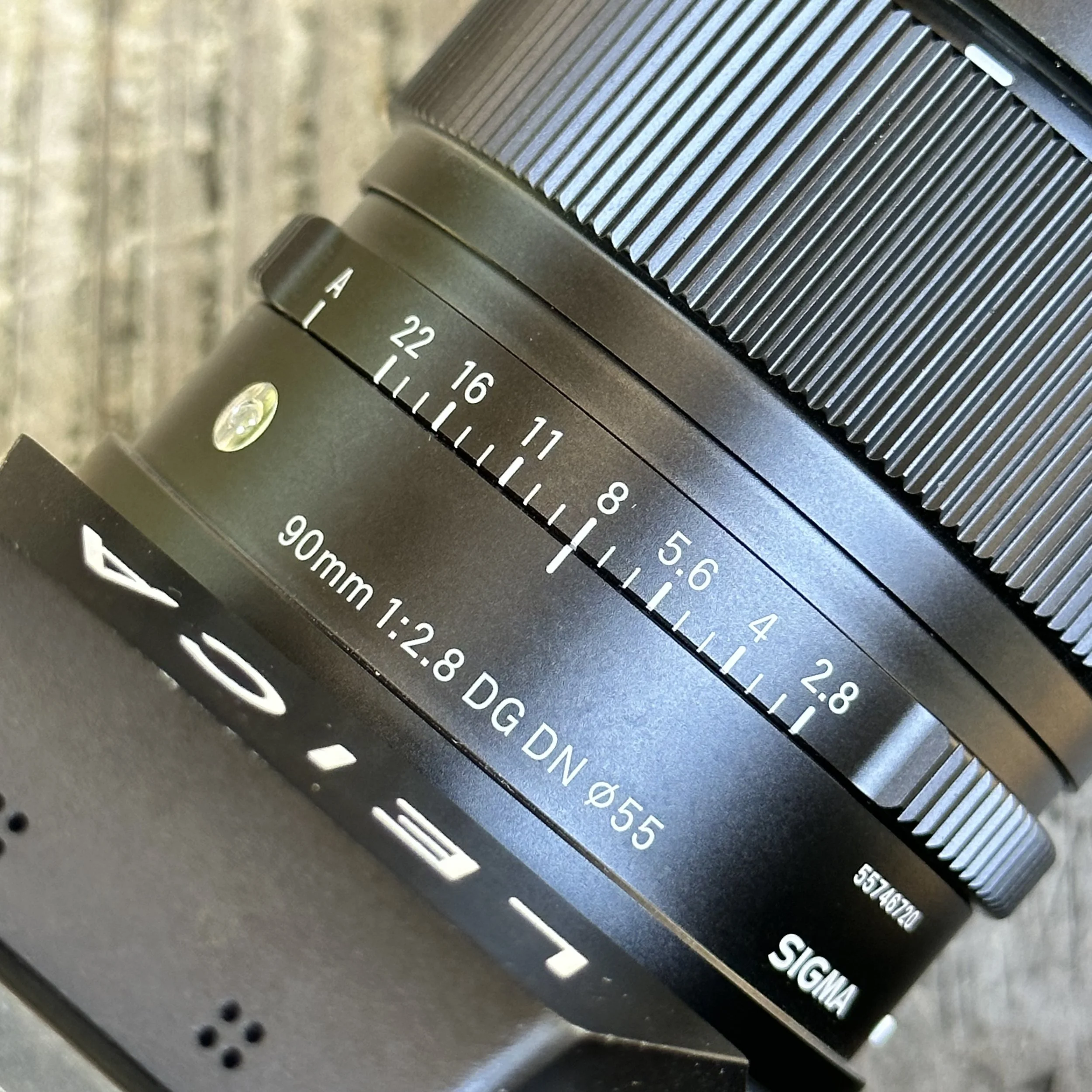
The aperture ring on the Sigma 90mm with 1/3 stop detents. This is a really nice feature that allows manual aperture control mapped to a control surface photographers are already used to. Turn it to "A" for camera-controlled aperture. Simple and intuitive!
The next thing they did on the lens that I am not so sure I like yet is to put a switch to choose between manual and automatic focus. The Leica lenses use a software control to do this and it is pretty simple to implement and once you get used to doing it that way it really is a good system. There are less openings in the lens to let water in and the control is right they with the various auto focus modes all in one spot. The Sigma system has you choose manual or auto on the lens and then if you choose auto, you have to further goto the software and choose the automatic mode you want. It makes choosing autofocus a two step affair. This is probably just a user issue where I lack practice with the lens, but this seems a little clumsy compared to the Leica process. It is possible that Leica didn’t share all the tech needed to make this happen, I don’t know, but like I said I am on the fence on this one.

The AF/MF switch on the lens barrel. This is the one design choice I'm not sold on yet. Leica lenses use software control for focus modes in one step. The Sigma requires you to switch here first, then choose the AF mode in the camera menu. It's a two-step process that feels clumsy compared to Leica's system. Still works fine, just takes getting used to!
Lastly is image quality. The Sigma has it. It produces sharp, distortion free images with good color and exposure. What more can I say here? It really is amazing what you get for the price. These lenses can run with the big boys, in my opinion, just fine. If you pixel peep deep enough you might find fault in them, but only photographers do that. The normal person never digs into the corners or zooms into 500% on a photo so I am not going to rate this lens like that either. The photos look wonderful…just look at the ones below.
Sample Photos: What This Lens Can Do
Let me show you what this lens can actually produce in real-world use. These are all shot with the Sigma 90mm f/2.8 on my Leica SL2:
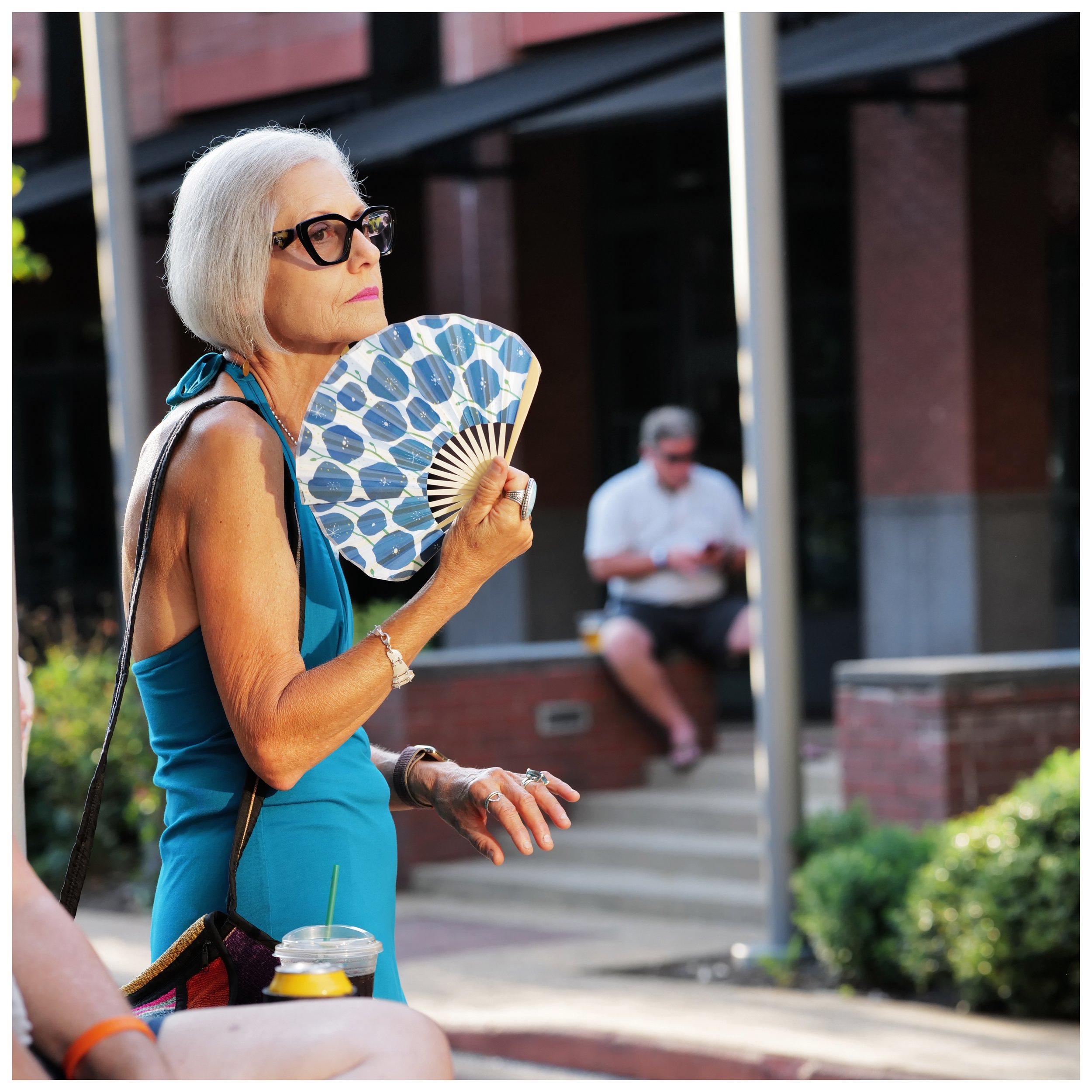
Sample photo shot with the Sigma 90mm f/2.8 on my Leica SL2. Look at the sharpness, color rendering, and contrast! This lens produces distortion-free images with excellent detail. What more can you ask for at this price point?
Look at the sharpness across the frame! The colors are accurate without being oversaturated, the bokeh is smooth and not distracting, and the compression at 90mm makes these compositions work. The first photo shows how this lens handles contrast and detail in mixed lighting. The second demonstrates subject isolation at f/2.8. The third shows color rendering in challenging light.
This is what you're getting for $600. Not "budget lens performance." This is legitimate high-quality glass that happens to cost less than the Leica equivalent.
One thing to note: these photos weren't babied. I was shooting handheld in various lighting conditions, some shots were wide open at f/2.8, and I didn't do any special post-processing beyond my normal workflow. This is real-world performance, not controlled test charts!

Another example of what this lens can do. The 90mm focal length gives you nice compression and the f/2.8 aperture provides good subject separation. The bokeh is smooth and not distracting. This is Leica-quality glass at a fraction of the cost!

More proof that the Sigma 90mm delivers excellent image quality in real-world use. Colors are accurate without being oversaturated, detail is sharp across the frame, and the lens handles mixed lighting well. These aren't test charts, this is actual photography!

Final sample showing the Sigma 90mm's capabilities. Shot handheld in Chattanooga during a block party. The lens is sharp, colors look great, and the compression at 90mm makes the composition work. If you want great glass at a fraction of Leica's price, this lens is the ticket!
Sigma vs Leica: Is the Price Difference Worth It?
Let's address the elephant in the room: Leica makes a 90mm lens for L-mount. The Leica APO-Summicron-SL 90mm f/2 ASPH costs about $5,400. The Sigma costs $600. That's a $4,800 difference.
What do you get for that extra $4,800?
The Leica advantages:
One stop faster (f/2 vs f/2.8)
APO designation (apochromatic correction, minimal chromatic aberration)
Legendary Leica color rendering and micro-contrast
Full weather sealing
Leica brand prestige (if that matters to you)
Probably slightly sharper wide open (though the Sigma is already sharp!)
The Sigma advantages:
Costs $600 instead of $5,400
Still produces excellent images (as you can see from my samples!)
Aperture ring with detents (Leica's is clickless)
Compact and lightweight
You save $4,800 that you can spend on other lenses or, you know, food!
My take: If you're a professional portrait photographer who needs f/2 and perfect optical performance for paying clients? Maybe the Leica is worth it. If you're a Leica SL2 shooter who wants excellent 90mm performance without spending a small fortune? The Sigma is absolutely the right choice.
I'd rather have the Sigma 90mm f/2.8 plus a Sigma 35mm and 65mm for the same price as one Leica 90mm. That's three lenses versus one! Unless you're chasing that last 5% of optical perfection, the Sigma is the smart buy.
Pros, Cons, and Who Should Buy the Sigma 90mm f/2.8
Let me break down the good and the not-so-good about this lens:
What I Love (Pros):
Image quality is excellent: Sharp, great color, minimal distortion
Compact size: Fits easily in a bag, lens hood is bigger than the lens!
Aperture ring with detents: Manual aperture control feels great
All-metal construction: Feels solid and well-made
Price: $600 vs $5,400 for the Leica equivalent
Real f/2.8: Not a variable aperture zoom, consistent light gathering
What I Don't Love (Cons):
Two-step focus mode selection: AF/MF switch on lens PLUS software menu selection feels clumsy compared to Leica's one-step software control
Only f/2.8: If you need f/2, you'll have to step up to the Leica (and pay 9x more)
No weather sealing: Leica lenses are weather sealed, this isn't
Learning curve: Takes some getting used to if you're coming from Leica's system
Who Should Buy This Lens:
Leica SL2 or Panasonic S-series shooters on a budget
Portrait photographers who want 90mm without spending $5,000+
Anyone building an L-mount lens kit and prioritizing value
Street photographers who like compressed perspective
Photographers who appreciate manual aperture rings
Who Should Skip This Lens:
People who absolutely need f/2 or faster
Photographers who require weather sealing for their work
Anyone who already owns the Leica 90mm f/2 (obviously!)
Wide-angle shooters (this isn't your lens!)
Support this website by using these affiliate links to shop on Amazon:
Sigma 90mm F2.8 DG DN for L Mount
Nikon AF-S FX NIKKOR 105mm f/1.4E ED Lens
Voigtlander Nokton 35mm f/1.4 II
Sandisk 128GB Extreme Pro memory cards
Final Thoughts
So in conclusion, if you want great glass at a fraction of the cost of Leica, this lens is just the ticket. Sigma has done a complete 180 from the last time I used one over a decade ago and that makes me happy.
Here's my bottom line: The Sigma 90mm f/2.8 DG DN is the lens Leica SL2 shooters should buy if they can't justify $5,400 for the Leica version. And honestly? Most people can't and shouldn't justify that price difference. The Sigma produces excellent images, feels solid, and costs less than many Leica lens hoods!
The only real downsides are the two-step focus mode selection (which is a user interface annoyance, not a deal-breaker) and the lack of weather sealing. If those don't bother you, this lens is a no-brainer for L-mount shooters.
Sigma has seriously stepped up their game in recent years. I remember using Sigma lenses a decade ago and being underwhelmed. These new DG DN lenses for mirrorless mounts? They're competitive with first-party glass at a fraction of the price. This is exactly what the L-mount system needs—excellent third-party options that don't compromise on quality.
Would I rather have the Leica 90mm f/2? Sure, if someone else is paying for it! But would I rather have the Sigma 90mm plus four other Sigma primes for the same money? Absolutely. That's the math that makes sense for most photographers.
Now get your camera out and go take a picture with it!
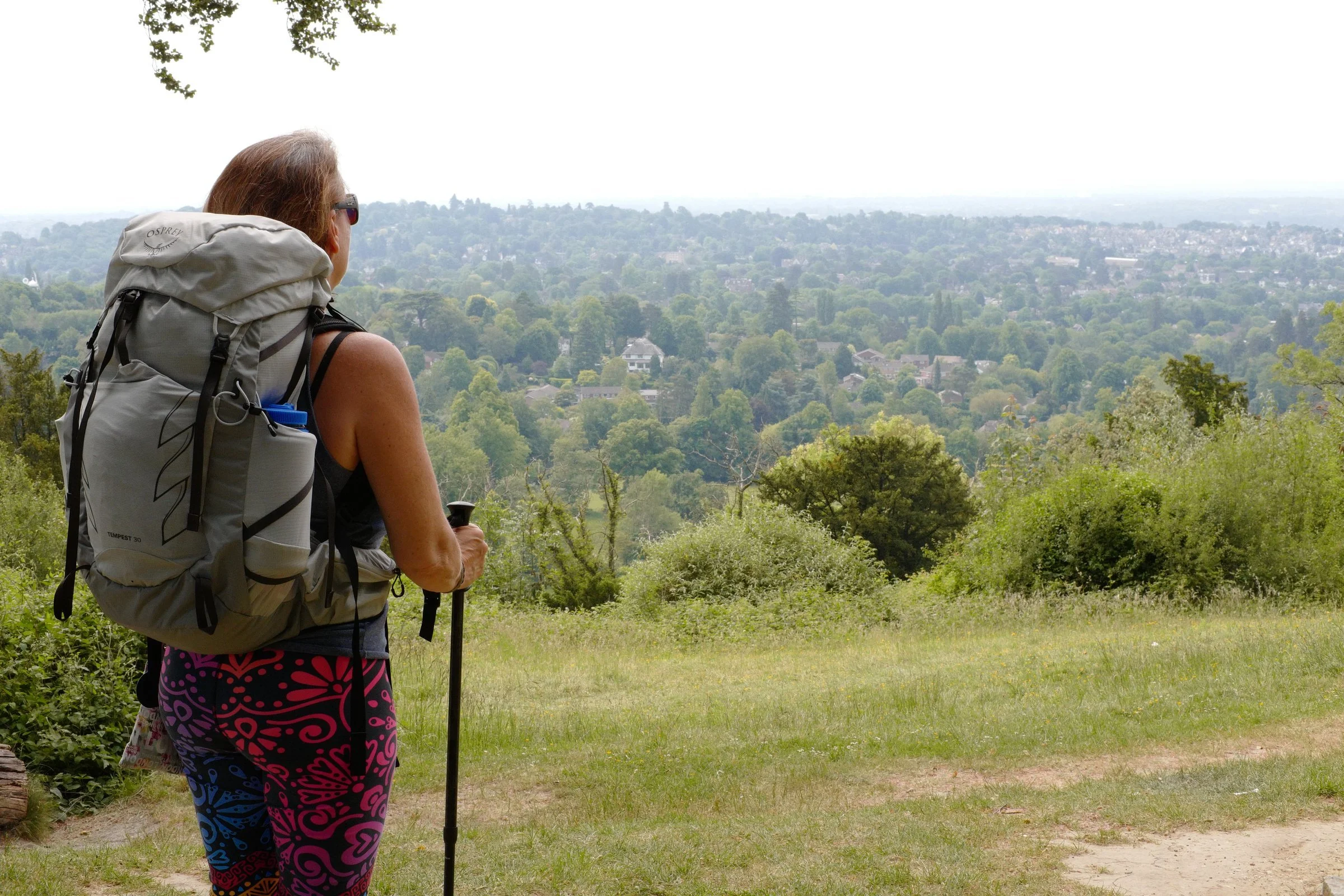
Canterbury Pilgrimage AAR: 2-Week Hike from Winchester to Canterbury (England)
When my friend Kelly first mentioned hiking the Canterbury Pilgrimage, I'll admit I was skeptical. I'd never done a long-distance hike before, and two weeks walking across England seemed ambitious at best. But Teresa and I said yes anyway, and that decision led to one of the most memorable adventures of my life.
When my friend Kelly first mentioned hiking the Canterbury Pilgrimage, I'll admit I was skeptical. I'd never done a long-distance hike before, and two weeks walking across England seemed ambitious at best. But Teresa and I said yes anyway, and that decision led to one of the most memorable adventures of my life.
The Canterbury Pilgrimage follows the historic Pilgrims Way from Winchester to Canterbury, the same route immortalized in Chaucer's Canterbury Tales. Over two weeks in June of 2023, we hiked through some of the most beautiful countryside England has to offer, stayed in quaint villages, explored ancient churches, and learned valuable lessons about packing light, staying hydrated, and stopping to smell the flowers.
This is our complete guide to the Canterbury Pilgrimage, including planning, packing, daily experiences, gear that worked (and didn't), and practical lessons for anyone considering this trek.
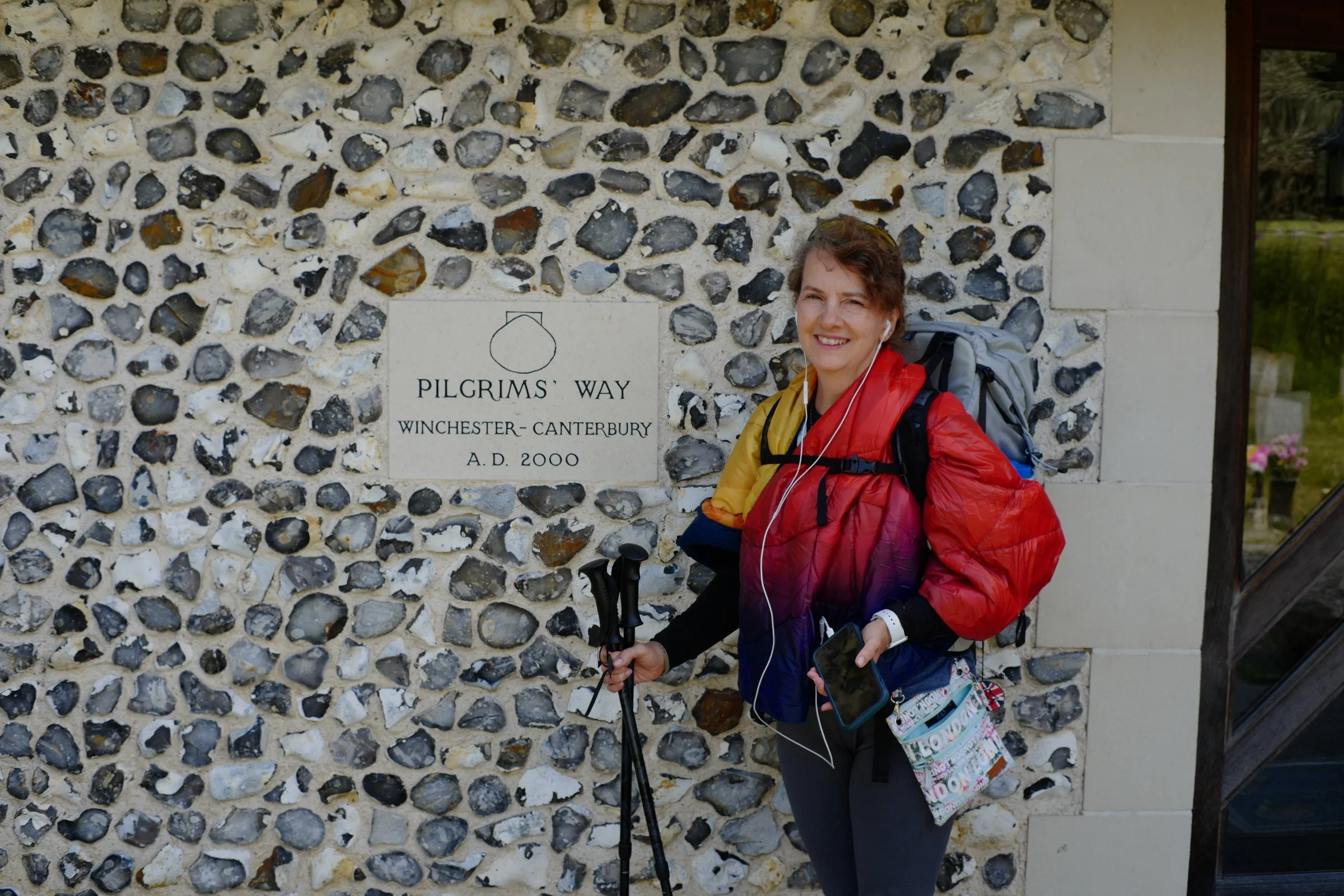
Teresa on the Pilgrims Way or AKA The Canterbury Pilgrimage in southern England
Planning Our Canterbury Pilgrimage: How It Started
When I first heard about this I was intrigued to say the least. I had never really considered doing a pilgrimage before or even doing extended length hiking trips of any kind. Enter Kelly, a lifelong friend and adventurer(she married one of my best friends in high school and was in our Dungeons and Dragons group). She tells of this adventure in England where she was planning to hike from town to town and follow the original Pilgrims Way laid out in the Canterbury Tales as well as a few notable stops while in London as well. (We also saw The Phantom of the Opera while in London!)
Well, us being the adventurous types that we are, we asked if there was room in the group for us too! As it turned out, the three of us would be the WHOLE group which actually worked out really well. So we started planning the adventure of a lifetime.
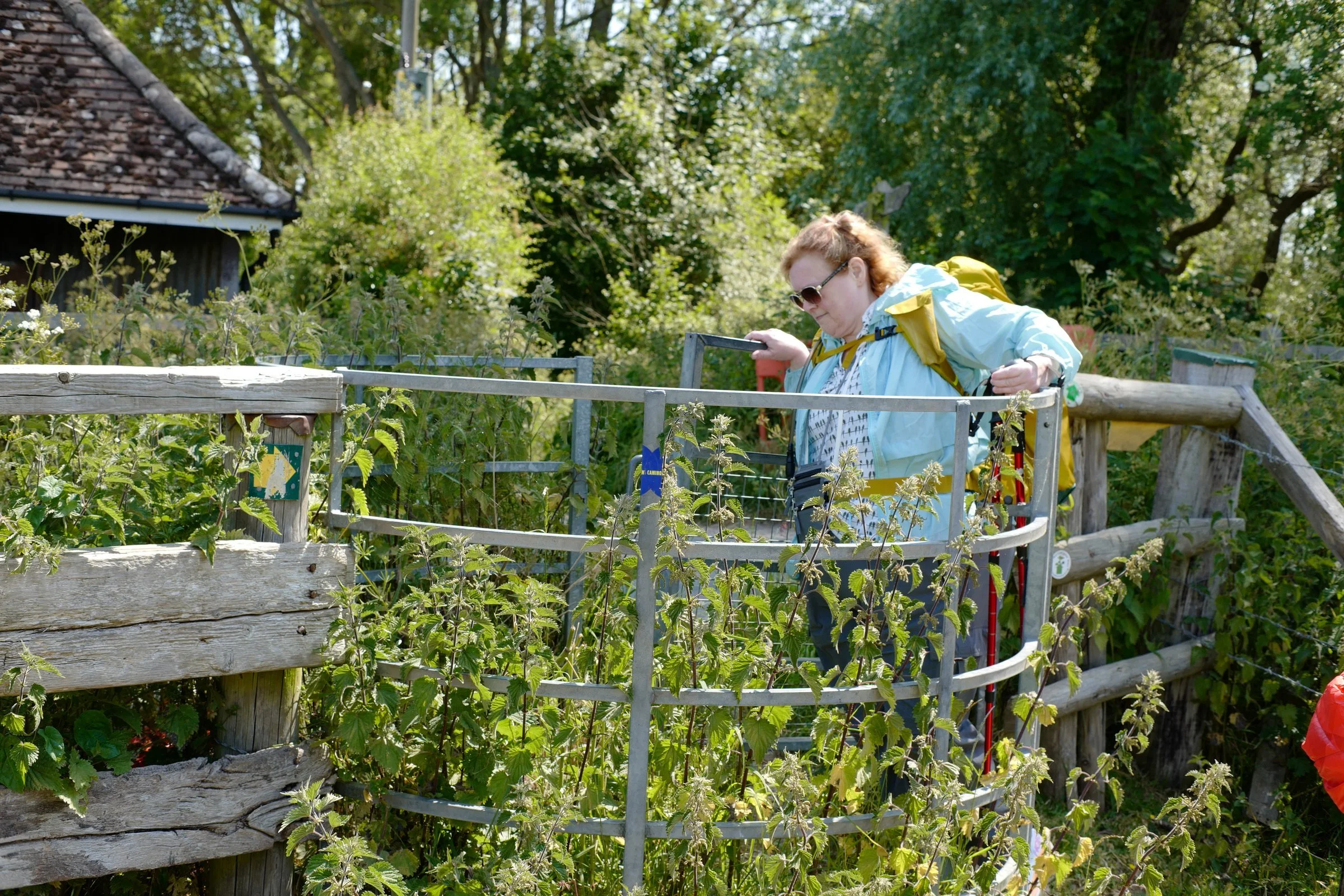
Our friend Kelly working her way through a "kissing gate" amid a veritable sea of Stinging Nettle!
Packing Light: The Backpack-Only Strategy
We decided early on to only bring what we could carry in our backpacks. Gone would be the "checked bag" at the airport as well as bringing computers and the associated baggage required for their operations. This actually made the airport part of the journey very easy as we didn't have to stand in lines for the check bag counter nor did we have to deal with baggage claim at all. It was very liberating to be honest.
The first thing we decided to do was limit our equipment to what we could carry in our respective backpacks. This eliminated a literal mountain of gear that we had deemed needed but optional. It also made the journey much nicer. We finally decided on a couple of changes of clothes, I took a small amount of camera gear in a dry bag (since it rains in the UK a lot), and a water bottle. We would pick up snacks along the way and add that to our loadout as we needed it.
Lightweight travel concept of only taking what fits in a backpack and nothing more is very liberating.
This also generated another benefit with our travel: the airport processing got A LOT simpler this way. We literally didn't check anything, so we just went through the TSA checkpoint and carried our packs right to the gate. Our hands were free to do things like buy coffee or get out credit cards! It made traveling so much less stressful to be quite honest that I might be adjusting my future travel to operate in this mode. You never lose your luggage as you walk onto the plane with it and it fits into the overhead space without issue... every time. This was glorious for me as I worry about the luggage making it to the same place as me or even worse, not arriving at all.
Just consider this a travel hack that actually works if you can live without all the stuff in your check bag…
Camera Gear for 2 Weeks of Travel Photography
Since we had decided to travel so light, I took a hard look at the camera kit I would use on the trip as well. I whittled it down to just the Leica CL, the TTartisan 17mm f1.4 L mount lens and the 35mm f0.95 L mount lens. That's it, no other gear whatsoever. Well... there were batteries and a charger, but you get the point here. So I quickly learned that I liked the 17mm in London and then once we got to Winchester I switched to the 35mm and left it in place almost the rest of the trip. To be honest, I could have left he 17mm at home and it would have been fine…lesson learned.
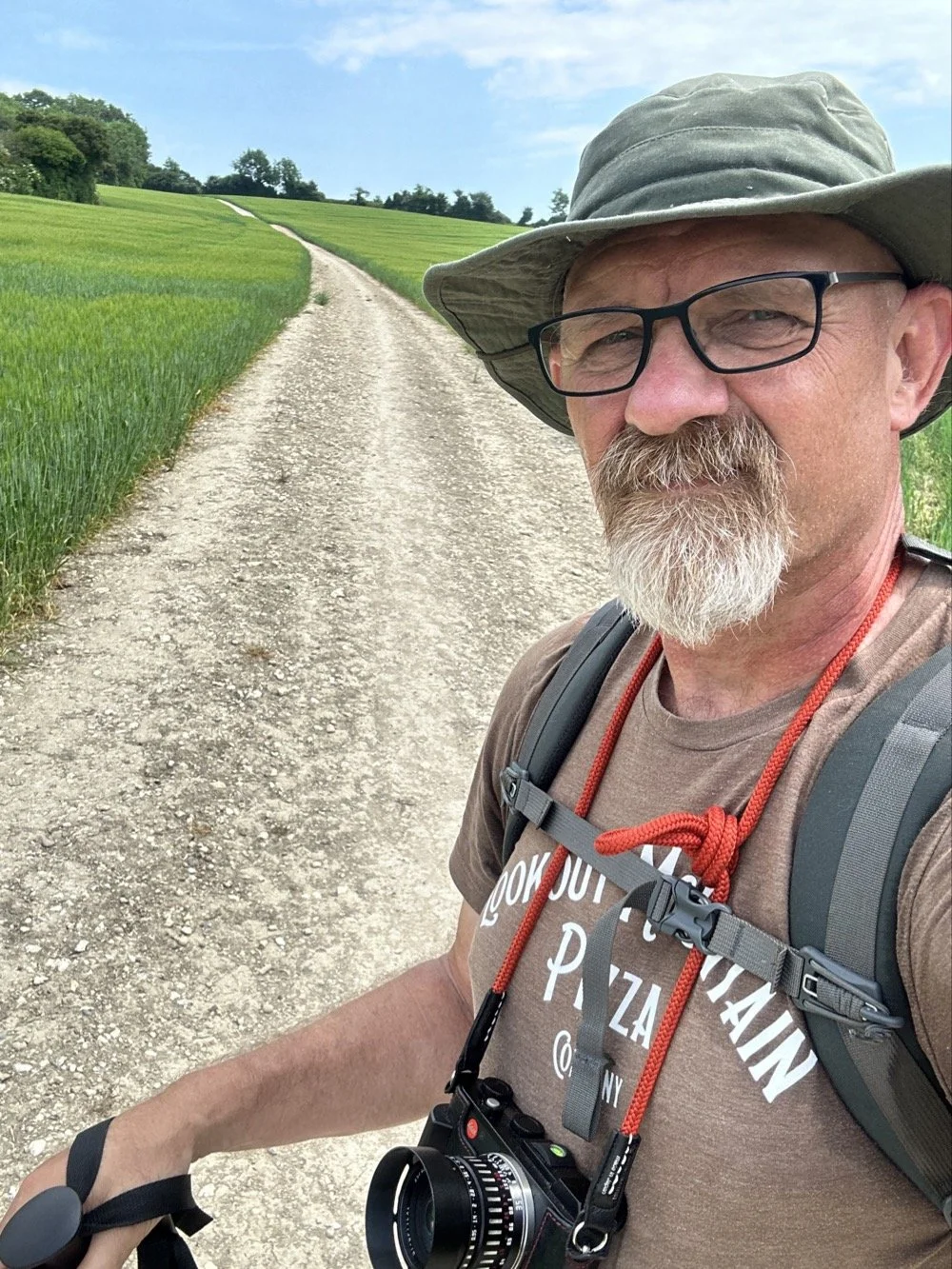
The author with the Leica CL mirrorless camera and the TTArtisan 35mm f0.95 lens on the Pilgrim's Way
For this trip I decided to travel light so I took my Leica CL and two prime lenses: the 17mm f1.4 and the 35mm f0.95 prime lens. Turned out I wished I had taken the 35mm f1.4 as it is smaller and lighter than the 0.95 aperture lens and would have saved me some weight. I don't know if I even once opened up to f0.95 on this trip, even at night. I just didn't need it, so it was wasteful to bring it.
I took a dry bag to protect the camera gear since it rains in the UK a lot. Smart decision, as we did hit some wet weather!
Mystery Ranch Backpack Review: 25-30 Pounds, No Back Pain
As for hiking gear, my loadout for this trip was as follows: I had a full change of clothes plus extra socks, I also took my phone charging gear, a Katadyn water filter as I was not sure if I would have ready access to clean water. Sometimes you don't have that access to be honest, and I wished I had taken another water bottle as well... I took a single Nalgene quart water bottle, a ziplock bag of snacks from the grocery store, a rain coat, and my dry bag with my camera gear in it, and that’s it.
I picked up a set of trekking poles in Winchester that I almost wore out by the end of the trip. My backpack that I used on this trip is a Mystery Ranch Pitch 40, which is actually geared toward rock climbing but worked just fine for this trip. I am going to take a moment here to point out that a really well-engineered backpack makes all the difference in the world. I was carrying about 25 to 30 pounds from day to day and my back was NEVER sore or painful from the pack, not even once. I can absolutely, and with certainty recommend Mystery Ranch backpacks after this trip. They work.
I never really understood how to properly use a backpack, but after using this one, I figured it out and got it dialed in. It is not really designed for this kind of trek, but rather it is engineered for route climbing and carrying rope and chalk and harnesses and such instead. I just used it anyway as it is what I had at the time. This didn’t seem to be a problem though as the load bearing system puts the load on your waist and not your shoulders. This is where people get things wrong because small bags and haversacks place the load on the shoulders and this causes fatigue unnecessarily. If you adjust your pack properly, you can carry it for hours and you will just be tired from the trekking and you will be sweaty from the physical workout, but your back will not hurt.
Arriving in London: Tourist Mode Before the Trek
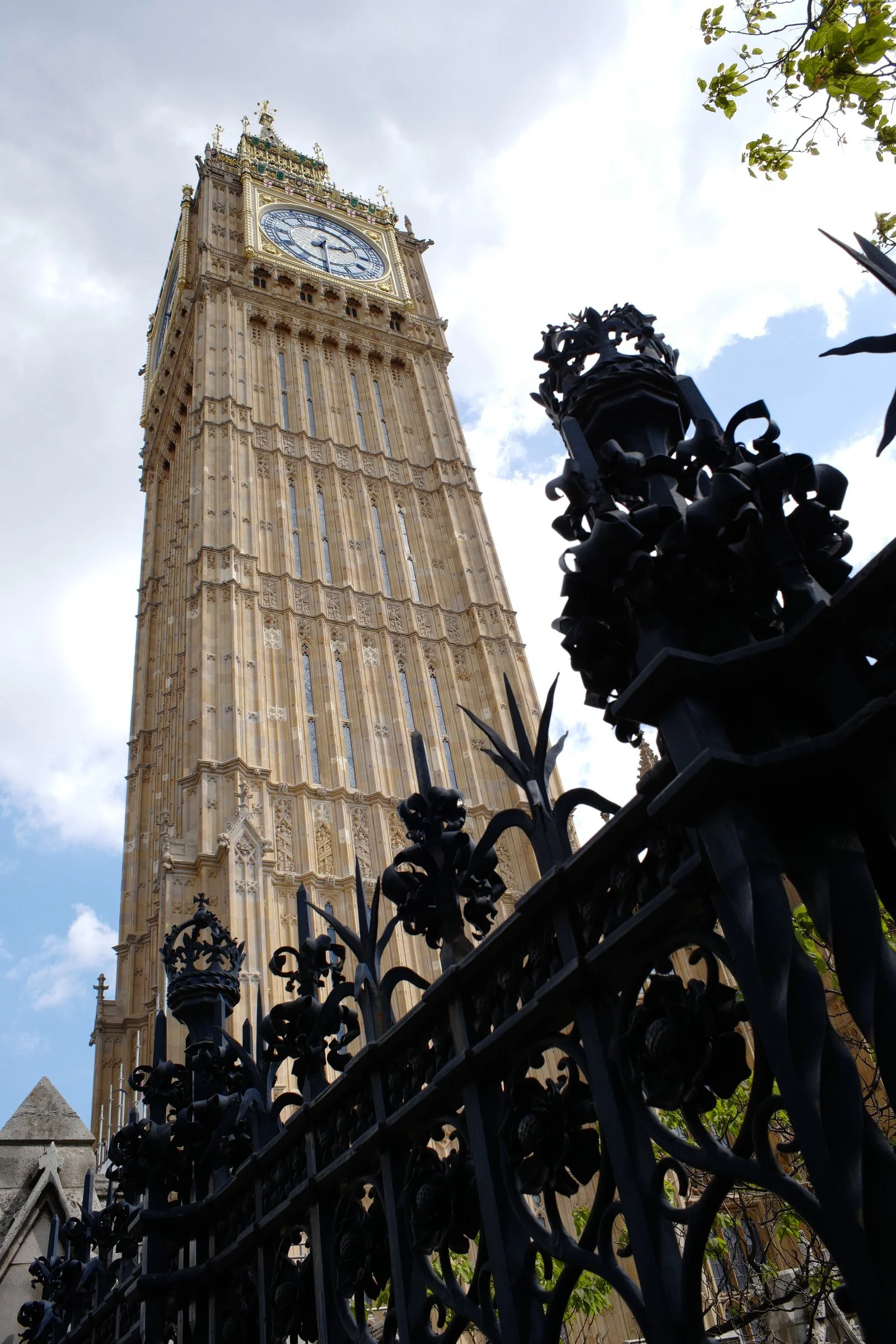
Big Ben in London England is an incredible iconic landmark that is a must see if you are in London. We did the usual tour and then went for a walk, which is how I was able to get this photo with the Leica CL and the TTArtisan 35mm f0.95 lens.
Once in England we started in London where we did the usual tourist stuff for a couple of days ahead of starting the pilgrimage proper. This included a bus tour and a short trip to the British Museum as well. We even took in the Phantom of the Opera while in town. What a treat that was! I was wholly unprepared for the experience that is the Phantom of the Opera, totally worth it.
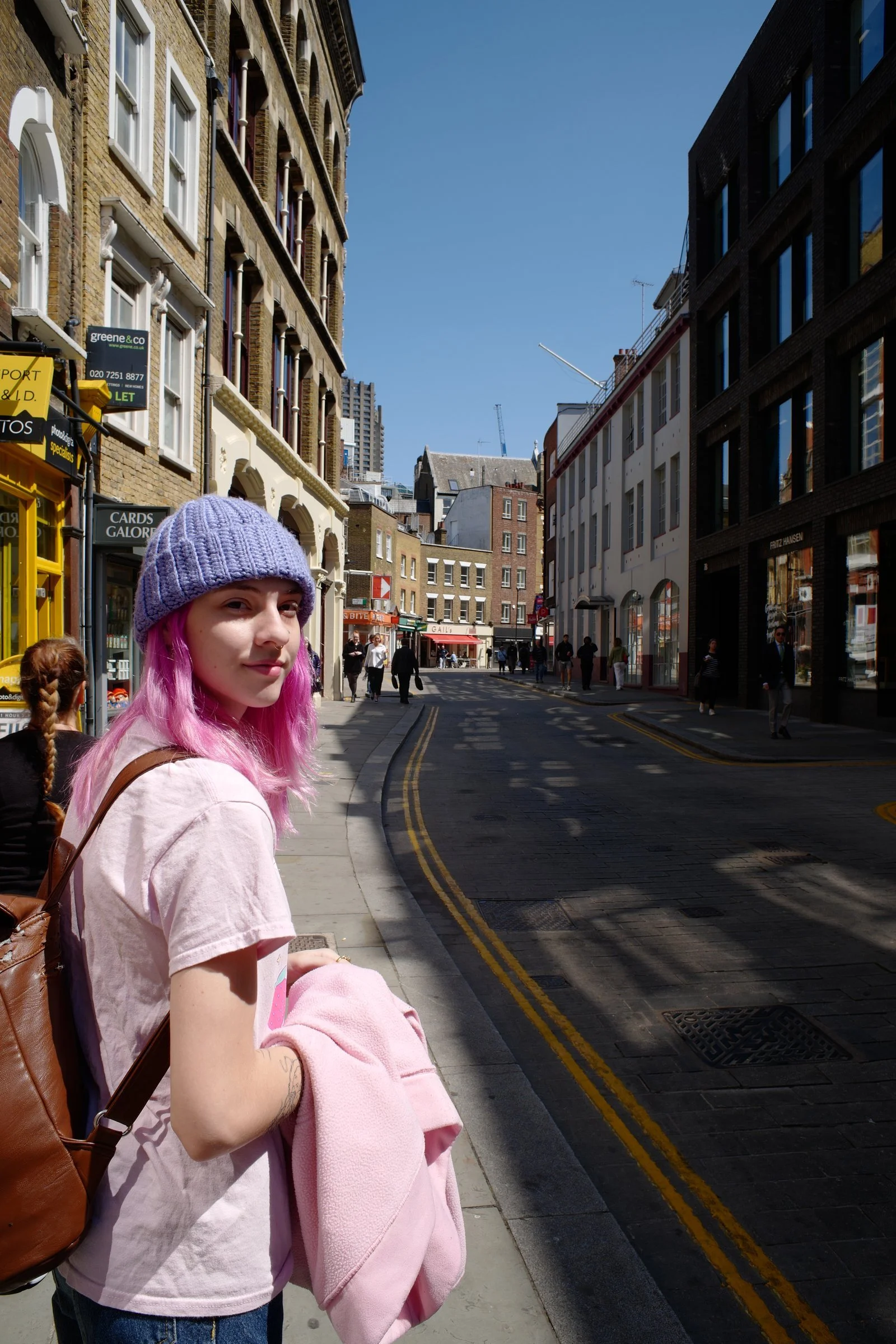
The daughter went with us to visit London and to hand out with us for the first few days of the Canterbury Pilgrimage, even though she cheated…
Well, once on the ground in England we checked into our hotel and went for some food. What we found is that the food in the UK is... different... from what we are accustomed to here in the US. We had to adjust to this as it seemed that they have a very specific diet and do not vary from it for any reason. We joked about how for a country that conquered most of planet earth at one point for spices…. doesn’t know how to use them! I will never understand this whole “beans on (soggy) toast” thing either…
We spent the next couple of days being tourists in London for the sake of brevity, then we embarked on the mission to Winchester to start the pilgrimage. We saw all the usual stuff, like Piccadilly Circus and Trafalgar Square and Westminster Abby and such, but it was only for a day or so, then it was off to Winchester!
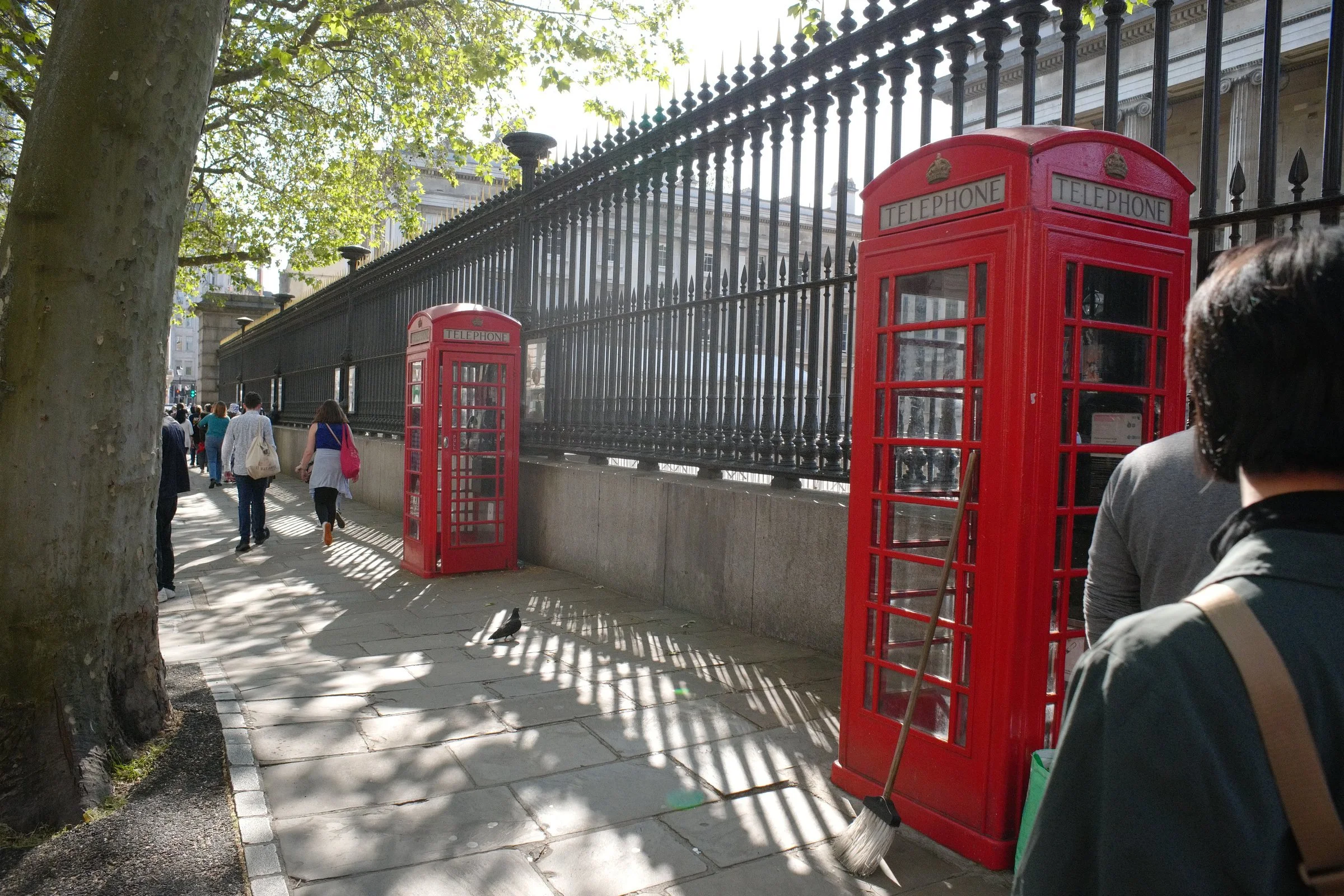
The fence outside the British Museum showcasing the iconic telephone booths in London.
Winchester Cathedral: The Official Start
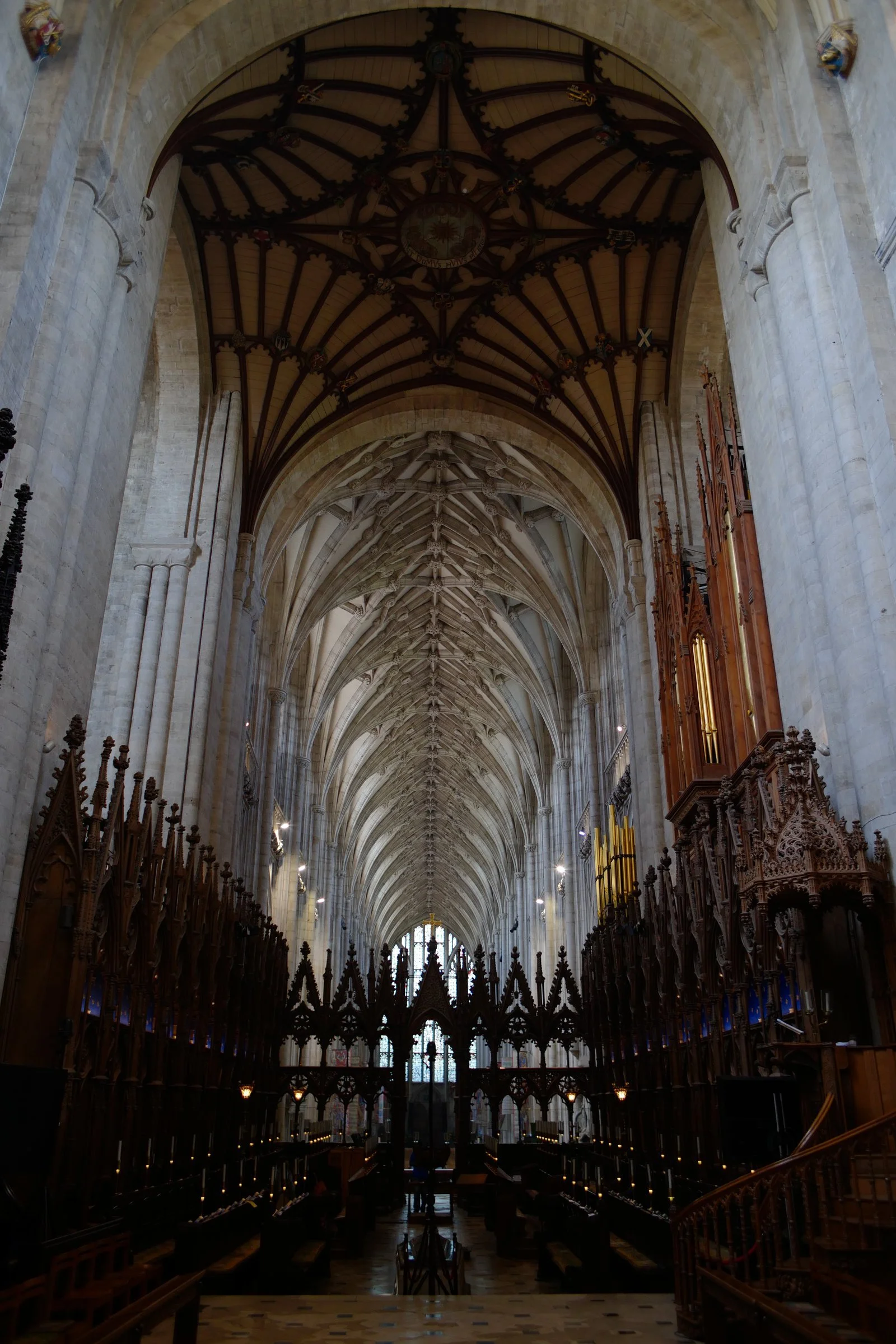
Interior of Winchester Cathedral in Winchester England.
Once in Winchester we attended a service at Winchester cathedral and received a blessing from the priest before we started, which was a really nice touch to add to the whole experience to be honest. If you do this hike, I recommend attending a service at the cathedral even if you're not really religious and hear the boys choir. The singing is beautiful. It also just adds a little something special to the trip in my opinion. I think the evening service is called “Evensong” or something like that, it is beautiful. We also found an outfitter in town (who would have guessed that there would be a HIKING outfitter at one end of the Canterbury Pilgrimage? HaHa) and this is where we learned about the value of trekking poles and decided to get a couple of sets for me and Teresa. I am really glad we did too, they helped so much! I will not do long hikes without them anymore. Once you see how much they help with load distribution as well as balance, you will never want to hike without them again too.
Now the adventure officially begins…
Winchester to Arlesford (First Steps)
Well, we strike out and head for the next town and I must say at this point that the English countryside is absolutely gorgeous! We couldn't get over how everywhere we looked that it looked like a postcard! We walked by beautiful fields, streams and all these little communities with some of the nicest people we have ever met!
The first “destination” was Alresford which is a quaint little village in the countryside that has several really old buildings (which becomes a recurring theme on this trip). One of which was constructed before the USA even existed. I point in out in one of the videos listed below actually. It turns out that it takes a lot longer to cover 8 to 10 miles than I thought it would too, we were complete neophytes at this and were REALLY over ambitious about how fast we would move on the trail, turns out we go ALOT slower than we thought… this resurfaces later in the blog, but just keep that in mind if you think you want to do this hike.
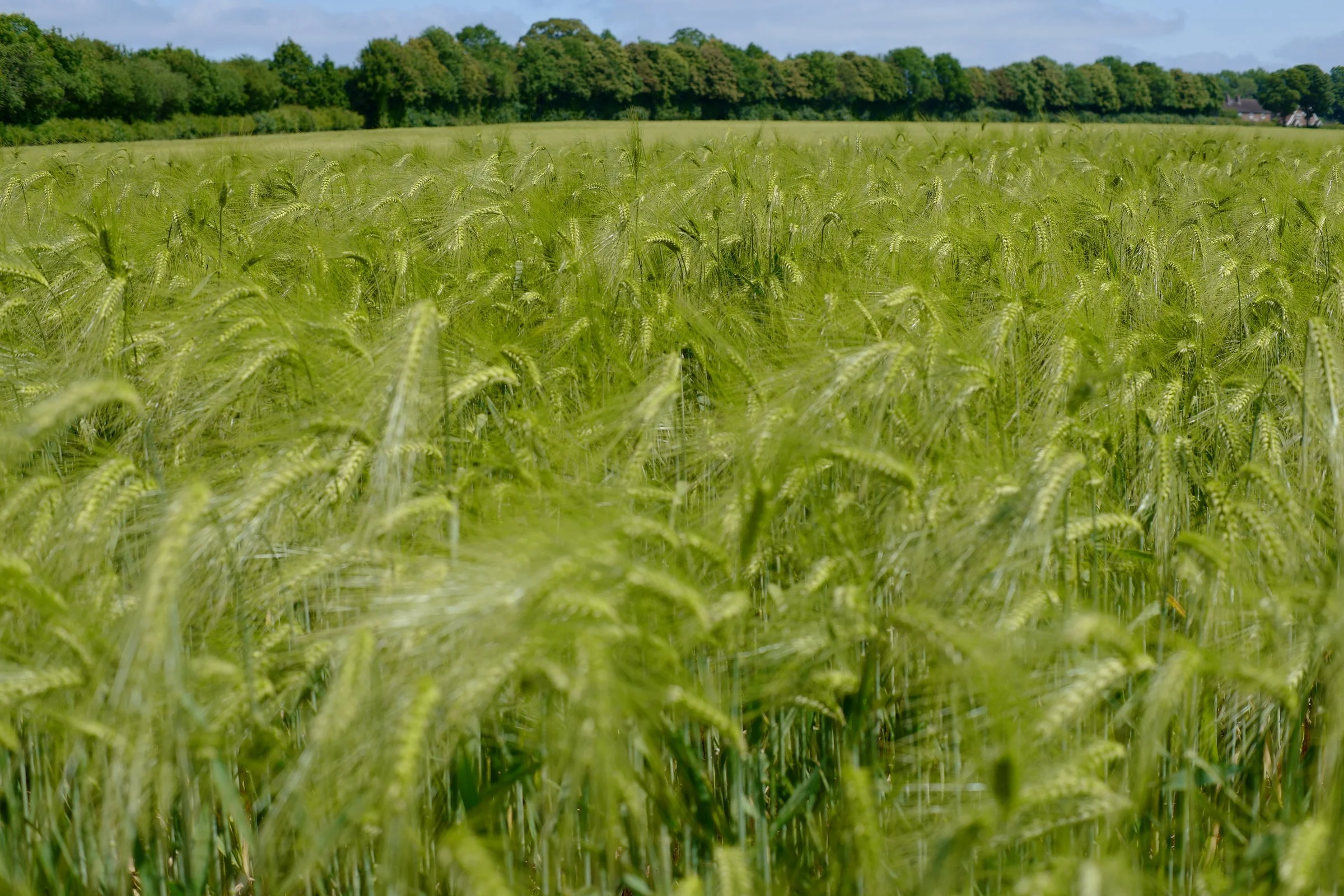
Wheat field south of London England on the Pilgrim’s Way of the Canterbury Pilgrimage.
Some of the things we have learned are that stinging nettle is a legit plant you don't mess with and it is literally EVERYWHERE. Another one is that the locals are very friendly, especially the older ones, and are a real treat to chat with when you find them here and there. They loved my accent most of the time and would call me “the Yank” when they would hear me talk…it was almost comical as I have a very strong Appalachian accent as you can hear in the video as well. The trail also isn't just a hiking trail through the woods, but more of a "way" which will cross fields, go down designated paths or even along roads at times. You really have to pay attention to make sure you don't miss your turn...ask me how I know.
All that aside we had a wonderful first day on the trail, albeit a long one where we ran into really interesting people and also learned a few things about the local flora and fauna we didn't know either.
English Countryside: Why It Looks Like Postcards
The English countryside is some of the most picturesque terrain I have ever laid my eyes on, and for the locals it is just...home... I have seen a lot of beautiful places on this earth and they all have a charm. The charm here is the people and how they groom the landscape for agriculture beautifully. It is literally a postcard in almost any direction you look. So I did just that, took photos in every direction, and wound up with something like 1400 unique images when I got home two weeks later.
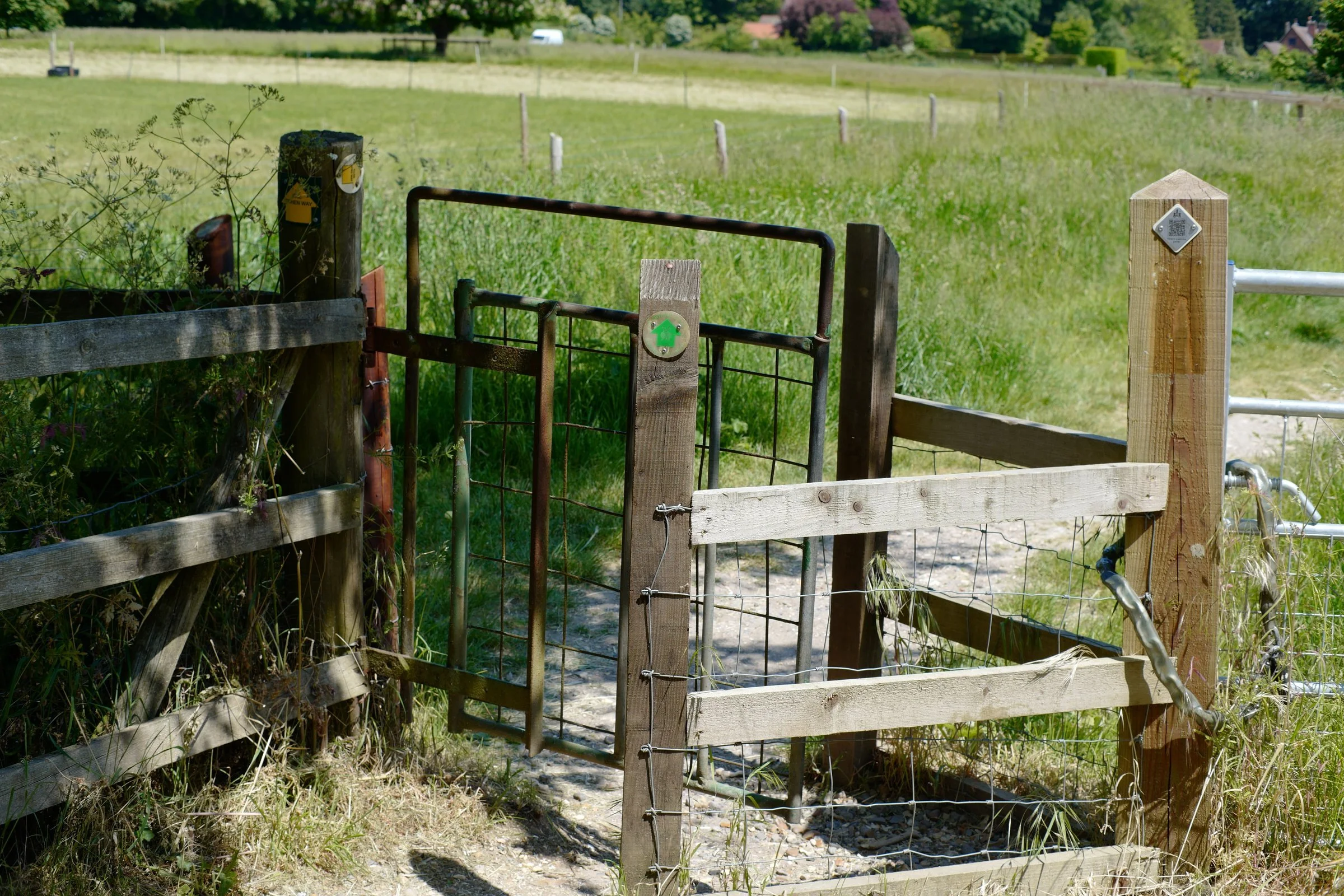
When you would cross from one field to another or maybe pass from the forest to the fields, you would come to one of these gates in a variety of forms, all of them would work in a pretty similar fashion, but nonetheless, it would be there. This is a simple cattle gate but in the United Kingdom, it is called a kissing gate for some reason. Above you can see Kelly passing through a modern steel kissing gate and they are all over these trail systems in England.
So first things first, hiking this trail is actually really fun. It could be monotonous for someone who isn't comfortable with their own thoughts for hours at a time, but it was fine to me. I didn't even listen to music on this trip, I was just...there...
Day 2: Arlesford to Alton (The 13-Mile Mistake)
From Post 2: This is the hotel we stayed in and it was simply adorable. The whole first floor of the part you see here is a restaurant/pub and the hotel is L shaped with a significant portion out back behind this street facing portion. The rest of the town is also really neat to me as well.
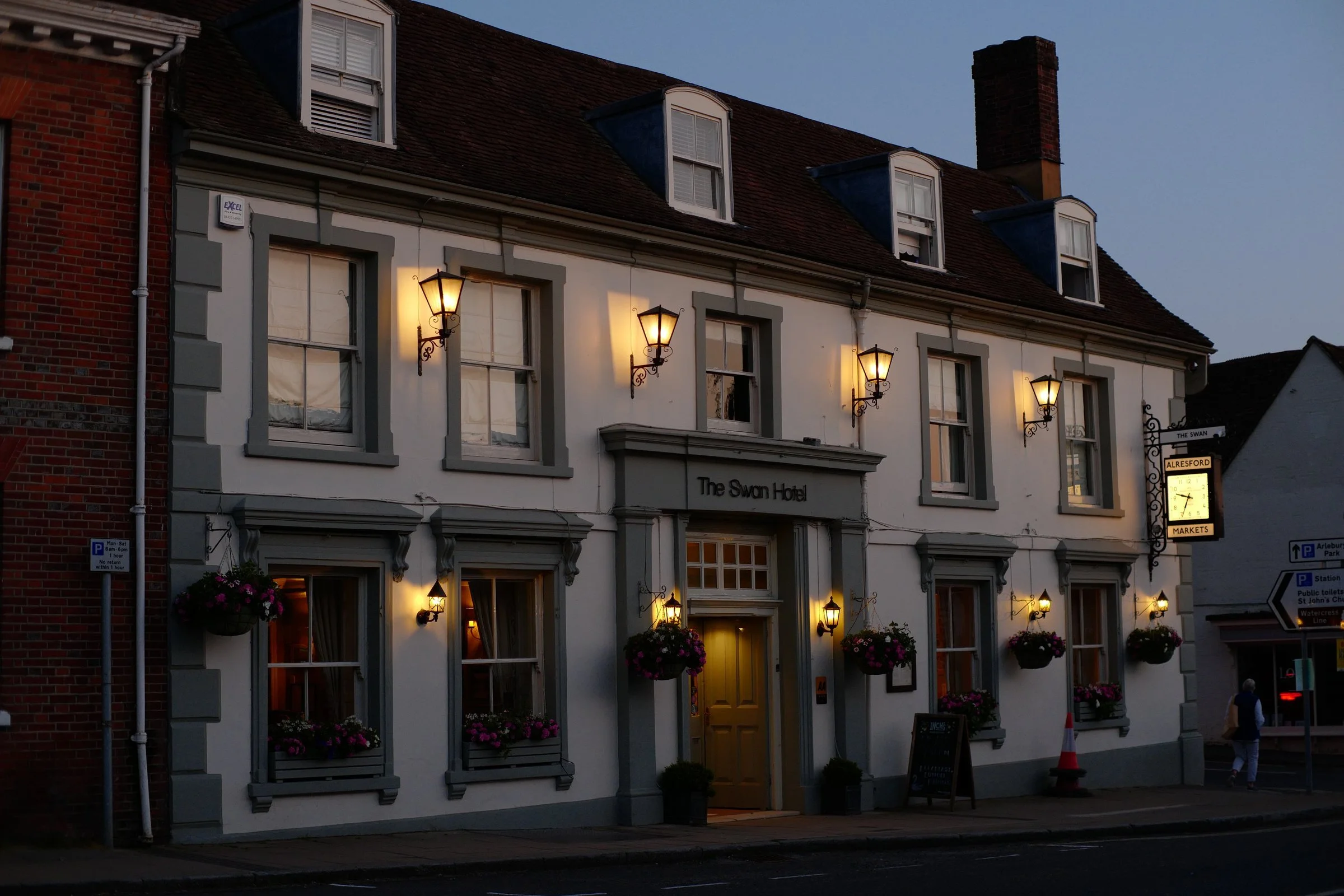
Swan Hotel Alresford England is a beautiful and very old hotel on the Pilgrim’s Way trail.
So the next morning we leave out for the next town and make pretty good time. Alton is a larger town and we are hoping to be there by lunch. Well, turns out the girls decided to take public transportation after about 5 miles or so and I decided to leg it on in... this would prove to be painful.
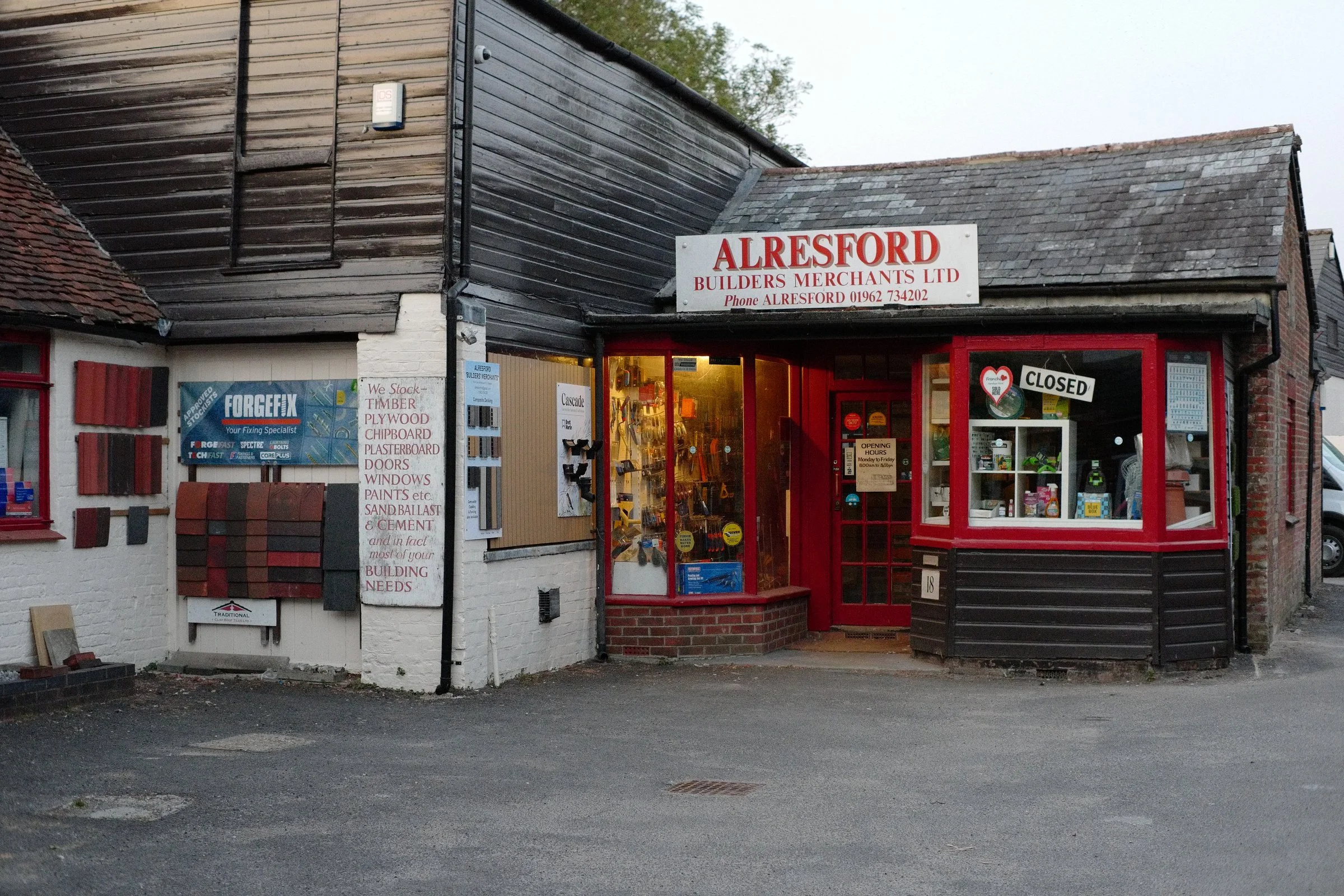
Hardware store in Alresford England is typical of the types of buildings you will find on the Pilgrim's Way.
I had looked at the map and speculated it to be about 10 miles to Alton and figured I would probably cover the remaining 5 miles in about 3 hours since I would be stopping to get photos and the erratic nature of the trail layout and such as that. Well, this turned into a 6-hour slog that added up to an additional 13 miles for the day! It even got to the point where I realized I needed to cover ground more rapidly or I would miss supper so I stopped capturing video for the YouTube channel all together and just grabbed the occasional photo instead. You read that right, 18 total miles in a single day, for a beginner trekker who had done almost no train up for this trip. What I had also forgot to account for was the fact that a lot of it was in the direct sun an really hot. I ran out of water probably with 2 hours left to hike if memory serves me and there was no where to stop and get more without trespassing on farmland. This is important as the trail passes through all this beautiful countryside and we are given special permission to use these trails, but we can not deviate from the trails, you have to stay on the trail. So if the trail doesn’t cross a stream, then there is no water. On this day, it didn’t even pass by houses hardly at all, it was just one field to the next, over and over, with occasional diversions down the country roads (that didn’t have shoulders at all in places).
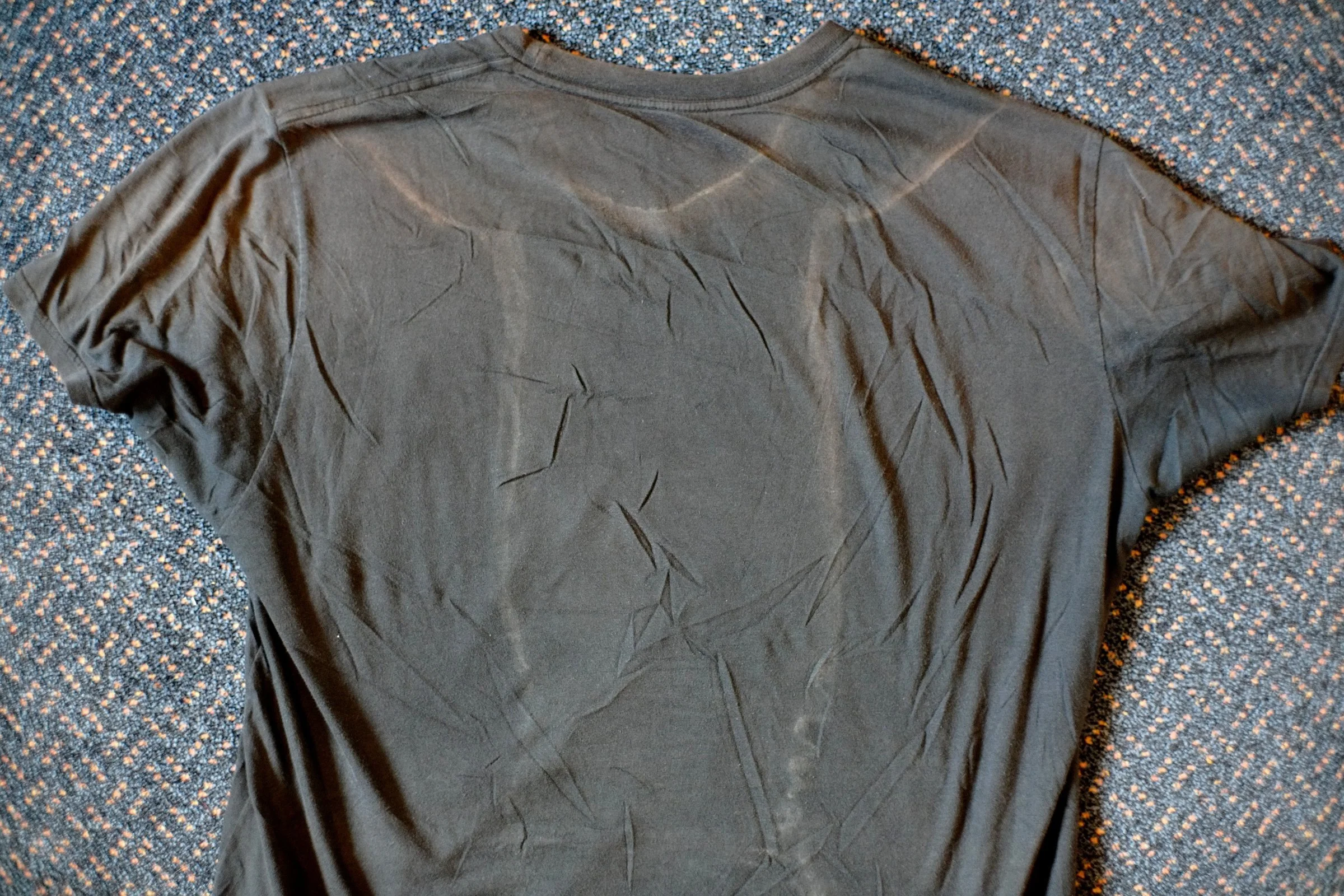
Hydration on a hike is critical and also taking in electrolytes too. I lost a lot of electrolytes on the Pilgrim’s Way trail to Canterbury as this shirt can attest!
Now to be fair, I did cross a lot of beautiful countryside on this leg of the trip and I don't regret making the trek this day, but I failed to drink enough water and had debilitating cramps later that night from dehydration. The lesson here is to drink more water, especially if you are doing an activity that is physically demanding in any way.
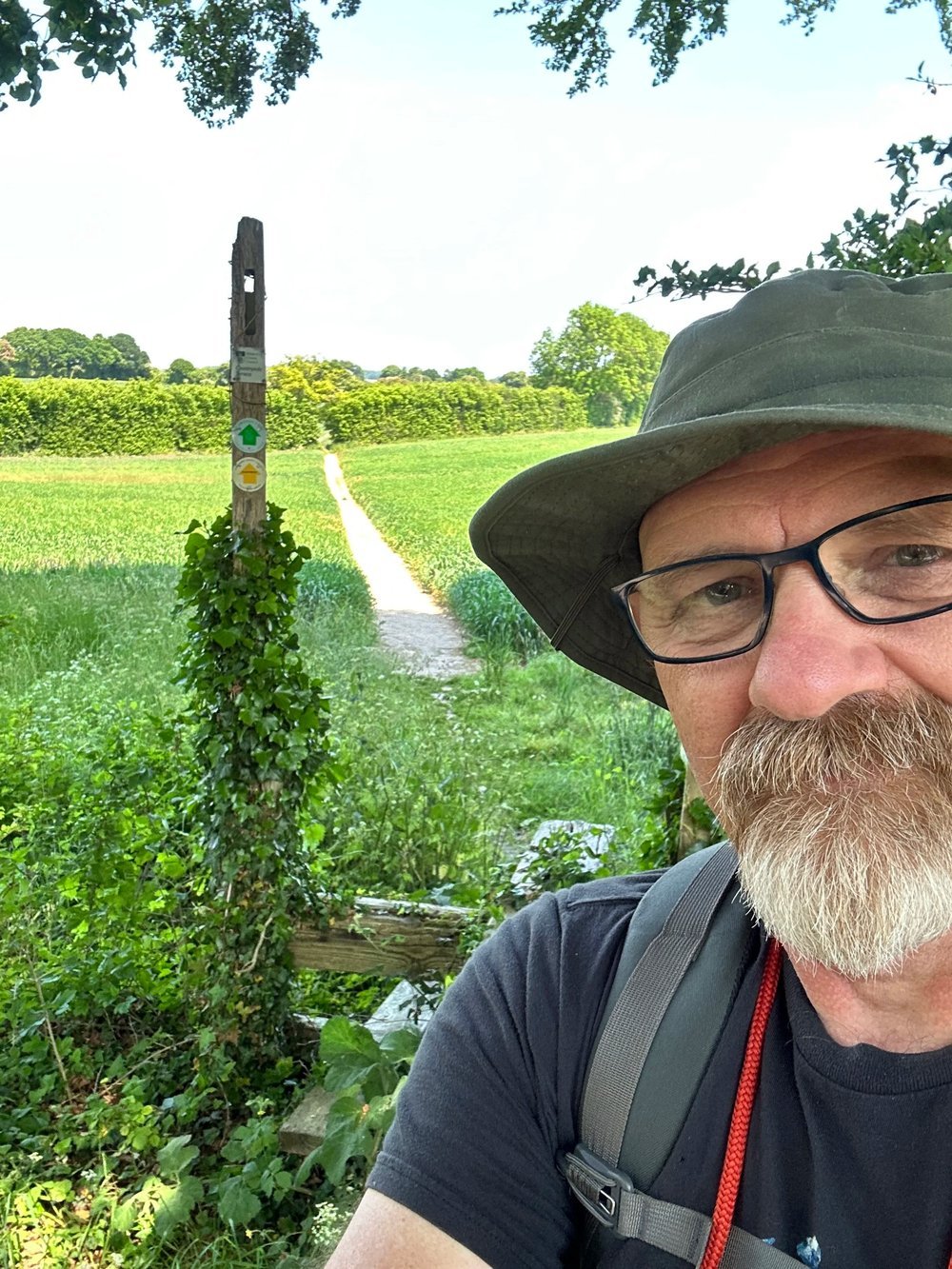
I grabbed this photo about midway through my 18 mile day with a single quart of water…lesson learned.
Over the course of the next two weeks we would explore numerous old churches as well as eat in many of the most quaint pubs you have ever seen! The bulk of the trek though is through the country with some parts being out in farmland for hours at a time on trail. You really need to make sure you take enough water when you leave too, as there are times when water just isn't available. I ran out on the 18 mile day and had debilitating leg cramps later that night because of dehydration. It is a thing y'all, don't scoff at this part: drink electrolytes and water, it matters…
Infrastructure and Details: What Makes England Special
Here we have the road crossing (well, more like a tunnel under the road actually)heading into Alton where you walk under the road to get into the town proper. This is the kind of thing you don't see much where I live and I found interesting. The footpaths are so important to the English that they build this kind of infrastructure to keep them operational. I wished we would have done this with the old hiking trails from our country's early settlements and made them into hiking trails today...just a thought.
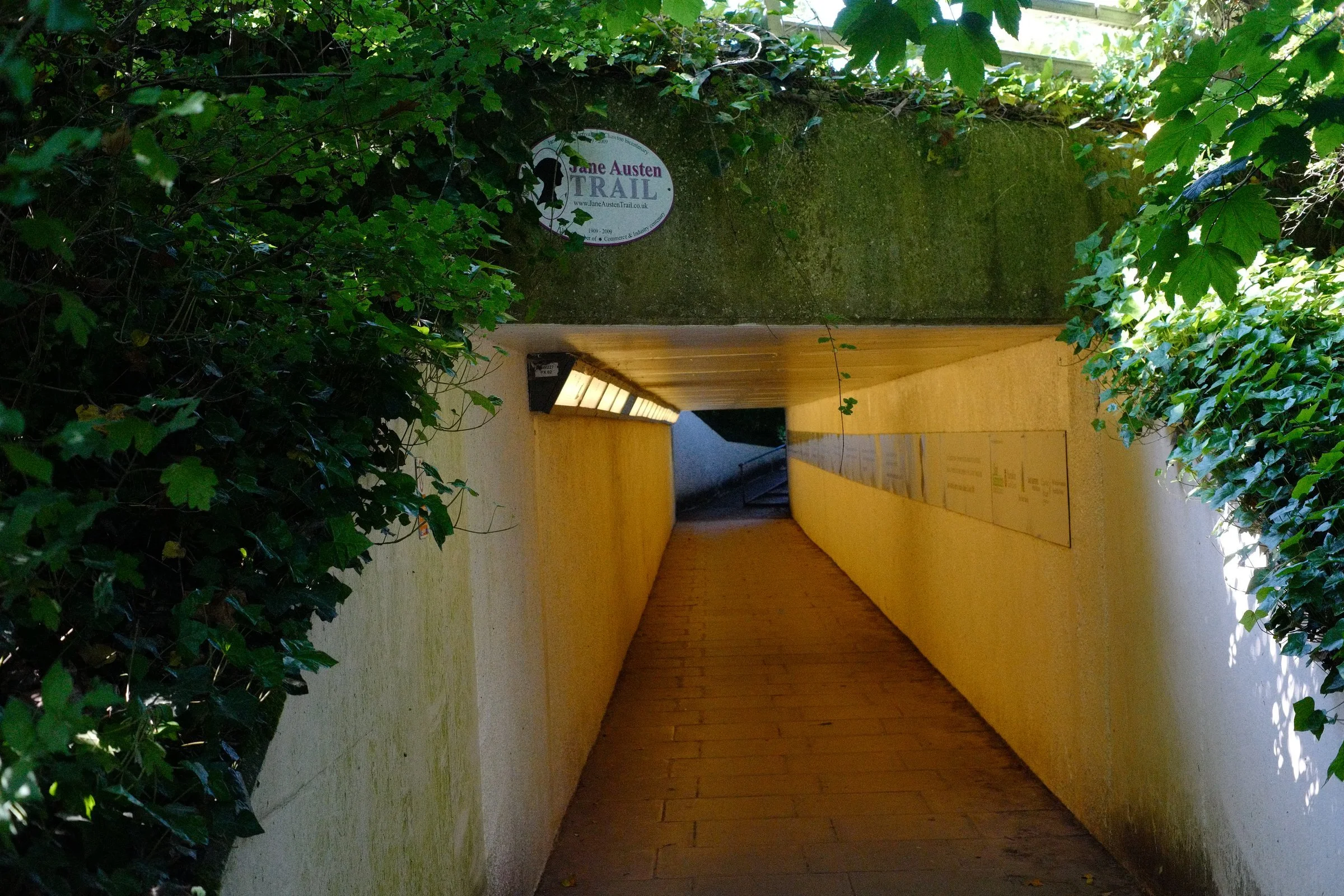
Trail tunnel under a main highway for the Pilgrim's Way heading into Alton England
Here is a perfect example of what I am talking about. This bridge is pre-war era construction. The reason I know this is because the whole thing is riveted together. Any other modern form of metal joining would be significantly cheaper than rivets. Arc welding wasn't really common place till after World War 2 so rivets were used everywhere till then. If I had been a typical traveler heading to the next destination, I most likely would not have noticed this.
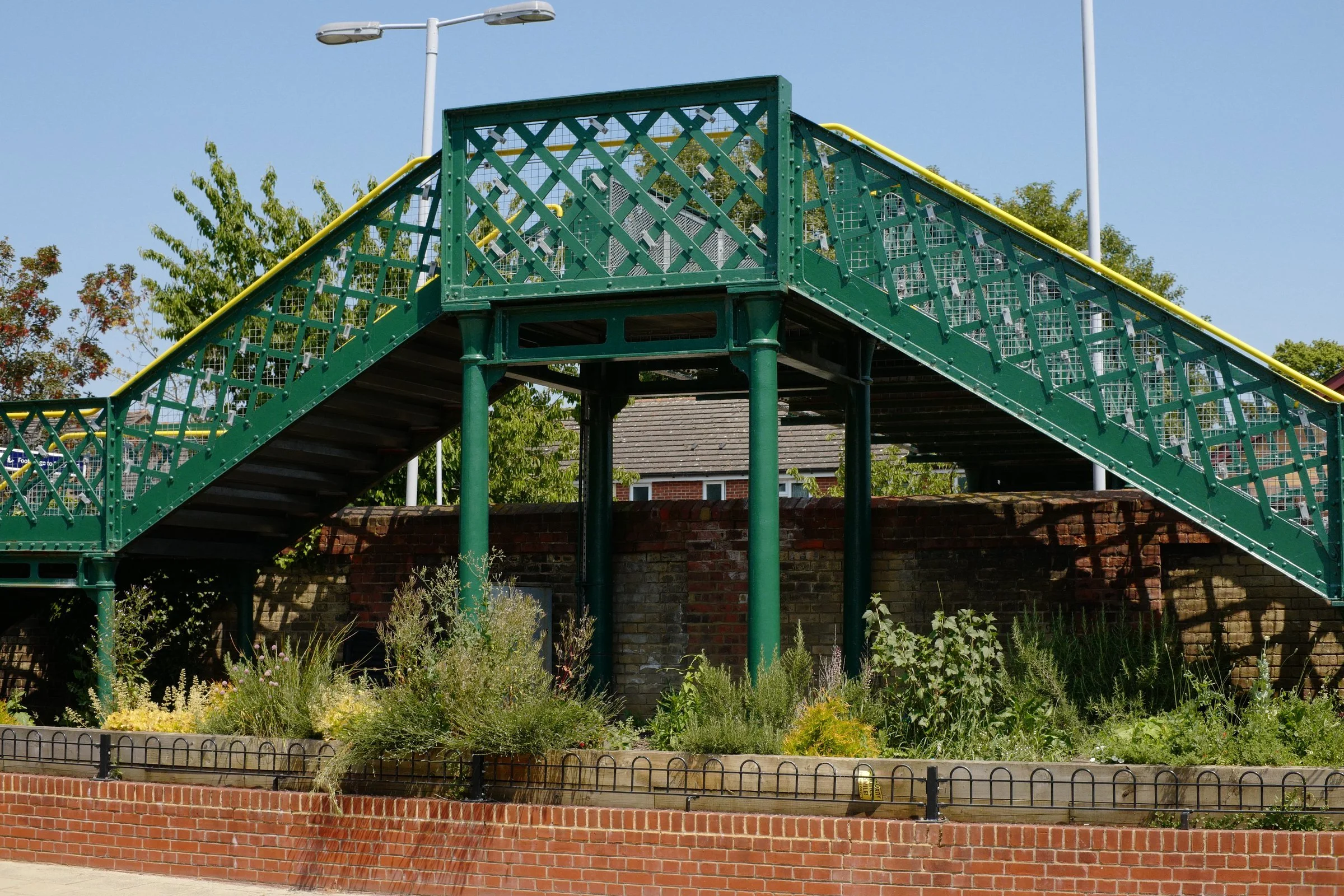
Pre-war riveted foot bridge to a train station in southern England.
Mid-Journey: Farnham and the Stepping Stones
The next day we really didn't do much hiking as I escorted Sierra to the airport and then went back and linked up with Teresa and we made our way by train over to Farnham. We really wanted to explore the town and Kelly had already went ahead on her own so it was the perfect opportunity. We had a great time in Farnham and found Kelly later so it all went great.
Then the next day we leave Farnham and make our way over to the stepping stones which is a huge deal on this trail and I didn't even know about it till this morning. These stepping stones are part of the trail system and when we found them we decided to make a small event of it and enjoy a few minutes at this location to make it a little more memorable. If you would like to see the stepping stones just watch the video linked above. I didn't get my camera out of the dry bag here for obvious reasons so I only have video from this location.
These kinds of treks are not just about seeing how fast you can cover ground or seeing how many miles you can hike in one day, but about stopping and smelling the flowers or grabbing some photos. This is what this pilgrimage was about for me.
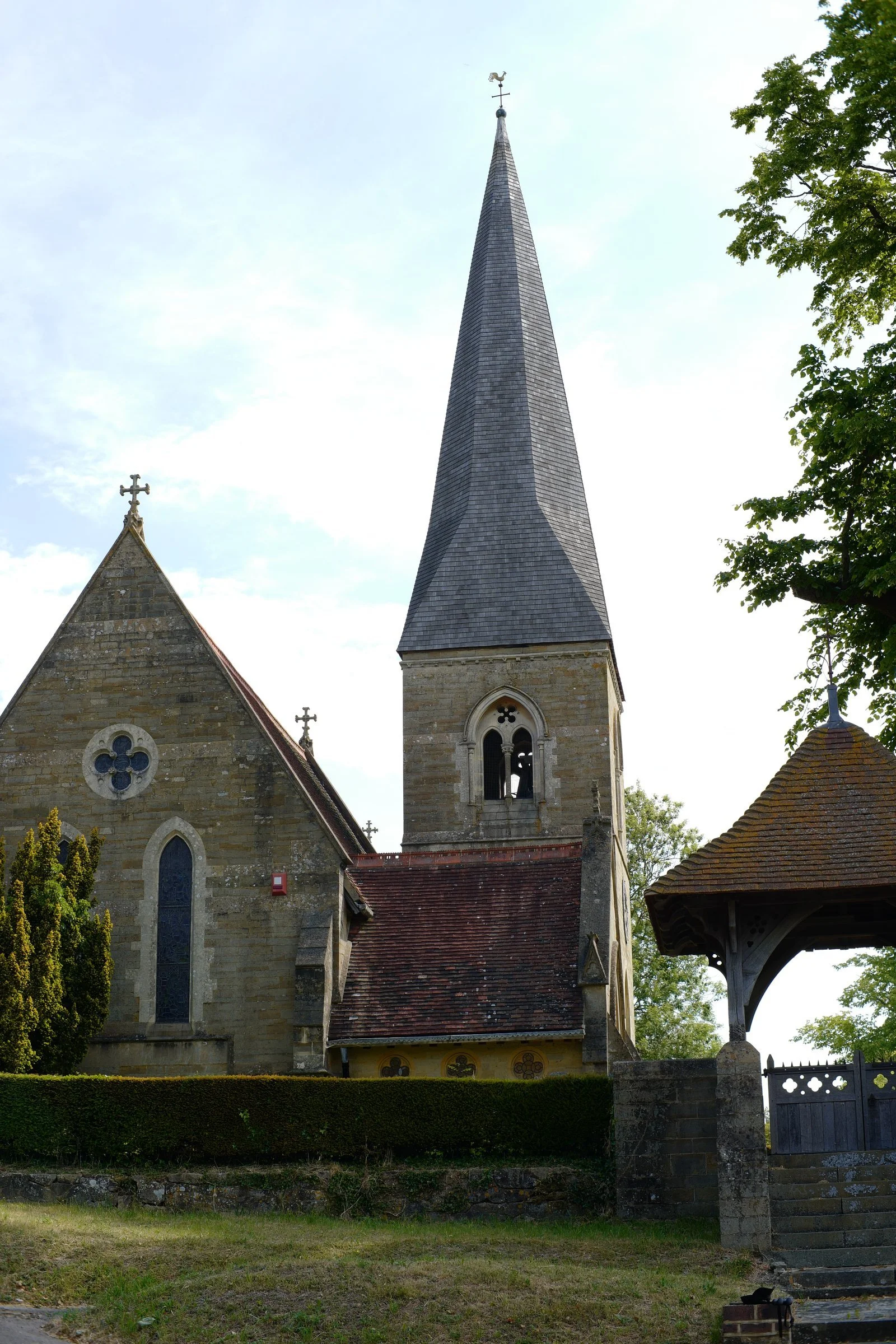
One of the many old churches in southern England on the Pilgrim's way (Canterbury Pilgrimage)
The Pilgrimage Experience: Disconnecting and Reflecting
This hike was a twofold event. First it was a way to explore England in a more intimate way than seeing the usual tourist sites and then hopping on a plane for the states. This way we get to talk to the locals and see parts of the country that other visitors will never see, eat food that they will never taste, and just enjoy the country like a traveler should.
The second part or probably what should be considered the first part is the pilgrimage part of the trip. A pilgrimage is a trek to a significant location for the purpose of reflection and to be able to spend time with the Lord. I had ample time for this too. You get to be with your own thoughts a lot if you keep your cell phone put away, which I did, this will give you a lot of time to reflect. I am glad I did this as it allowed me to just disconnect from life for a while and to be able to just enjoy where I was at the time without having to think about what I was going to do the next day or whatever.
This was so important to me that I didn't even post much about the trip while on it. I used the map function most of the time (there is a website where you can get the route and it overlays on Google maps). This was wonderful for someone who has grown VERY accustomed to using their phone a lot.
Above is one of the many churches we explored on our pilgrimage to Canterbury. Over the course of the next two weeks we would explore numerous old churches as well as eat in many of the most quaint pubs you have ever seen!
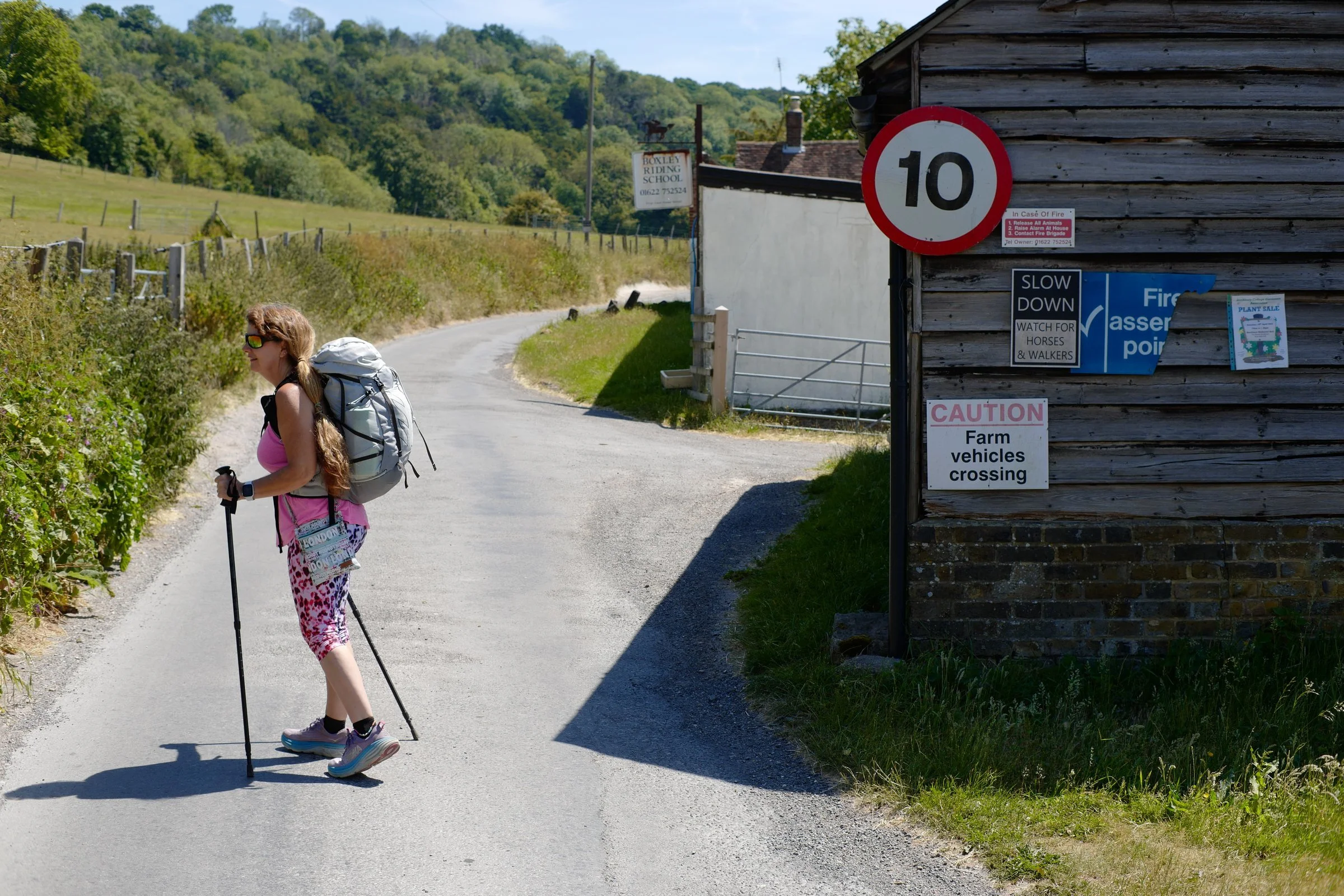
The Pilgrim's Way to Canterbury England is a beautiful hike. A quality backpack will make all the difference too.
Canterbury and completing the pilgrimage
After about two weeks we finally walked out of a field, into an old road and there it was…Canterbury! We had finally made it and the sense of completion is hard to describe. The long days on the trail, the injuries, the dehydration cramps, all those photos to sort through… It was surreal to be honest about it. We stopped at a pub to get a bite to eat and had a wonderful time chatting with the locals before heading into the old city to check into our hotel. The Cathedral Gate Inn (I think that is the name) is ANCIENT!!!! There were all sorts of oddities associated with this Inn, but aside from that we have made it to the Cathedral! We went to the ticket office to go into the Cathedral grounds and when the attendant figured out we were Pilgrim’s he personally escorted us FREE OF CHARGE (at this point I don’t know if there is a charge, but he got real excited when he figured out we were pilgrims) to the courtyard to the marker that signifies the official end to the hike.
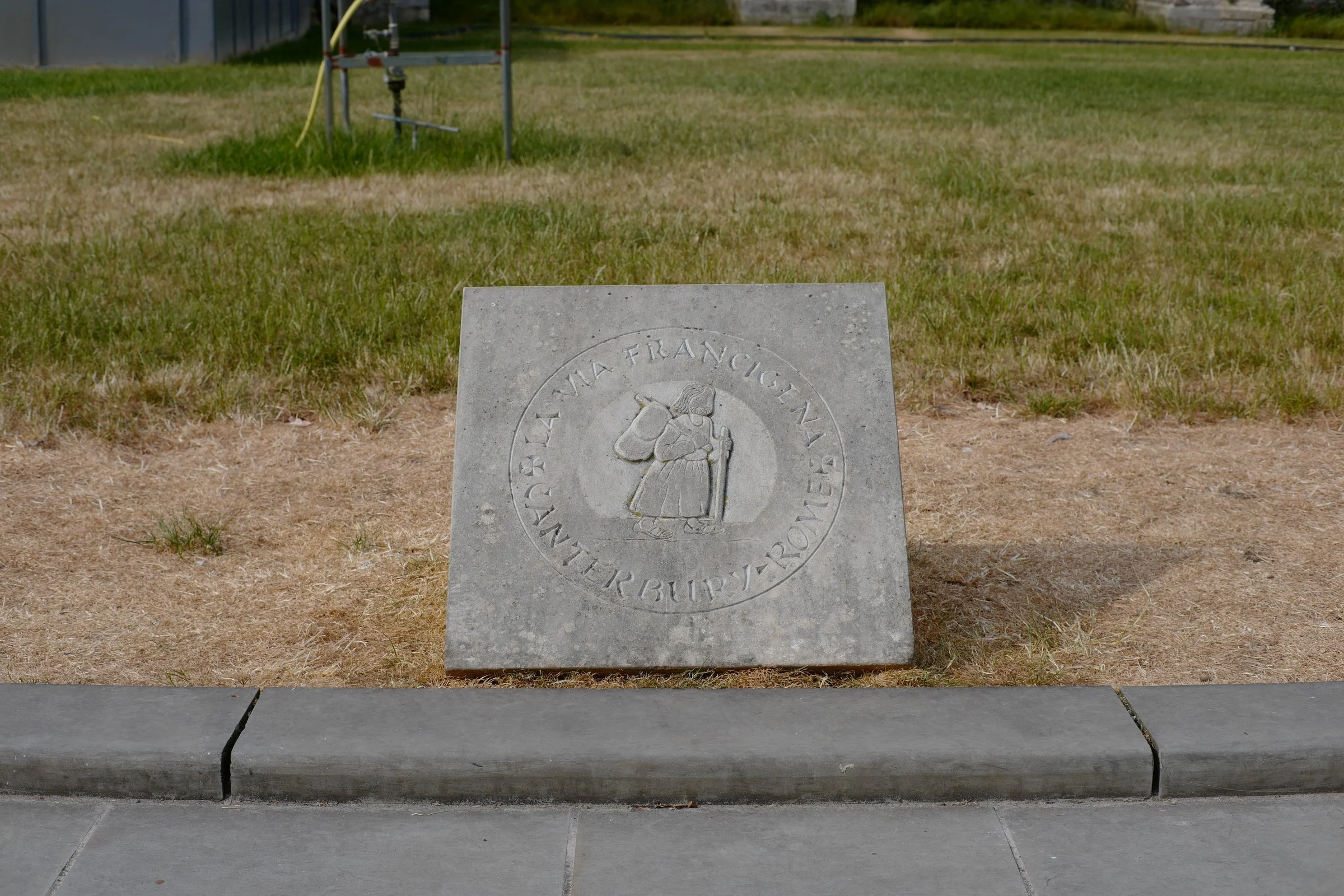
Trail End Stone at Canterbury Cathedral in Canterbury England
We all made our photo with the stone and then went for supper. Later we were treated to a special blessing from the priest at Canterbury Cathedral as well as being personally escorted to the Pilgrim’s Sanctum in the far back of the church. The story is that all the stained glass in the other churches are of Christ, the Saints and biblical events BUT here all the stained glass is of PILGRIMS to honor those who make the journey and we were the latest ones to get there. This was after Evensong service with the boys quire and the pipe organ. If you have never heard this and you have the chance, you really should experience it for yourself. It was incredible.
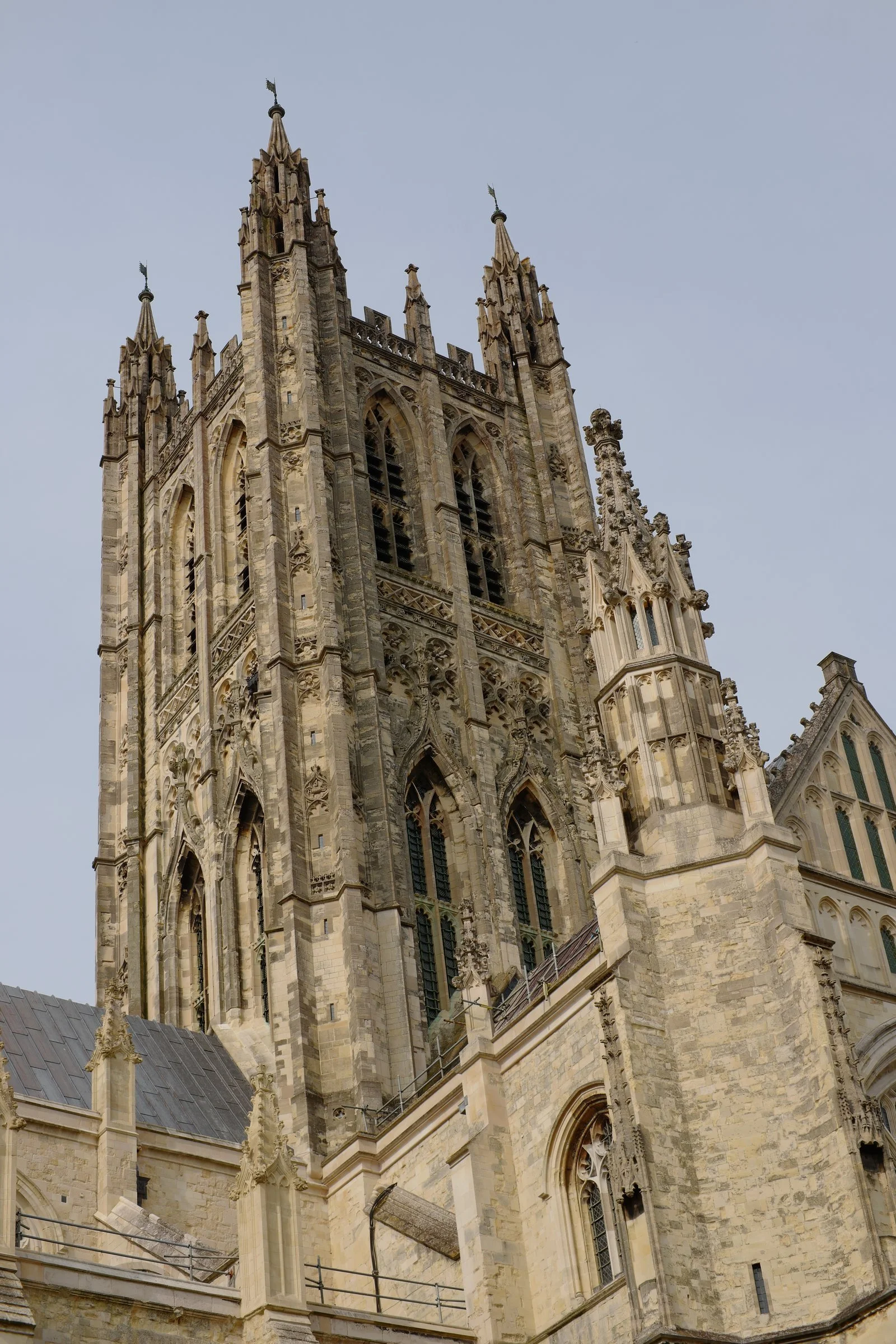
Canterbury Cathedral is so large and ornate that it is impossible to capture it in one photo. I opted to just get this one spire as some of it was obscured by scaffolding and the rest was just so large. This photo shows the level of detail and the sheer scale in just one photo. It is hard to imaging a Cathedral can be so large. Canterbury has to hold some sort of record for this…
What I Learned: Practical Lessons for Future Pilgrims
Let's talk about what really matters. In closing, I am going to wrap this with the following quote that I made up just for this blog, but it does seem fitting to me: "If you don't stop to look at the flowers along the way, you wasted part of your trip."
I am really one of those people that likes the journey as much as the destination and this was the perfect blend for me. Daily goal-oriented activity with lots to do and see along the way...
Key lessons:
Drink more water than you think you need (I learned this the hard way with debilitating leg cramps!)
Pack lighter than you think (I should have taken the 35mm f/1.4 instead of the heavier f/0.95)
Stop to smell the flowers (literally and figuratively)
The journey IS the destination (don't rush through beautiful countryside)
Backpack-only travel is liberating (no checked bags, less stress!)
A good backpack matters (Mystery Ranch saved my back)
Support this website by using these affiliate links to shop on Amazon:
Nikon AF-S FX NIKKOR 105mm f/1.4E ED Lens
Voigtlander Nokton 35mm f/1.4 II
Sandisk 128GB Extreme Pro memory cards
Nikon 50mm f1.8 S Lens for Z mount
Canterbury Pilgrimage FAQ: Planning Your Own Trek
How long does the Canterbury Pilgrimage take?
The complete Canterbury Pilgrimage from Winchester to Canterbury is about 120-130 miles depending on your exact route. Most people take 10-14 days to complete it, averaging 10-15 miles per day. We took two weeks and found that pace comfortable for stopping to explore villages, photographing the countryside, and actually enjoying the journey rather than just grinding out miles. If you're a strong hiker you could do it faster, but I'd recommend taking your time! The whole point of a pilgrimage is reflection and experiencing the journey, not setting speed records.
What's the best time of year to hike the Canterbury Pilgrimage?
Late spring through early fall (May through September) is ideal for the Canterbury Pilgrimage. The weather is milder, days are longer, and most of the pubs and accommodations are fully operational. We went in [season] and had great weather overall. That said, England is England, so expect rain regardless of when you go! I carried my camera gear in a dry bag the entire trip and I'm glad I did. Winter is possible but you'll face shorter days, colder weather, and some accommodations might be closed.
Do I need to be religious to do the Canterbury Pilgrimage?
Absolutely not! While the Canterbury Pilgrimage has deep religious roots (it's been walked by pilgrims for centuries), plenty of people hike it for the history, the beautiful countryside, or just the challenge of a long-distance trek. I approached it as both a spiritual journey and an adventure, but you can focus on whichever aspect appeals to you. That said, I do recommend attending the service at Winchester Cathedral before you start, even if you're not religious. The boys choir is beautiful and it adds something special to the experience!
How much does the Canterbury Pilgrimage cost?
Budget varies widely depending on your accommodation choices and eating habits. We stayed in hotels and B&Bs and ate at pubs every meal (since we didn't pack cooking gear), which probably ran $100-150 per person per day including accommodation and food. If you camp or stay in hostels and cook your own meals, you could do it much cheaper. The trail itself is free to walk. Don't forget to budget for getting to Winchester and from Canterbury back to London. Flight from US to London obviously adds to the cost, but we saved money by only carrying backpacks (no checked bag fees!).
What should I pack for the Canterbury Pilgrimage?
Pack lighter than you think you need! We went backpack-only (no checked bags) and it was liberating. My essentials: full change of clothes, extra socks, rain jacket, water bottle (I wished I'd brought two!), water filter, trekking poles (bought in Winchester), phone charging gear, camera gear in a dry bag, and snacks. I carried 25-30 pounds in a Mystery Ranch Pitch 40 backpack and my back never hurt. The key is a well-engineered backpack with proper weight distribution. Pack for the reality that you'll be carrying everything on your back for two weeks, not for every possible scenario!
Where do you stay on the Canterbury Pilgrimage?
You have options! We stayed in hotels and B&Bs in the towns along the route (Arlesford, Alton, Farnham, etc.). The advantage is comfort, hot showers, and you can just show up without reservations in most cases. The disadvantage is cost. Other options include camping (England has lots of campsites), hostels, or even churches that offer pilgrim accommodation. Some people book everything in advance, others wing it day by day. We were somewhere in between and it worked fine. The towns are spaced reasonably for daily hiking distances.
How hard is the Canterbury Pilgrimage physically?
If you're in reasonable shape and can walk 10-15 miles a day, you can do this! I'd never done long-distance hiking before and I completed it fine. The trail is well-marked and not technically difficult (no rock scrambling or anything like that), but it's still physically demanding to walk day after day. The biggest challenge for me was my 13-mile mistake day where I hiked farther than planned and didn't drink enough water. I had debilitating leg cramps that night from dehydration. Learn from my mistake: drink more water than you think you need, especially on long days!
What's the trail like? Is it easy to navigate?
The Pilgrims Way isn't a single continuous trail through the woods. It's more of a "way" that crosses fields, follows designated footpaths, and sometimes goes along roads. You'll encounter lots of kissing gates (cattle gates) when crossing between fields. The trail is generally well-marked but you do need to pay attention to avoid missing turns. We used a website that overlays the route on Google Maps which was incredibly helpful. The countryside is absolutely gorgeous, literally like postcards in every direction!
Do I need special hiking gear or can I use regular stuff?
You don't need ultra-technical gear! I used a rock-climbing backpack (Mystery Ranch Pitch 40) and it worked great. Trekking poles are highly recommended (I bought mine in Winchester and almost wore them out). Good hiking boots or trail shoes are important for two weeks of daily walking. Rain gear is essential. A water filter is nice to have but not strictly necessary. Camera gear is optional but highly recommended—the English countryside is stunning! I took my Leica CL with two lenses and got 1,400 photos. Looking back, I wish I'd packed my 35mm f/1.4 instead of the heavier f/0.95 lens.
What's the deal with stinging nettle?
Stinging nettle is a plant that's literally EVERYWHERE along English trails and you do NOT want to mess with it! It causes a stinging, burning sensation if you brush against it. The locals just accept it as part of life, but as an American, it was something I had to learn about quickly. Wear long pants when hiking through overgrown sections, and don't grab random plants for support. The stinging sensation is temporary but annoying. This was one of our first lessons on Day 1 and we got much better at avoiding it after that initial encounter!
Until next time, get your camera out and go take a picture with it.

Test driving the Leica Q2...sorta.
I went for a little stroll in downtown Chattanooga and decided that on this photowalk that I wanted to simulate the Leica Q2 to see if i really wanted on. Photography is a funny thing, some photographers will buy one camera and use it all their life and others will change out lenses and camera bodies numerous times.
If you want to see more photos and some more discussion on the idea, follow this link to the video where I do this walk. Other wise, read on friend!
I went for a little stroll in downtown Chattanooga and decided that on this photowalk that I wanted to simulate the Leica Q2 to see if i really wanted on. Photography is a funny thing, some photographers will buy one camera and use it all their life and others will change out lenses and camera bodies numerous times.
My simulated Leica Q2 for the day: Leica SL2 + Asahi Optical 28mm f/3.5 prime lens. Not as compact as the real Q2, but it's got the same 47MP sensor and 28mm focal length to test the shooting experience!
I am a little of both as I love to play with new gear as well as use gear that has become my favorite kit so to speak. Well, I have the Leica SL2 and I also have a nice little Asahi optical 28mm prime lens that I have an adapter for so I figured I would put this together and see if the shooting experience would be close enough to the Q2 to give me an idea of what it would be like without having to spend 6000$ on it.
Breaking Down the Numbers: Q2 vs My Simulation Setup
Before I headed out for this photowalk, I wanted to understand exactly what I'd be testing. Here's how the Leica Q2 stacks up against my Leica SL2 with a 28mm lens setup.
The Leica Q2 has a 47.3 megapixel full-frame sensor, a fixed 28mm f/1.7 Summilux ASPH lens, weighs about 718 grams (1.58 lbs), measures 130 x 80 x 91.9mm, and costs around $5995. It's got fast contrast-detect autofocus, built-in macro mode (focus down to 17cm), weather sealing, and that famous Leica build quality with brass top and bottom plates.
My simulation setup used the Leica SL2 with a 47 megapixel full-frame sensor (nearly identical to the Q2), an Asahi Optical 28mm f/3.5 prime lens on an adapter, total weight of about 850+ grams with the adapter, much larger body dimensions, and total cost of what I already owned. This setup meant manual focus only, f/3.5 maximum aperture (two stops slower), no macro capability, and definitely not as compact or refined!
The key similarities were the sensor resolution and the 28mm focal length. The key differences were autofocus capability, maximum aperture, size and weight, and overall shooting experience. But for testing whether I'd actually enjoy shooting with a fixed 28mm for street photography? This simulation was close enough to give me real answers!
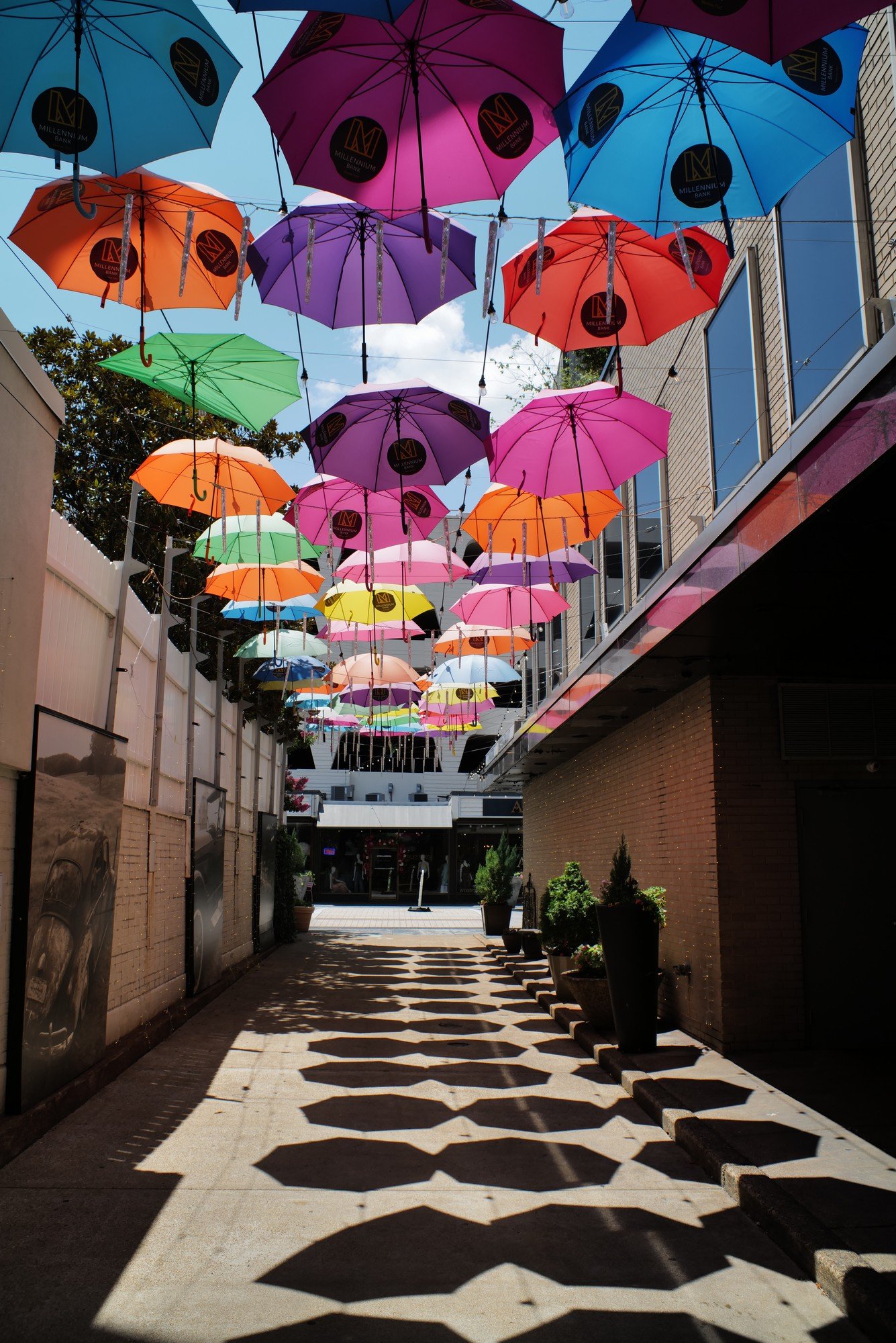
Shooting street photography in downtown Chattanooga with the SL2 + 28mm combo. I really love those Leica colors - the images just seem more rich in color to me! Maybe it's bias, maybe it's real, but these results have me happy.
I really love those Leica colors for some reason, maybe it is a bias I have towards the brand but to me the images just seem more rich in color. I really love how they turned out though and the idea of the Q2 is a great one for a general street camera. The high megapixel sensor combined with the 28mm lens is a potent street combination as you can see below where I shot the image as a candid just in passing and was able to adjust the composition later in post to get what I was looking for.
Is the Leica Q2 Worth $6000? Let's Do the Math
Here's the question that started this whole experiment: is the Leica Q2 worth $6000? To answer that, I needed to figure out what I'd be paying for versus what I could achieve with gear I already own.
The Leica Q2 at $5995 gets you a complete, ready-to-shoot system! One camera, one lens, no decisions about what to bring. You're paying for that Summilux lens (which would cost $4000+ if sold separately), the compact integrated design, Leica's legendary build quality, and the refined shooting experience. If you shot nothing but 28mm street photography, that's actually pretty reasonable for a professional tool!
My alternative approach using the SL2 I already own plus a vintage 28mm lens (which I picked up for about $150 used) costs essentially nothing additional. I already had the SL2 body, I already had the adapter, I just needed a good 28mm lens. Total additional investment: under $200. The compromise? Manual focus, slower aperture, bulkier setup, and no integrated refinement.
So is the Q2 worth the extra money? If you're starting from scratch and you know you love 28mm, absolutely! The convenience, the autofocus, that f/1.7 aperture, the compact size - those are real benefits worth paying for. But if you already own a camera body with a similar sensor and you can adapt lenses? You can get 80% of the Q2 experience for a fraction of the cost. That's what this test proved to me!

This photo was shot about 10 feet away with the 28mm on a full frame sensor - it looks MUCH further away than it actually is! But through the power of cropping with 47 megapixels, I can make it take on a couple of different looks. This is the original uncropped frame.
This photo was shot about 10 feet away and with the 28mm on a full frame sensor it looks MUCH further away. But through the power of cropping… I can make it take on a couple of different looks as you can see below.

This is a 12 megapixel crop of the original image - still plenty of resolution for web or print! Notice how the tighter crop changes the entire mood? This version has a lonely, almost bleak feeling to it. Same photo, completely different story.

This is a 16 megapixel crop of the original image - a slightly wider crop than the 12MP version above. This one has a warmer, almost restful feel to it. That's the power of 47 megapixels - you can change the entire dynamic of the image with a simple crop!
As you can see I can get two very different feeling images from this single frame. That is kinda powerful to be honest. I mean, you can change the entire dynamic of the image with a simple crop. That is actually liberating to be honest. I mean just look at the two again. One has this lonly, almost bleak feeling to it while the other has a warmer almost restful feel to it. That is really cool to me. So this is a perk of the Leica Q2 in my book.
So what else comes with the Q2 that I didnt have today? Well, autofocus is one, another is larger aperture. This lens is f3.5 which is two full stops slower than the lens on the Q2. This would matter more in low light as I was shooting most of this day at f11 to reduce the need to adjust focus. Range focus at f11 on a 28mm prime is basically 4 feet (1.3 meters) to infinitiy. So it literally was point the camera, press the shutter and the image was in focus. But if I wanted to shoot indoors or in the evening, the f1.7 aperture would be nice to have to keep my ISO down some or be able to raise the shutter speed a little to freeze action better.
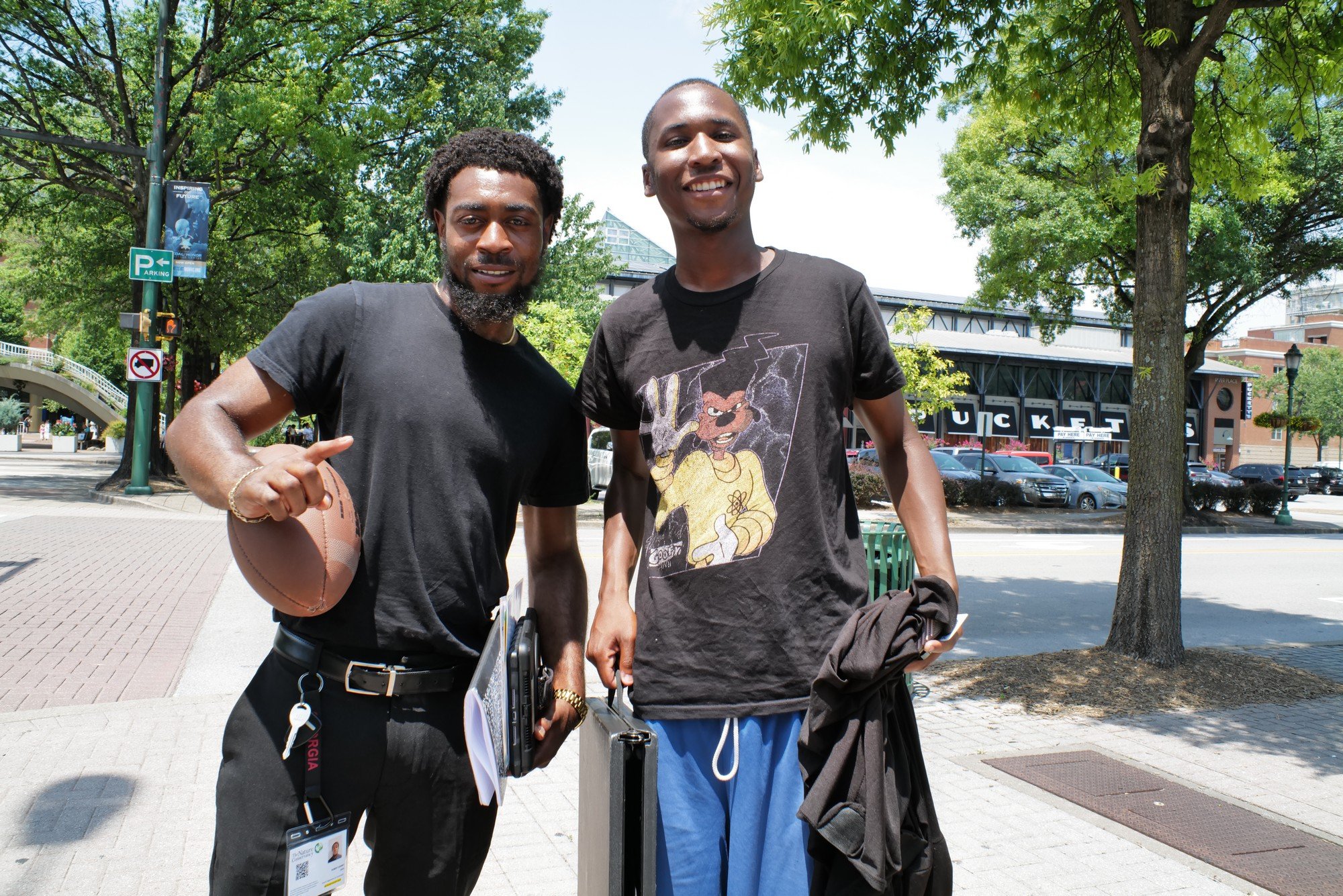
What I really liked about the 28mm was that it made me interact with people more! These two guys were walking by and I just asked them if I could grab a quick photo - they were stoked and so was I. The 28mm forces you to get closer if you want the detail, which means you have to actually talk to people. This is helping me overcome my shyness about street photography!
Is the Leica Q2 Right for You? Here's My Honest Assessment
After this simulation experiment, I've got a pretty clear picture of who the Leica Q2 is perfect for and who should probably look elsewhere. Let me break this down based on what I learned!
You should seriously consider the Q2 if you primarily shoot street photography at 28mm, value compact size and don't want to carry multiple lenses, are willing to pay for premium build quality and refinement, want that f/1.7 aperture for low light, love the idea of a one-camera solution for travel, and appreciate Leica's color science and shooting experience.
The Q2 really shines for minimalist photographers who've already decided 28mm is their focal length. If you know you love this field of view and you want the best possible 28mm compact camera, the Q2 is hard to beat! The autofocus, the aperture, the size, the build - it's all there. You're paying a premium, but you're getting a refined tool that just works.
But you should probably skip the Q2 if you already own a high-megapixel full-frame camera (just buy a 28mm lens like I did!), like to switch between different focal lengths regularly, aren't sure if 28mm is your preferred street photography focal length, are on any kind of budget, or want the flexibility of interchangeable lenses for different situations.
For me personally? I do really like the ergonomics of the SL family of camera bodies, so I will keep my SL2 and use a 28mm lens when I want to have the Q2 experience. The simulation proved I'd enjoy the Q2, but it also proved I don't need it! I get most of the benefits with gear I already own, and I get to keep lens flexibility for other types of shooting.
The key is being honest about your actual shooting style versus your aspirational shooting style. Do you really shoot primarily at 28mm, or do you just like the idea of being a minimalist street photographer? If it's the former, the Q2 might be worth every penny. If it's the latter, save your money!
What I really liked about the 28mm was that it made me interact with the people more. The photo above is a great example of this, these two guys were walking by and I just asked them if I could grab a quick photo, they were stoked and so was I. This is honestly a problem I have that I am working to get past. I don’t like bothering people and will walk by potentially great photos simply because I don’t want to bother them. The 28mm forces you to get closer if you want the detail in the photos so I have to get closer to do that. So I think honestly, this is going to have be a perk of the 28mm Summilux lens after all…
All in all, this kit performed really well for me and I think the Leica Q2 would perform equally as well. BUT I do really like the ergonomics of the SL family of camera bodies so for me I will keep my SL2 and use a 28mm lens when I want to have the Q2 experience in a camera. So until next time, get your camera out and go take a photo with it.
Just capturing everyday life…
When I decided to take some time away from youtube and just explore my photography, I didnt know how much fun it would be to just take the camera and an extra battery. It blew my mind to be honest.
Still I found myself starting to look for more interesting photos when I am out and about these days. Something else I have really come to realize is that you cant get the photo if you dont go out with your camera.

Here is an example of what I mean by getting out and shooting more. You are not going to be where the action is if you dont get out and shoot. Just being out in the field greatly increases your chances of getting a photo. That being said, I am the worlds worst at failing to get the shot. I got the one about due to range focus being set on the lens so I didnt need to even bring the camera to my eye. I literally saw it unfolding and just raised the camera and snapped the frame. It is also heavily cropped too so I can get the composition I wanted. That is a luxury of the 47mp sensor on the Leica SL2 that I was using that day, it gives you options.
Here we have a photo I have taken a couple of times now. Every year our hometown has an event in this park and the kids play in the creek is flagrant defiance of the posted sign. It is such a cliche photo that I can’t pass it up. Obvious civil disobedience to signage if a fun photo so if you see one of these scenarios just get your camera out and take the picture. You just might like what you end up with.
Here we have a scene of “small town Americana” that I thought was kinda interesting. These little carnival foodie trucks are a common sight in rural America and I wanted to capture that essence if possible. I am not sure if I was successful but to me it is a cool photo.
Here I found something interesting when I went to Cloudland Canyon State Park to setup a POTA activation the other morning. A cloud inversion isnt real common until the fall, but conditions were apparently just right. So I grabbed a photo before turning on the radio and now I have this photo.
Here is the last photo I want to talk about. This was a quickie iPhone capture that I saw and just had to get right quick. Use what you have and get the photo, that is the rule of the day. I have come to learn that when you get something like this in your head just go take the photo and be done with it, it will gnaw at you forever if you dont. I think some of the best photos, street or otherwise, come from just capturing everyday life. What do you think?
An updated treatise on my travel camera gear.
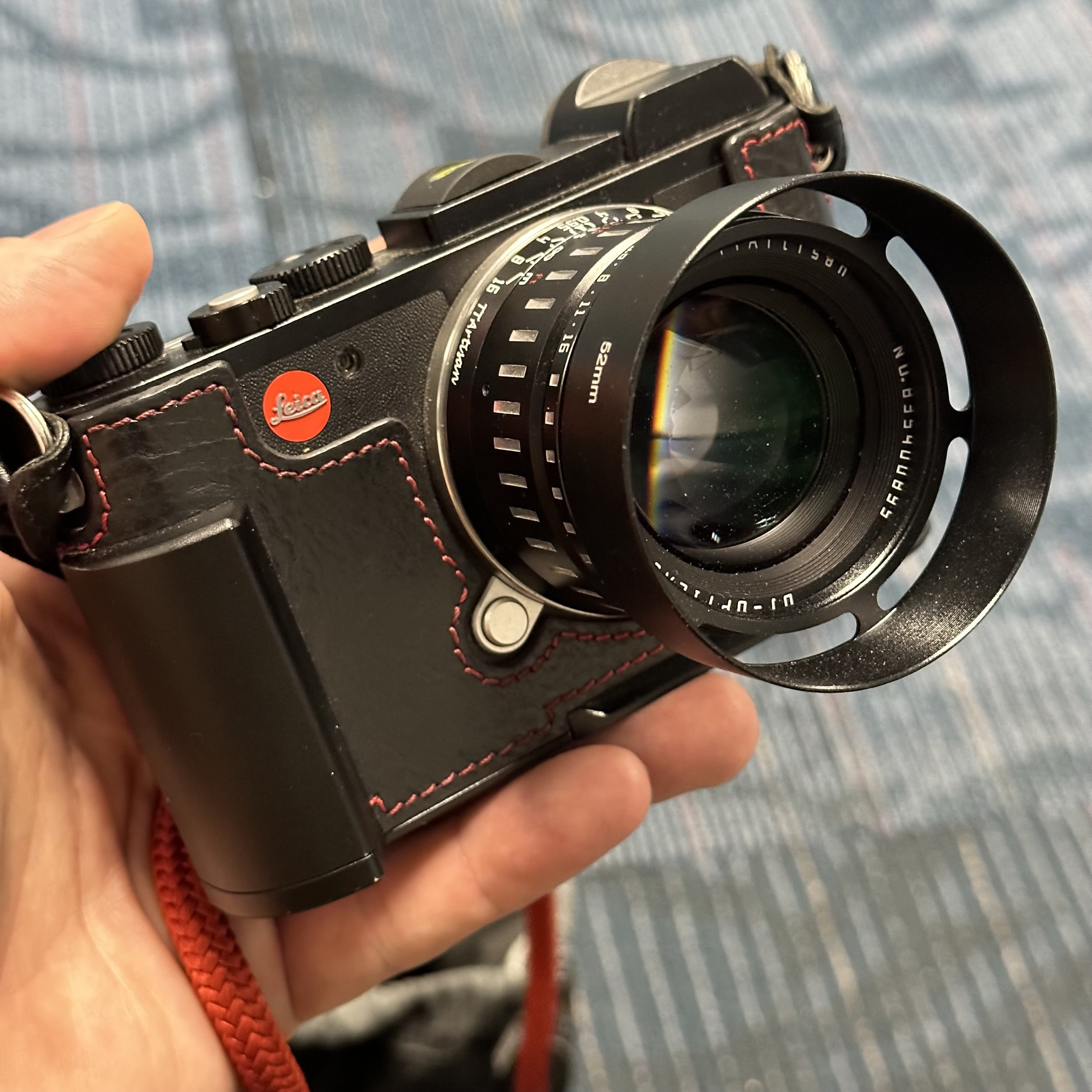
When I wrote the last blog post about flying with cameras gear, I had only considered the airport and airplane overhead space only.
Well, here I am again in a different scenario and this time the kit looks very different. The overarching theme here is apparently that you should tailor the kit to suit the trip. Lol. I have done just that.
For this trip we are being tourists more or less, so the camera kit will reflect that. I am taking the Leica CL and just two prime lenses. The 17mm and the 35mm lenses are perfect for tourist type photography and there is two more reasons for taking two primes over a single zoom… read on to learn why.
When choosing kit for trips now, I start with the premise of the trip. For a long time, I would have these illusions of grandeur and would take all this gear for events that never happened. You see, I dont plan the trips, the wife does so she plans on things the I don’t consider. She will arrange tours and such and I am just too busy with other things to pay much attention. Well, I finally learned and now I dont bring hardly any of that stuff and this makes travel SO much easier. Some types I have encountered are tourist, wildlife, street, and such as that. Once this is nailed down then I choose a camera that best fits that type of trip. Usually between crop sensor and full frame first as this gets me the right camera. For wildlife I prefer my crop sensor Z50 but for architectural purposes I prefer a full frame sensor. Things like street photography can be shot with either but on long days, the little crop sensor Leica CL is a much better choice over the much heavier Leica SL2.
Now that I have a camera picked out, I will decide what is the most likely scenario I will be shooting in and choose a lens for that. Next I will look at what else there is and choose a lens that will work for this as well as loosely backup for the main lens.
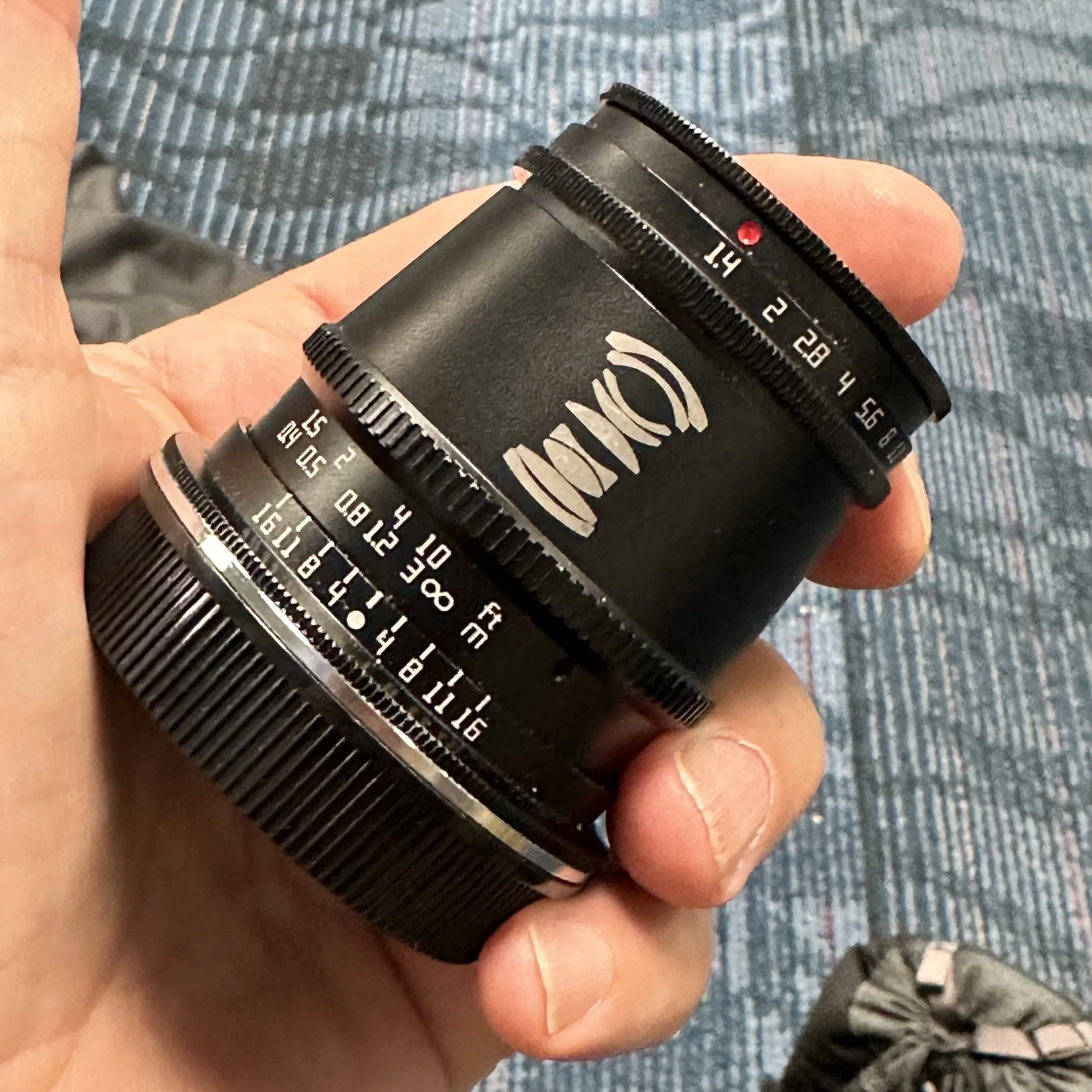
Using this process, I chose the 35mm f0.95 TTArtisan lens as my main lens and the TTArtisan 17mm f1.4 lens as the backup. These are designed for the Leica CL which is a crop sensor camera so the equivalent field of view for these lenses is 50mm and 28mm respectively. These are two VERY useable focal lengths for a travel kit. These will also both work just fine if one or the other gets damaged at some point. I might have to adjust my shooting style a little but the trip is not a loss…
I want to take a moment here to mention TTArtisan and how they are making some amazing lenses for crazy low prices. The quality of all three of the lenses I currently have that they made are just stellar. I have one they gave me as a review sample but I bought the other two on my own. They are great little manual lenses.

Another reason I like using prime lenses for trips is the maximum aperture is much larger than on general purpose zoom lenses. General purpose lenses work great in broad daylight but the lack of large apertures make them less than desirable for me in the evening and early morning.
What this means is I will end up with a really compact kit with this camera and two lenses. These being native L mount lenses also means they are smaller than adapted lenses as well. (This is something that I do regularly and dont sweat it and that is how I know.) Native mounted glass means they are more compact though and that is what I wanted.
Since we are hiking this trip, I wanted to make sure that rain didn’t ruin my camera gear. This is why I put all my camera gear into a dry bag and then put that inside my backpack.

Once inside the dry bag, they are divided into three different lens “dump” bags I used for this trip to organize this gear loadout. These are made by Thinktank Photo and are great for street photography photo walks as you can stick batteries and a spare lens, business cards and lens wipes and such in them and they are still small and lightweight.
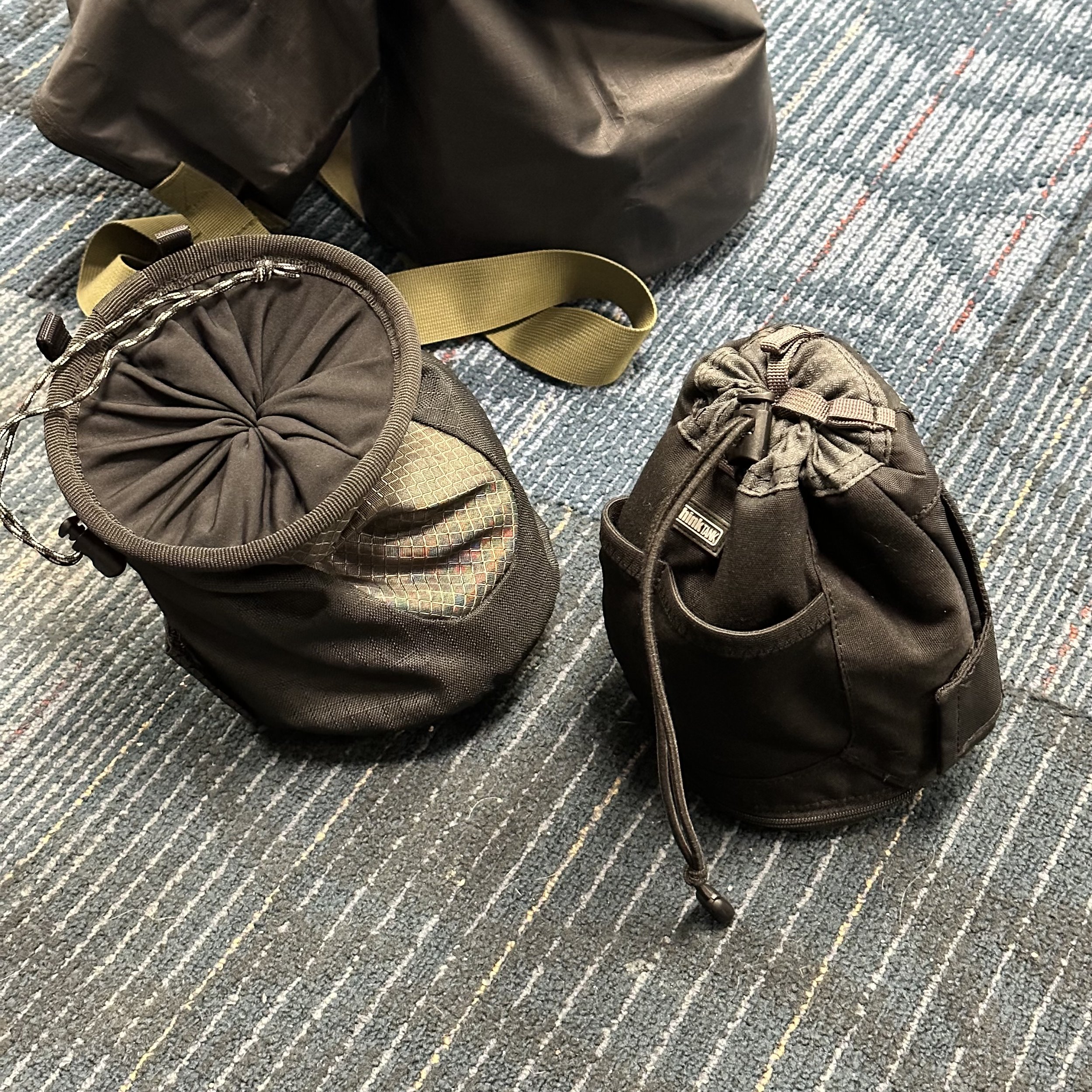

I realize now that I desperately need to clean my lens! Will do that asap!!!
Armed with this kit I am ready to take on just about any tourist, street, or even landscape type photo with hood confidence that I will come away with something reasonable. The next blog post in regards to this kit will be a photo spread describing what I found to photograph.
Until next time, get your camera out!!!
Is Leica right for you?

Since moving to the Leica camera system I have learned that the brand is super polarizing in the photography community and the odd part is there is no one other competing brand, except maybe Fujifilm and Ricoh in some genres.
You see there is the Nikon vs. Canon rivalry which everyone knows about. People either love Leica or hate them and there seems to be no middle ground. What I hear the most has to do with the extreme price of Leica cameras and what I usually hear second is how (insert their favorite brand here) had a list of features that Leica lacks. By far these are the two main complaints I hear with there being a few odd things otherwise.
Let’s take a look at some speculation on this topic and see if we can get a better understanding. Now, this next part is pure speculation on my part with only a little actual research behind it. But I did make a simple questionnaire for a few people to see what they thought.
Here is my question list:
Why dont/do you currently own any Leica gear? (Cameras and lenses)
What is your opinion of Leica in general?
Why do you have that opinion?
Armed with these questions let’s see what we get. I got the following answers…
————————————————————————————-
Why don't you own any Leica gear?
1. Between the price point and lack of a body geared towards sports there wasn't a setup that fit into my shooting needs.
What is your opinion of Leica Gear?
2. From my limited experience the camera I used felt well built and the quality I have seen produced by Leica cameras and glass is as good as other brands but seem more geared towards fine art, street or portriat style photography.
Why do you have that opinion?
3. Most photos produced where Leica has been identifed as the camera in my opinion have fit into the fine art, street or portrait categories.
————————————————————————————-
Why don't you own any Leica gear?
1. I have thought about buying a Leica as a street camera or personal camera, but the cost, even used, is a bit prohibitive for me.
What is your opinion of Leica Gear?
2. In general, I have a very favorable opinion about Leica. They are well-built, feel good when holding them, and take most excellent images. I am especially enamored with the M10 that only shoots monochrome. That is my dream, money is no object camera. And I love the look of those square frames lenses. They are quite aesthetically pleasing.
Why do you have that opinion?
3. I have this opinion partly from trying one out previously, but mostly from watching them used on YouTube. They are/were the camera of choice for some of the most famous photographers in the world.
————————————————————————————-
1.Why don't you own any Leica gear?
I would love to own some Leica gear. It’s a little on the expensive side, but I think they truly are pieces of quality kit. Lenses I think are pretty top notch. Also quality of lens construction seems to be pretty great.
2.What is your opinion of Leica Gear?
I think that Leica is focused towards a certain type of photographer. One that wants no compromises, while being methodical and authentic at the same time. They produce a different shooting experience for a more niche audience. But for those who enjoy Leica, they know exactly what they want from a camera. And Leica seems to know what their shooters want as well.
3. Why do you have that opinion?
I met a friend through a friend who was obscenely wealthy and he only shot on Leica. That, and general impressions based off of YouTube and other avenues where stereotypes are routinely expressed. I’m certainly open to change if and when I shoot on one!
————————————————————————————-
1.Why don't you own any Leica gear?
Leica doesn't make a single camera that interests me.
2. What is your opinion of Leica Gear?
I respect the brand and the company. I think they make really great lenses. Their bodies, while well made don't have the features that I look for in a camera body. I like their simplistic beauty. That's just not what I'm looking for. I think they are probably great street photography cameras but not too good for sports and wildlife. On the other hand, there are other brands that make great sports and wildlife cameras. The difference is, these great sports and wildlife cameras can also handle street, portraits and basically any kind of photography with no worries. So I need a camera that can do everything as opposed to a camera that can only do a few things.
3. Why do you have that opinion?
You don't see a lot of Leica shooters on the sidelines of a sporting event or at the wildlife refuge. There is a reason for that.
————————————————————————————-
1.Why do you currently own Leica gear?
What drew me to Leica is it’s history and mystique. Leica is the originator of the 35mm camera, and a great deal of great photographers have used Leica. I wanted a piece of that mystique, not that it would make me a better photographer but it was very enticing. I started with the Leica Q, probably the most affordable full-sensor Leica and I was hooked the color science of that camera is godly, better than any other Leica camera I have owned. Then the Q2 Monochrome, I have always wanted a monochrome camera, so why not. Followed by the Q2 because I wanted more megapixels for cropping, The color science on the Q2 is not in my opinion as good as the Q but it improves on the Q in many other ways. Then finally the M10p, I don’t any Leica glass except for the lenses mounted on the Qs which are all 28mm. I have always said I can afford the camera but not the lenses.
PS. The real reason is David Saylors, I had beaten the bug to get a Leica, then I met David and ended up with a Leica Q
2. What is your opinion of Leica in general?
My first thought is a prestige brand for the affluent. In reality, it is much more than that. I see them as an extremely high-quality brand manufactured in Germany for the most part, you have to pay for that labor and Leica is not a high-volume brand. They need to charge that kind of money to stay in business.
I am lucky enough to have a Leica store near me and I have learned how much they do to promote up-and-coming photographers, free gallery openings, and photo walks and that is at the local level. World wide they have awards to promote photographers no matter what brand they use. They look at photography as an art form and help to cultivate new photographers.
3. Why do you have that opinion?
On the built quality of Leica, all you have to do is pick one up. They are solid and rugged. I could use my M10P to protect myself and still use it to take a photo of the attacker. You can still buy old M2 and earlier that still work perfectly well and they will service them.
Regarding fostering photographs look at the Leica Oskar Barnack Award or the countless events available on Eventbrite for free.
————————————————————————————-

As you can see, the price is what gets most people right away. To be fair to both the consumer and the manufacturer let’s take an honest look at what makes these cameras cost so much. I have been given a unique perspective to see both sides of the transaction event so to speak. For Leica I understand what they have done over the century of their operation as a camera manufacturer.
They were “first movers” in that they invented using 35mm movie projector film in a still frame camera. This gives them a market advantage of sorts… or it did… that is until Nikon released the SLR in 1959. The SLR changed the game, no longer did you worry about your camera getting out of calibration and the photos being out of focus as you are actually looking straight through the taking lens directly for your composition. A large portion of the world that was using Leicas at this point wanted this new technology and went over to Nikon and Canon (who saw the light and jumped into the SLR game as well as many others). Leica stuck to their roots though and this almost proved fatal by the 1970s.
They tried making an SLR in conjunction with Minolta but it was too little too late and the R series never did really take off even though they made them for over 20 years. Leica on the other hand, always stayed focused on the M system. They also spent a lot of time cultivating their target audience as well. But since their company could not employ large scale manufacturing and the mechanical complexity of the M system makes them costly with skilled labor to manufacture, they could never compete in the world of high volume, mass production like the big players. How do you sell something that by its very nature has to have a high retail price due to high fixed costs in manufacturing? Market to the wealthy is how… The mantra of “exclusivity has its price” is true and if you make low volume but yet high quality products you can market to a niche group like the wealthy. There is a reason people joking say Leica is the brand of dentists and lawyers. Because Leica realized they could not compete with Nikon and Canon on low price/features, they had to figure out where they fit in the photography space. This turned out to be in reportage and street photography mainly. This and the aforementioned exclusivity adds up to a potent mixture for a brand that is for the affluent.
The reasons for the cameras price is multifaceted and I am straight speculating here too. I am pretty sure that I am right though as I have worked in the field of manufacturing and selling of products. You see, first the cameras they make are basically like fine mechanical watches, in that they are hand assembled and tuned individually. All this meticulous labor runs the score WAY up. Especially when you consider that it takes a skilled craftsman to build one of these and not just someone off the street trailed to do an assembly line job. Henry Ford figured out that low skill labor can complete complex tasks if there is enough people to break down the job into small enough tasks. Problem with Leica is that they don’t have the business model or the sales volume to be able to setup this sort of operation, so they instead lean into the individual craftsman concept even harder.
Today though, you are starting to see a lot more people shooting on Leica cameras and it is because the world has improved (whether we like it or not, the industrialized “1st world countries” are, over all, wealthier than they have ever been). People have learned that they have enough disposable income to be able to get that M6 with the 35mm Summicrion now, and the do! I am starting to see more and more youtubers using Leica cameras…shoot, even good ole Pete has a Q2 now!
Now does this mean that people need to add one to their arsenal to be cool? No. Absoloutly not, they should use whatever makes them happy and gives them the results that they want. If this means shooting a Leica M11 with a 12,000$ Summilux lens, then you do you. If it means shooting on a Sony RX100, then that is the camera for you.
In the end Leica will never be a cheap camera system, nor will it ever have the bleeding edge features like Sony or Canon, but it will continue to serve a dedicated niche market that they have carefully cultivated over decades. For me, that fact alone makes them an awesome company. They are out there doing there own thing and really dont care about the rest of the market.
Getting a fresh perspective on a common event.
Today I had a thought about what sets my Sacred Harp photos apart from everyone else’s photos.

I thought about this for a while and figured out that my goal is not to simply capture every leader (although that is kind of a side quest) but rather I want to capture the essence of the event as a whole. The reason I say this is because I see others capturing images of just the leaders and usually just from the front straight on. Now to be fair, this does produce good images but for me they are not as interesting. Hence…
When I goto a Sacred Harp singing there is a specific location that I want to be at in the room. It is near the bass section where it meets the tenor section. Now if I were more serious about the photos, and less serious about singing with the class, I would actually goto the other side of the room as most people mark time with their right hand. This makes getting a good photo, which I will spell my recipe for below, even harder since I am on their right side and their hand blocks their face alot.
My “recipe” for a good photo is as follows:
I want them looking at the crowd and not their book if possible (I want to see their eyes)
I would love a strong expression
I want the face to look relaxed and not contorted from singing a strong note
I want their hand in motion and slightly blurred from movement
I want their face properly exposed
I want good white balance
I want them 75 to 80% offset to the side for deep “look space”
Finally, I also want photos of the rest of the event (this is kinda separate but it helps tell the story)
So with that daunting list of requirements delineated let’s take a look at them a little more in depth.

I want them looking at the crowd.
This is kinda standard composition information but this creates a bond in the photo between the leader and the class visually. I want the photo to hold the viewer and have them explore the image.

I love getting a strong expression.
This is really hard to do most of the time. I have certain leaders that I know will give me this and I actually look forward to these leaders for this reason alone. This draws the viewer into the photo and lends an emotional aspect to the image.

I want the face of the leader to look relaxed.
Most of the time, when people lead, they are nervous and it shows in the photos. So I watch for them to relax a little. This usually happens towards the end of the song so I will watch for opportunities to get a better photo then if I can. Sometimes people have odd expressions when they sing as well and this contorts the face to make them look less appealing in the photo, so I will look for pauses in the music to where they might be catching their breath or their part is silent so I can grab a quick photo then. My goal here is to get them actually enjoying the song and not just leading it.
I want the motion blur of them marking time with their hand.
This gets me that “action” look that I am wanting that shows something is happening and that they are not just standing there I want that photos to show that the event is “alive” with activity if possible. By having a little motion blur from the hand moving, it does this without making the whole image blurry. At least for me, it does.

I want their face properly exposed.
This as it turns out, is a really hard thing for me to get right while on the fly. Seems there is almost always a window in the frame and the sunlight is wreaking havoc on the light meter in the camera. I do my best to compensate for this, but sometimes it just doesn’t work right and the person is almost a black silhouette. As a good photographic rule though, this is normally a well exposed part of the image.

I want good white balance.
Again, you would think this would be a no brainer, but as it turns out, this is a lot harder than you would think. You see these events happen normally in venues that are poorly lit with mixed color temperature lights so you never really know what to expect. I will normally grab a white balance value at the beginning, and again at lunch as the sunlight will dope the reading and make your pictures look yellow…

I want them offset way over to one side.
We are talking way past the rule of thirds concept as I am not trying to follow that concept at all, but rather I am wanting to tell a story and it is not about one person, but the class as a whole with the leader just one part of it. The singers are just as important so I want as many of them in the frame as possible to give more context to the image. Sometimes I get a good image and this isn’t the case like with Terry (1st at the top), but this is not what my usual goal is. He leads very uniquely and I love photographing him for this reason.

I want photos of the rest of the event.
You see, there is more than just the singers and the leaders and them singing songs. There are people just there to hear it, kids playing and people eating… Plus this is sometimes the only venue where some people ever meet up so there are lively conversations sometimes as well and lots of laughter. I want to try to capture this as well.

The desert table alone is worth the trip in my book!
This is a tall order to be sure, but I normally get one or two “real keepers” from these singings that will meet either all or nearly all of my rules for leaders. So of those rules are pretty low hanging fruit, like proper white balance, just takes me remembering to take a sample of the interior occasionally to make sure it has not changed on me. some are much harder, like getting position and facial expression and exposure right when they are moving around while they lead… Something I dont strive for though is perfectly sharp images, a little motion blur just adds character to the photo and makes it look like they are actually doing something instead of posting up static for a photo. Also I dont care if the eye isnt tack sharp either as the photo isnt a portrait but rather something closer to reportage in my mind. I like it when the eyes are sharp but it isnt on the list if you will notice. I dont list it because the story is more important to me than that aspect. I dont know why, but that is how I see it. Everyone loves the images when I share them too so I am happy with most of them too…
Do you have a favorite venue or event you like to shoot and do you have a set of personal rules that make us your perfect photo from that event? I would like to hear about your version of this story!!!
How important is the time of day when you shoot a photo?
When you take the photo is just as important as what you photograph
Seems there is all sorts of information out there about what to take pictures of, but no one (other than landscape photographers) talk much about the TIME you take your photo. In this article, I want to explore this a little with a simple location that is right down the road from my apartment and show the difference that just a few hours can make in the mood and feel of a location that is being captured.
The camera of choice with my the Leica CL with the TTArtisan 17mm f1.4 lens shot off of a tripod so shutter speed isn’t a problem. I will be maintaining an ISO of 100 for all photos and an aperture of f11 on all photos, so shutter speed will be what I have to change to keep the exposures to where I like them.
The time of day is something that a lot of people think about a little but really don’t put much effort into the planning of the photo. It takes a good bit of reconnoitering to get the location scouted with the vibe you are wanting in the photo. I see these locations all the time, when I am driving around in the day time and when I see them at night it is a completely different scene. Some people like shooting in the daytime, some like the blue hour or golden hour and some, like me, prefer the night… So seeing a night photo while viewing the scene lit by the sun is a problem. I can get somewhat of a visual based on previous photos I have taken of other locations, but until you see it lit by the street lights and 8’ fluorescent tubes, you just don’t know what you will be getting.
I don’t know why I like shooting at night so much, but I do. The low light and the negative space just do something for me and the photos reflect it.

Ybor City has some interesting light that is only available at night.
I do like some blue hour stuff to add the touch of blue sky to my images at times, but not always. Another perk to shooting at night is that it is cooler in the summer months, with temps being generally lower and the sun in not beating down on me, I am more inclined to stay on a location longer and get better images. Street photos at night are a little tougher as I need larger apertures to keep ISO manageable, and this means focus is a lot more of an issue as depth of field is significantly shallower than in the daytime, but it is manageable if you think about it first.
I normally set focus traps and shoot in burst mode and this will usually net me a sharp photo of a scene at night at even crazy large apertures like f1.4 or f0.95… It just takes a bit of practice and patience.
The gear matters…
The gear you use at night matters just as much as the subject you are shooting. If you have the wrong equipment, you simply won’t get the shot.

Fast glass gives you options.
Take for instance, street photography, this is dynamic and has movement in it. For most human movement, a shutter speed of 1/250 second will freeze action sufficiently. 1/200 in a pinch if the subject isn’t moving too much will net sharp photos. Well, to get a decent exposure, you will need fast glass, shot wide open and will still probably need a fair amount of ISO to compensate.
Now, if you are shooting static subjects like buildings or scenes and motion isn’t an issue, you can just let the shutter stay open until the exposure is good, but once you cross about 10 seconds, humans tend to vanish from the scene… Cars make long lines with their headlights as they drive by and things begin to look different. So you can see it all depends on what you want to capture to drive your gear choices here.

I personally like to have fast glass if possible as this is the most versatile lenses. These lenses can still be stopped down for times when you want deeper depth of field and opened up when you need the extra light gathering power of “fast glass”. So whenever possible, I will always opt for the larger aperture option over the smaller, if just makes sense to me to have that extra optional aperture when needed. The old adage “better to have it and not need it than to need it and not have it” comes to mind…
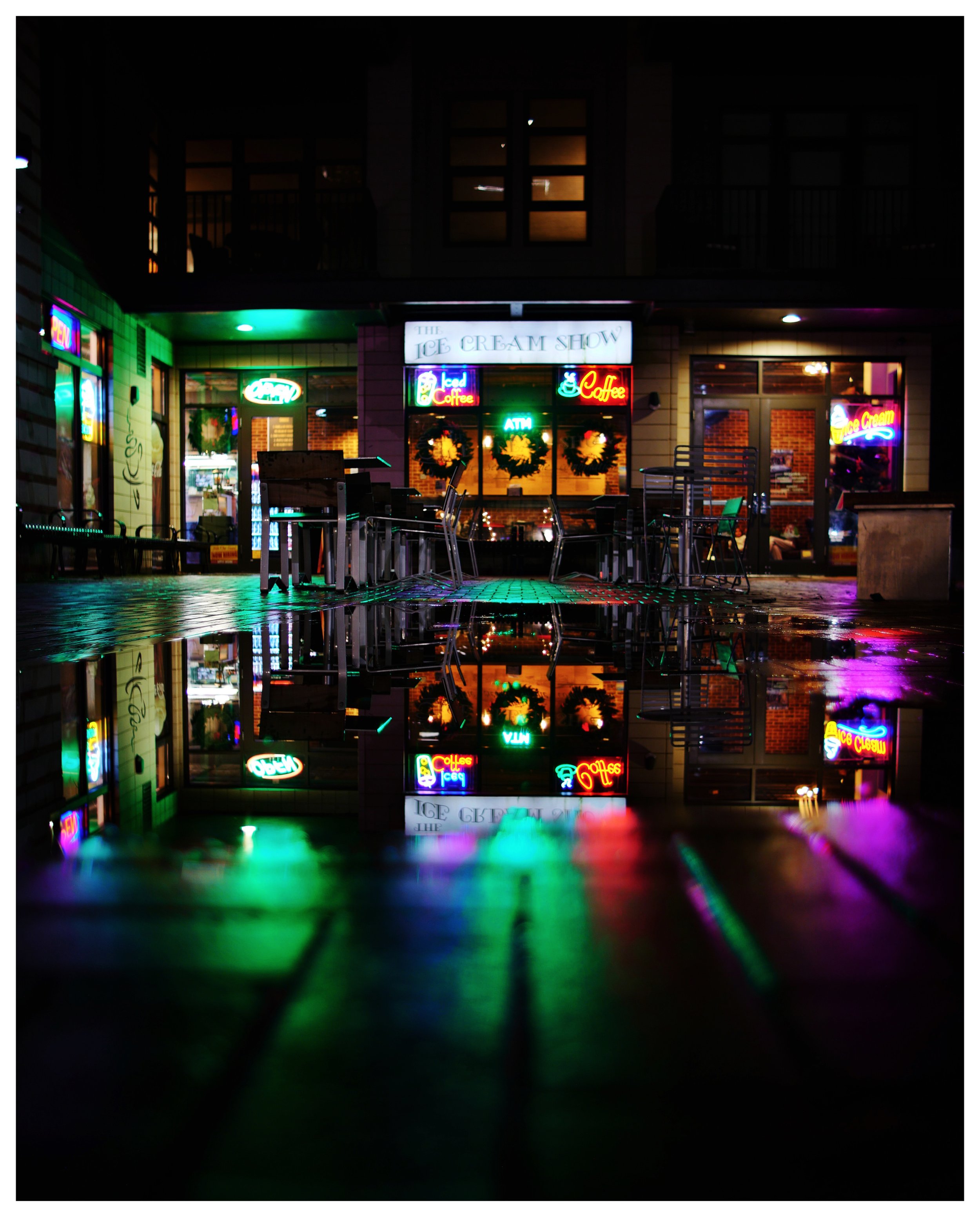
Water reflections are magical in low light or night photos.
Now that lenses are talked to death, what about the camera? Well, honestly any camera will do. It is the least important part of the equation to be honest. As long as it can be controlled manually for all three major functions, it will do. You see, it must be able to adjust shutter speed, ISO and aperture manually to be able to get creative results at night. The camera running in automatic mode will make choices in these controls that will not be what the photographer wants most of the time. It is guessing and will most likely guess wrong… But just about all reasonable cameras will let you control these functions and this is where it gets good…
The time of day.
Back to the original subject. Here are two photos taken from the same location, with the same camera and lens combination, at two different times of day.

Here we have a daytime scene of a garage.
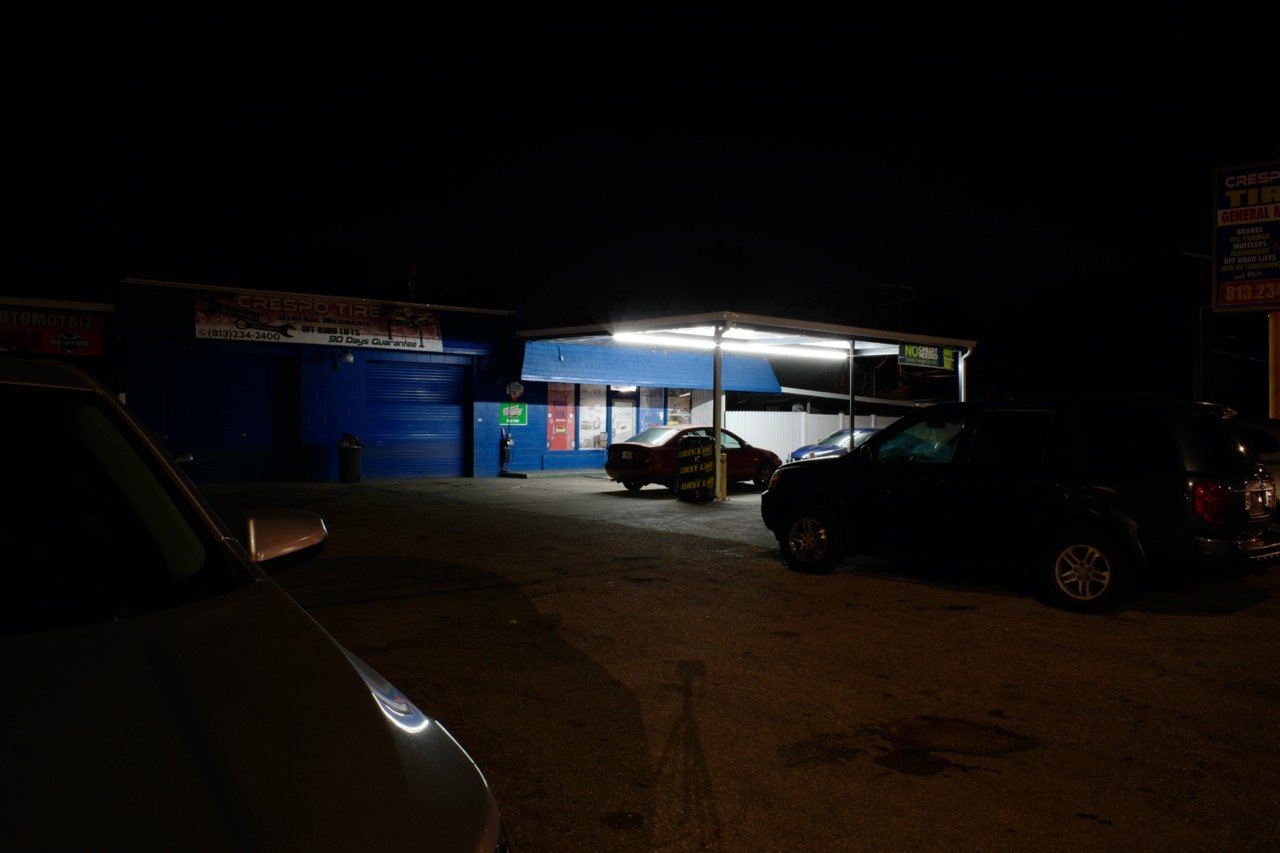
Here is the same composition at night. Notice the change in mood.

Here is the same scene, but the overhead lights are turned off (different day). This changes the mood even more and gives the scene a different feel. Take a look at the scene below of the Dutch Motel sign I found the other evening. The daytime photo isn’t much to look at, but the night time one has all sorts of interesting features that make it unique and otherworldly since it is distorting time so much with the incredible shutter time of 10 seconds!

The Dutch Morel sign isn’t much to ponder during the day…
1/400 second ISO 100 f8
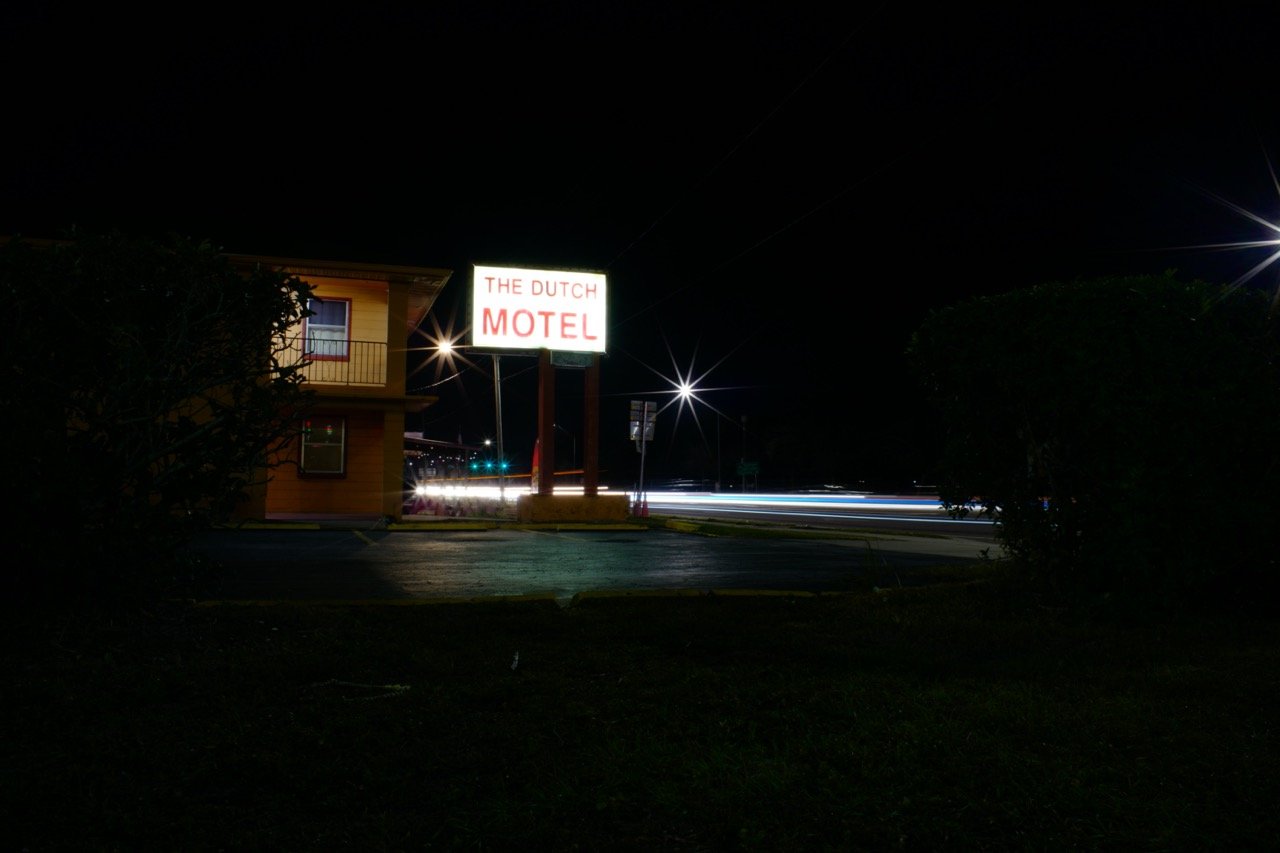
Once nightfall comes and you slow down the shutter, the magic happens
10 seconds ISO 100 f8
This is just a couple of examples too, there are many others that I have noticed over the years. So if you want a certain feel from an image, the time of day absolutely matters. There are some things that a strobe just won’t overcome and the sun is one especially if you are shooting buildings and not portraits.
So if you want to learn more about low light photography, check out my youtube channel here. David Saylors Youtube Channel.
Why don't I shoot more landscape photography?
The short answer…it is out of my reach.

Mid day sun is “flat”…
You see I have always loved shooting nature and landscape photography and such but once I started really looking at it seriously, I started to realize that it can only be shot at certain times of the day or it doesn’t have that magical look to it.

Deep blue hour adds to this image where the building is white and red neon primarily.
Where the sun is at in the sky makes a ton of difference to how the image looks and for the most part, the higher the sun angle the less interesting the image. Just watch most landscape photography youtube videos and you will see them getting up several hours before dawn so they can get the sky colors like they want with the mood of the terrain like they want as well. Most of the time it is dawn or dusk only for the photos they want. This is for good reason too, the images just won’t be interesting otherwise.
You see, the shallow sun angle makes all sorts of things different and not just the direction the light is coming from. It changes the color of the light, the size of the shadows, how dark the shadows are, the sun controls lots of environmental elements like fog rising off of the grass or water, and if there is frost or not in the image. These are just a few of the things the sun directly controls, but you get the idea.
The main thing for me though is that I am not able to get out at these times of the day so I end up shooting either mid-day or early evening. Both of these are terrible for landscape photography and the images out there prove it. You just can’t get good images of wonderful vistas at those times, it only takes a moment to search the web to see this is true.
I do occasionally get out at the right times and will snag a cool photo or two of some cool landscape stuff, but for the most part … not…
What I do get are photos like the one below. I can get out at night some, and mid day as it seems to work out, but not at golden hour or blue hour either for the most part, but sometimes I will get that chance, so instead I have embraced night photography as well as high contrast mid day photography, which works well for street photography if more people were in the area.

I will also do some local documentary style photos of stuff like buildings in the town that are changing or if there is some kind of activity. Most of the time though, I end up just walking around.
This also turns out to be a good practice as it gives you perspective and you will start to notice images that you didnt see before. It makes me more observant of the environment or so it seems.
Well, I successfully wandered down a rabbit hole anyway… lol. You get the idea though, I am pretty sure I am not alone in why I cant do landscape photography and I am also sure there are more reasons than these. what do you shoot because of your circumstances instead? Leave a comment below and until next time. Get your camera out!!!
What does lens focal length do to me psychologically when shooting street photography?
Photography and the human mind…
I have found that when I put on a wide lens, I suddenly loose the fear of getting close to people for some reason. I am still guarded with people and don’t approach a lot of them, but I will still get closer. This is a real struggle for me and I find it even harder due to time constraints that I have to shoot street. I don’t normally get to go shoot street when the large crowds are out and about. I end up being in the areas when there is little to no activity. So for me to get a good candid street photo is pretty special. I don’t get dozens a week like some photogs I see, but maybe one a month…maybe.

17mm APS-C photo on the Leica CL
I find that I like to get two kinds of photos when I shoot wider than 35mm and a different kind of photo when I shoot 35mm or longer. I didn’t even realize it until the other day when I put the 17mm on my Leica CL (like a 28mm on full frame) The 28mm is also what happens to come on the Leica Q series cameras. This particular machine is quite costly and you can’t change the lens either. But for street photography , the 28mm is a great choice and lots of people LOVE the Leica Q2 and Q2 Monochrome just for this reason!
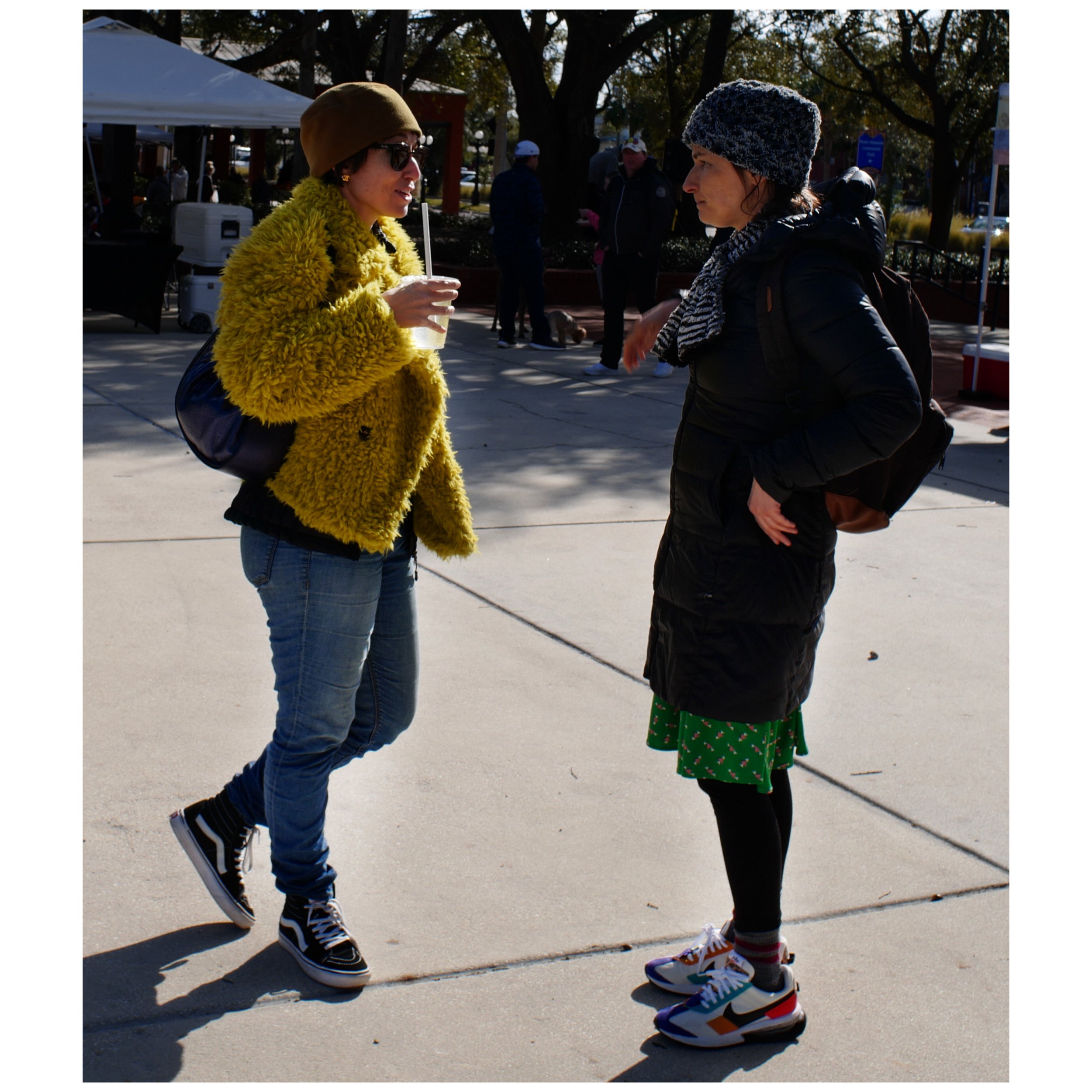
17mm APS-C photo on the Leica CL
When I put the 17mm TTArtisan APS-C lens on the camera I consciously know that the lens is very wide and that I am going to have to get close if I want to fill the frame. Then I fill the frame with images that make me happy for some reason. It is really strange that if you want better photos, sometimes you just have to get closer… Photography is strange, people have all sorts of different ideas about what it is. You know what? They are all correct. Every single one of them. What is that all about? LOL

35mm APS-C photo on the Leica CL
When I put on the 35mm (50mm equivalent) The mindset shifts to scenes with people in them or portraits on the street when I use longer lenses for some reason. It just happens too, I don’t even think about it, I just do it. I start looking for interesting things across the street when running the 35mm or longer lens. I also noticed that I like to compose from different view points too. I will end up shooting from a lower angle with the wide lens and from my eye level with the longer lenses. I think this is because of the viewing angle when I look at the photos in post, but it is a very strong phenomenon.

The Leica CL has become my de-facto street camera with either the 35mm or the 17mm as of late. I really like the form factor of the Leica CL and I also use a grip frame on it. This grip frame is made by LIMS that is currently out of production from everything I have seen. This grip frame is awesome because it has a ARCA SWISS tripod adapter on it and there is an opening for the battery door in the bottom plus it has the grip extension on the right side that makes this basically the perfect street camera for me. I like the form factor of this machine the most, it being very unassuming yet has exceptional image quality, makes this a wonderful little street camera. My only thing I would like better would be to have the Leica Q2 Monochrome as I love monochrome AND the low light power of that camera is phenomenal! But for now, I really want to use the CL all the time.
I say that with a bit of sarcasm, you see as as of late I have really started to embrace color photography more and more and have not shot in monochrome on my digital machines in ages. So the monochrome might not be the best solution for me, but I really like the idea of the low light powerhouse that it is. That is the real appeal for me to be honest about it.

The Leica CL adorned with the TTArtisan 17mm f1.4 APS-C manual lens.
So there you have it, a small treatise on my thoughts about the focal length and what I instinctively shoot with each one. I am odd and I know it, so this is by no means a definitive explanation about anything, but rather just an observation into what I do when I use certain lenses and what kind of gear I tend to lean towards when I go shoot.
Now get your camera out and go take a photo with it!
Preserving the Past Through Photography: Documenting Small Town Historic Buildings
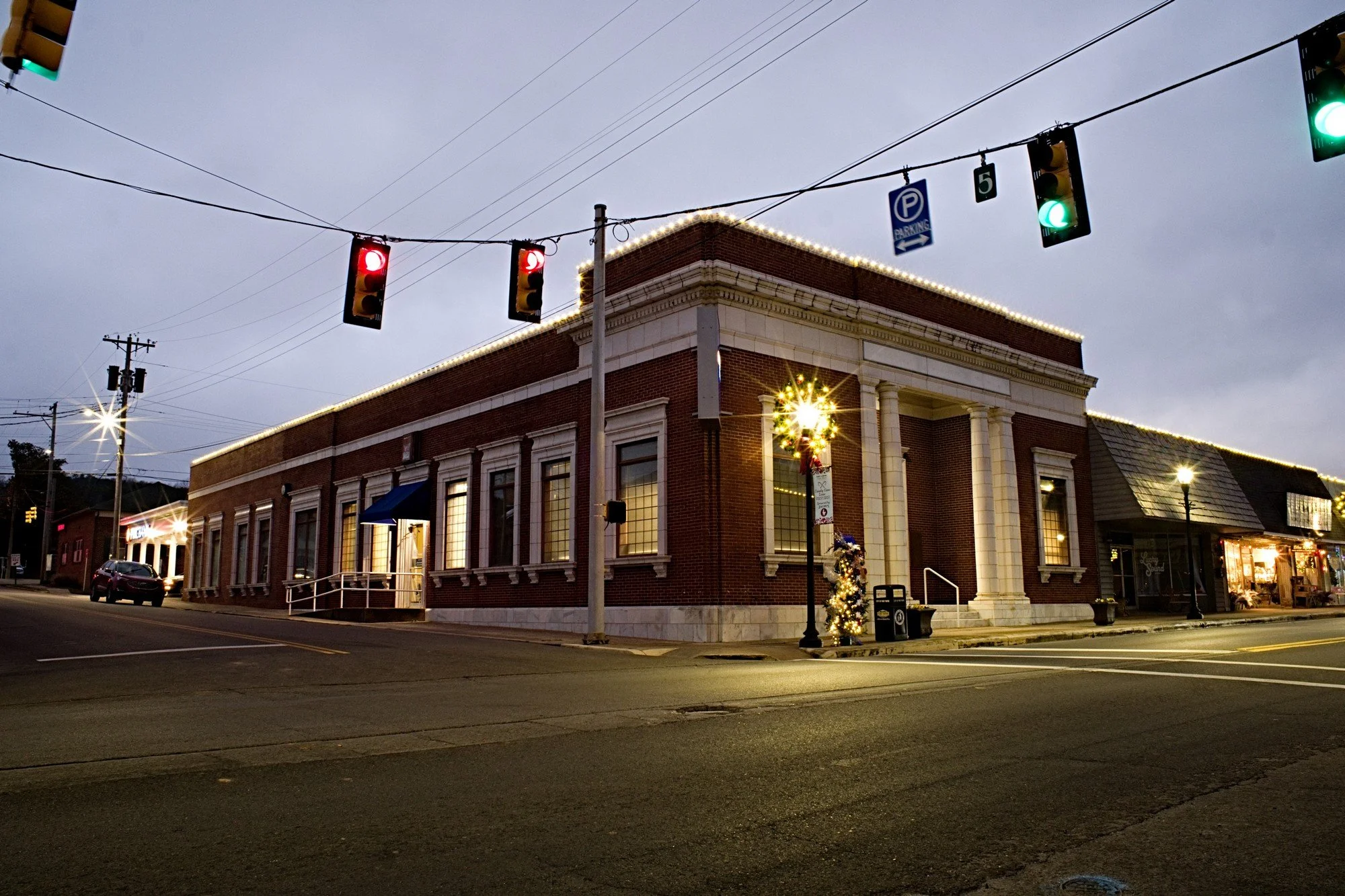
As a photographer, I am constantly on the lookout for new and interesting subjects to photograph. While I love the beauty and grandeur of natural landscapes and cityscapes, I also find a strange allure in the odd and often overlooked subjects that populate our world.
One subject that has particularly captured my attention in recent years is the cityscape of small towns. To some, these areas may seem uninteresting and even dull, but to me, they represent a unique and compelling source of inspiration.

There is something about the charm and character of these small towns that I find deeply appealing. The quaint and often crumbling buildings, the narrow streets and alleyways, the sense of history and community that surrounds them – all of these elements combine to create a visual feast that is unlike anything else.
But beyond the surface level aesthetic appeal, there is also a deeper meaning to be found in these spaces. They represent the resilience and determination of the people who live and work within them, the traditions and values that have sustained them through the years.

Photographing these small town cityscapes is not always easy, as they can often be difficult to access and require a more patient and thoughtful approach. But the challenges only serve to make the process all the more rewarding, as the resulting images capture a world that is often overlooked in the rush of modern life.
Whether it's the beauty of nostalgia or the timelessness of small town life, there is always something new and exciting to discover in these forgotten corners of the world. So if you're ever feeling stuck for inspiration, don't be afraid to venture into the world of the small and overlooked – you never know what you might find.

I have always been drawn to the beauty and mystery of old buildings. There is something about the character and history that these structures hold that captures my imagination and inspires me to create.
But there is a certain magic to be found in shooting these buildings at blue hour or at night. The soft, diffused light of the setting sun casts a warm glow on the architecture, highlighting the intricate details and textures of the building's façade. And when the sun has set and the night has fallen, the artificial lights that illuminate these structures take on a life of their own, creating a sense of atmosphere and drama that is hard to replicate in the daylight.

Shooting old buildings at blue hour or at night also adds an element of surprise and intrigue to the process. These structures are often still in use and powered up, and seeing them in this state – with their windows glowing and their machinery humming – adds a sense of vitality and energy to the image. It's a reminder that these buildings are not just static relics, but living, breathing entities that are integral to the communities they serve.
Whether it's the beauty of the blue hour light or the drama of the night, there is always something new and exciting to discover when shooting old buildings in these unconventional hours. So if you're ever feeling stuck for inspiration, don't be afraid to try something new and experiment with shooting at blue hour or at night – you might just be surprised at what you find.
Industrial Landscape Photography in Jasper TN
The other day while on a business call, I had to travel through an industrial area and my eye just started picking up these images. Now I cant get them out of my head till I go shoot them.

This is the life of a photographer… once you get a composition in your head, you cant let it go till you shoot it.
It is interesting to me that I work like that. I will get fixated on a photo I want and nothing else will make me happy till I get it.
I am pretty sure that I am not alone on this either. I think it is part of the creative mindset. The photos I have in mind are of the industrial landscape that are local to my area. I saw the area in the morning light and it had this ethereal or maybe apocalyptic vibe. Like it was abandoned but was still intact and could be turned on at any moment. This is because I like those kinds of movies too, I guess.
So here is the plan, get back over there with a camera in the early morning light and shoot a bunch of stuff and then see what I got.
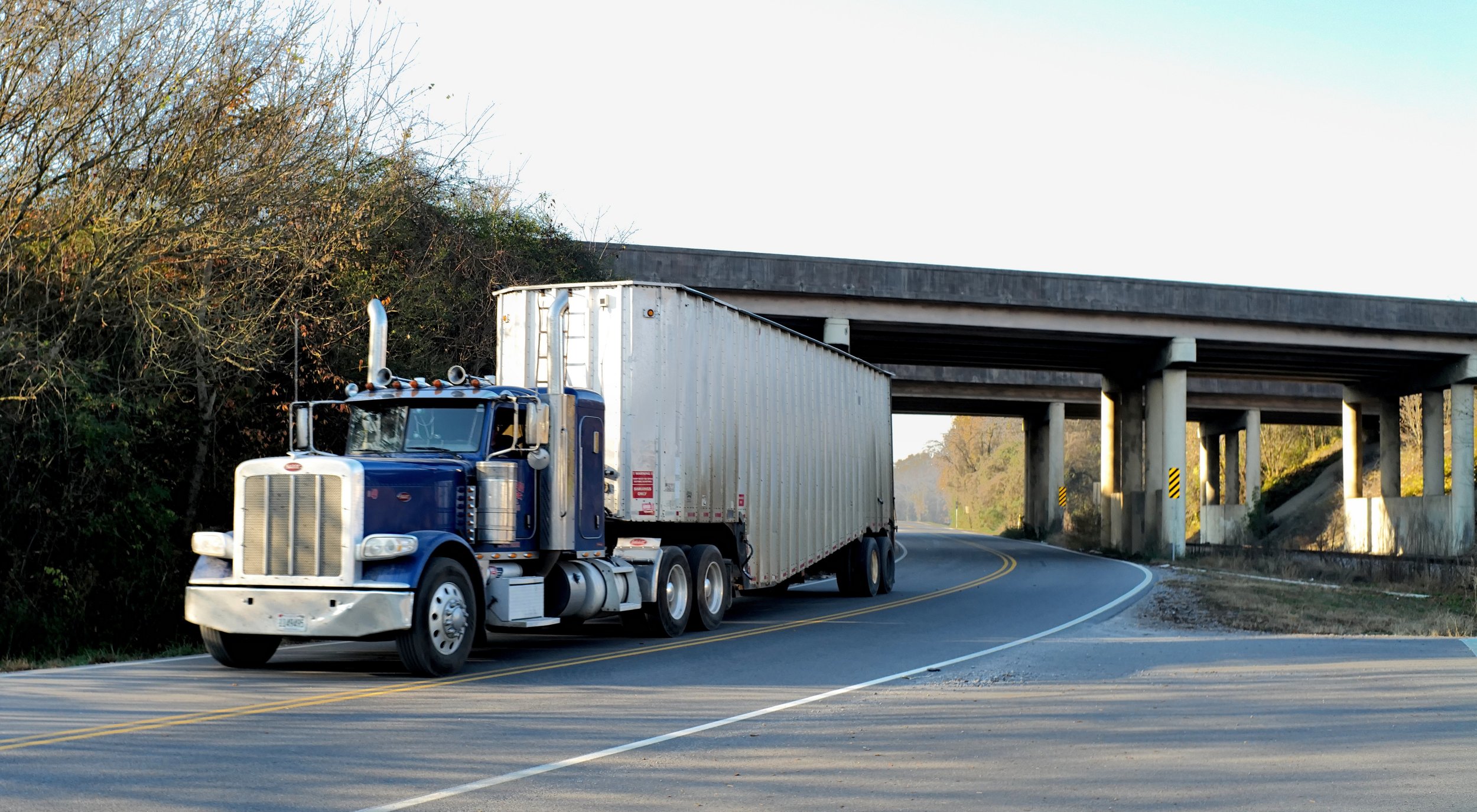


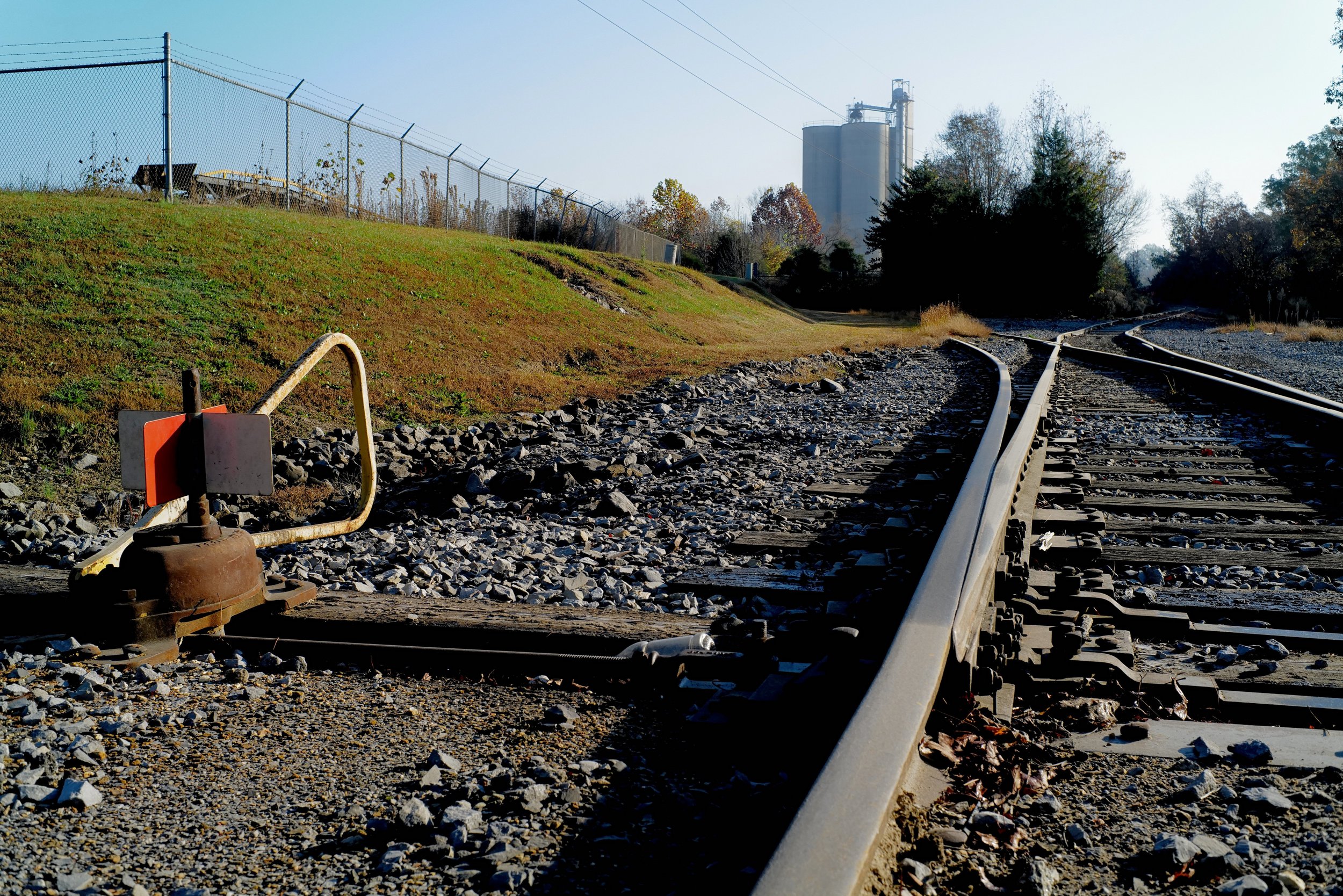
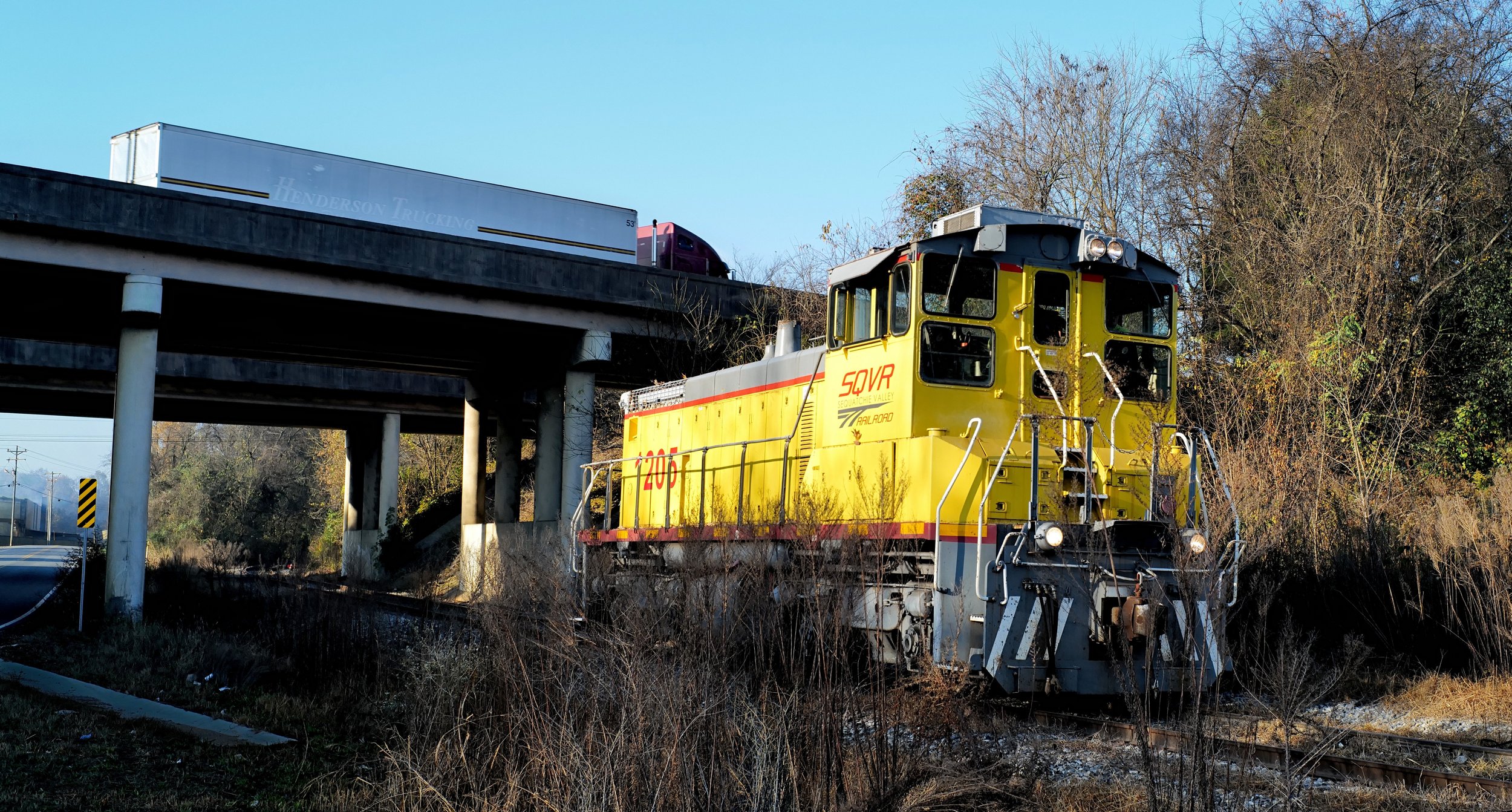
I found the air a little less foggy upon my return, but the morning light made it look good nonetheless so I got out and started getting images. The first stop was a plating factory that was in full operation and had a bunch of steam coming out of the factory. I had to shoot over a 6’ tall fence to get my image. It took several tries to get the one I wanted, but I finally got it.
Then I moved to work compositions around the railroad and associated infrastructure. The balance of the images are centered around this concept. I even hit pay dirt when a local switch engine showed up to move some tanker cars around!
My favorite image though has to be the image of the abandoned cattle gate. This is urban decay at its finest and I love this sort of thing for some reason. I hope this post and images inspires you to go back to something that caught your eye and get a photograph or two of it.
Until next time, get your camera out and go take a picture with it.
David - The Georgia Photographer