WK4DS Amateur Radio Blog
Search Posts
What have I learned from documenting my antenna position?
The short answer … nothing world changing really.
But honestly I have learned a lot about what it takes to make contact with a QRP radio. The most important part is you setting up the radio and trying to make contact with it. I know this sounds obvious but it is often overlooked as people will look at the band prediction information like the space weather forecast and such and get paralysis through analysis from, this. They will not even bother to turn on their radio. This is a sad result that generates no activity and creates a group of operators that do not operate…
The next best thing I have learned from doing this small experiment is that I was not collecting near enough data to have a informed answer in any way, shape, or form. I was literally only recording my transmitter power, the signal reports (and this is totally subjective and not accurate really), and the antenna direction then generating a QSO map of my contacts from that time. This is not enough information to have any sort of relevant value to even bother with documenting the antenna position or elevation or any of that stuff. What I did learn though is that the antenna elevation and the counterpoise make a large difference and how well the antenna performs if you’re using wire antennas. I would attempt to get the wire as high in the trees as possible and it always seemed that the radio would here and talk much better when I did.

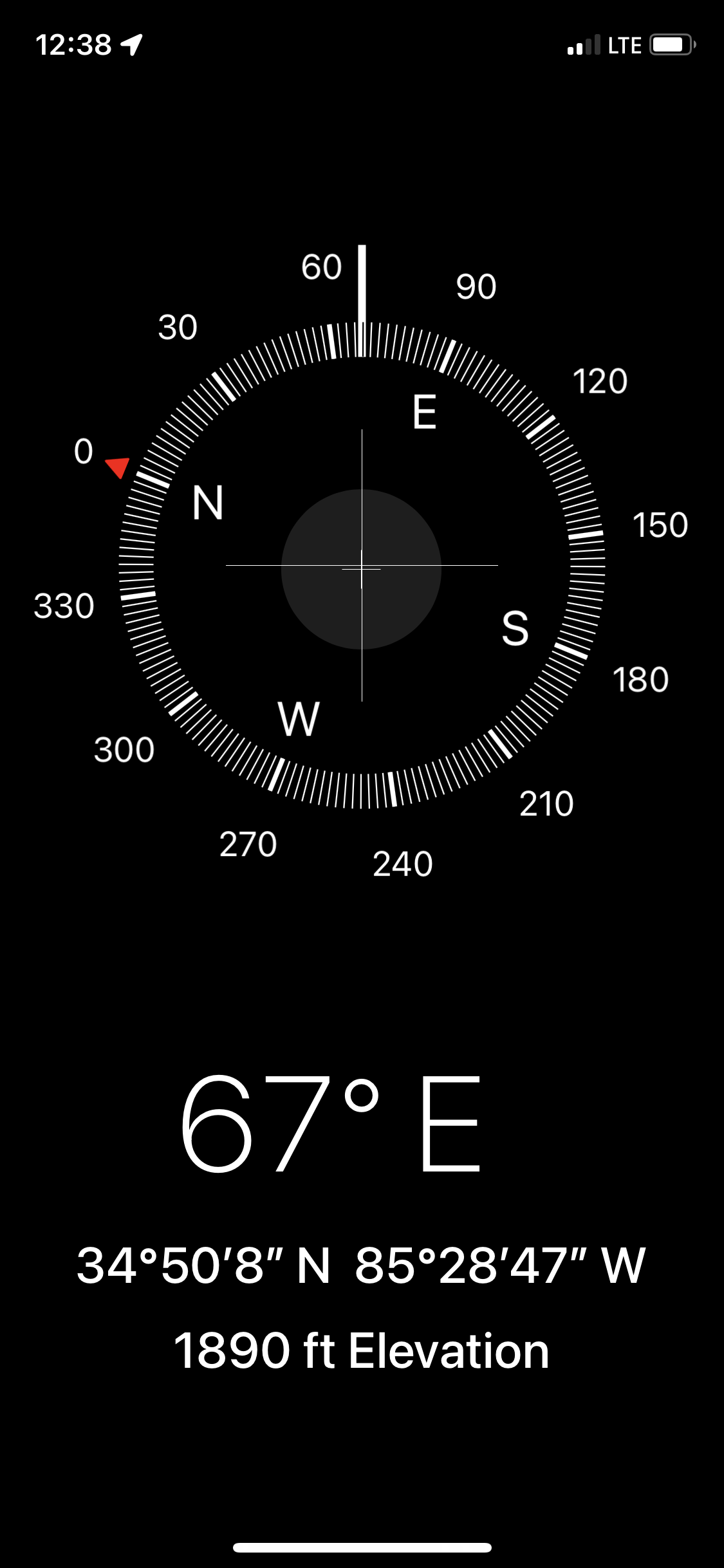
Antenna direction
I posted once on Facebook about this phenomenon of antenna direction and the location of the contacts and a reply was made that I had a omnidirectional contact chart mainly because I was where the radio operators were also at. This was said as a joke but it actually had merit. This actually made a lot of sense. What the charting of my contacts does show is that there is almost 0 NVI (near vertical incident) with wire antennas strung in the trees. Almost all of my QSO contacts are several hundred miles away usually showing that the near vertical incident is almost nonexistent with my wire antennas.
What this has basically taught me is that even if the prediction is for poor band conditions get out and try anyway this will normally result in you at least making a few contacts if not getting an activation in a park or just having a good time in general you don’t have to sweat it too much just get the wire up in a tree put out a counterpoise of some form and the antenna will do its job once you tune it with a tuner. It’s all the better if it is a resident antenna anyway as you do not have to tune this antenna to be able to use it.

Antenna Direction
Parks on the air is a wonderful activity and I really would recommend you try it out if you have not done it already it is a lot of fun and I get to operate QRP radio in the park and I’ve become the DX! This is something that I have never experienced under normal operating conditions as a US amateur operator. It is literally not something that happens to me normally. So if you want to try out being the “DX” this is an easy way to do it without breaking the bank from having to travel lol
ARRL Amateur Radio Field Day 2022 After Action Report from a CW op.

Well that fateful day has come and went, fun was had, radios were used and new skills were learned.
I want to thank Ms. Dana K4GCA, for hosting us on her property so graciously, this made the whole event feel so much better. You see, this is our first field day without her late husband Brian (K4GC) who passed away unexpectedly last year. We miss Brian dearly and it made this field day even more special to be allowed to operate the site from his back yard.
This was the first year I have been to a field day event in many years. A lot of new faces have came onto the scene since the last time I did field day with the K4SOD amateur radio club. It was good to see old faces as well as the new ones and to put faces to call signs is always a good thing.

Roger KG4WBI brought several radios and antennas and proceeded to build a huge antenna array on a push-up pole to connect his Ten Tec Argonaut to via hamstick dipoles. I had to leave before the system was built completely and go to church for the evening but when I came back I went back over to the site to operate some CW on the air..

Once things got underway, they setup the SSB station in the back workshop and got to work. Ricky W4EMA getting on the air here on Roger’s KG4WBI Alinco DX77T HF rig while Steve KI4WJG waits his turn at the controls. Thanks to KK4IJR Kevin for many of the photos in this article, but somehow we didnt get a single image of him!!! LOL


It is strange how CW will draw a crowd I did not think most people enjoyed it but it was a huge conversation topic the whole time I was trying to work contacts. The guys were truly interested and it surprised me. I was looking around trying to find contacts with the Argonaut but since it only has 5W of output power it was very difficult to get through the band QRM and make a contact. I spent the better part of almost an hour trying to make five contacts, it was very different from the parks on the air style of operating.

I finally gave in and we used Josh’s KN4RTY Yeasu 891 to up the power output and to get through and make some contacts. At this point my confidence was boosted somewhat and I was able to get back on the Argonaut and it’s five watts of output power and make a few more contacts with it before I called it quits at 2:48 in the morning local time(5:48 UTC).


Getting to use the Argonaut was a special treat as those radios have been out of production for many years maybe even decades at this point. Roger had went to the trouble of having this radio professionally tuned, aligned and cleaned so that it would be in pristine operating condition for the night. Ten Tec transceivers are amazing radios especially for the CW operators. They seem to specialize in that type of radio communications with their transceivers. If you really enjoy using CW in my opinion, you really should look at Ten Tec and Elecraft radios, these radios excel at that mode. Now don’t get me wrong, all amateur radios, pretty much, work really well with CW. It is just a subset of all the amateur radio operating modes so don’t think you have to have a certain brand of radio to use CW, I just prefer Ten Tec radios.

I decided to take two different CW keys with me to the field a side. One was my straight key I made some 20 years ago but since we were using it on the Argonaut 2 I had to change the cable to an RCA cable to be able to connect it to the radio. The other key was my serial number 1 “prototype” WK4DS paddle and I love this key greatly so I put it in a waterproof hard shell storage box with some closed cell phone to protect it during travel. These two CW keys are my primary keys that I use when I work outdoors or sometimes indoor operations. I have others as well, but these are my favorites.

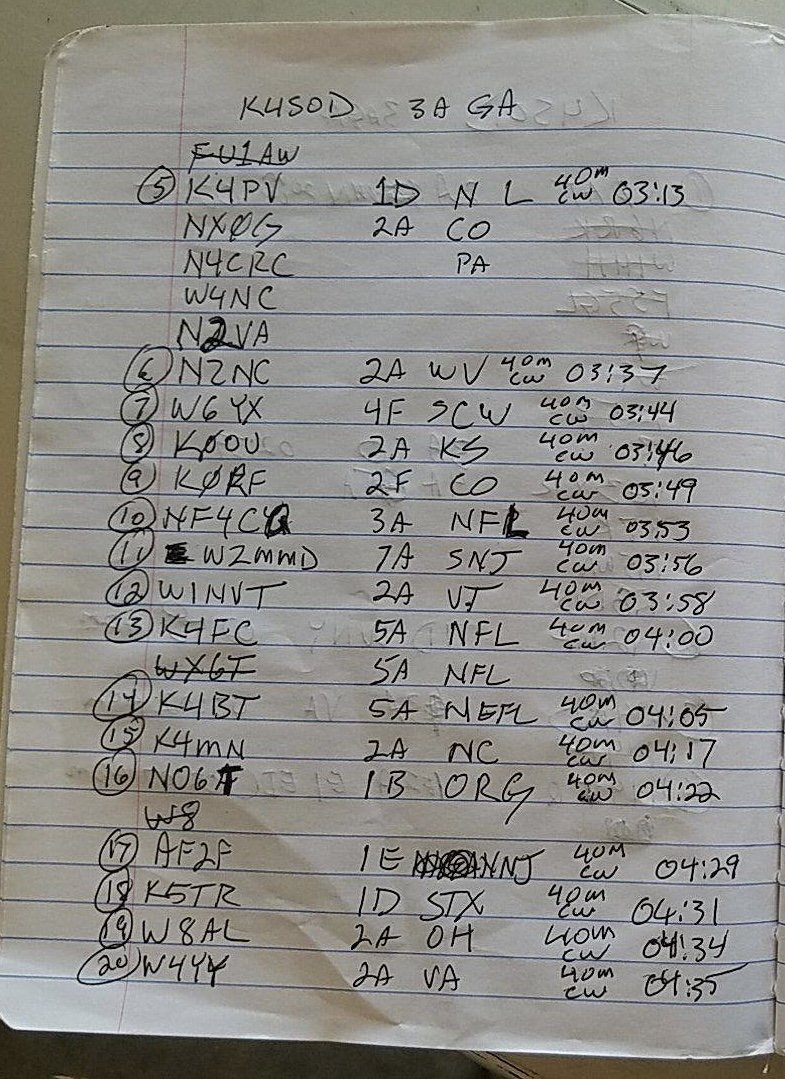
My logbook is a mess! I would get the call first then get their exchange info before even calling them, this way i could listen to the exchange and just confirm what I had written down already. This made code copy at such high speeds much easier for me. You see, I am kinda slow at copy right now… lol…


It was a really good time and I really enjoyed meeting with people that I had not seen in a long time it makes me realize how great this community really is. If you have not gotten out and interacted with the local hams in your area I highly recommend it. Until next time get your radio out and go make a contact with it will see you later 73 WK4DS
Back to K-2169! I get the luck of the draw and the bands cooperate!

Well, it has been a week since I activated a park so I had a few hours this afternoon and a charged battery, lets POTA!!! So I grab my bag and head over to Cloudland Canyon State Park and my usual spot has people in it and they looked like they were going to stay a while so I went to my second location of choice and it was all clear! Got the antenna up on the first throw this time! The sloper was facing 55 degrees NE to the high end without a single branch near it! I strung out the 20 meter wire for a counterpoise and hooked them to the tuner, antenna done! Cranked up the radio right at 20:00 UTC and I started calling CQ on 12 meters for nearly 15 minutes with zero replies! So I moved down to 15 then to 17 where I pounced on XE1XR in Mexico to start things off right. Not hearing much else, I go to 20 meters and literally find every HAM that has ever turned on a radio! Yeah, 20 was open… so I found me a spot and started calling CQ. I didn’t have good internet today for some reason so I sent my friend KV9L a text and got him to spot me, but then the reverse beacon took over after that I think because in 19 minutes I had garnered 15 QSOs and making this trip a valid activation! Well I didn’t stop there as I still had plenty of time to play radio so i kept calling and you guys kept answering. I logged KG5CIK at 20:51 UTC and moved to 30 meters for a minute to see what I could do there. I ended up with 6 QSOs on 30 meters then hit 17 again but no one was there and then finally back to 20 to finish out the day. Got a couple of park to park QSOs this time as well as K9IS whom I log almost every trip out and CU3AA in the Azores! I am always amazed at what just a few watts of rf can do! That was a good trip for me today, ended up with 37 QSOs in just at 2 hours time. That has to be some sort of record for me, I am sure of it. lol…
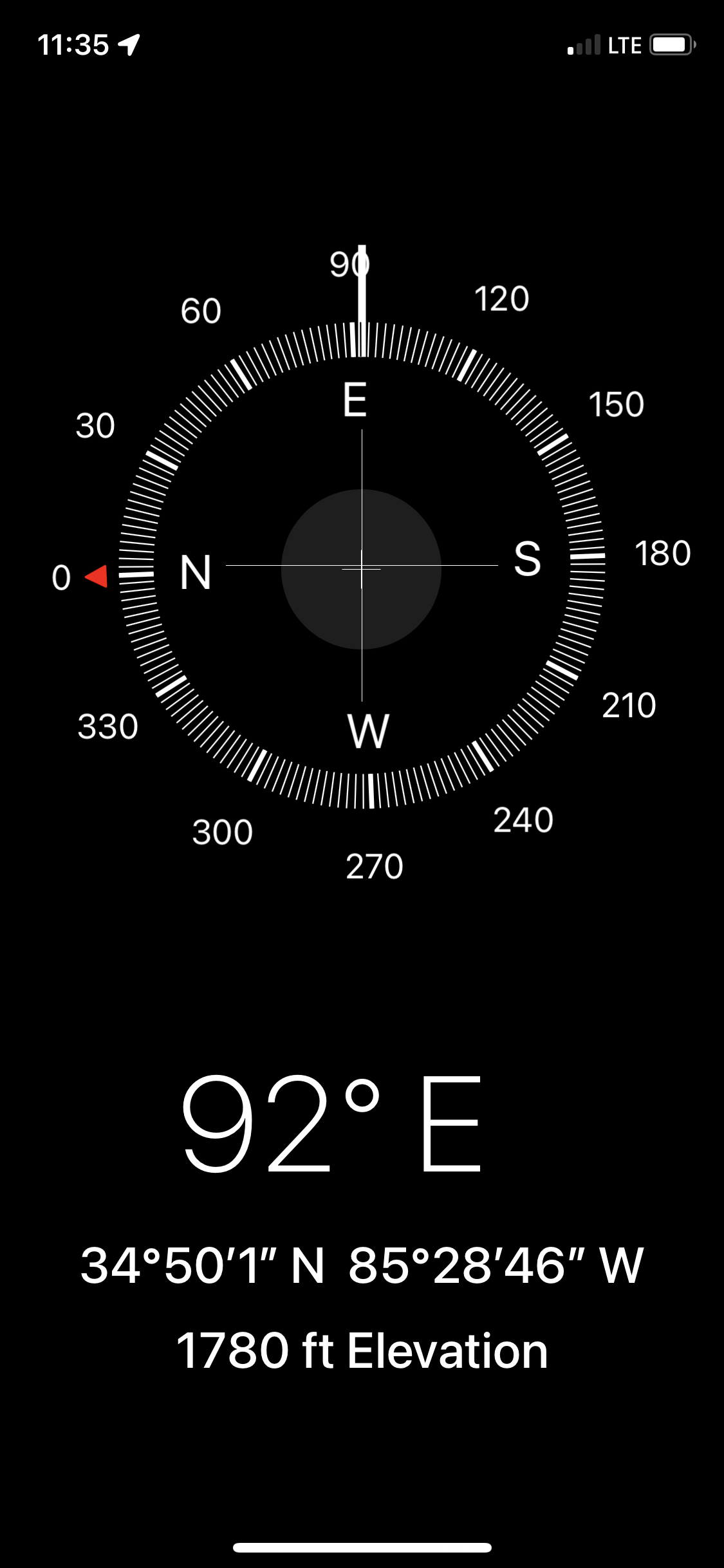
Compass I use is from my iPhone and it works pretty well as it also has a bunch of other data from the location as well. This is the direction the high end of my sloper was facing with it hanging at close to a 30, maybe 35 degree angle. Compare that to the QSO map for propagation reference info. I like this simple kind of research, alot of it is not documented, but I think it is enough to give me an idea of what I can do with the antenna when I string it up.
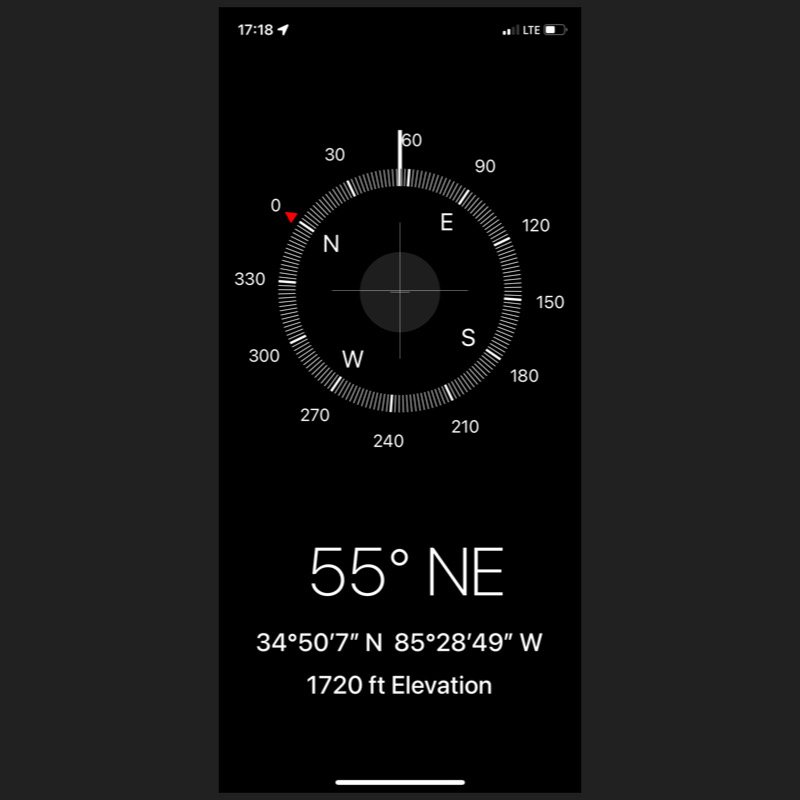
I overlayed the compass onto the qso map to see what it was doing and the results are kinda cool to see visually.

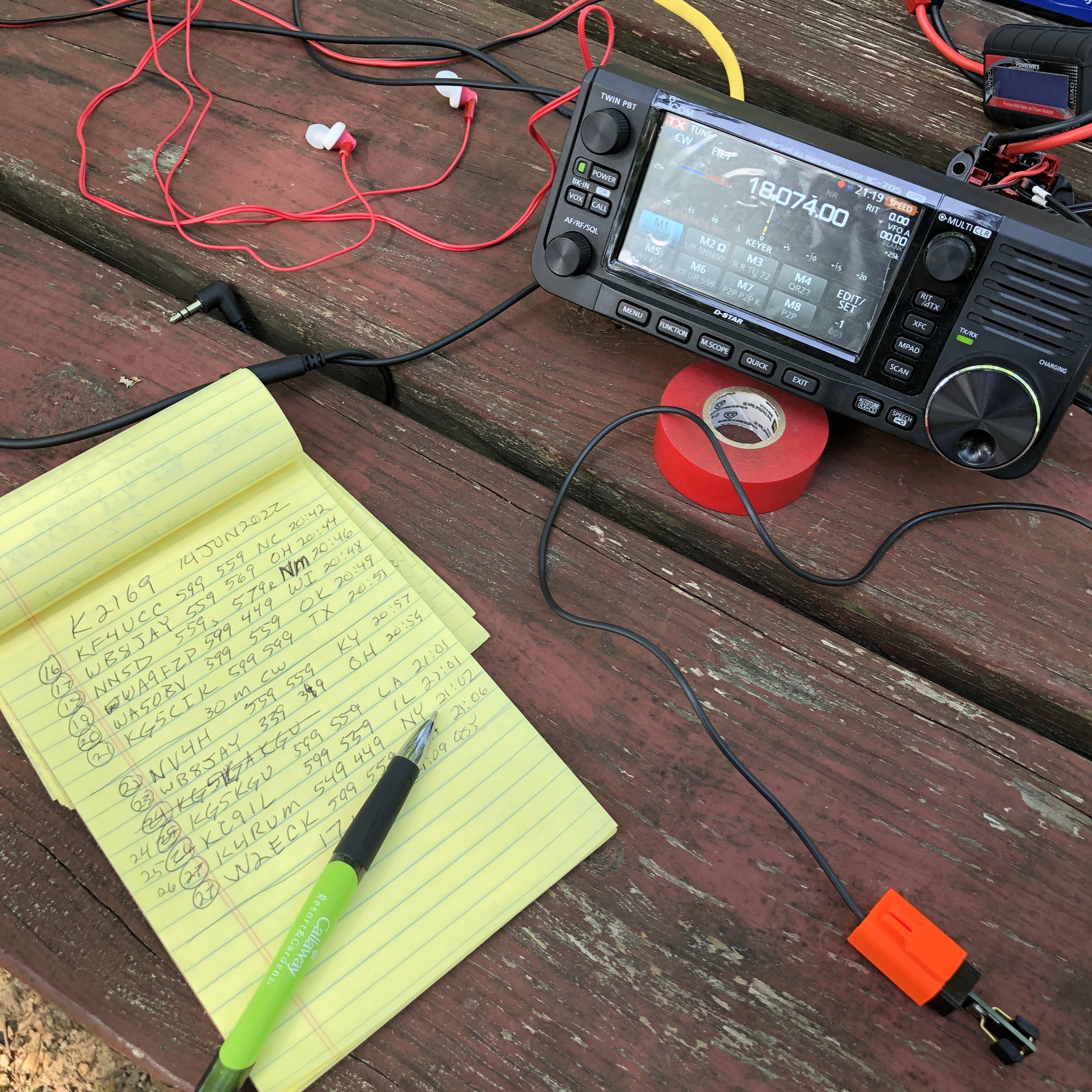
Using this tiny little travel key takes some practice as it is not super easy for me to master, it works really well but it is very small and I am used to large heavy bench keys that sit by themselves and do not require two hands to operate, this is what I am talking about. The key itself performs VERY well. I really like the little guy.

If you will notice, my logbook contains only CW contacts today, this is because of two things, for one, I love using CW. For some reason I have always enjoyed using this mode on the air, even though I am not very good at it… and number two, nobody could hear my calls on SSB today. I think it takes a little more than 10 watts to bust through a pileup… lol. I do get some SSB from time to time and plan to try some RTTY and FT8 as well in the future…once I learn how.
Thanks for your time and 73
de WK4DS
Got something magical in the mail today from my POTA radio time!

When you embark down the road of ham radio you learn a lot of history as part of the journey.. A little piece of that history is QSL cards. QSL cards are super interesting to me as I am pretty sure it is one of the only times that a person involved in an activity will go to the trouble of documenting and sharing that documentation with the other involved party to confirm it happened. A QSL card is usually nothing more then a post card with the contact data on it, sometimes mailed like a post card sometimes in an envelope. Then there are “nicer” cards that will have photos on them, but the ones I REALLY like have personal hand written notes on them. Those are the best to me. If you are active in radio very much on HF at all, you will end up with at least a few of these in your mailbox. The usual courtesy for me is to reply to all cards I get in the mail, I once actively sent cards to all my contacts that I made, but I no longer do that due to the costs involved, but I will always reply to one sent to me…always.

I find it charming to keep this tradition alive, but it can get complicated too, before you throw your card in the mail, be sure to check to see how the other op handles their QSL cards, there are several ways to do it , just so your aware. Most of these are done to help either save time or money and sometimes the DX station will have rules as well as sending a “green-stamp” to offset return postage or an SASE to help them with the expense of sending those exotic cards over seas.
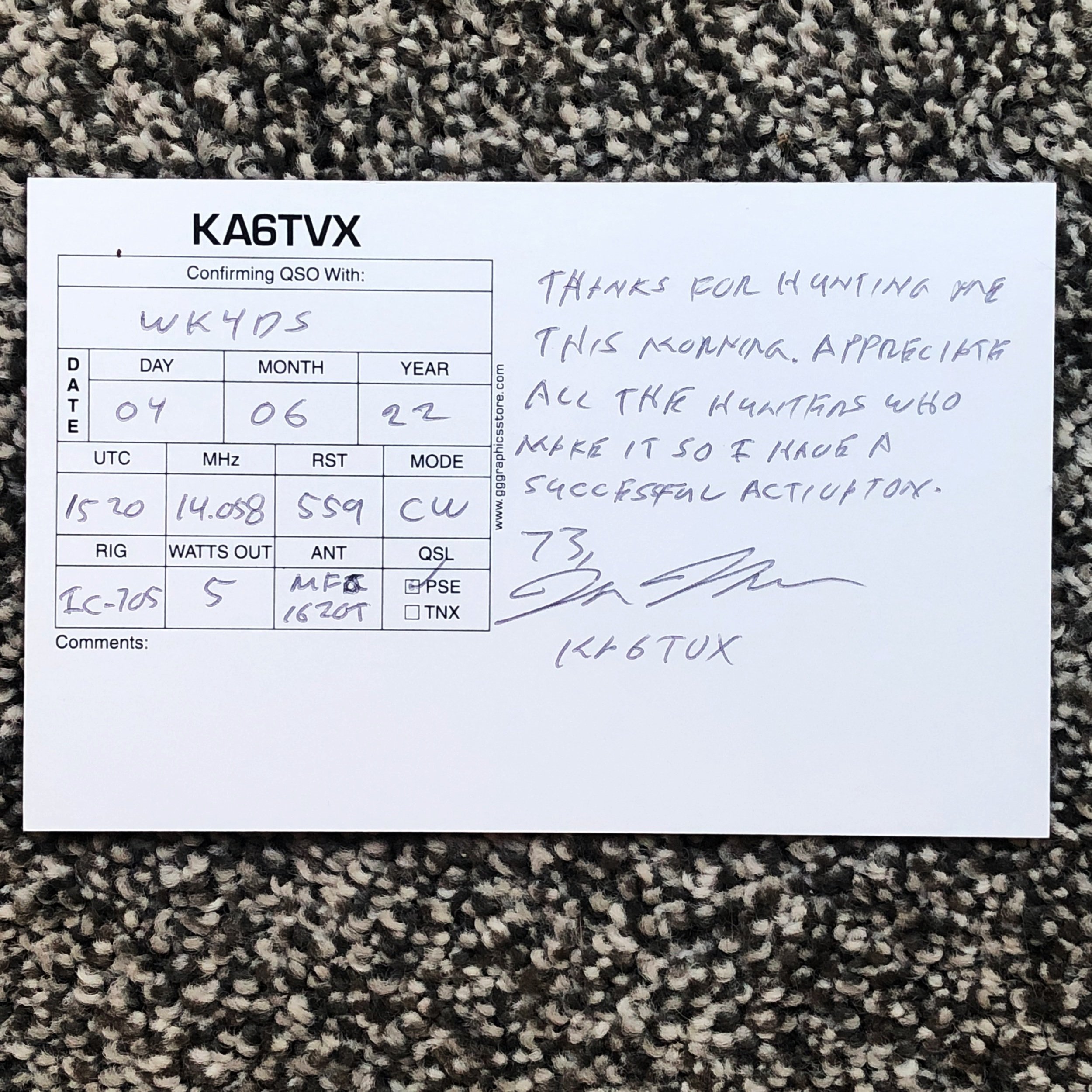
Since I have been out of radio for sometime, I am honestly needing new cards. I think I will go with photo cards this time and not add any special logos so they will translate to all types of radio like voice modes and even digital.

Customizing your QSL cards doesn’t have to be a once and done thing either, I have routinely made custom QSL cards in the past by just doing some photo editing and then printing photos and writing the QSL info on the back. I would always mail these in envelopes as I didn’t want the post office sorting machines abrading the photos. But this is just one way to make the card, you can literally write a letter if you wanted to… The rules are not set in stone here.
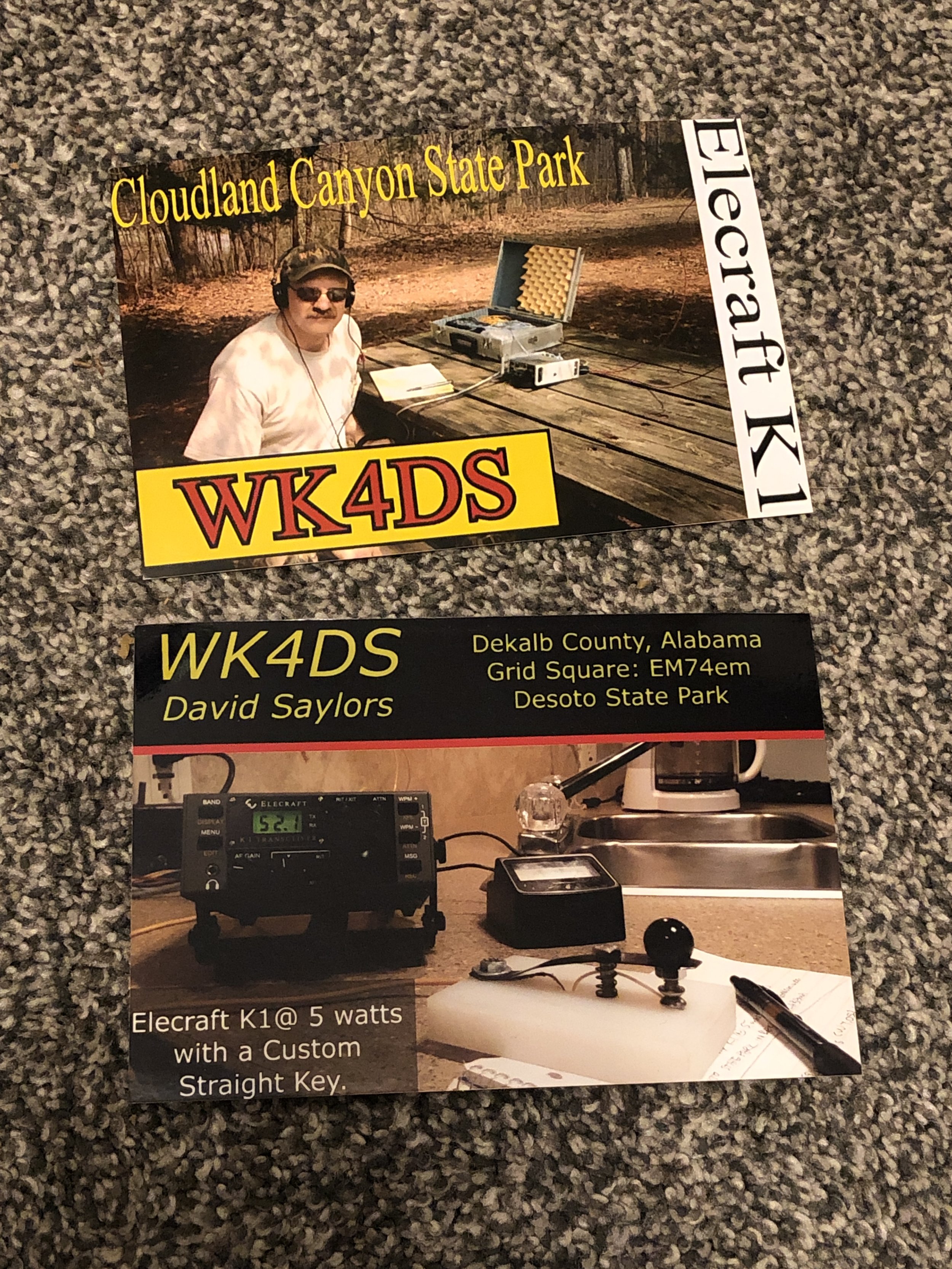
I always enjoyed getting these kind of “shack” info letters, it was always interesting for me to see what the other op was using when we made contact. Sometimes it would be a 10,000$ power house machine and sometimes it would be a homebuilt rockbound radio that cost 25$.

Yes, we had a QSO and he was transmitting with 250 milliwatts! The note about the contact is below.

So I hope if your new to amateur radio that you will consider sending some cards out and going the extra mile and personalizing them as well. Have some fun with it! That is what it is all about anyway!
Tough conditions, dead batteries and a lot of amateur radio fun.
This is a tale of a guy who thinks he is going to get a “quick” POTA activation and then go grab some photos as well… It didn’t go like that…at all.
You see I thought I had this whole Parks On The Air thing dialed in and have even built a little “kit” to activate parks with that I can just grab and go. I am repurposing an old camera bag (a story for another day) and it organizes the QRP rig perfectly for activations. Soooooo, this is how it goes on that fateful day. I have a few hours in the afternoon on June 8th 2022 and tell the wife I am gonna “run” over to Cloudland Canyon state park and get a quick activation and then be back in time for supper with the kids later. I grab said POTA bag, hop in the truck and head over to my spot to activate K-2169.

Well, I should have heeded the warning when I got there I guess as my favorite location on top of the hill was occupied with a group of teens on a day trip from a local school. I circle through the parking lot really slowly surveying the area and decided to park for a bit and see if I could figure something else out when I catch a break! They start packing up to leave!!! So I wait patiently for them to vacate the location I want to use and once clear, I move the truck and grab my gear.

Setup was frustrating this time as I had to throw my line 7 times to get a good location like I wanted (turned out later that really didnt seem to matter, haha). I FINALLY get the line up in the tree and then hook up the radio and we are off to the races! Well, I was off to the races, seems nobody could hear me. It took several minutes of calling CQ to get my first contact. Normally once I get one, then I will end up with at least an activation (10 contacts) within about the next ten minutes. Not this time, it took a full ten minutes to get the next QSO in the log! So then I figure I would go hunting some other parks and I did get one then another! NO! It was a SOTA op that is didnt hear well… lol. Well after that I got my hopes up again as I got a run of 5 in about 25 minutes. As I would be just about to give up and try something else, I would get another one and it would keep me in place a little longer. So I am an hour in and only have 8 contacts at this point, I need 10 for a technical activation, so I REALLY want to get two more before having to shut down the operation. It was at this point that I realized why I was getting the 339 reports…THE REMOTE BATTERY WAS DEAD!!! I’m thinking at this point. Really doofus, your brought a dead battery to an activation??? Well, yeah, I did… So I am now running on the battery that comes with the 705 which will only produce 5 watts output. I can hear stations but they cant hear me… I head over to 30 meters and bag N3VO for the 9th QSO in the log, it is basically time to break down the rig, but I need one more contact to have an activation, so I go back to 20 meters and switch to SSB, after trying to get through 4 pile ups without no success, I score a park to park on my last QSO of the day and get my 10th contact securing an official activation. This one was close, but I made it, I quickly broke the rig down and headed home…

So if you think you cant make it work, there is almost always a way to do it, even if you have a dead battery and the bands are terrible for QRP and you have to switch modes, you just might get it done.
73
WK4DS