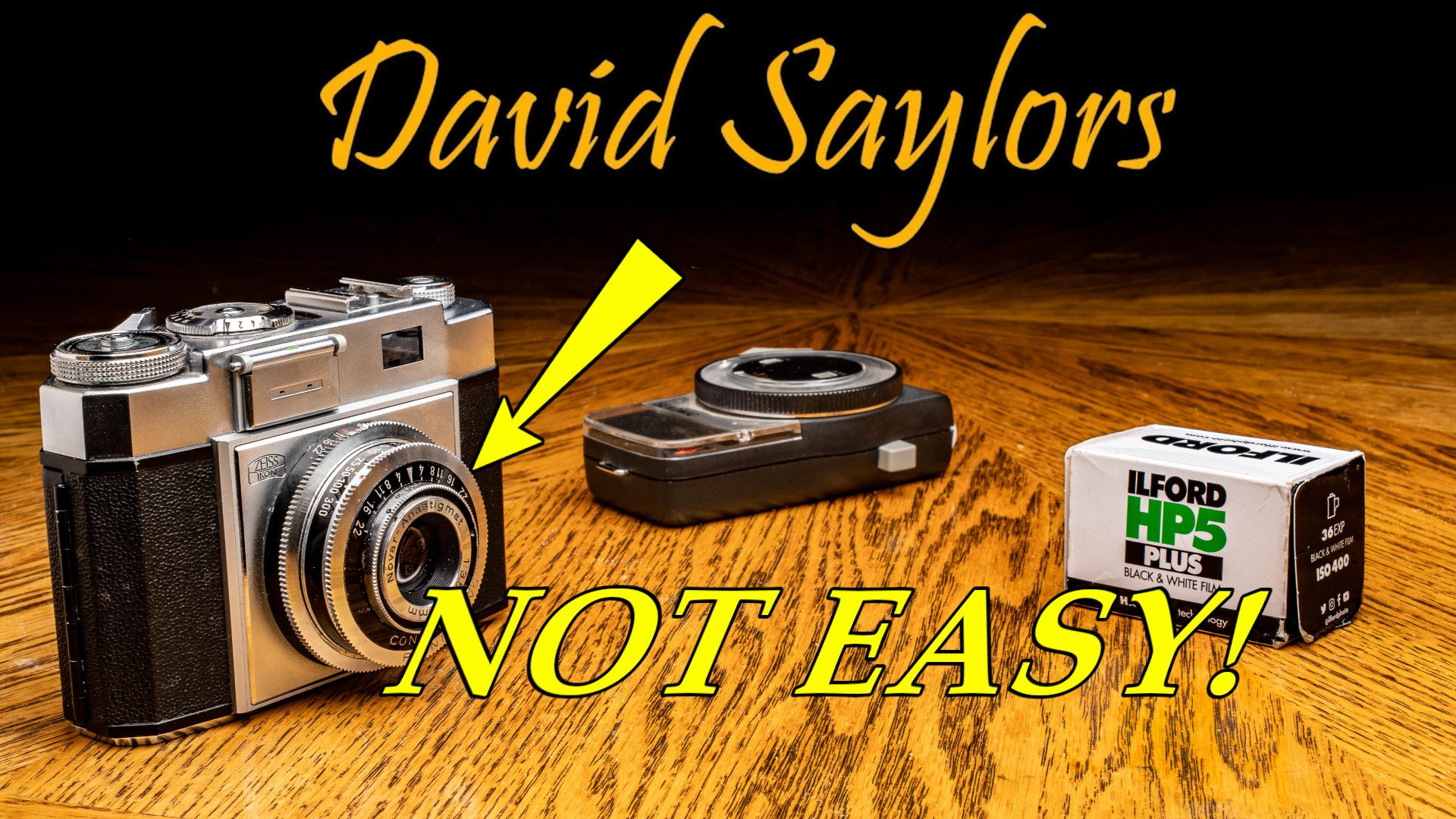
How shooting with Zeiss Ikon Contina made me realize I am spoiled...
When I started out on my own in photography it was already the 90s so I really didn’t know how good things were at the time since I got a second hand Yashica SLR that was manual focus, but had Program mode for exposure control.
My Photography Journey: Starting in the 90s
When I started out on my own in photography it was already the 90s so I really didn’t know how good things were at the time since I got a second hand Yashica SLR that was manual focus, but had Program mode for exposure control.

Once I got that camera it was a whole new world of photography since up to that point I had only owned the little “point and shoot” cameras that you could get for about 40$ at the time. Turns out those simple little cameras were a god send in technology compared to just a couple of decades earlier where we had cameras like the Zeiss Ikon Contina.
The SLR, being semi-automatic in nature, was like giving a driver of race cars his first stick shift car after driving automatics. It was a level of control that was hard to understand at first but soon became something that I looked forward to. This was because the rest of the exposure was being handled by the camera and I could easily confirm focus on the SLR as I was literally looking through the “taking lens” when focusing. All of this and I loved it, it was a very “connected” way to shoot and for the first time, I really wanted to get out and shoot photos. Sometimes it just takes the right tool to get the job done!
Why I Still Shoot Vintage Manual Cameras (Occasionally)
Given everything I've said about how difficult the Contina is to use, you might wonder why I bother at all. Here's the honest answer:
It's Meditative: When I take the Contina out, I'm forcing myself to slow down completely. Every frame requires thought, measurement, estimation, and commitment. There's no rapid-fire shooting, no checking the back screen, no instant gratification. It's almost zen-like in its deliberation.
It Builds Skills: Shooting manual cameras makes you better at photography fundamentals: understanding exposure, reading light, estimating distances, pre-visualizing shots. These skills translate to better photography with ANY camera.
It Creates Appreciation: This is the big one! After shooting the Contina, I pick up my modern cameras and feel genuine gratitude for autofocus, auto exposure, instant feedback, and all the conveniences. Instead of taking these features for granted, I appreciate them.
It's Different: Sometimes you just want a different experience. Shooting digital all the time can feel samey. Film is different. Manual exposure is different. Range focus is VERY different! The variety keeps photography interesting.
The Results Are Unique: The Zeiss Tessar lens renders differently than modern lenses. Film looks different than digital. The whole aesthetic is its own thing. Sometimes you want that look!
BUT (and this is important): I'm not saying everyone should shoot vintage cameras, or that old is better than new, or any of that gatekeeping nonsense. Modern cameras are objectively superior in almost every way! I shoot vintage cameras occasionally because I enjoy the experience, not because I think it makes me a "real" photographer. Use whatever camera makes you happy and helps you make the photos you want to make!

The 8-Step Shooting Process (No Automation!)
You see, the Zeiss Ikon Contina has none of these things. It doesn’t do anything for you automatically…at all. Here is the operational sequence to take a photo…
Find the scene you want to shoot.
Meter the light in the scene with the light meter.
Set the aperture based on film ISO.
Set the shutter speed also based on film ISO.
Guess the focus distance and set it on the lens.
Second guess yourself on focal distance and do it again…
Fire the frame and advance the film.
Repeat…at least once since you probably missed focus…lol.
Notice how you have to guess the focus. That is because there is no way to visually confirm it other than looking at the numeric distance numbers on the lens and hoping you are good at range estimation. You literally have to rely on the range focus system and shoot stopped down if you really need the photo to be in focus, that is the only real way of getting it…well that and a tape measure…
The Contina is NOT a rangefinder! It's a viewfinder camera with range focus. Big difference in usability! A true rangefinder like a Leica M-series or a Canonet makes focusing so much easier because you can actually SEE when you're in focus. With the Contina? You're just guessing and hoping!
Oh and that is a cold shoe on the top, not a coupled hot shoe so you have to use a sync cable that connects to the front of the camera to fire a flash module and I am not sure that is even a thing anymore…

The technology has advanced so much that we are to the point now where the camera has to focus PERFECTLY on the nearest eye of a moving subject…and that subject doesn’t even have to be a human either. On top of that we now expect the CAMERA to follow that subject while it and maybe even ourselves are moving and maintain that perfect focus as well! Isn’t it amazing how far the technology has evolved in less than the period of my mother’s lifetime?
Getting the Contina: Winchester England Story
So when I came into possession of the Contina, I was in Winchester England. We had found it at one of those public junk sales. Back home we call them Flea Markets. You know, where anut Gerty brings our her little figurines and next to her is a guy selling his ratty comic book and then another person is selling home made bread… and so on. It was sitting among several vintage cameras at one fella’s booth and it just caught my eye. It was really reasonably priced…or so I thought, so on my way back through the market, I just paid the guy for it. I didn’t know if it worked properly or not so I sent it home with my daughter as she was traveling home sooner than me. Once back home I proceeded to search out a reputable camera repair shop and sent the machine up to them for a full service. This also took a while as a lot of these shops are now “one man” operations and if they do good work, there is a backlog. So I finally get the camera back and take it out for its maiden voyage to shoot a roll of Ilford HP5 and see what the lens could produce. This was also to test for light leaks to make sure it didn’t need light seals either, so in that vain, I shot the first roll kinda haphazardly and then had it developed and scanned so I could check for light leaks. To be honest, I really liked the scans and that is what I used here and in the video below as well.

Well, I was impressed to be quite honest about it . To lack any semblance of automation, this little camera came away with a surprisingly high number of keepers in my book. Now, I am not talking about Pulitzer prize winning “keepers” but rather properly focused and exposed photos. I did use my handheld Sekonic light meter a lot that day, making adjustments to the camera as I went along to keep the exposure where I hoped it would make good photos.
I did have 400 speed Ilford HP5 in the camera so the maxed out shutter speed of 1/300 second was my only real choice when the sun was out fully. I then ran the aperture all the way down to make up for it so the images would be close to correctly exposed. I figured out once I got the camera back from service that it was designed for film from an era where there was no 400 speed film…yet.
Anyway, after spending the day with this camera I learned what it meant to be spoiled by the technology that we have today. It is akin to them getting this camera back then and the people doing wet plate talking about how good the new people have it. LOL. There really isnt anything new under the sun… Well, I still enjoy the little camera and I take it out on occasion for some “me” time where I will be by myself and just immerse myself into the activity of shooting with little camera.
Camera Specifications
Zeiss Ikon Contina (Type I or II, depending on your model):
Manufactured: 1950s (West Germany)
Lens: Zeiss Tessar 45mm f/2.8 (4-element design, excellent sharpness!)
Shutter: Prontor-SVS or Vario, 1 second to 1/300 second
Focus: Range focus (scale focus), manual distance estimation
Viewfinder: Simple optical viewfinder (not coupled to focus)
Film: 35mm, 24 or 36 exposure
Flash sync: Cold shoe + PC sync port (requires cable)
Exposure: Fully manual (no built-in meter)
Body: Folding design, collapses for compact storage
Weight: Approximately 400-500g depending on model
Current used price: $50-200 (plus CLA service recommended)
Film Used:
Ilford HP5 Plus 400 (black and white)
Would recommend ISO 100 film for better exposure flexibility given the 1/300 max shutter speed
Accessories Needed:
Handheld light meter (essential!)
Film (obviously!)
Flash sync cable if using flash
Patience and good distance estimation skills! lol
Support this website by using these affiliate links to shop on Amazon:
Leica M11 Digital Rangefinder Camera
Nikon AF-S FX NIKKOR 105mm f/1.4E ED Lens
Voigtlander Nokton 35mm f/1.4 II
Sandisk 128GB Extreme Pro memory cards
Nikon 50mm f1.8 S Lens for Z mount
Leica M11 Digital Rangefinder Camera
Nikon AF-S FX NIKKOR 105mm f/1.4E ED Lens
Voigtlander Nokton 35mm f/1.4 II
Sandisk 128GB Extreme Pro memory cards
Nikon 50mm f1.8 S Lens for Z mount
Frequently Asked Questions About Range Focus Cameras and the Zeiss Ikon Contina
What is a range focus camera and how does it work?
A range focus camera (sometimes called scale focus or zone focus) doesn't have any system to visually confirm your focus! You literally have to estimate the distance to your subject and set that number on the lens barrel. The Zeiss Ikon Contina has distance markings on the lens (measured in feet and meters), and you set the focus by guessing how far away your subject is. No rangefinder patch, no split-image focusing screen, no autofocus... just you, your eyes, and hopefully some good distance estimation skills! If you're off by a few feet? Well, your photo might be out of focus. That's why I mentioned using a tape measure in the post... haha. I was only half kidding!
Is the Zeiss Ikon Contina a rangefinder camera?
Nope! This confuses a lot of people. A rangefinder camera (like a Leica M-series) has a coupled rangefinder mechanism where you see two overlapping images in the viewfinder, and when you focus, those images align. The Contina doesn't have this. It's a viewfinder camera with range focus (scale focus). You're just looking through a simple optical viewfinder that shows you the frame, but it doesn't help you focus at all. The viewfinder and the focusing mechanism are completely separate, which makes focusing much harder!
What's the difference between a cold shoe and a hot shoe?
A hot shoe has electrical contacts built in so when you slide a flash onto the camera, it automatically connects and fires when you press the shutter. A cold shoe is just a metal bracket on top of the camera with no electrical connection. The Zeiss Ikon Contina has a cold shoe, which means if you want to use flash, you need a sync cable that plugs into the front of the camera body and connects to your flash unit. This is old-school flash sync from the 1950s! Modern hot shoes are SO much more convenient (and that's an understatement).
Why is the Zeiss Ikon Contina so difficult to use?
Because it doesn't do ANYTHING for you automatically! Let me break it down: (1) You have to meter the light separately with a handheld meter, (2) You have to set both aperture and shutter speed manually based on your meter reading, (3) You have to guess the focus distance and set it manually with no visual confirmation, (4) You have to advance the film manually after each shot, and (5) You have to keep track of how many frames you've shot since there's no fancy frame counter that resets automatically. Modern cameras do ALL of this for you automatically, or at least make it way easier. That's what I mean when I say I'm spoiled!
Can you actually get good photos with the Zeiss Ikon Contina?
Yes! I was honestly surprised by the keeper rate from my first roll. The Zeiss Tessar lens on the Contina is actually really good glass from the 1950s. If you take your time, use a light meter, shoot stopped down a bit (f/5.6 or f/8 helps with focus), and carefully estimate your distances, you can absolutely get sharp, well-exposed photos. The lens renders beautifully on film. BUT, you have to slow down and be deliberate about every single frame. This isn't a camera for street photography or fast-moving subjects unless you're some sort of range-estimation superhuman! For static subjects, architecture, landscapes, and portraits where your subject isn't moving? It works great if you take your time.
What film should I use in the Zeiss Ikon Contina?
I used Ilford HP5 Plus 400, which is a great general-purpose black and white film. However, here's the thing: the Contina's max shutter speed is only 1/300 second, which means it was designed for SLOWER film. Back in the 1950s when this camera was made, ISO 400 film didn't exist yet! Most film was ISO 100 or slower. So with ISO 400 film in bright sunlight, I was constantly maxed out at 1/300 and f/22 (smallest aperture) just to keep from overexposing. For this camera, I'd actually recommend ISO 100 film (like Ilford FP4 or Kodak TMax 100) so you have more flexibility with your exposure settings in bright light. Or just embrace shooting at small apertures... which actually helps with the whole focus guessing problem! lol
How much does a Zeiss Ikon Contina cost?
They're pretty affordable on the used market! You can find them anywhere from $50 to $200 depending on condition and whether they've been serviced. I sent mine out for a full CLA (clean, lubricate, adjust) service, which cost me about $100-150, so factor that into your budget if you buy one that hasn't been serviced recently. These cameras are 70+ years old, so getting them professionally serviced is pretty much essential if you want them to work reliably. The shutter speeds drift over time, the lubricants dry out, and the aperture blades can get sticky. A good CLA makes a huge difference!
Where did you get your Zeiss Ikon Contina serviced?
I sent it to a reputable camera repair shop that specializes in vintage cameras. (I don't remember the exact shop name offhand, but there are several good ones that work on vintage folders and rangefinders.) The CLA took a while, but they did a great job. The shutter speeds are accurate now, the aperture blades work smoothly, and everything functions as it should. If you're looking to get a vintage camera serviced, ask around in the film photography communities on Reddit or the Rangefinder Forum... people there have great recommendations!
Is the Zeiss Ikon Contina good for beginners learning film photography?
Honestly? Probably not as your FIRST film camera! lol. It's too challenging for someone just starting out because of the range focus system and completely manual operation. I'd recommend starting with something that has either (1) a coupled rangefinder for easier focusing (like a Canonet or Olympus 35RC), or (2) an SLR with a viewfinder focusing screen (like a Pentax K1000 or Canon AE-1). Once you're comfortable with manual exposure and film basics, THEN the Contina becomes a fun challenge. It'll teach you to really think about every single frame and appreciate how much modern cameras do for us!
Why do you still shoot with the Zeiss Ikon Contina if it's so difficult?
Great question! Because sometimes I enjoy the challenge and the "me time" aspect of it. When I take the Contina out, I'm forcing myself to slow down, think about every frame, and engage with photography in a more deliberate way. There's no chimping on the back screen, no instant feedback, no spray-and-pray... just careful consideration of each shot. It's almost meditative in a way. Plus, it's fun to use camera gear from a completely different era and appreciate how far technology has come. That said, I'm NOT shooting the Contina exclusively or even regularly! It's an occasional thing when I want that experience. For everything else? I'm absolutely using my modern cameras with autofocus and metering and all the conveniences! haha
BONUS QUESTION: What's the biggest lesson you learned from shooting the Contina?
Appreciation for modern technology! Seriously. After spending a day with this camera, manually setting everything and guessing focus on every single shot, I came home and picked up my Nikon Zf and was like "Holy crap, this thing focuses ITSELF and exposes ITSELF and even follows moving subjects!" We really are spoiled by what modern cameras can do, and that's not a bad thing at all. The Contina taught me that "the good old days" weren't always that good... at least when it came to camera technology! lol

Carl Zeiss Jena Biotar 58mm f/2 Review: 60-Year-Old Vintage Magic
When Aaron offered to loan me his 58mm, I had no idea it was a Zeiss and over 60 years old. But once I held it in my hands, the history became obvious. This isn't just any vintage lens. It's a Carl Zeiss Jena Biotar from East Germany!
The Carl Zeiss Jena Biotar 58mm f/2 from East Germany. This lens is over 60 years old and still producing beautiful images! Notice the all-metal construction and vintage styling. This is German engineering that lasts!
Carl Zeiss Jena Biotar 58mm f/2: A 60-Year-Old Lens
When Aaron offered to loan me his 58mm, I had no idea it was a Zeiss and over 60 years old. But once I held it in my hands, the history became obvious. This isn't just any vintage lens. It's a Carl Zeiss Jena Biotar from East Germany!
The Carl Zeiss Jena Story: After World War II, the original Carl Zeiss optical company in Germany was split between East and West. The Jena facility ended up in East Germany (DDR), while the West German operation continued in Oberkochen. For decades during the Cold War, there were TWO Carl Zeiss companies making lenses! The East German Carl Zeiss Jena produced exceptional optics throughout the 1950s, 60s, 70s, and into the 1990s.
The Biotar design dates back to the 1920s-1930s and is a double Gauss optical formula. This particular 58mm f/2 version was produced primarily in the 1960s and early 1970s. That means this lens I'm holding is literally 60+ years old and still producing sharp images! That's German engineering right there.
What makes Carl Zeiss Jena lenses special today is that they were made to the same high standards as West German Zeiss, but now they're available on the used market for a fraction of what modern Zeiss lenses cost. You can find these Biotar lenses for $100 to $300 depending on condition, versus thousands for a modern Zeiss prime!
Well, it didn’t take long to figure that out and to round up a simple M42 to Leica L mount adapter so I could get this lens on my Leica SL2.
The next thing I did was look the lens over really closely. The usual controls are there of aperture and focus but it has a third ring as well. This ring is spring loaded and is some sort of adjustable stop for the minimum aperture. This is how it works, you pull the ring towards the camera, compressing the spring. While the spring is compressed, you rotate the ring and align a mark on it with the aperture you want it to stop at. Once here, release the spring and it will seat in this position stopping the aperture ring from stopping down past this point. This was for cameras back in the day as you had to meter the scene manually then set the aperture for the meter value. To compose though, you needed all the light you could get so you set the ring for the aperture you plan to shoot the photo at then you would open the aperture all the way to see good and get good focus. Once this was done, you could simply spin the aperture ring to the stop and it was set to the metered value and you didnt even have to come off the camera to do it. Pretty slick if you ask me.
Another item of note is that the aperture ring is ”clickless” or in other words, it simply turns smoothly through the range without any detents to locate it at specific settings.
The next thing I noticed is that the machine work is impeccable…which I have grown to expect no less from the German people. The focus ring is smooth as silk even with its advanced years. Quite the opposite of some of my other lenses to be quite honest.
330 Degrees of Focus Throw: Close Focus Priority
Something else I noticed is that the lens has incredible close focus with about 330 degrees of focus throw. Of that 330 degrees it devotes probably 250 degrees to close focus. Crazy precise focus for a lens this old. The first 1/4 turn though is the normal use range so it will go from infinity to 2.5 meters in that 1/4 turn and then the rest of the throw is for close range work. Pretty neat how the normal range stuff is in such a short throw so you can get focus fast with it. Just a little practice and you a can get street photos of moving subjects and fairly large apertures in focus. You just learn how to use it with some time.
Sample Photos: What This Vintage Lens Can Do
Let me show you what this 60-year-old lens can actually produce on a modern 47-megapixel Leica SL2:

Portrait of Teresa shot with the Biotar at a local state park. Look at that sharpness and the smooth bokeh! This is what makes vintage lenses so cool—they still got it after 60+ years. Razor sharp where it matters with beautiful rendering.
Teresa's Portrait: Look at that sharpness! The Biotar is razor sharp at f/2 where it matters (Teresa's face and eyes), with smooth falloff to the background. The 15-blade aperture creates beautifully smooth bokeh without harsh edges. This is exactly what you want in a portrait lens. The rendering has that vintage "look" that's hard to describe but you know it when you see it. Colors are slightly warm, micro-contrast is excellent, and the overall feel is organic rather than clinical.
Walk Around Shots: The other samples show the Biotar's versatility as a general-purpose lens. At 58mm, it's slightly longer than the standard 50mm, which gives you a bit more reach for street photography while still being wide enough for environmental shots. I took these during photowalks around Chattanooga, just grabbing scenes that caught my eye. The lens renders these scenes with great detail and pleasant tonality.
What Makes Vintage Rendering Special: Modern lenses are designed to be clinically perfect. Flat field correction, perfect color neutrality, zero distortion. That's great for product photography or technical work! But vintage lenses like the Biotar have character. Slight warm color cast, gentle vignetting, bokeh that's smooth rather than razor-sharp. It's the difference between digital perfection and analog soul. Not better or worse, just different. And for portraits or artistic work? I'll take the vintage rendering every time!
Technical Specifications and Pricing
Here are the specs for this vintage glass:
Optical Specs:
Focal length: 58mm (slightly longer than standard 50mm)
Maximum aperture: f/2
Minimum aperture: f/16
Aperture blades: 15 (yes, fifteen! Creates smooth bokeh)
Optical design: Double Gauss (Biotar formula)
Physical Specs:
Mount: M42 screw mount (universal vintage mount!)
Filter size: 49mm
Weight: Approximately 290g (10.2 oz)
Length: About 45mm
Focus throw: 330 degrees (!) with close focus priority
Minimum focus distance: Approximately 0.5 meters (very close!)
Age and Origin:
Manufactured: 1960s-1970s (60+ years old!)
Origin: Carl Zeiss Jena, East Germany (DDR)
Production numbers: Relatively common, still available used
Used Market Pricing:
Typical price: $100-300 depending on condition
Excellent condition: $200-300
Good condition with some wear: $100-180
Compared to modern Zeiss Batis 55mm f/1.8: $900+
The value proposition here is incredible! You're getting genuine Carl Zeiss optics with 60+ years of proven performance for less than the cost of a cheap modern lens. That's what makes vintage glass so appealing!
It is not a bad lens in any way either, just look at the photo of Teresa I got at the local state park one day with it. Razor sharp and great rendition too. This is what makes vintage lenses so cool, they still got it…

The Biotar works great as a general purpose walk around lens too. I grabbed this during a photowalk in Cloudland Canyon State Park. The lens renders scenes with excellent detail and pleasant tonality. This is real-world performance, not controlled test shots!
Adapting M42 Lenses to Modern Mirrorless
One of the best things about the Biotar 58mm is that it uses the M42 screw mount. If you're not familiar with M42, let me explain why this is actually a huge advantage!
What is M42 Mount? M42 (also called "Universal Screw Mount") was THE standard lens mount for decades, used by dozens of camera manufacturers from the 1940s through 1980s. Companies like Pentax, Praktica, Zenit, Fujica, Mamiya, and many others all used M42. This means there are millions of M42 lenses out there on the used market!
Why M42 is Great for Modern Mirrorless: The M42 flange distance (the distance from the lens mount to the sensor) is 45.46mm, which is longer than any modern mirrorless mount. This means you can adapt M42 lenses to pretty much ANY mirrorless camera with a simple, inexpensive adapter. No optics needed, just a metal ring!
Adapters are Cheap and Easy:
M42 to Leica L-mount adapter: $15-40
M42 to Sony E-mount: $10-30
M42 to Canon RF: $20-40
M42 to Nikon Z: $15-35
I'm using a simple M42 to L-mount adapter that cost me about $25 on Amazon. No electronics, no optics, just a precisely machined metal ring. Screw the Biotar into the adapter, mount it on my Leica SL2, and boom! I've got a working 58mm f/2 lens.
Manual Focus on Modern Mirrorless: The beauty of using vintage manual lenses on modern mirrorless cameras is focus peaking! My Leica SL2 shows colored highlights on in-focus areas in the electronic viewfinder, making manual focus actually easier than it was back in the 1960s with optical viewfinders. Combined with the Biotar's smooth 330-degree focus throw, you get precise control that's honestly pretty enjoyable!
What You Give Up:
No autofocus (obviously!)
No electronic aperture control
No EXIF data recorded
No lens corrections applied
What You Gain:
Incredible value ($100-300 vs $900+ for modern Zeiss)
Built-in character and vintage rendering
All-metal construction that'll last another 60 years
The satisfaction of using historic glass!

Another example of the Biotar's versatility. At 58mm, it's slightly longer than the standard 50mm, giving you a bit more reach while still being wide enough for environmental shots. The vintage rendering has character that modern lenses don't replicate!

The Biotar's close focus capability is impressive! That 330-degree focus throw with close focus priority means you can get really close to subjects. This 60-year-old lens works beautifully on my modern 47-megapixel Leica SL2.

Final sample showing what this vintage lens can do in real-world use. If you're into the vintage glass look, the Biotar is definitely worth grabbing if you can find one. Genuine Carl Zeiss optics for $100-300? That's incredible value!
Pros, Cons, and Who Should Buy the Biotar 58mm
Let me break down the good and the not-so-good about this vintage lens:
What I Love (Pros):
Build quality is exceptional: German engineering from 60+ years ago that still works perfectly
f/2 is fast enough: Good low light capability, nice bokeh
Incredible close focus: That 330-degree throw with close focus priority is amazing
Unique mechanical features: Adjustable aperture stop, clickless aperture ring
M42 mount universality: Adapts to any modern mirrorless camera easily
Price: $100-300 for genuine Carl Zeiss optics!
Vintage rendering: Character and soul that modern lenses don't have
15-blade aperture: Smooth, round bokeh
What I Don't Love (Cons):
No autofocus: Manual focus only (but focus peaking helps!)
No EXIF data: Camera doesn't know what lens you're using
Some copies are soft: Vintage lenses vary in condition, test before buying
Not weather sealed: It's 60 years old, be gentle!
Clickless aperture: Great for video, but some photographers prefer detents
Requires adapter: Extra $15-40 expense and adds a bit of length
Who Should Buy This Lens:
Vintage lens enthusiasts who appreciate the history
Portrait photographers wanting unique rendering
Budget shooters who can't justify $900+ for modern Zeiss
Film aesthetic lovers who want that organic look
People who enjoy the slower, more deliberate manual focus process
Collectors interested in Carl Zeiss Jena heritage
Who Should Skip This Lens:
Anyone who needs autofocus for their work
Sports or action photographers
People who want perfectly clinical modern rendering
Photographers who hate manual focus
Anyone expecting modern lens perfection
Frequently Asked Questions About the Carl Zeiss Jena Biotar 58mm f/2
What is Carl Zeiss Jena and how is it different from regular Zeiss?
Carl Zeiss Jena was the East German optical manufacturer that operated from 1946 to 1991 after the original Carl Zeiss company was split following World War II. The Jena facility ended up in East Germany (DDR), while West German Zeiss continued in Oberkochen. For decades during the Cold War, there were TWO Carl Zeiss companies both making excellent lenses! Carl Zeiss Jena lenses were made to the same high standards as West German Zeiss but are now available on the used market for much less money. The quality is genuinely excellent, it's just Cold War history that created the split!
How much does a Carl Zeiss Jena Biotar 58mm f/2 cost?
On the used market today, you can find the Biotar 58mm f/2 for $100 to $300 depending on condition. Excellent condition copies with clean glass go for $200-300, while good working copies with some cosmetic wear run $100-180. Compare that to a modern Zeiss Batis 55mm f/1.8 which costs $900+, or a Leica Summilux 50mm which is $4,000+. You're getting genuine Carl Zeiss optics with 60+ years of proven performance for less than the price of a cheap modern lens. That's incredible value!
What is M42 mount and can I use it on modern cameras?
M42 (Universal Screw Mount) was the standard lens mount used by dozens of camera manufacturers from the 1940s through 1980s. The beauty of M42 is that it adapts to pretty much ANY modern mirrorless camera with a simple $15-40 adapter. No optics needed, just a metal ring! M42 to Sony E-mount, M42 to Leica L-mount, M42 to Canon RF, M42 to Nikon Z—adapters exist for everything. I'm using a $25 M42 to L-mount adapter on my Leica SL2 and it works perfectly. This makes M42 vintage lenses incredibly versatile!
Does the Biotar 58mm work on Leica cameras?
Yes! The Biotar 58mm f/2 uses M42 screw mount, which adapts to Leica L-mount cameras (SL, SL2, SL2-S, CL) with a simple M42 to L-mount adapter. I'm using this lens on my Leica SL2 with a $25 adapter and it works great. You get manual focus only (obviously), and the camera's focus peaking feature makes manual focusing actually easier than it was in the 1960s with optical viewfinders. No autofocus or electronic aperture, but you get genuine Carl Zeiss optics on your Leica for $100-300 instead of thousands!
Is the Biotar 58mm sharp enough for modern high-resolution sensors?
Absolutely! I'm using it on a 47-megapixel Leica SL2 and it's sharp where it matters. At f/2 it's razor sharp in the center with smooth falloff toward the edges (exactly what you want for portraits). Stopped down to f/4 or f/5.6, it's sharp across the entire frame. Sure, a modern $900 Zeiss Batis might be slightly sharper in the absolute corners at 500% zoom, but for real-world photography? The Biotar is more than sharp enough. Look at the sample photos in this review—that's what you get on a modern high-resolution sensor!
What is the adjustable aperture stop on the Biotar?
The Biotar has a unique spring-loaded ring that lets you set a minimum aperture stop. Here's how it works: pull the ring toward the camera (compressing the spring), rotate it to align with your desired aperture, then release. The ring locks in place and prevents the aperture from closing past that point. This was brilliant for manual metering cameras in the 1960s! You'd meter the scene, set the stop to that aperture, then open up to f/2 for composing and focusing with maximum light. When ready to shoot, just spin the aperture ring until it hits the stop—instant correct exposure without looking. Pretty clever mechanical solution!
Is 58mm better than 50mm?
58mm is slightly longer than the standard 50mm focal length. That extra 8mm gives you a bit more compression and working distance, which is nice for portraits. It's still wide enough for general purpose photography and street work, but with slightly more reach than 50mm. Some people find 58mm to be the "perfect" focal length—not quite as wide as 50mm but not as tight as 85mm. It's a Goldilocks focal length! The Biotar was designed as 58mm rather than 50mm for optical reasons related to the double Gauss formula.
Can you use vintage lenses professionally?
Absolutely, if your work allows for manual focus! Many portrait photographers, wedding photographers, and commercial shooters use vintage lenses specifically for the unique rendering they provide. The vintage "look" with its smooth bokeh, slight warm cast, and organic rendering is something clients actually request. Obviously you wouldn't use a manual focus vintage lens for sports or fast-moving subjects, but for portraits, product photography, or artistic work? Vintage lenses are totally viable. Just make sure you test your specific copy thoroughly—condition varies with vintage glass!
How do I know if a vintage Biotar is in good condition?
When buying a used Biotar (or any vintage lens), check for: (1) Clean glass with no fungus, haze, or separation, (2) Smooth focus ring with no grinding or sticking, (3) Aperture blades that open and close properly, (4) No oil on the aperture blades, (5) Clean exterior with no major dents. Hold it up to a light and look through the glass for any issues. Some dust is normal for 60-year-old lenses and won't affect image quality. Fungus, haze, and separated elements are deal-breakers. Always ask for sample photos if buying online!
Should I buy vintage lenses or save for modern lenses?
Both! I use modern lenses for work that requires autofocus and vintage lenses for creative projects where I want character. The Biotar 58mm f/2 costs $100-300, which is pocket change compared to modern Zeiss or Leica lenses. You can build a whole collection of vintage glass (35mm, 50mm, 85mm, 135mm) for less than the cost of one modern premium lens. Start with vintage lenses to learn what focal lengths you love, then invest in modern versions if needed. Or just use vintage glass forever—it genuinely produces beautiful images!
Pros, Cons, and Who Should Buy the Biotar 58mm
So if you are into the vintage glass "look" then I might suggest grabbing one of these old girls if you can find one and adapting it to your mirrorless camera to see what you can get with it. I think you'll be pleasantly surprised!
Here's my bottom line: The Carl Zeiss Jena Biotar 58mm f/2 is a phenomenal example of why vintage lenses are still worth using in 2024. This lens was made 60+ years ago in East Germany, and it still produces sharp, beautiful images with character that modern lenses can't replicate. The fact that you can buy one for $100 to $300 makes it even better!
The mechanical features are genuinely clever. That adjustable aperture stop? Brilliant design from an era before electronic everything. The 330-degree focus throw with close focus priority? Purposeful engineering that still makes sense today. The clickless aperture ring and 15-blade aperture? Features that modern lenses charge hundreds extra for!
Yes, you give up autofocus. Yes, you have to use an adapter. Yes, you won't get EXIF data. But what you gain is access to genuine Carl Zeiss optics with history, character, and exceptional build quality for the price of a cheap modern lens. That's a trade I'll make every time for creative work.
I need to give this lens back to Aaron eventually, but honestly? I might just need to find my own copy. The Biotar has earned a permanent spot in my bag for portrait work and photowalks where I want that vintage rendering. If you see one at a camera show or online for $200 in good condition, grab it! You won't regret it.
Now get your camera out and go take a picture with it!
Support this website by using these affiliate links to shop on Amazon:
Leica M11 Digital Rangefinder Camera
Nikon AF-S FX NIKKOR 105mm f/1.4E ED Lens
Voigtlander Nokton 35mm f/1.4 II
Sandisk 128GB Extreme Pro memory cards
What Shooting a Zeiss Ikon Contina Taught Me About Modern Cameras
I picked up a vintage Zeiss Ikon Contina while on a trip to the UK and had it sent straight to Zack's Camera for a full CLA when I got home, because the shutter was dragging badly. Once it came back in good working order I loaded it with Ilford HP5, grabbed my old Sekonic handheld light meter, and hit the streets of Chattanooga to find out what shooting a fully manual film camera with no rangefinder and no automatic anything actually feels like. The short answer is that our modern cameras are far more remarkable than most of us give them credit for.

Me with my freshly CLA Zeis Ikon Contina ready for some fun on the streets of Chattanooga TN.
I picked up a vintage Zeiss Ikon Contina while on a trip to the UK and had it sent straight to Zack's Camera for a full CLA when I got home, because the shutter was dragging badly. Once it came back in good working order I loaded it with Ilford HP5, grabbed my old Sekonic handheld light meter, and hit the streets of Chattanooga to find out what shooting a fully manual film camera with no rangefinder and no automatic anything actually feels like. The short answer is that our modern cameras are far more remarkable than most of us give them credit for.
Zeiss Ikon Contina…a vintage fully mechanical camera.
I bought this camera while on my trip in the UK and when I got back home I sent it to Zack’s Camera for a CLA as the shutter was dragging pretty bad. Once back from Zack’s, (who did a phenomenal job BTW) I loaded it up with some HP5 and grabbed my old Sekonic light meter and hit the streets of Chattanooga to play with my “new” toy.

The Zeiss Ikon Contina after returning from a full CLA at Zack's Camera. Everything is fully mechanical, no batteries required anywhere in the system.
It didn’t take long to realize that we as photographers in the 21st century are so spoiled with our cameras that have auto…everything. I am currently 54 years old and even when I was younger we already had cameras with automatic focus and exposure and even auto film advance. This machine is the grandfather to those cameras.
Shooting photos with the Zeiss Ikon Contina Camera
The day I went out to shoot had partly cloudy skies so as I would walk the streets I would take light meter readings and adjust the camera accordingly for the light on hand. This almost turned into a chore as the clouds would move in front of the sun and lower the light by 2 stops then the cloud would move out of the way and the meter would jump back up those two stops. Also, I learned dark shade is 3 stops lower than direct sun, so keep that in the back of your mind while looking for street scenes too.

A good light meter like the Sekonic pictured here will make getting the exposure set correctly a lot easier.
So now I see why some people like having those tiny little hot shoe mounted light meters. The handheld one was nice but it sure was inconvenient to carry around. Having a free hand to adjust and hold the camera would have been nice at times. Plus the light meter is just in the way all the time. I don’t have a lanyard on it so I either had it in my pocket or my hand, neither of which are really desirable.
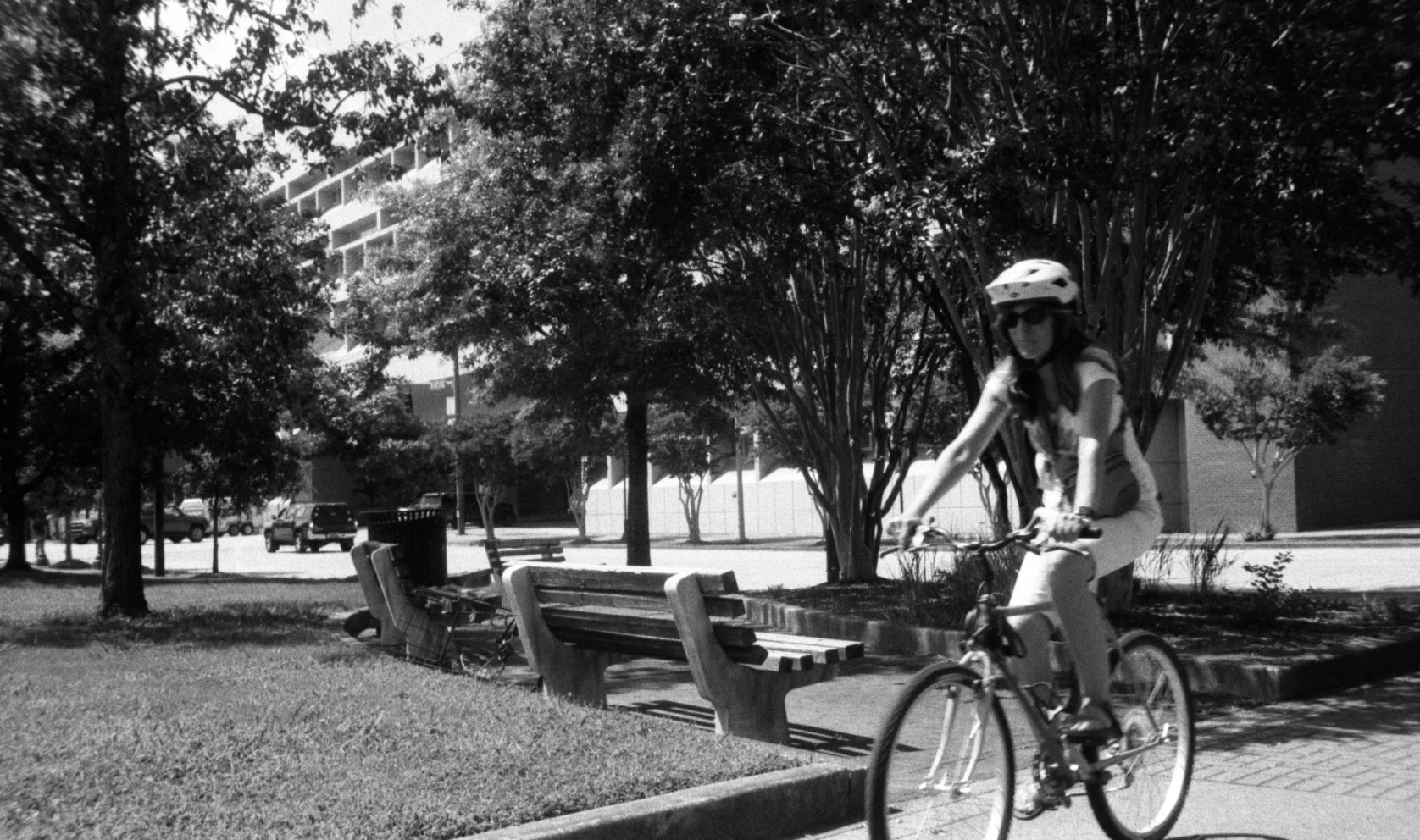
Motion blur in full sun… Zeiss Ikon Contina vintage camera with Ilford HP5 film.
Once I started to get the exposure settings figured out, I start thinking, I am ready to hit the trail and get some sweet street photos. Nothing could be further from the truth. I now have to learn how to focus the camera. Yes, you heard that right, I… a photographer, had to learn how to focus a camera. That was strange to me as I have been accustomed to simply looking through the viewfinder and focusing and then pressing the shutter. Not so on the Contina! You have to engage in the fine art of range estimation with this camera. Yeah, you literally either get out a tape measure and put your camera on a tripod OR just guess as best you can. Seriously, those are the choices here…spitballing it or measuring tools! The viewfinder is literally used only for composing the image. The taking lens is a completely separate system. Unlike the rangefinder cameras such at the Leica M series of legend where the view finder has a calibrated “patch” from the rangefinder that is mechanically coupled to the taking lens, where you see what appears in the viewfinder as an aligned image when it is in focus, you just throw the dice with the Zeiss Ikon Contina. It is quite humbling to he honest about it.

You quickly learn about f stops and how to change depth of field so you have a hope of getting something in focus. Notice on the lens the distance scale and the depth of field scales? You better, because you are going to be using those alot if you plan to shoot with the aperture opened up at all.
The film for the day… Ilford HP5 B&W Film
On my first roll of film I used Ilford HP5 400 speed and quickly realized this was actually a mistake. This camera is so old that the highest ISO on the built in meter is 320 and the fastest shutter speed is 1/300 second. Yeah, in a world where I personally have cameras right now that will shoot at 1/32000 second, I just bought a camera that maxes out at 1/300… Luckily, the aperture goes down to f22 so in full sun it is correctly exposing (I think) at 1/300 second. This did help with the other problem though…focus. Since at f22 everything from 1 meter to infinity is in focus I just had to make sure that I had not bumped the focus ring and moved it.
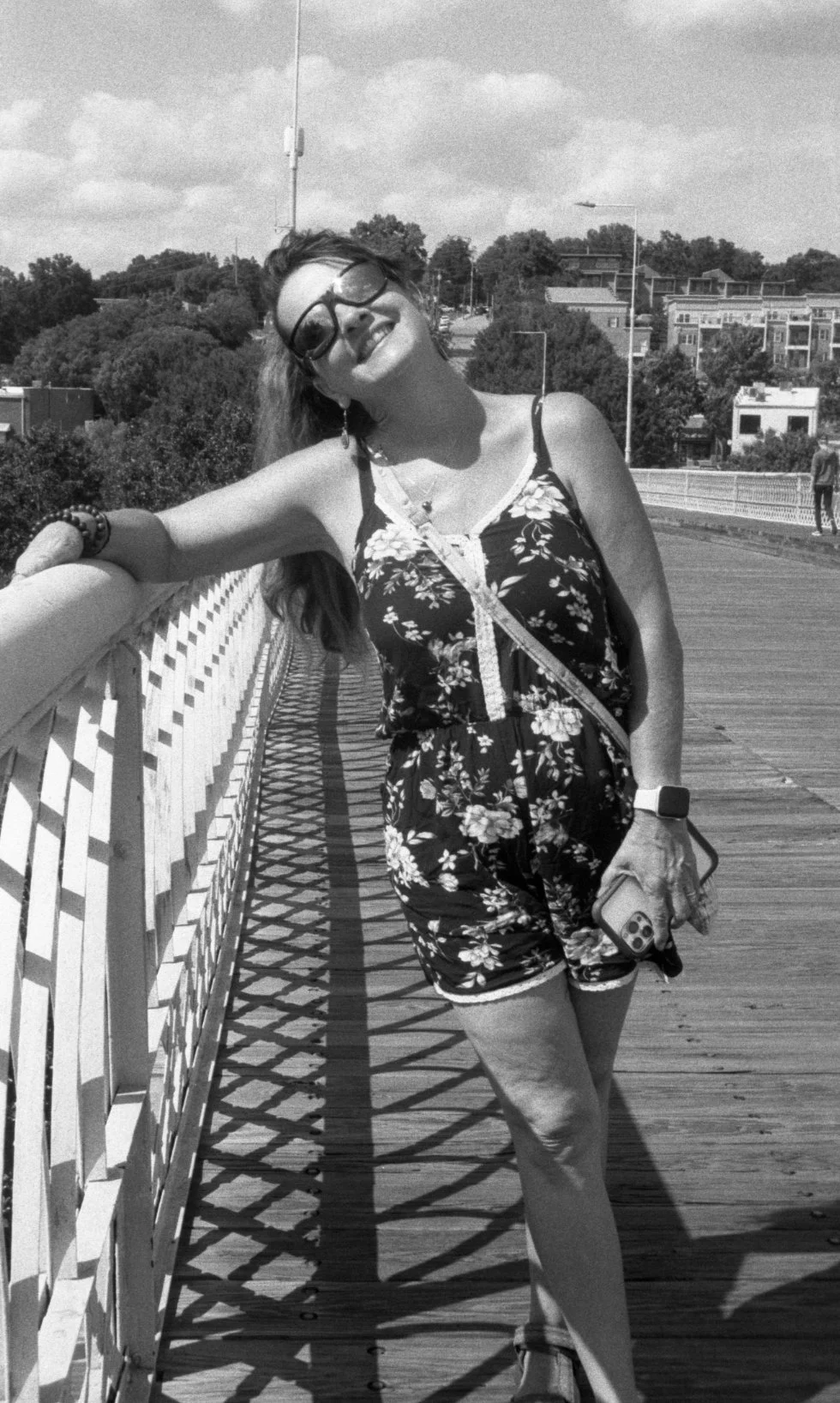
Teresa on the Walnut Street Pedestrian Bridge in Chattanooga TN shot on the Zeiss Ikon contina camera. Ilford HP5 Film
Once I used it for about an hour I would start to choose estimated focus distances to try to land better focus. We will see once I get the film developed and scanned…

All three exposure controls are on the lens itself. The narrow front ring is focus, the middle ring is shutter speed, and the large rear ring is aperture. The depth of field scale between the focus and shutter rings is essential for zone focusing.
Another thing you will notice in this photo is that all three major functions of the camera are on the lens, the focus is the first and smallest ring, then the shutter speed is the middle ring and the rear most and largest ring is the aperture ring. All the controls on the top are used to control film exposure and movement. The shutter release button, the film advance, frame counter, and rewind knob are in this area. There is a cold shoe and a light meter in the center area on top. That’s it. I love the simplicity, but wow, photos made in that period were worked for.
Going forward I will now have a brand new appreciation for my modern cameras with all their conveniences. I have learned that our forefathers had it much harder and that we should be more appreciative of the photos from that period. I will continue to use this warhorse of a machine but plan to get some lower ISO film first and we will see what we get over time.
Frequently Asked Questions About the Zeiss Ikon Contina
What kind of camera is the Zeiss Ikon Contina? The Zeiss Ikon Contina is a fully manual 35mm viewfinder camera produced in West Germany in the 1950s. It has no rangefinder and no automatic exposure system. All focus, shutter speed, and aperture settings are set manually by the photographer. The built-in selenium light meter is a reference tool only and is not connected to the camera's exposure system in any way.
Does the Zeiss Ikon Contina need batteries? No. The Contina uses a selenium light meter which generates its own small electrical current from ambient light. There are no batteries required anywhere in the camera, which is one of its great practical advantages as a vintage shooter.
What film should I use in a Zeiss Ikon Contina? Because the Contina's built-in meter only goes up to ISO 320 and the fastest shutter speed is 1/300 second, lower ISO films work better in most lighting conditions. Ilford HP5 at ISO 400 is usable but can be tricky in bright sun. A 100 or 200 speed film like Kodak T Max 100 or Ilford Delta 100 gives you more flexibility with aperture and shutter settings in daylight.
How do you focus a Zeiss Ikon Contina? The Contina uses estimated zone focusing rather than a rangefinder. You set the distance on the focus ring based on your best estimate of how far away your subject is, then use the depth of field scale on the lens to confirm your focus zone. Stopping down to f8 or f11 significantly increases depth of field and makes zone focusing much more forgiving. At f22, everything from about 1 meter to infinity is in focus, which effectively eliminates the need to focus at all.
What is a CLA and does the Zeiss Ikon Contina need one? A CLA stands for Clean, Lubricate, and Adjust. It is a service performed by a camera repair technician that cleans the internal mechanisms, replaces dried lubricants, and adjusts the shutter speeds and aperture blades to factory spec. Most vintage cameras benefit from a CLA before heavy use, especially if the shutter feels sluggish or sticky. Zack's Camera is a well regarded shop for vintage camera service.
Is the Zeiss Ikon Contina good for street photography? It can be, but it requires patience and practice. The lack of a rangefinder means you need to get comfortable with zone focusing before you can shoot quickly and confidently. Once you learn the camera's quirks and develop a feel for estimating distances, it produces sharp images with the characteristic look of mid-century German optics. It is better suited to slower, more deliberate street photography than fast-moving candid work. Unless, once again, you stop down to f22 where everything is essentially in focus and you can simply point the camera and take photos.
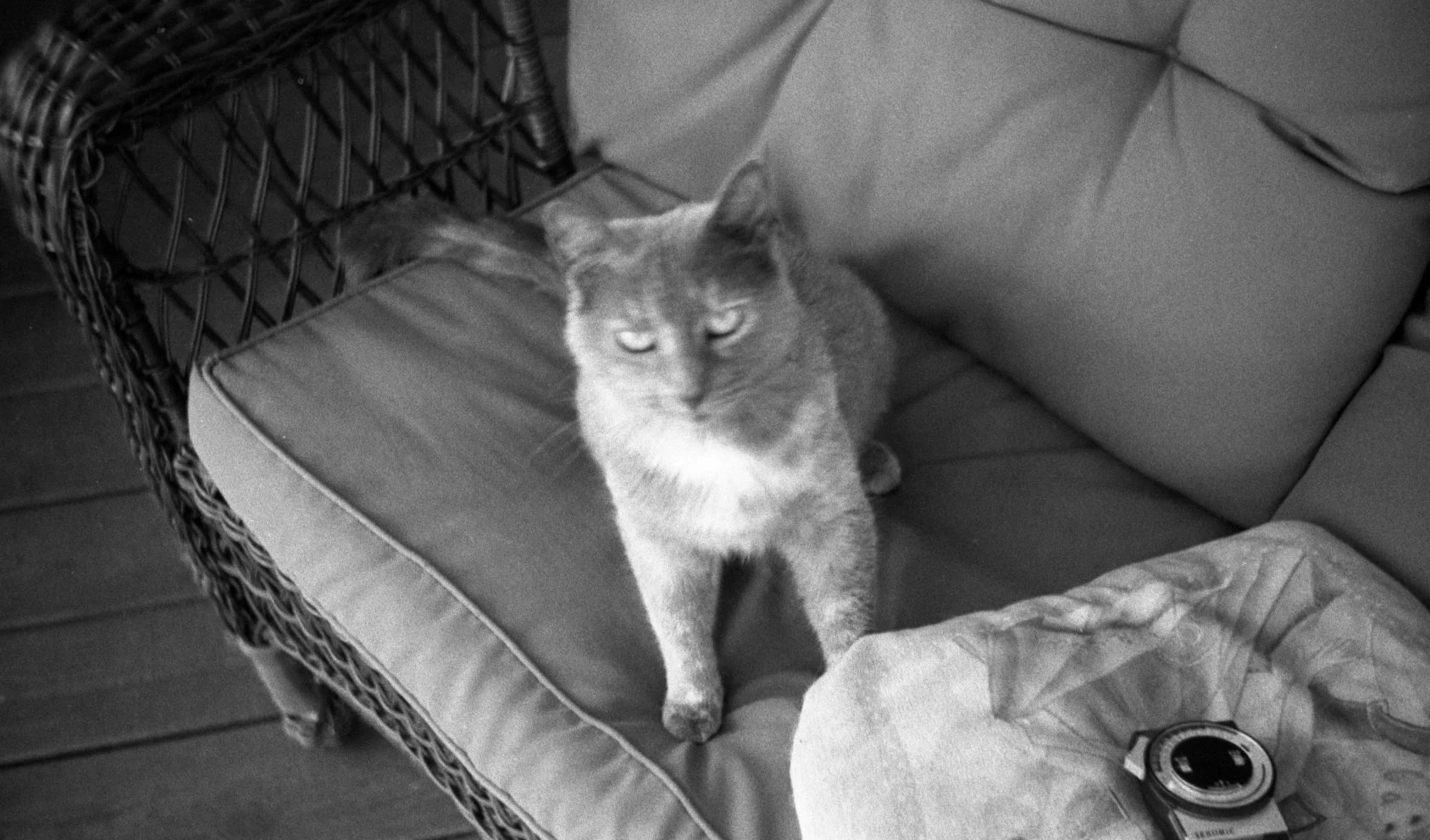
Zeiss Ikon Contina vintage camera missed focus of the cat…
Support this website by using these affiliate links to shop on Amazon:
Nikon AF-S FX NIKKOR 105mm f/1.4E ED Lens
Voigtlander Nokton 35mm f/1.4 II
Sandisk 128GB Extreme Pro memory cards
Nikon 50mm f1.8 S Lens for Z mount
So until next time, get your camera out!