
Solo Street Photography with Leica CL: Finding Joy Shooting Alone (Not Following the Rules)
I really like the 50mm perspective of these lenses on a crop sensor camera like my Leica CL. If I use a full frame machine then Iwill usually opt for something in the 50 to 58mm range as well.
After years of feeling pressure to do street photography "the right way," I finally figured something out: solo street photography photowalks with my Leica CL and a 50mm lens bring me more joy than following anyone else's rules. This is the story of how I stopped trying to shoot like Peter McKinnon, quit worrying about YouTube success, and rediscovered why I fell in love with photography in the first place—just grabbing my camera and hitting the streets alone.

My go-to setup: Leica CL with Voigtlander 35mm Nokton—this gives me a 50mm perspective on the crop sensor.
Why I Love Solo Street Photography (And You Might Too)
There's something incredibly freeing about solo photowalks that I didn't appreciate until I tried them consistently. When you're alone, there's no one to impress, no one waiting on you, and no one questioning why you're standing in the same spot for ten minutes watching the light change. You can be completely present with your camera and your surroundings without any social pressure.
I'll admit, at first the idea of walking around with a camera alone felt a bit weird. But then I realized—nobody cares. People are absorbed in their own lives, and you're just another person walking down the street. The freedom this brings is immense. If I see something interesting, I can stop and shoot it from ten different angles without feeling like I'm holding anyone up. If nothing inspires me, I can just enjoy the walk. There's zero pressure to "perform" or justify your creative choices to anyone.
My Leica CL Street Photography Setup: 50mm Perspective on Crop Sensor
It is just plain fun to grab a camera, a spare battery and hit the streets to see what I can find to photograph. My weapon of choice is the Leica CL mirrorless camera with one of several lenses. Usually though, my Leica CL is wearing a Voigtlander 35mm Nokton or a TTArtisan 35mm f/1.4, you never know which.
I really like the 50mm perspective of these lenses on a crop sensor camera like my Leica CL. The 1.5x crop factor means that 35mm lens gives me a 52.5mm field of view—basically a classic 50mm perspective. This is perfect for my shooting style because it gives me comfortable working distance from my subjects while still creating nice compression and subject isolation. If I use a full frame machine then I will usually opt for something in the 50 to 58mm range as well.
The Leica CL itself is the perfect camera for solo photowalks. It's small enough to not be intimidating, quiet enough to be discreet, and produces image quality that rivals cameras three times its size. The electronic viewfinder is bright and clear, the controls are simple and intuitive, and the whole package fits easily in my hand or jacket pocket. I can carry it all day without fatigue, and more importantly, I can carry it without thinking about it—which means I'm thinking about photography instead of gear.
I will take my 28mm lenses for the occasional stroll, but my staples are the 50mm lenses. Shoot, I even have the Leica APO Summicron SL 50mm for my Leica SL2 mirrorless camera as well because I like them so much. That is an insane package to be just strolling around town with slung around your neck…as well as heavy. Haha.
Breaking the Street Photography Rules: Why 50mm Works Better for Me Than 28mm
This literally took me years if not decades to truly figure it out. That is a hard pill to swallow at times too. Looking back, things could have gone a very different way had I followed my real passion instead of thinking I could be like Peter McKinnon… Live and learn I guess.
Before Pete came along and made me think I could be this ultra successful YouTube personality, I did things that other people said were what you should do. Like do street photography with wide glass and get close to people and stuff like that. That works for some people, but not me, I seem to have a real problem getting close to other people. Invading their personal space is such a red flag for me that I will just let the photo go before I attempt something like that.
Here's what nobody tells you about the "get close with a wide lens" approach: it's not just about technical skill, it's about personality. Some photographers are naturally extroverted, comfortable in stranger's personal space, and can pull off that close-up street style. I'm not one of those people. And you know what? That's completely okay. Using a 50mm or even longer lets me capture authentic moments from a respectful distance where neither I nor my subject feels uncomfortable. The photos are different than 28mm shots, but they're not worse—they're just mine.
This made for some truly terrible photos just to be honest about it. Mostly, it made me not want to go out and shoot though… so my very first Nikon DSLR would sit in the closet for months at a time with me not so much as looking at it. Who wants to go to a job and be stressed about that all day THEN make your hobby about "getting out of your comfort zone" and being stressed about that too?!? I almost gave up photography at one point because of this to be honest.

A typical scene from my solo photowalks—natural moments, comfortable distance
I have spent so long making YouTube content that I had actually forgotten how much fun it was to just go shoot. I will now get my camera and a battery or two and just hit the bricks. What I had to learn to do was to make a video about one every so often to share what I am doing with the viewers. I took a “sabbatical” the last two years in the first part of the year so I could do this. It helped dramatically too with my well being and my creativity.


Simple gear for photowalks: one camera, one lens, spare batteries. That's all I need.
From YouTube Pressure to Photography Joy: My Personal Journey
I finally found some joy when my daughter began competing in rock climbing. She joined a team and they would go all over for these events and I got my camera out and started photographing these gatherings and realized that there was more to this hobby than just what others said is good photography. I found a lot of joy in capturing interesting angles of the climbers and going to the trouble of sharing the photos with the team when done. It was really rewarding to be honest.
Then I broke my ankle and at about the same time, Sierra "aged out" of the team and stopped attending the events as life got in the way. Well, I needed a new avenue to focus on and found it in my YouTube channel. I learned over the years that a good YouTube content creator is not a good photographer—they are two very different things and I wandered down that rabbit hole for a while before realizing that it wasn't going to work for me.
The YouTube algorithm rewards consistency, spectacle, and engagement over artistry. It wants you to post weekly, chase trends, and create content that keeps people watching. That's fine if you want to be a content creator, but it's exhausting if you just want to be a photographer. I found myself thinking more about thumbnails and titles than I did about light and composition. I was shooting for the camera review, not for the creative satisfaction. That's when I knew something had to change.
The Joy of Street Photography Photowalks Without Pressure
This is where I am at now… just a guy with a camera out taking some pictures. No YouTube schedule to maintain, no algorithm to please, no gear to review, no style to emulate. Just me, my Leica CL, and whatever catches my eye. Some days that's dramatic light on a building. Other days it's a person waiting for the bus. Sometimes it's nothing at all, and that's fine too.
I have spent so long making YouTube content that I had actually forgotten how much fun it was to just go shoot. I will now get my camera and a battery or two and just hit the bricks. What I had to learn to do was to make a video about one every so often to share what I am doing with the viewers. I took a "sabbatical" the last two years in the first part of the year so I could do this. It helped dramatically too with my wellbeing and my creativity.
The biggest lesson? Photography should add to your life, not drain it. If your hobby is causing you stress instead of joy, you're doing it wrong—not because you're a bad photographer, but because you're following someone else's path instead of your own. Give yourself permission to shoot what you love, how you love, with whatever equipment makes you happy. That's where the good work lives.
Solo Street Photography Tips: Finding Your Own Style
Ultimately I found that I loved to go on photowalks and simply take pictures around me. Here's what I've learned about making solo photowalks work:
Keep your gear simple. I bring one camera, one lens, and two batteries. That's it. No bag, no accessories, nothing to fidget with or second-guess. This simplicity forces you to work within constraints, which actually makes you more creative, not less.
Shoot for yourself first. I used to think about how a photo would perform on Instagram or YouTube before I even took it. Now I shoot what interests me in the moment. Some of my favorite images would probably get three likes on social media, and I don't care. They're mine.
Walk the same routes sometimes. There's this idea that you need exotic locations for good street photography. I've learned more shooting the same three-mile radius around my house than I did traveling to "photogenic" cities. Familiarity breeds understanding. When you know a place well, you start to see the light differently, notice the rhythm of the day, and find moments you'd miss as a tourist rushing through.
Don't force it. Some walks I come home with fifty keepers. Other times I get nothing. Both are valuable. The walks where I don't press the shutter much are still feeding my creative eye, teaching me to see, and giving me time to think. Photography is as much about observation as it is about capture.
Frequently Asked Questions About Solo Street Photography
Is it okay to do street photography alone?
Absolutely! Solo street photography is not just okay—it's often the best way to shoot. When you're alone, you move at your own pace, follow your creative instincts without compromise, and blend into the environment more naturally. I've found that shooting solo actually reduces pressure because there's no one watching, judging, or waiting for you. You can spend five minutes on one corner if that's what feels right, or walk five miles following the light. Some of my best work happens when I'm alone with my camera and my thoughts.
What focal length is best for street photography?
There's no "best" focal length—only what works for your personality and shooting style. The conventional wisdom says 28mm or 35mm, but I prefer 50mm equivalent (which is a 35mm lens on my Leica CL crop sensor). The 50mm perspective gives me comfortable distance from my subjects, creates nice compression, and doesn't make me feel like I'm invading anyone's personal space. If you're uncomfortable getting close to strangers, telephoto focal lengths like 50mm, 85mm, or even 105mm can work beautifully. Don't let anyone tell you there's only one "right" way to do street photography.
How long should a street photography photowalk be?
Your photowalk should be exactly as long as it needs to be. Sometimes I'm out for 30 minutes and come home with great shots. Other times I'll wander for three hours and barely press the shutter. I've learned to follow my energy and creative flow rather than forcing a specific duration. Start with 30-60 minutes if you're new to photowalks, and let it evolve naturally. The goal is joy and creativity, not checking off a time requirement.
Can you do street photography with a Leica CL?
The Leica CL is fantastic for street photography! It's compact, discreet, produces excellent image quality, and the crop sensor actually gives you a nice 50mm perspective with a 35mm lens (or 75mm with a 50mm lens). The quiet shutter, simple controls, and build quality make it perfect for solo photowalks. I love that it doesn't scream "expensive camera" like a big DSLR or even a Leica M, so I can blend in while still getting Leica color and image quality. It's honestly my favorite camera for just grabbing and hitting the streets.
Do I need to follow street photography "rules"?
No! This is the most important thing I've learned: there are no rules, only guidelines that work for some people. You don't have to shoot wide angle, you don't have to get close to strangers, you don't have to shoot in black and white, and you certainly don't have to make yourself uncomfortable to get "good" street photography. Find what brings you joy and shoot that way. The best street photography comes from authentic vision, not from following someone else's rules. If 85mm or 105mm feels right, use it. If you prefer color, shoot color. Make your own rules.
What should I bring on a solo street photography walk?
Keep it simple—that's the beauty of solo photowalks. I typically bring just my Leica CL with one lens (usually my Voigtlander 35mm Nokton or TTArtisan 35mm f/1.4), and one or two spare batteries. That's it. No camera bag, no lens changes, no complicated gear setup. The simplicity is liberating. You can add a small water bottle and maybe your phone for emergencies, but resist the urge to pack heavy. The lighter you travel, the longer you'll walk and the more you'll enjoy it. Less gear equals more photography.
Support this website by using these affiliate links to shop on Amazon:
Leica M11 Digital Rangefinder Camera
Nikon AF-S FX NIKKOR 105mm f/1.4E ED Lens
Voigtlander Nokton 35mm f/1.4 II
Sandisk 128GB Extreme Pro memory cards
Nikon 50mm f1.8 S Lens for Z mount
Thanks for following along on my ramblings here. If you're feeling the same pressure I felt—to shoot a certain way, use specific focal lengths, or build a YouTube following—I hope this gives you permission to just grab your camera and go shoot for the joy of it.
Are you doing solo photowalks? I'd love to hear about your experiences in the comments below. What focal length do you prefer? Do you follow the "rules" or have you found your own path?
Want more honest photography content without the pressure? Subscribe to my photography blog for weekly posts about real creative journeys, not just gear reviews and pixel-peeping.

My Photography Journey: From Nikon D7000 Beginner to Leica Minimalist
Back in the dark ages, it was common to buy actual books on a subject of photography as YouTube was still sort of in its infancy. You could find information on the web but it was still really limited. Today we are literally bombarded with a constant stream of information that is dizzying.
Introduction (Keep your opening, add this after the first image):
When I started on my photo knowledge journey, I went by all the usual things associated with doing a self-taught skillset.
Back in the dark ages, it was common to buy actual books on a subject of photography as YouTube was still sort of in its infancy. You could find information on the web but it was still really limited. Today we are literally bombarded with a constant stream of information that is dizzying.

The author on the streets of Chattanooga taking photos with his Nikon D7000 camera.
Starting My Photography Journey with the Nikon D7000
I chose my camera based on information from one of the OGs of the photography space on the web… Ken Rockwell. Now hear me out before you throw your computer across the room.
It is no secret that Ken has a love affair with Nikon and it shows through on his site. So many well worded reviews to choose from made starting my journey with photography a Nikon based one. It is cemented so well that I have never even tried to shoot Canon on my own volition. Nikon should be giving Ken royalties to be honest about it. His reviews are fair (from what I can tell) and well worded and very technical. He has other brands on his site these days too, but back in the day, it was a wealth of Nikon information. For more of my photography philosophy and techniques, browse through my photography blog archive.
When I did jump in, it was with a D7000 DSLR. This was the most technologically advanced of the DX format models at the time. The camera included things such as the focus motor for the older screw drive focus lenses as well as sporting several other features not available on the lesser models of the period. I loved that camera and shot on it for several years while learning the rudiments of the craft.
Looking back, the Nikon D7000 was an excellent choice for a beginner. The DX sensor gave me reach for wildlife and sports, the built-in focus motor meant I could use affordable older lenses, and the 16-megapixel sensor was more than enough for learning composition and exposure. If you're considering a used D7000 today, it's still a capable camera for learning photography fundamentals.
Learning the Rules (And Eventually Breaking Them)
During this period I learned all the cliche things about shooting "better" photos and some of those old rules still linger today in my composition techniques. Fortunately I have since learned that some things are not actually set in stone and you can bend and even break the rules if done right and the images will be great anyway.
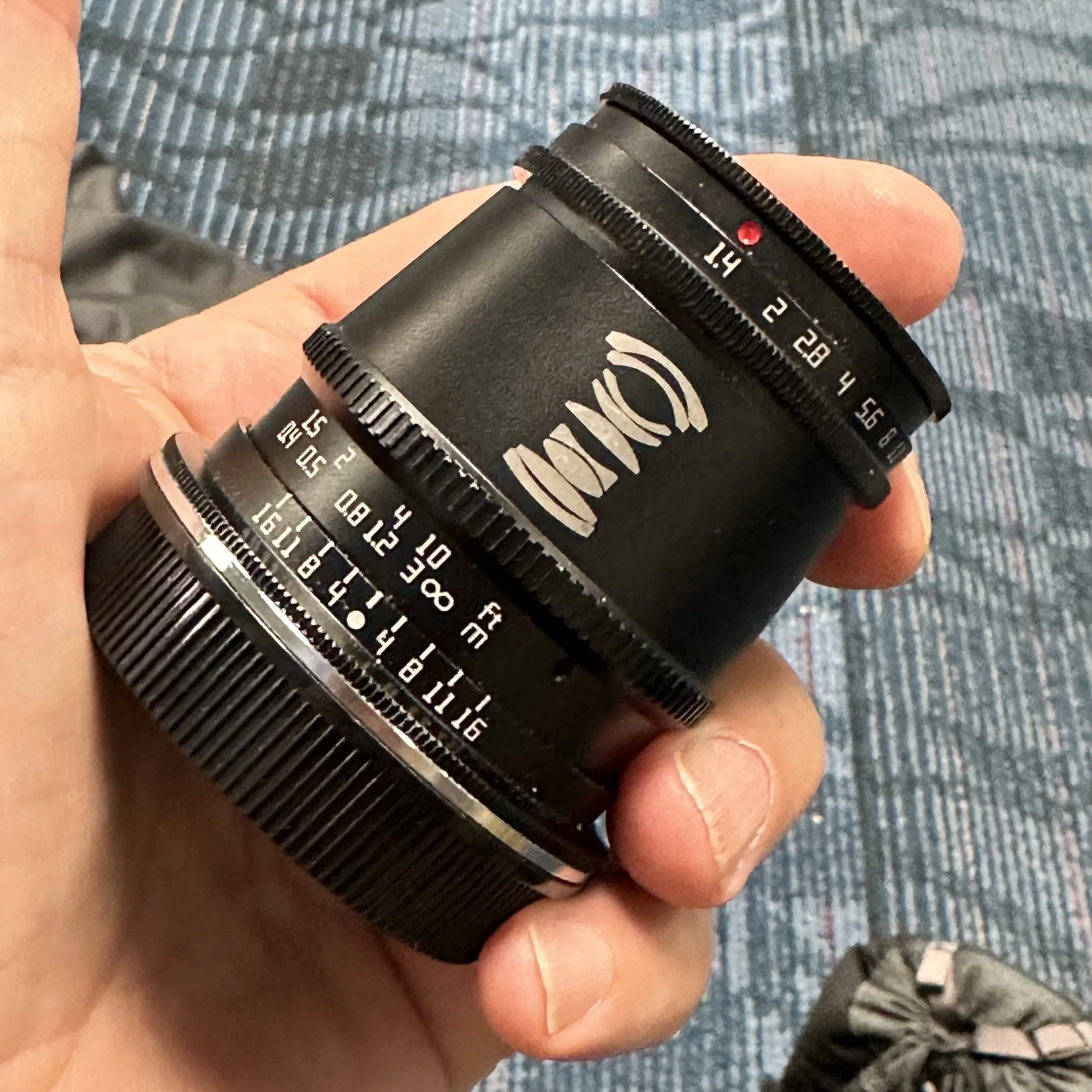
My vintage lens collection - living proof that GAS recovery is an ongoing journey!
Back then I took the idea of mounting one lens and using it for a period of time. Sometimes these periods of time could be quite long. I remember mounting the 35mm f1.8 and leaving it on the camera for months at one point. This is probably why I have gravitated back to that field of view today. Once you use a certain focal length a while, you will get comfortable with what that lens can do for you and you know what to expect. It is like asking an old friend for advice… you just know it is going to be good.
This "one lens" approach taught me more about photography than any gear upgrade ever could. By limiting my options, I learned to see in 35mm. I learned to move my feet instead of twisting a zoom ring. I started anticipating shots instead of reacting to them. This was my first step toward minimalism, though I didn't realize it at the time.
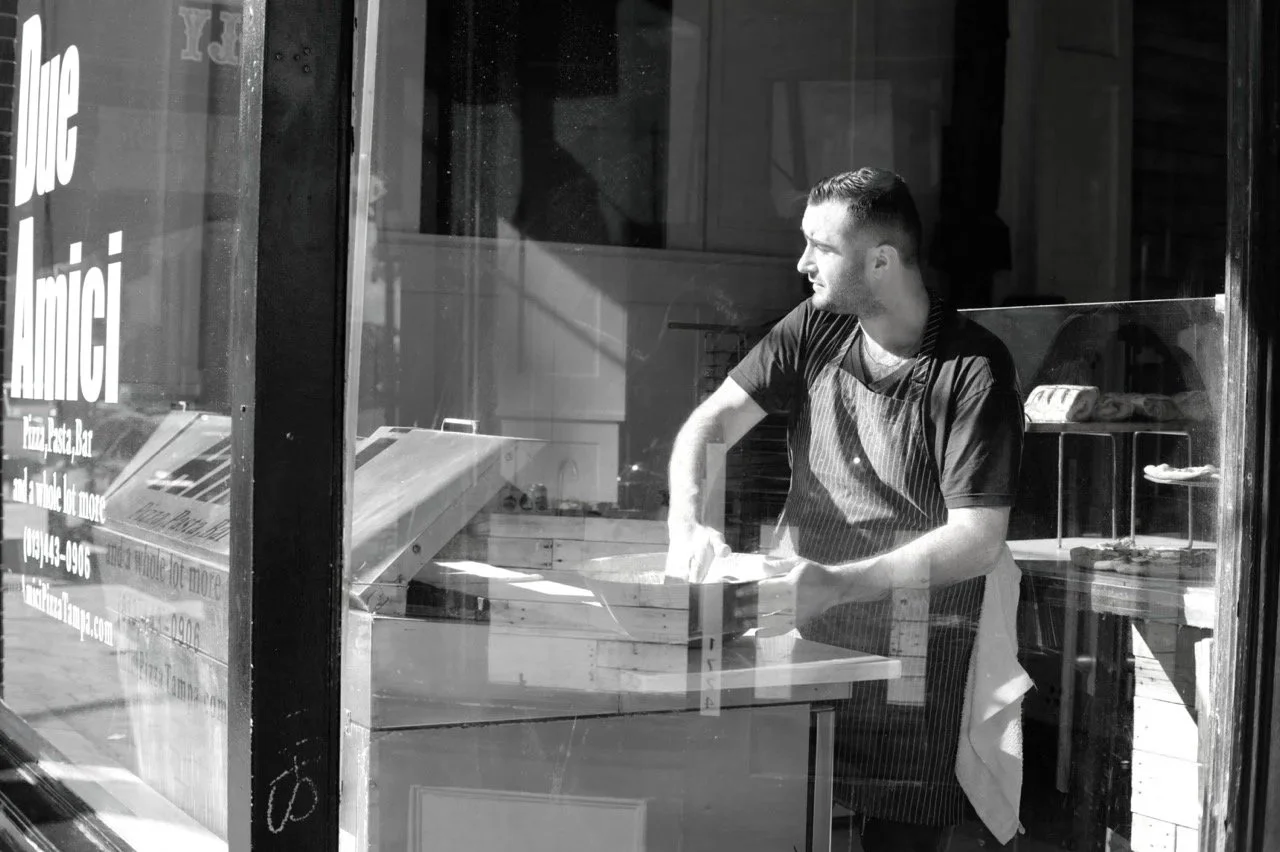
Early street photography from my Nikon D7000 learning phase - exploring light and composition
[Image placement here]
The Gear Acquisition Syndrome Phase
At some point I bought a big fast aperture zoom (the 70-200mm if memory serves me) and thought I was in hog heaven. Well, if you dont need a big expensive zoom lens, then why did you buy one? G.A.S. Is the usual culprit here and I am guilty of having this disorder of photography. I am recovering at this point though and at some point I simply stopped buying the latest camera because it was better than the last one or what ever. I still to this day cant seem to stop buying vintage lenses though so I am a work in progress… lol.
Every photographer goes through the GAS phase. We convince ourselves that the next lens, the next camera body, or the next upgrade will unlock our creative potential. The truth? It rarely does. That 70-200mm f/2.8 was an incredible lens, but I found myself leaving it at home more often than not because of the weight and bulk.
I have since figured out that with my photography, I dont need zoom lenses very often at all. I have figured out that I can have more fun with a nice prime lens and not worry too much about missing some special photo or some such. I have learned to just let some photos go and be more in the moment instead. You dont always have to get every single photo possible.
Prime Lenses vs Zoom Lenses: What I Learned
Prime lenses changed everything for me. Here's what I discovered:
Lighter kit = more shooting: A 35mm prime weighs a fraction of a 70-200mm zoom
Better low-light performance: Fast primes (f/1.8, f/1.4) let me shoot in conditions where zooms struggled
Creative limitations = creative growth: Fixed focal lengths forced me to think differently
Better image quality: Even affordable primes often outperform expensive zooms
The 35mm focal length became my signature. On DX format (Nikon D7000), this gave me roughly a 52mm equivalent field of view—perfect for street photography, environmental portraits, and everyday shooting. If you're looking for more on my current gear choices, check out my gear page.
Living Through the Viewfinder vs Living in the Moment
I went through this phase too. Living life through the camera viewfinder… this isn't really living but rather documenting and is not the same thing. This is why I now travel with a very light camera kit if I am going on a trip to do something other than photography for the primary focus of the trip. I feel it is more important to live in the moment than to worry incessantly on getting the best angle or exposure or whatever.
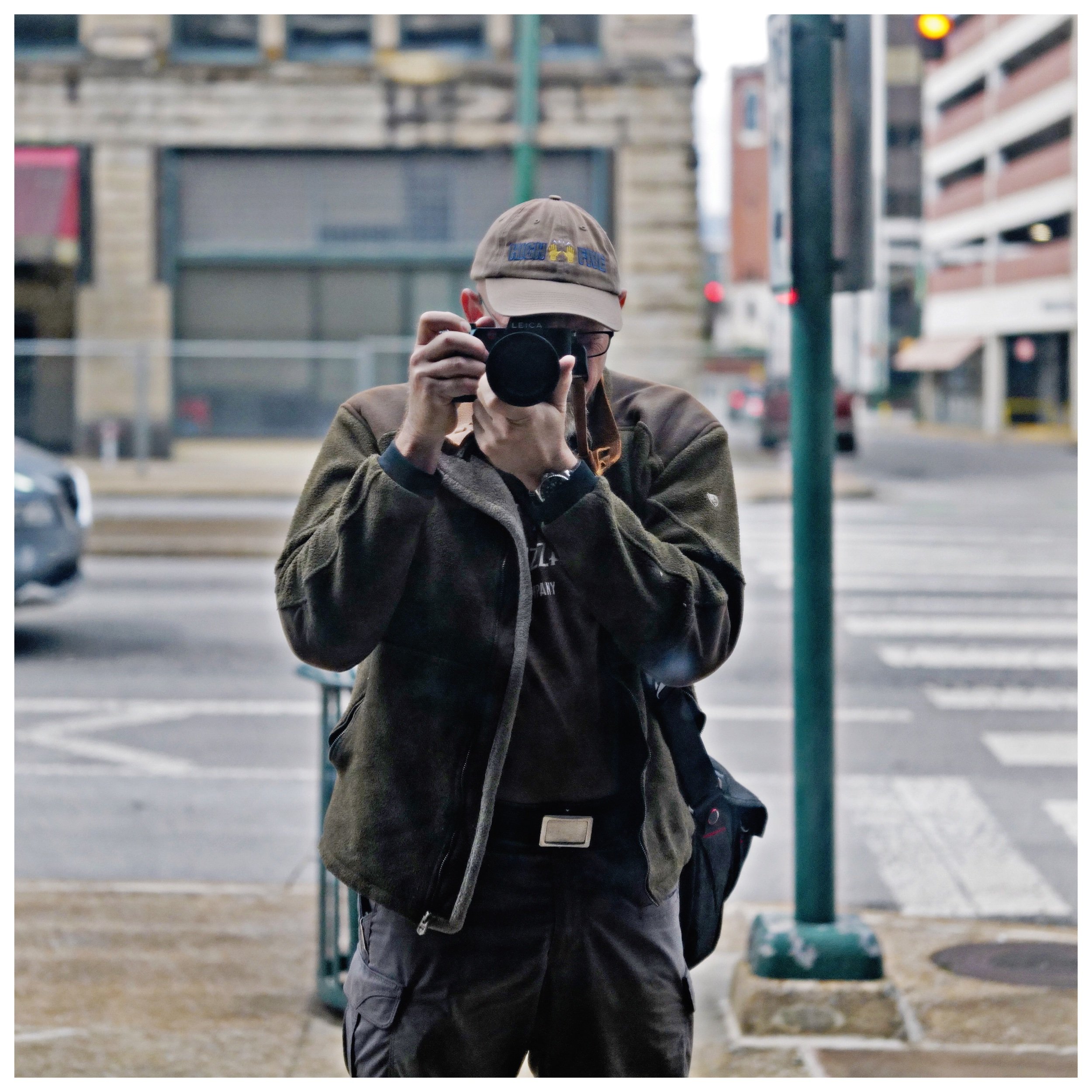
Early street photography from my Nikon D7000 learning phase - exploring light and composition
This realization was profound. I was so focused on capturing every moment that I wasn't actually experiencing the moments I was capturing. Family vacations became photo assignments. Dinners with friends became lighting challenges. I was missing the point entirely.
It is this last part that has taught me that I have evolved as a photographer. I no longer need to photograph everything possible and spend countless hours editing in lightroom to be happy. To be completely transparent about it, I only edit a very select few images in Lightroom these days just to get the "one" I want. I still shoot in raw plus jpeg to give me that choice but I rarely use the raw files.
My current approach: I shoot RAW+JPEG but use the JPEGs 95% of the time. The camera's built-in processing is usually good enough, and accepting that has freed me from spending hours at the computer. When I do edit, it's intentional—one or two photos from a day that really speak to me.
You can see this philosophy in action in my post about solo street photography with the Leica CL, where I discuss finding joy in the process rather than the pursuit of perfection.
My Photography Evolution: From Technical to Intentional
Looking back at your photography journey, have you progressed in a positive way?
For me, the answer is absolutely yes—but not in the way I expected. I haven't progressed by acquiring better gear or mastering more advanced techniques. I've progressed by:
Simplifying my kit - From a bag full of zooms to a single prime lens
Reducing post-processing - From hours in Lightroom to accepting JPEGs
Being more selective - From shooting hundreds of frames to choosing moments intentionally
Enjoying the process - From chasing the perfect shot to experiencing life with a camera in hand
My journey from the Nikon D7000 to my current Leica setup isn't about having better equipment—it's about understanding what I actually need and what brings me joy. The D7000 taught me the fundamentals. The prime lenses taught me to see. The GAS phase taught me what I don't need. And minimalism taught me what photography is really about.
You can see this philosophy in action in my post about solo street photography with the Leica CL , where I discuss finding joy in the process rather than the pursuit of perfection.
Frequently Asked Questions
Is the Nikon D7000 still good in 2024?
Yes, the Nikon D7000 is still an excellent camera for learning photography. While it lacks modern features like 4K video or advanced autofocus, its 16-megapixel sensor, built-in focus motor, and solid build quality make it perfect for beginners. You can find used D7000 bodies for under $300, making it an incredible value for learning the craft.
Should beginner photographers use prime lenses or zoom lenses?
I recommend starting with a prime lens, specifically a 35mm or 50mm. While zoom lenses offer versatility, prime lenses force you to move, think about composition, and really learn to see. They're also typically sharper, faster (better in low light), and more affordable than equivalent zoom lenses. Once you master a prime, you'll know if you actually need a zoom.
How do you overcome Gear Acquisition Syndrome (GAS)?
The best cure for GAS is to pick one camera and one lens and commit to using only that setup for 3-6 months. You'll quickly learn what you actually need versus what you think you need. I also recommend asking yourself: "Will this new gear let me take photos I literally cannot take with my current setup?" If the answer is no, don't buy it.
What focal length is best for street photography?
I prefer 35mm (on full frame) or 23mm on APS-C, which gives you a similar field of view. This focal length is wide enough to capture context but not so wide that it distorts subjects. The 50mm equivalent focal length is also popular and works beautifully—it's really about personal preference. Try both if you can. See examples in my street photography portfolio</a> to see how I use these focal lengths in practice.
Do you need to shoot RAW or is JPEG okay?
For most photography, especially if you're still learning, JPEG is perfectly fine. Modern cameras have excellent JPEG processing. I shoot RAW+JPEG and use the JPEGs 95% of the time. Only shoot RAW if you know you'll be doing significant post-processing or if you're shooting in challenging lighting conditions where you'll need maximum flexibility.

Support this website by using these affiliate links to shop on Amazon:
Leica M11 Digital Rangefinder Camera
Nikon AF-S FX NIKKOR 105mm f/1.4E ED Lens
Voigtlander Nokton 35mm f/1.4 II
Sandisk 128GB Extreme Pro memory cards