
The Hanimex 28mm f2.8 lens is a really interesting little lens...
Sometimes I just throw the dice on a vintage lens and occasionally it comes out really good and sometimes it is a dud. The Hanimex 28mm f/2.8 I picked up for $20 at Ball Photo in Asheville? This time it's a winner.
Sometimes I just throw the dice on a vintage lens and occasionally it comes out really good and sometimes it is a dud. The Hanimex 28mm f/2.8 I picked up for $20 at Ball Photo in Asheville? This time it's a winner.
I paid something like $20 for this lens at Ball Photo. Twenty bucks. For that price, even if it turned out to be terrible, who cares? You're not risking much. But when it turns out to be actually good — sharp, solid build, nice colors, usable on a modern camera — that's when you feel like you found a hidden gem sitting in a used lens bin.
This is why I love digging through vintage gear at camera shops. Most people walk right past this stuff looking for autofocus lenses or the latest Sigma Art prime or whatever. Meanwhile there's a perfectly good 28mm sitting there for the price of lunch. Sure, it's got quirks (the sun flare is real), but it's also got character and it actually works. Can't beat that value.

The Hanimex 28mm f/2.8 on my Leica SL2 — not the prettiest combo, but it works.
Hunting for Glass at Ball Photo in Asheville
I went to Ashville NC on a small trip recently and on this trip I was doing photography. Well, when it is a photography trip I always make it a point to go to Ball Photo and just “go shopping” for something interesting. They have SO much vintage gear to choose from that it is almost overwhelming to be honest. It is not for the feint of heart to be honest about it. But today found me at Ball Photo and while there I started looking for some glass to pick out… Well I found some.
All-metal construction with nice silver accent rings. Built like lenses used to be built.
We all know how much I love to shoot with vintage glass and I am always on the hunt for a new lens to play with. I have Leica glass for the Leica SL2 and use it quite often but I still really enjoy adapting some older lens to the camera and then seeing what I can get with this lens and camera combination when I go out with it. It is almost a challenge to see if I can come away with something good using this old lens… What generally happens is that I slowly build a collection of lenses that I REALLY love to use and I am starting to collect a full set of these lenses. Some examples would be the 28mm f3.5 Asahi Optical M42 mount lens that I keep in the camera bag, this lens is literally one of my favorite lenses of all time for some reason. I just love the results I get with it on the Leica SL2 camera. Well today finds me using a lens that is 2/3 of s top faster and a little bigger too.
What Makes the Hanimex 28mm f/2.8 Special
The Hanimex 28mm f2.8 is a well made lens with the whole thing made of metal (probably brass from the way it feels but it could be anodized aluminum too I really am not sure) and has some really nice accents like the little silver bands around the focus ring which also has a faux leather appearance but I am almost certain is rubber. The range focus scale is graduated for every aperture marked (sans f4 for some reason) on the aperture ring, which is a nice touch for street photography. The detent clicks on the aperture ring are nice and pronounced as well as solid, no mushy aperture detents on this lens! All in all, it is a great little lens by design engineering standards. It is even a well designed attachment scheme as well with the M42 mount as it is easily adapted to about all mirrorless cameras on the market.

The M42 mount adapter — see those three tiny set screws? That's how you time the lens if you care about that kind of thing.
Adjusting M42 Adapters (If You Care About That Sort of Thing)
Many people also don’t realize that the M42 adapter can be adjusted to get the lens top dead center of the adapter too. There are three tiny set screws on the adapter that hold the threaded ring in place on the lens adapter to adjust this. To make this adjustment is simple, just screw the lens into the mount till it seats and snug it well so it wont work loose while in use. Next get the Allen key that came with the adapter and loosen the three set screws till the lens can spin in the mount and simply turn the lens till the center mark is top dead center of the adapter and then push in on the mount while tightening the set screws back down to make it hold the ring again and your done. It is that simple. Mine is slightly off center here and I have simple been too lazy to adjust it as it is close enough for me to be able to get out and shoot anyway. I don’t normally worry about it too much as once you set the adapter once, then all the lenses will time up and you don’t have to mess with it again. Installing lenses over the years on this adapter and tightening them has slipped the timing a little and this is why it is slightly off center. Once again, it is no big deal to me and i just go out and shoot…
Look, I know there are "better" lens mounts out there. But M42 is just so easy to adapt to basically anything. You can throw these lenses on Leica, Sony, Fuji, whatever — and they cost pennies compared to native glass. Plus there's something satisfying about the all-manual experience. No electronics, no autofocus hunting, just you and the glass trying to get the shot. It's photography the way it used to be, which sounds pretentious when I say it like that, but honestly it's just fun. There's a directness to it that I appreciate.
And here's the thing: M42 lenses were made by so many different manufacturers over the years that there are hundreds of options out there. Some are great, some are terrible, and part of the fun is just digging through used lens bins at places like Ball Photo to see what you find. It's like thrift shopping for camera gear.

First outing at Hamilton Place Mall in Chattanooga on Black Friday. The Hanimex handled it just fine.
Taking It to the Mall on Black Friday (Because Why Not)
So the first official outing with this lens was to go to the mall in Chattanooga TN with it and capture some Christmas spirit with it…on black Friday no less.
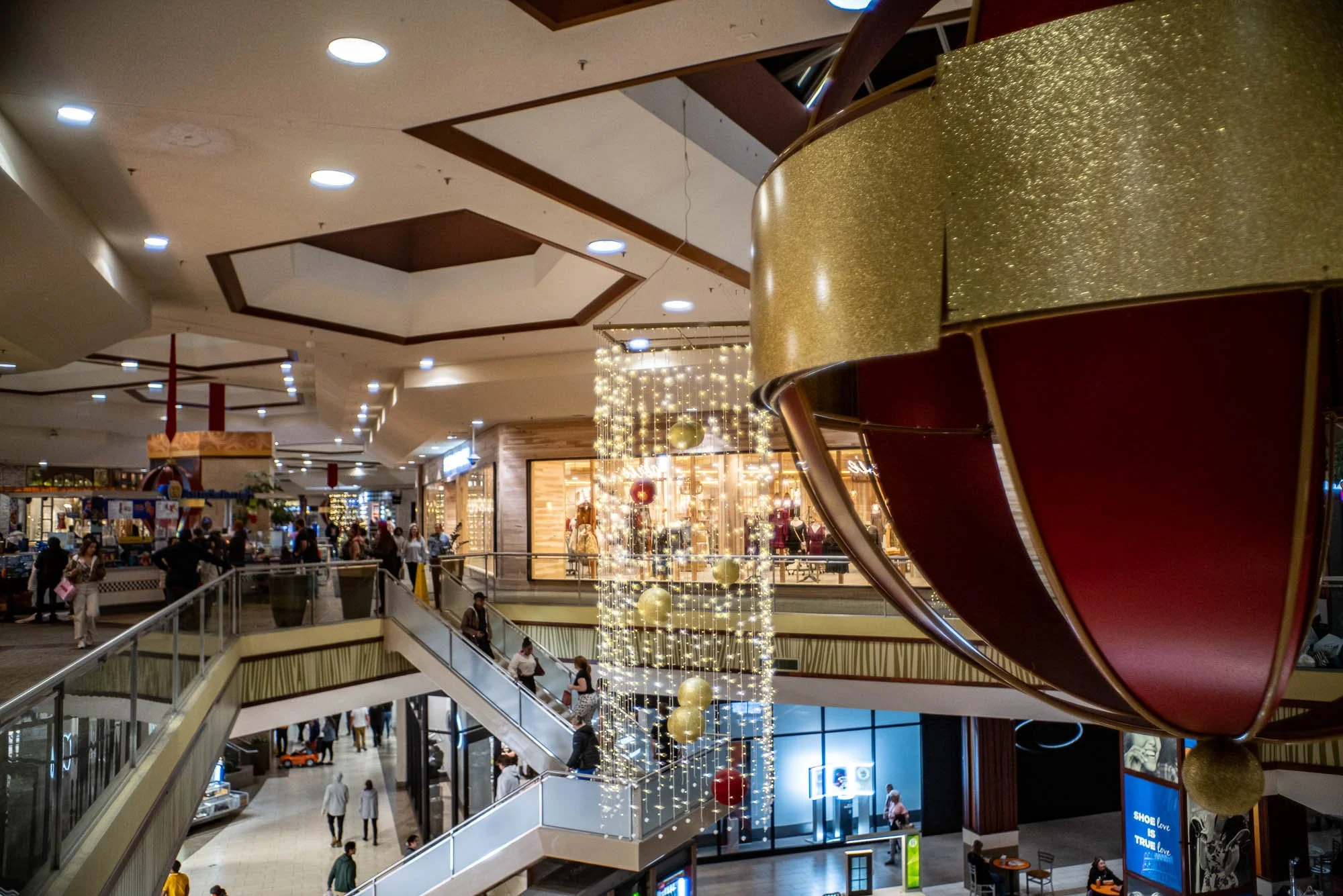
Well to be quite honest, it performed wonderfully. Now to be fair, the camera does have IBIS in it and this allows me to shoot at pretty slow shutter speeds without the need for a tripod. As long as you go into the camera settings and tell the camera it is a 28mm lens, the camera can compensate for movement really well allowing for incredibly slow shutter speeds like the last photo in this string from the mall where it was 1/10 of a second…hand held. Most of the other photos are shot at 1/250 second to freeze the people so that I can show the current clothing styles as well as the general appearance of the mall in 2023.
The Leica SL2's IBIS is genuinely a game-changer for vintage glass. Without it, that 1/10 second handheld shot at the mall would've been a blurry mess — the old "reciprocal rule" says you need at least 1/30 second for a 28mm lens, and that's being optimistic. But with IBIS doing its thing, I can get away with shutter speeds that should be impossible with a manual lens.
This is why I keep coming back to the SL2 for adapted lenses. It makes old glass way more usable than it has any right to be. You're essentially taking a lens from the 1960s or 70s and giving it capabilities it was never designed to have. Nikon didn't build this Hanimex thinking someone would hand-hold it at 1/10 second in a mall forty years later.

1/250 second to freeze the people and capture 2023 fashion in all its glory.
The Christmas decorations at the mall — shot handheld at 1/10 second thanks to the SL2's IBIS.
1/250 second to freeze the people and capture 2023 fashion in all its glory.
The Christmas decorations at the mall — shot handheld at 1/10 second thanks to the SL2's IBIS.

1/250 second to freeze the people and capture 2023 fashion in all its glory.
The Christmas decorations at the mall — shot handheld at 1/10 second thanks to the SL2's IBIS.

1/250 second to freeze the people and capture 2023 fashion in all its glory.
The Christmas decorations at the mall — shot handheld at 1/10 second thanks to the SL2's IBIS.
All in all, the Hanimex performed extremely well in this role. The images are sharp and the colors are easily adjusted in post processing to give any look you want. It also doesn’t hurt to have that Leica “look” from the camera processing the colors before saving the RAW file too, Leica does something special with their processing to give the colors a look that is unique to Leica cameras. It is hard to explain, but it is a thing.
The Sun Flare Problem — Yeah, It's Bad
In the next photos I didn’t show all the images as they just reflect what it is like to shoot indoors where there is controlled light and no sun to deal with. The following photos show what happens when you have the sun shining on the front element.

Same shot as the next one but the lens is shaded from the sun — clean and sharp.
Above is the same photo as the one right under this text except that I shaded the lens from the sun. This lens cant handle the sun shining on it from any angle without showing you that it was happening with some sort of sun flare in the image. In the below image there is geometric artifacts as well as a overall glare from the sun.

What happens when the sun hits the front element. Vintage lenses and coatings don't play nice with direct sunlight.
In the below photo you can also see the geometric glare in the center of frame, this could be used to your advantage in some applications like vintage style portraits where you position the subject to where the flare adds to the aesthetic of the image. Here the flare doesn’t do that though and is more of a nuisance that anything else. So this is something to keep in mind when using vintage glass, you will run into these kinds of problems from time to time like the older generation has to do…lol.

That geometric glare in the center? Classic vintage lens behavior. Could be useful for portraits if you position it right.
Can You Shoot Portraits with a 28mm? Actually, Yes
Lastly, can you make portraits with the 28mm lens? The answer is yes, you can as long as you are careful with the composition and keep the subject centered like I did here. The 28mm lens can distort toward the edges so it is imperative to keep the person in the center of the photo as much as humanly possible if you want the image to turn out like anything you want at all. Maria was gracious and allowed me to make her portrait at the mall using one of the advertising lights as a “studio light” to give us nice diffused side light and I think the image turned out really well for a 60 year old lens with improvised lighting.

Maria at the mall using an advertising light as improvised diffused side lighting. Not bad for a 60-year-old lens.
Now, shooting portraits with a 28mm isn't what most people would recommend. The conventional wisdom is 50mm or 85mm for portraits, and there's good reason for that — longer focal lengths are more flattering and don't distort faces. But if you keep your subject centered and don't get too close, a 28mm can work. The key is composition and knowing the lens's limitations.
Maria's portrait here is proof that it's doable. I kept her in the center of the frame where distortion is minimal, used the advertising light for nice diffused side lighting, and shot from a reasonable distance. If I'd moved her to the edge of the frame or gotten right up in her face, it would've looked weird. But treated carefully, a 28mm can give you a portrait with some environmental context in the background, which can be a nice look.
Just know what you're getting into. This isn't a portrait lens. But it can make portraits if you're intentional about it.
As well as this blog post, I also have a video sharing some of these points and showing more of the old Sitton’s mill location should you want to go check that out at the link below.
Thanks and if you are into vintage glass, this is a keeper in my book — and for pennies too. Twenty bucks for a solid 28mm that actually performs? I'll take that deal every time. Sure it doesn't like the sun and you probably won't shoot portraits with it every day, but as a walkaround lens for street photography or just messing around? It's great.
So with that, get your camera out and go take a picture with it. Maybe even throw the dice on some weird vintage lens you've never heard of. You might just find a winner.
Questions People Ask About the Hanimex 28mm f/2.8
Is the Hanimex 28mm f/2.8 any good?
Yeah, it's actually pretty good for the price. Sharp in the center, solid build quality, and it handles well on modern mirrorless cameras with IBIS. The biggest issue is sun flare — this lens does NOT like having the sun anywhere near the front element. You'll get geometric artifacts and overall loss of contrast if you're shooting with the sun in or near the frame. But for $20-30, it's absolutely worth picking up if you see one. I mean, at that price, even if it's just okay, who cares? But when it turns out to be actually good, you feel like you found a hidden gem.
What mount is the Hanimex 28mm f/2.8?
M42 screw mount, which is great because you can adapt it to basically any mirrorless camera. I use it on my Leica SL2 with an M42-to-L adapter, but it works just as well on Sony E-mount, Fuji X-mount, Canon RF, whatever you've got. M42 is one of those universal old-school mounts that just adapts to everything. Plus the adapters are cheap and plentiful, so you're not spending a fortune to use these lenses on modern cameras.
Can you use vintage lenses on the Leica SL2?
Absolutely. The Leica SL2's IBIS makes vintage glass way more usable than it used to be. You can hand-hold at slower shutter speeds that would normally require a tripod, and the camera's focus peaking makes manual focusing pretty straightforward once you get used to it. Plus the L-mount has a short flange distance so you can adapt almost anything — M42, Nikon F, Canon FD, Leica M, you name it. I actually prefer shooting with adapted vintage lenses on the SL2 sometimes because it's just more fun than using modern autofocus glass.
How do you deal with sun flare on vintage lenses?
Use a lens hood or just shade the lens with your hand when the sun is hitting the front element. Vintage lens coatings from the 60s and 70s aren't anywhere near as good as modern multi-coatings, so direct sunlight will give you all kinds of flare, ghost images, and loss of contrast. If you're shooting into the sun or with bright light hitting the lens at an angle, expect problems. It's just how old glass behaves. Sometimes you can use it creatively for that vintage look, but most of the time it's just annoying. I literally had to shade the lens with my hand at Sitton's Mill to get clean shots.
Is 28mm good for street photography?
It's a little wider than the classic 35mm or 50mm focal lengths most people use for street, but yeah, it works. You get more context in the frame, which is good for environmental portraits or showing a whole scene instead of isolating subjects. The trade-off is that 28mm has more distortion at the edges, so you need to be careful about composition. Keep important stuff — especially people's faces — toward the center of the frame. I shot a portrait of Maria at the mall with this lens and it turned out great, but I made sure to keep her centered. If I'd put her at the edge of the frame, her face would've looked stretched and weird.
Where can I buy a Hanimex 28mm f/2.8?
I got mine at Ball Photo in Asheville, North Carolina for about $20. They have an absolutely overwhelming amount of vintage gear if you're ever in the area. Otherwise, check eBay, KEH Camera, or local camera shops that carry used gear. These lenses aren't rare or collectible, so they're usually pretty cheap when you find them. Don't overpay — if someone's asking more than $30-40 for one, keep looking. There are plenty of them out there.
Support this website by using these affiliate links to shop on Amazon:
Leica SL2 Mirrorless Camera Body
K&F Concept Lens Mount Adapter M42-L Manual Focus
Actual Lens Adapter in this Blog Post
One of my favorite camera straps
Sandisk 128GB Extreme Pro memory cards
Nikon 50mm f1.8 S Lens for Z mount
Have you shot with the Hanimex 28mm or other obscure vintage glass? Drop a comment below — I'd love to hear what hidden gems you've found digging through used lens bins.
Sigma 65mm f/2.0 Review: 98% of Leica Quality for $700 (L-Mount)
The Goldilocks Focal Length: 65mm sits right between the standard 50mm and the classic portrait 75mm. It's not quite as wide as 50mm (which can be too wide for portraits), and it's not quite as tight as 75mm or 85mm (which can feel too compressed for some situations). It's just right!
So a good friend loaned me his lens. One of my subscribers that I have grown to know over the years offered to send me a couple of his Sigma lenses and let me use them for a while as review samples for you guys.
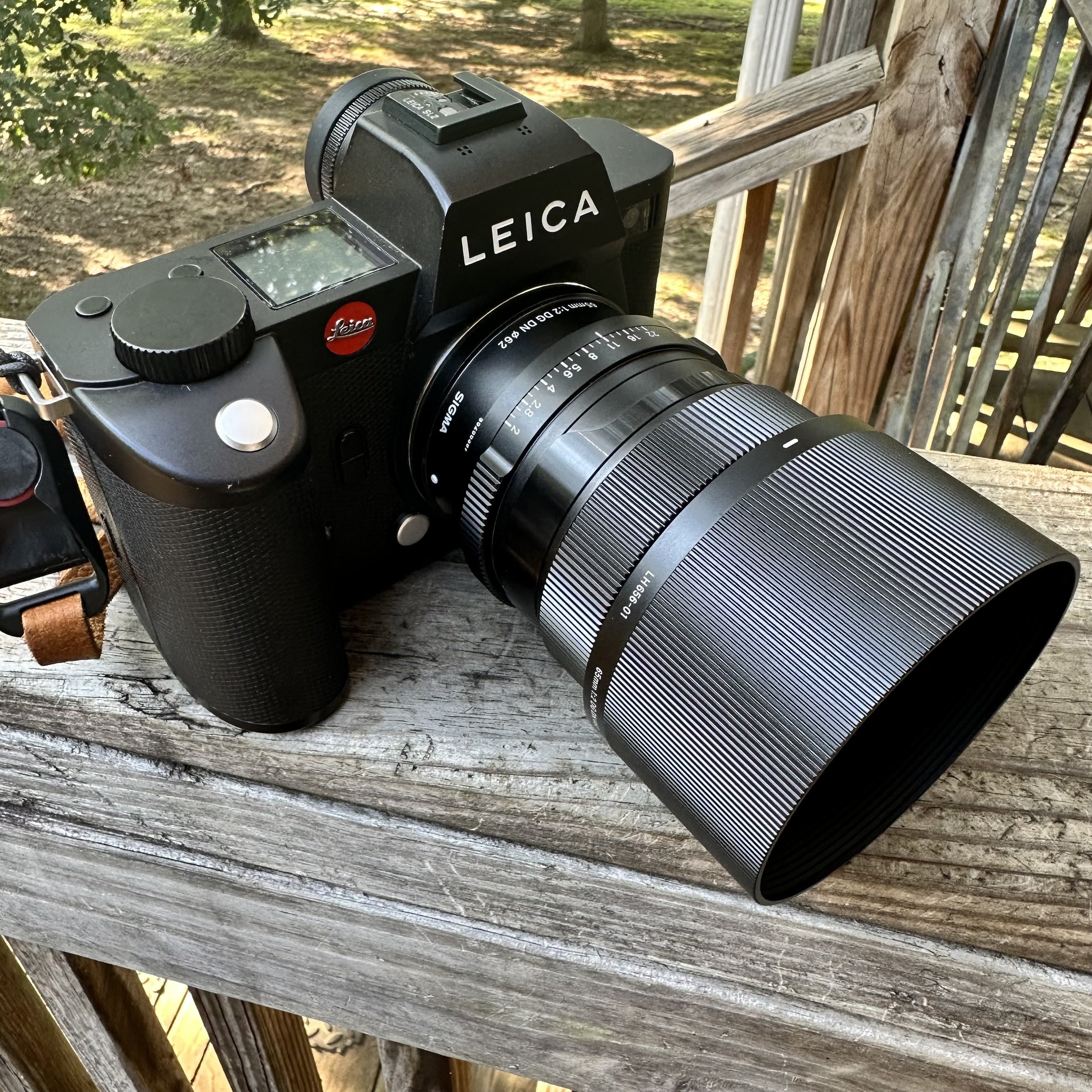
The Sigma 65mm f/2.0 mounted on my Leica SL2. You can see the physical aperture ring with 1/3 stop detents (one of my favorite features!). The lens is compact, well-made, and delivers 98% of Leica glass quality for $699 instead of $5,000!
Technical Specifications and Pricing
Before we dive deeper, here are the specs for the Sigma 65mm f/2.0 DG DN:
Optical Design:
Focal length: 65mm
Maximum aperture: f/2.0
Minimum aperture: f/22
Aperture blades: 9 (rounded for smooth bokeh)
Optical design: 14 elements in 11 groups
Physical Specs:
Mount: L-mount (Leica SL/CL, Panasonic S-series)
Filter size: 62mm
Length: 2.8 inches (72mm)
Weight: 14.3 oz (405g)
Minimum focus distance: 21.7 inches (55cm)
Construction:
All-metal barrel
Weather-resistant construction
Aperture ring with 1/3 stop detents
AF/MF switch on lens barrel
Smooth focus ring (encoder design)
Price:
Sigma 65mm f/2.0 DG DN: ~$699
Leica APO-Summicron-SL 75mm f/2 ASPH: ~$4,995
Yeah, you read that right. The Leica costs seven times more than the Sigma. And yet, as I'll explain, the Sigma delivers 98% of the image quality! Let's dig into that comparison.
Why 65mm? The Perfect In-Between Focal Length
If you're not familiar with 65mm as a focal length, let me explain why this is such a sweet spot:
The Goldilocks Focal Length: 65mm sits right between the standard 50mm and the classic portrait 75mm. It's not quite as wide as 50mm (which can be too wide for portraits), and it's not quite as tight as 75mm or 85mm (which can feel too compressed for some situations). It's just right!
Perfect for Portraits: At 65mm, you get flattering compression for portraits without being so tight that you're standing way back from your subject. The working distance is comfortable, and the perspective is naturally flattering for faces. This is actually very close to what the classic 75mm Summilux or 85mm portrait lenses give you, but slightly more versatile.
Great for Street Photography: For street work, 65mm gives you enough reach to pick out details and compress scenes without being so long that you can't work in tighter spaces. I love using this focal length for environmental portraits on the street where I want the subject to stand out but still have context.
Comparison to Other Focal Lengths:
50mm: Wider, more environmental, great for general use but can be too wide for portraits
65mm: Perfect balance, flattering for portraits, good for street, versatile!
75mm/85mm: Tighter compression, classic portrait lenses but less versatile for general use
90mm: Even tighter, requires more working distance, more specialized
The 65mm focal length is honestly underrated. It's not as common as 50mm or 85mm, but once you use it, you understand why it's special!
I really appreciate your offer Hassan and look forward to the day when we finally get to link up and go out on a photowalk together!
Hassan packed up two of his beautiful Sigma primes and sent them up for a look. He sent his 65mm f2 DG DN and his 90mm f2.8 DG DN. Both of these are in Leica’s L mount as Hassan has a Panasonic Lumix camera that is also in L mount due to the L mount alliance between Leica, Sigma and Panasonic.
The first impression of this lens is the darn thing is tiny. This lens is really small, this is awesome as it means it makes the system really compact. The next thing I noticed right away is how nice the build is, all metal construction for the major parts, including the lens hood from what I can tell. Really nice fitment of the lens components so there really is no play in the mating parts. Parts designed to move, like the aperture ring, move only in the direction they are designed to move in. The machine work and fitment is nicely executed from what I can tell.
The next thing I noticed is how fast the focus works, just understand this…it is fast. How fast? Well, it is fast enough to get the shot for me. it is not as fast as my native Leica glass, but it is plenty fast enough for my personal use. I don’t have a way to measure the focus speed, but it works great and I have no complaints about it.
Sample Photos: What This Lens Can Do
Let me show you what this lens actually produces in real-world use. This is shot with the Sigma 65mm f/2.0 on my Leica SL2 during a photowalk around Chattanooga:
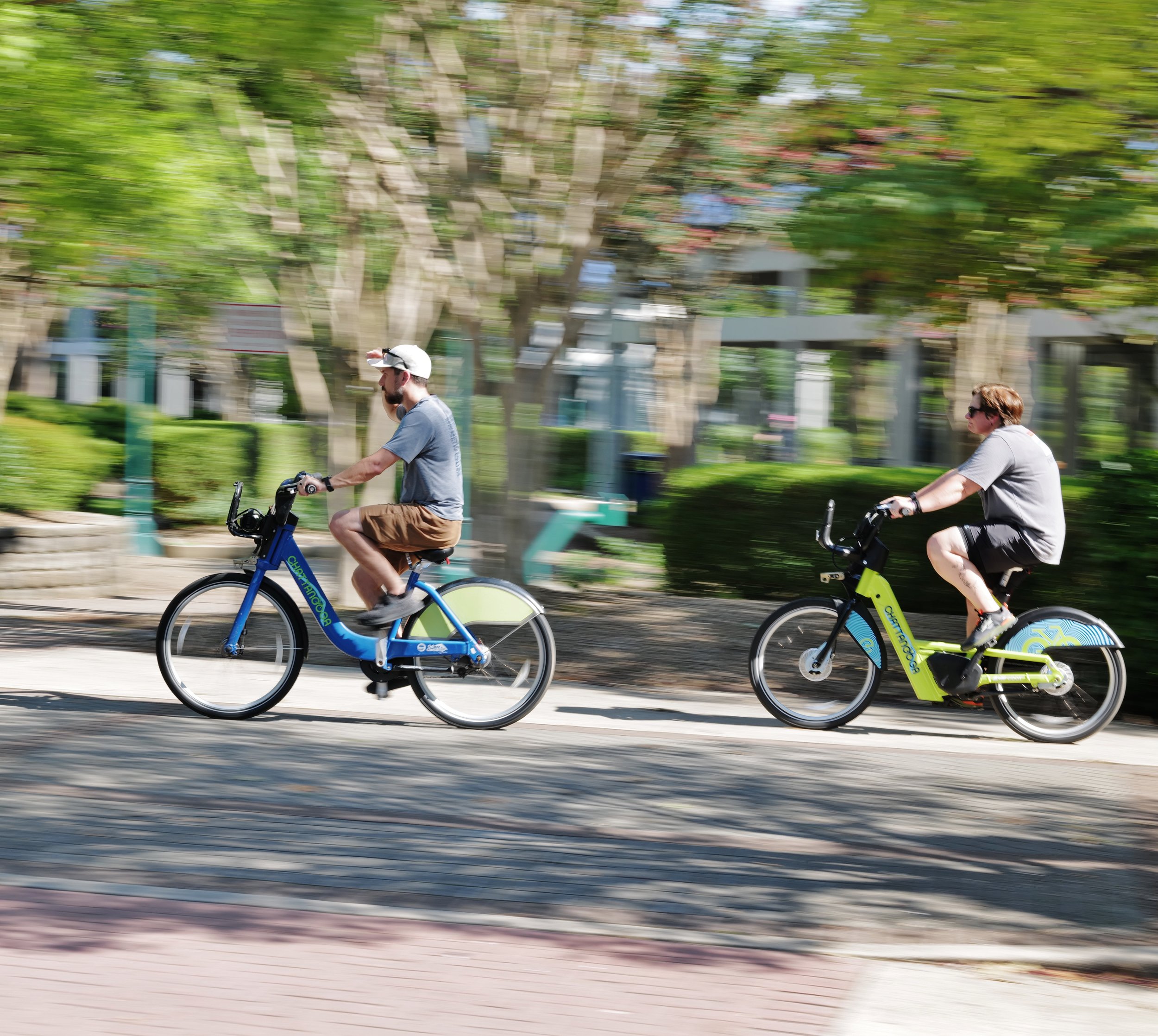
Panning blur shot of bicycle riders at Coolidge Park in Chattanooga. This demonstrates how fast and accurate the Sigma 65mm autofocus is! Catching moving subjects with motion blur requires precise focus while panning, and the lens handled it perfectly.
This photowalk sample shows what I meant by "98% of Leica glass." Look at the sharpness, the rendering, the color! This is what you're getting for $699. Not "budget lens performance." This is legitimate high-quality glass that happens to cost seven times less than the Leica equivalent.
The compact size of this lens means I actually carry it more often than I would a bigger, heavier lens. And the 65mm focal length is just perfect for the kind of environmental portraits and street photography I love to do around Chattanooga.
Sigma vs Leica: 98% of the Quality at 14% of the Price
Let me be really clear about something: I said this lens is 98% of my Leica glass in every conceivable way. That's not marketing speak. That's my honest assessment after using both extensively.
The Price Difference is Staggering:
Sigma 65mm f/2.0 DG DN: $699
Leica APO-Summicron-SL 75mm f/2 ASPH: $4,995
That's a $4,296 difference. The Sigma costs 14% of what the Leica costs. Let me repeat that: you're paying seven times less for the Sigma!
What Does the Leica Give You?
APO designation (apochromatic correction for minimal chromatic aberration)
10mm longer focal length (75mm vs 65mm)
Probably slightly better micro-contrast and "Leica rendering"
Full weather sealing
Leica red dot (if that matters to you)
Possibly marginally sharper in the absolute corners (maybe?)
What Does the Sigma Give You?
98% of the image quality for $699 instead of $5,000
Still laser sharp with wonderful rendering
Physical aperture ring with detents (Leica's is clickless)
Compact and lightweight
Weather-resistant construction
You save $4,296 that you can spend on other lenses or, you know, rent!
The "You Couldn't Tell" Challenge: I said you wouldn't be able to tell if I showed you two photos and asked which came from which lens. I stand by that! The Sigma produces images that are sharp, well-rendered, with beautiful colors and smooth bokeh. Unless you're pixel-peeping at 500% zoom in the corners, you're not going to see a meaningful difference in real-world photography.
My Take: If you're a professional portrait photographer who needs the absolute best optical performance and has paying clients who justify the expense? Maybe the Leica makes sense. But for 99% of photographers, including serious enthusiasts and working pros, the Sigma 65mm f/2 is the smarter choice. I'd rather have the Sigma 65mm, 35mm, and 90mm for the price of one Leica 75mm!
The Sigma isn't "almost as good as Leica." It's "actually just as good for any practical purpose, and you save $4,300."
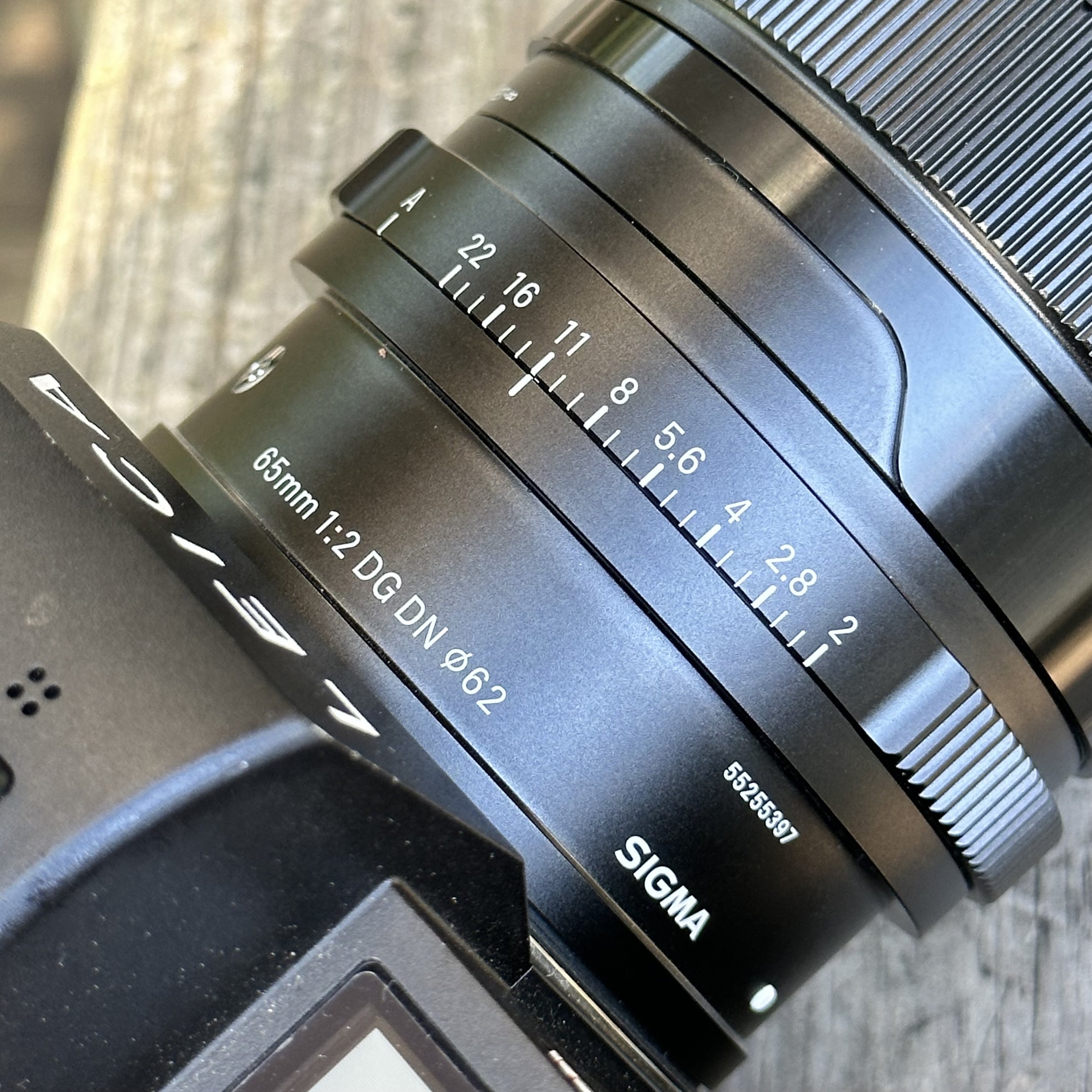
The Sigma 65mm f/2.0 mounted on my Leica SL2 with the aperture ring showing the 1/3 stop detents (one of my favorite features!). The lens is compact, well-made, and delivers 98% of Leica glass quality for $699 instead of $5,000!
Another thing I want to mention here is that the interaction with the lens is different than my Leica glass. Sigma approaches the aperture and the manual focus modes differently that Leica. I will be honest here, I kinda like the Sigma approach to aperture better too. The Leica lens is all software controlled, there are no external controls on Leica L mount glass except for the focus ring, so you use the camera’s controls to adjust everything. On the Sigma, the aperture control is on the lens, which is nice in my opinion. It has aperture choices in 1/3 stop clicks from f2 to f22 and then you can roll the aperture ring around to “A” for auto mode and the camera now has full control of the aperture just like the SL primes.
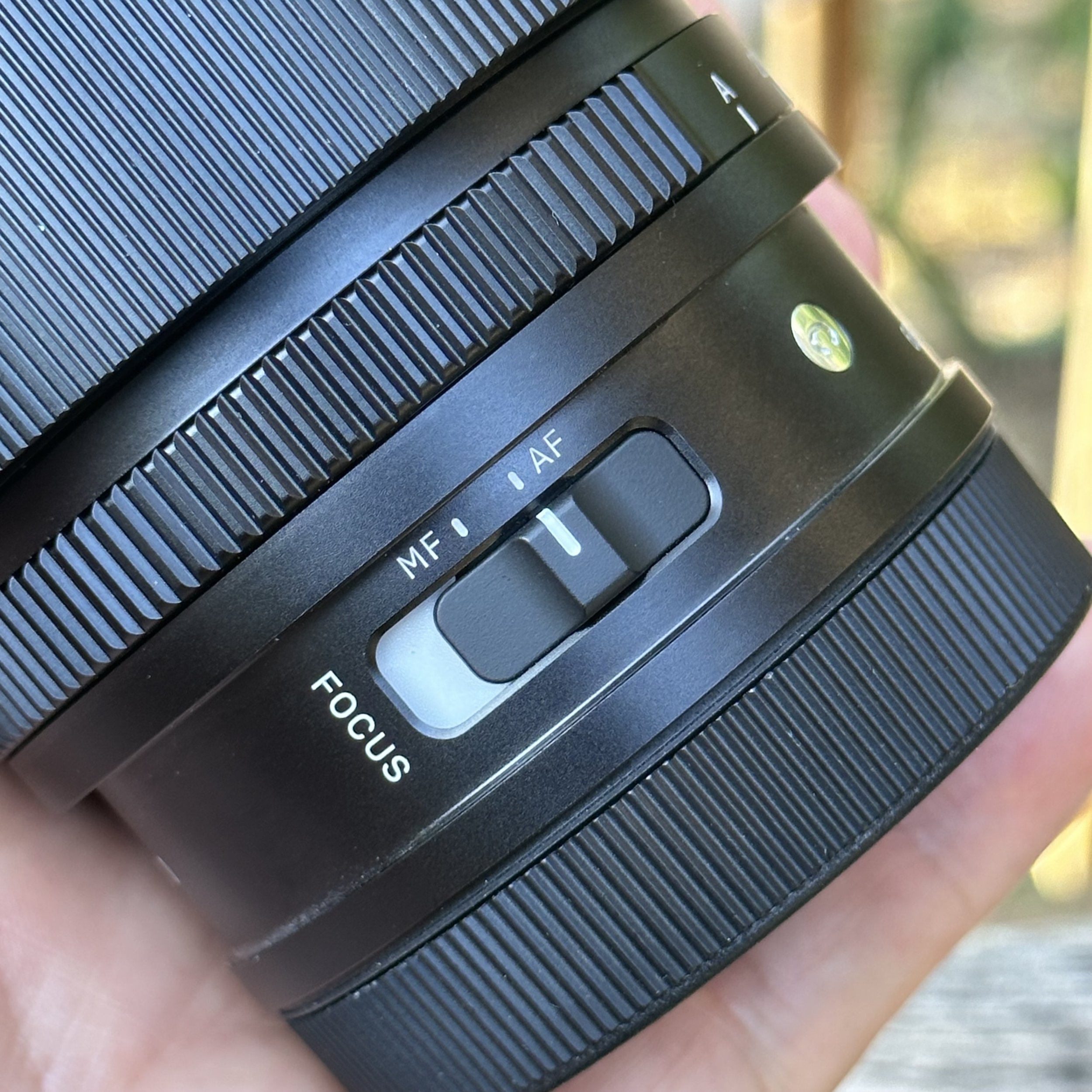
The manual /. auto focus switch is not one of my favorite features, but it works none the less.
The other thing that Sigma does is something I am on the fence about. The manual focus is a switch selection on the lens itself. I dont know why they chose this way to control this function and to be honest, it is not my favorite way of doing this function. It might be that Leica’s firmware prevents Sigma from exploiting manual focus without it. I really don’t know why, but the focus ring is an encoder design which means it is not mechanically connected to the focus helicoid in the lens. One would think this would be how it would be designed if there was a mechanical switch separating the two modes. All that to say my thoughts of this lens are that it is a great lens, especially for the money and you can get them about anywhere. Well done Sigma, well done.
Pros, Cons, and Who Should Buy the Sigma 65mm
Let me break down the good and the not-so-good about this lens:
What I Love (Pros):
Image quality is 98% of Leica: Laser sharp, wonderful rendering, you couldn't tell the difference
Compact size: "Darn thing is tiny" makes the system really portable
Aperture ring with detents: I prefer this over Leica's all-software control
All-metal construction: Feels solid and well-made
Price: $699 vs $4,995 for the Leica equivalent (seven times less!)
Fast autofocus: Fast enough for real use, no complaints
Build quality: Nice fitment, no play in parts, professional feel
65mm focal length: Perfect sweet spot between 50mm and 75mm
What I Don't Love (Cons):
AF/MF switch on lens: I'm on the fence about this vs Leica's software-only approach
Slightly slower AF than native Leica: Not as fast as Leica glass (but still plenty fast!)
Focus ring is encoder design: Not mechanically connected to focus helicoid
No dedicated "Art" line features: This is the DG DN "Contemporary" line, not Art
Who Should Buy This Lens:
Leica SL2 or Panasonic S-series shooters on a budget
Portrait photographers who want 65mm/75mm without spending $5,000
Street photographers who love the 65mm focal length
Anyone building an L-mount kit and prioritizing value over badge
Photographers who appreciate physical aperture rings
People who want Leica-quality images without Leica prices
Who Should Skip This Lens:
People who absolutely need the fastest autofocus for sports
Photographers who already own the Leica 75mm f/2 (obviously!)
Anyone who values brand prestige over practical performance
People who need weather sealing for extreme conditions (Sigma is weather-resistant, not fully sealed like Leica)
Frequently Asked Questions About the Sigma 65mm f/2.0 DG DN
Is the Sigma 65mm f/2.0 really 98% as good as Leica glass?
Yes! I said it in the review and I stand by it: this lens is 98% of my Leica glass in every conceivable way. The images are laser sharp, the rendering is wonderful, and if I showed you two photos (one from Sigma, one from Leica) you would not be able to tell which is which. The Sigma 65mm f/2 costs $699 versus $4,995 for the Leica APO-Summicron-SL 75mm f/2. You're getting 98% of the performance at 14% of the price. Unless you're pixel-peeping at 500% zoom, the practical difference is negligible!
Does the Sigma 65mm work with Leica SL2?
Absolutely! The Sigma 65mm f/2.0 DG DN is made specifically for L-mount, which includes Leica SL, SL2, SL2-S, CL, and Panasonic S-series cameras. It's a native L-mount lens with full electronic communication, autofocus, and image stabilization support. No adapter needed. I've been using it on my Leica SL2 and it works perfectly. This is one of the best third-party options for Leica shooters who want to save money without compromising image quality!
Why 65mm instead of 50mm or 75mm?
65mm is the perfect in-between focal length! It sits right between the standard 50mm and the classic portrait 75mm. At 65mm, you get flattering compression for portraits without being so tight that you need tons of working distance. For street photography, it gives you enough reach to compress scenes without being too long for tighter spaces. Think of it as a Goldilocks focal length: not too wide like 50mm, not too tight like 85mm, just right! Once you use 65mm, you'll understand why it's special.
How is the Sigma 65mm autofocus speed?
The autofocus is fast! I said in the review "it is fast enough to get the shot for me." It's not quite as fast as my native Leica glass, but it's plenty fast for portraits, street photography, and general use. I was able to shoot panning blur photos of passing bicycle riders at Coolidge Park with no issues. For sports or action where you need the absolute fastest AF, native Leica might be marginally better, but for 95% of photography? The Sigma is more than fast enough!
What's the difference between Sigma Contemporary and Art lenses?
The Sigma 65mm f/2.0 DG DN is part of Sigma's "Contemporary" line, which focuses on compact size and portability while maintaining excellent optical quality. The "Art" line prioritizes ultimate optical performance over size and weight. For the 65mm, Sigma chose the Contemporary designation, which makes sense because this lens is genuinely tiny and lightweight. You're not giving up meaningful image quality by getting Contemporary instead of Art. This lens punches way above its weight!
Does the Sigma 65mm have an aperture ring?
Yes, and it's one of my favorite features! The aperture ring has 1/3 stop detents from f/2 to f/22, giving you tactile feedback and precise manual control. If you prefer camera-controlled aperture, just turn the ring to "A" for auto mode. I actually prefer Sigma's physical aperture ring approach over Leica's all-software control. It's faster to adjust and you get physical feedback. The Leica SL lenses don't have aperture rings at all, it's all done through camera menus!
Is the Sigma 65mm sharp?
Laser sharp! I said it in the review and the sample photos prove it. The Sigma 65mm f/2.0 is sharp wide open at f/2, and stopped down to f/4 or f/5.6 it's incredibly sharp across the entire frame. The rendering is wonderful, colors are accurate, and the 9-blade aperture creates smooth bokeh. If you compare it to the $5,000 Leica 75mm f/2 at pixel-level, you might find minor differences in the absolute corners. But for real-world photography? You won't see a difference. This lens is sharp enough for any professional application!
Should I buy the Sigma 65mm or save up for the Leica 75mm?
Buy the Sigma unless you have $4,300 burning a hole in your pocket! The Leica APO-Summicron-SL 75mm f/2 costs $4,995. The Sigma costs $699. That's a $4,296 difference! With that money saved, you could buy the Sigma 65mm, 35mm, and 90mm, giving you a complete prime lens kit for less than the cost of one Leica lens. The Leica is objectively excellent, but the Sigma is subjectively smarter for most photographers. Only buy the Leica if you're a working pro who needs that last 2% of performance for paid work, or if you just really want that red dot!
How compact is the Sigma 65mm?
It's tiny! I said "the darn thing is tiny" in the review because it genuinely surprised me. At 2.8 inches long and 14.3 ounces, it's significantly more compact than comparable lenses. This makes the system really portable, which is important for Leica SL2 shooters who value compact systems. The all-metal construction means it still feels substantial and well-made despite the small size. It's the perfect travel lens because it doesn't weigh down your bag!
What's the AF/MF switch issue you mentioned?
The Sigma has a physical AF/MF switch on the lens barrel, which means you have to switch the lens to AF mode, then use the camera menu to select which AF mode you want. Leica lenses do everything in software with one step. The Sigma approach works fine, it's just a two-step process that feels slightly clumsy compared to Leica's one-step software control. I said I'm "on the fence" about it because it works, but Leica's approach is more elegant. It's a minor user interface quirk, not a deal-breaker!
Pros, Cons, and Who Should Buy the Sigma 65mm
Thank you for reading my thoughts on the Sigma 65mm f2 DG DN lens that Hassan loaned me for my Leica SL2. It has been an adventure for me.
Here's my bottom line: The Sigma 65mm f/2.0 DG DN is 98% of Leica glass quality at 14% of the price. That's not hyperbole. That's my honest assessment after extensive use.
Hassan, thank you for trusting me with your beautiful lenses! This 65mm has honestly made me reconsider my lens buying strategy. Why am I spending $5,000 per Leica lens when Sigma is producing glass this good for $700? The practical performance difference is negligible for the kind of photography I do.
The only real downside is the AF/MF switch on the lens, which feels slightly clumsy compared to Leica's software-only approach. But that's a minor user interface quibble, not a deal breaker. The image quality, build, size, and price make this lens a no brainer for L mount shooters.
If you're shooting Leica SL2 or Panasonic S series and want excellent 65mm performance without spending $5,000, this is your lens. Period. Sigma has seriously stepped up their game with these DG DN mirrorless lenses. They're not just "good for the price." They're genuinely excellent, full stop.
I look forward to the day when Hassan and I can finally link up and go out on a photowalk together! Maybe by then I'll have bought my own copy of this lens because honestly? It's earned a permanent spot in my bag…or should I say “on my shelf” lol.
Now get your camera out and go take a picture with it!
Support this website by using these affiliate links to shop on Amazon:
Sigma 65mm f2.0 DG DN Lens L mount
Nikon AF-S FX NIKKOR 105mm f/1.4E ED Lens
Voigtlander Nokton 35mm f/1.4 II
Sandisk 128GB Extreme Pro memory cards
Astrhori 18mm F8 Tilt Shift Lens Review
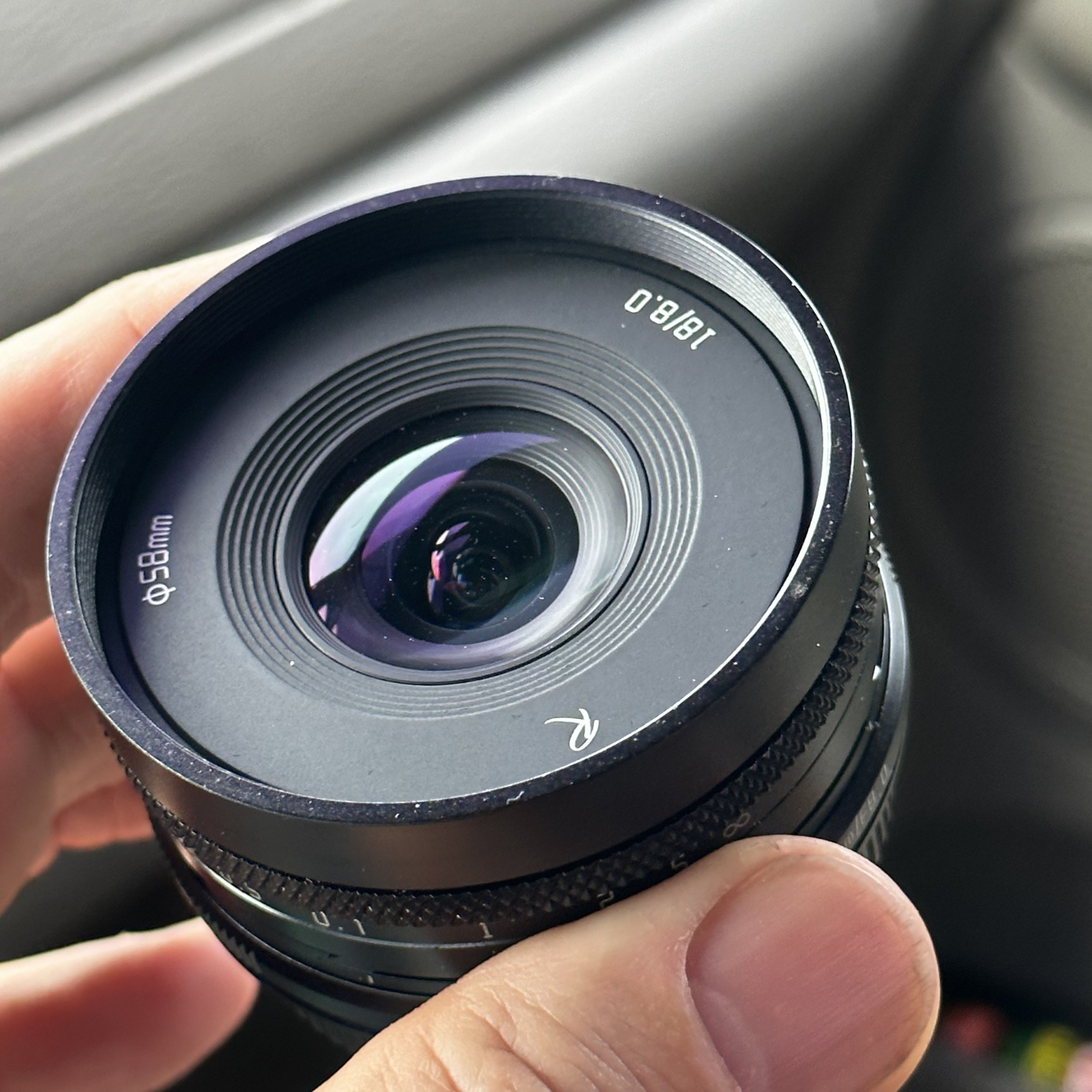
Camera gear is a interesting thing. ESPECIALLY for photographers as they love collecting it for some reason or another. I have reviewed quite a few lenses over the years on this channel, but never a tilt-shift version of anything. This is because these lenses are very specialized and usually very expensive too. Not having a focal length that I normally use is also another reason I have not bought one before.

Well, Phil Thach was contacted by Pergear about a lens they we’re launching and he recommended me to them. Thank you Phil, I appreciate the contact.
So after some emails, they sent me the sample lens for review. This particular unit did not come in a box but rather just a heavy ziplock bag. I am pretty sure the actual retail variant will be in a really nice box, so don’t worry about that. The lens is really neat for what is happening with it. You see, this little guy has a couple of cool features that most other lenses in the range do not have and it lacks on feature that almost all of the others does have.
The lens has the shift feature from “tilt/shift” lenses without the tilt function. It also has a rotation feature that allows the user to index the shift feature in 45 degree increments. So if you need it to correct vertically, you can do that. It will only shift in one axis at a time as well. This isn’t a real problem though as the intended use case for this lens is correcting converging lines on architecture and such. So you set the shift axis to match you framing and there you have it.
It will shift 6mm in each direction from center and this is more than enough for almost all scenarios. It does vignette the corners on full frame at the extreme ends of this range but carerful application of photo editing software should be able to fix this.
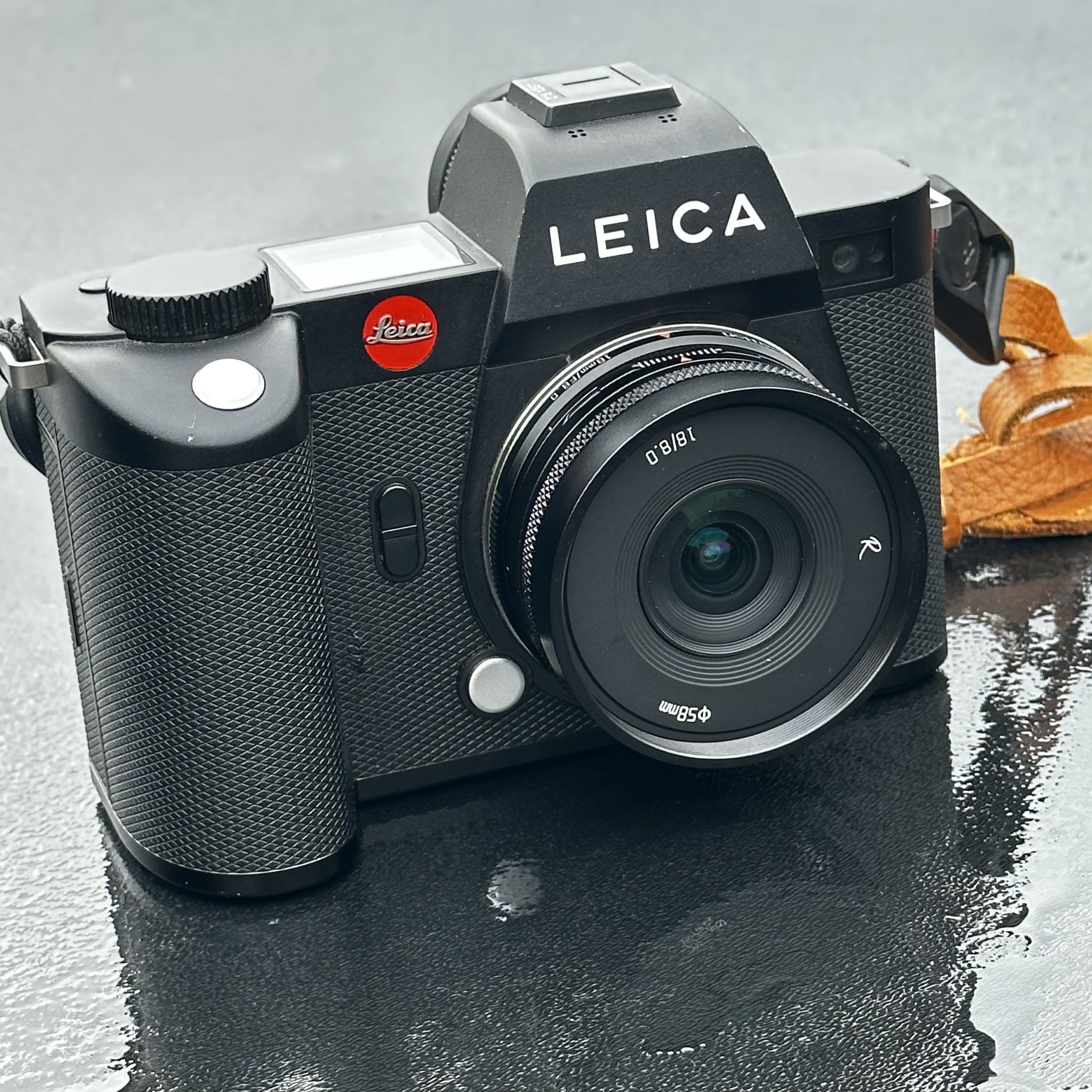
While using this lens, I have learned a few things about it though that I would like to share with you if you are consider getting one of these lenses for architectural photography. Honestly, I cant recommend it. If you plan to be a serious architectural photographer, it is worth the money if you want to dabble in this type of photography, just to see if you are interested because it is a cheaper alternative than a full on tilt/shift lens from any of the major manufacturers. But it lacks certain features that those lenses possess and that makes it more difficult to work with. Also, the build quality is lower than the Nikon and Canon alternatives and makes this lens less desirable in that manner as well. Another problem is that it is a fixed f-stop lens and it is 18 mm only. Traditionally, tilt shift lenses can be had in multiple focal lengths other than 18mm and variable F stops, this one has neither of those functionalities. It is a neat little pancake lens that is easy to use as a street photography lens on a crop sensor camera though, so when I put it on my Leica CL it worked wonderfully for just point shooting.

The F8 aperture and the 18 mm focal length gives you very deep depths of field that makes most everything in focus in your photos. So simple that it only required you to do little more than point the camera at the subject and fire the shutter. This is very beneficial for street photography purposes. A problem kept arising though, when I was shooting street photography with it using my Leica CL was that if I bump the lens, it would shift it or just letting it ride on a camera strap around my neck would be enough inertial force to shift the lens off axis. This is a problem as you could guess. So I really do not recommend this lens unless you were into novelty lenses or you were wanting to dabble in architectural photography with a little correcting shift lens, otherwise I would honestly say do not buy this lens and spend your money on something else.