Photographing Belize: Nim Li Punit Mayan Ruins, San Pedro Street Photography, and Local Culture
To get a feel for a country, you have to step away from the glitz and glamour of the tourist areas (isn't that true for all tourist destinations though). In some places this can be life threatening but in others it can be very rewarding. Belize seems to be a lot like Costa Rica in this regard. Just about anywhere you go the people are nice and helpful from what I have seen.
To get a feel for a country, you have to step away from the glitz and glamour of the tourist areas (isn't that true for all tourist destinations though). In some places this can be life threatening but in others it can be very rewarding. Belize seems to be a lot like Costa Rica in this regard. Just about anywhere you go the people are nice and helpful from what I have seen.
This is part 2 of my Belize photography journey. If you missed part 1, read about my minimalist camera gear setup and travel philosophy first.
Exploring Rural Belize: The Journey to Nim Li Punit

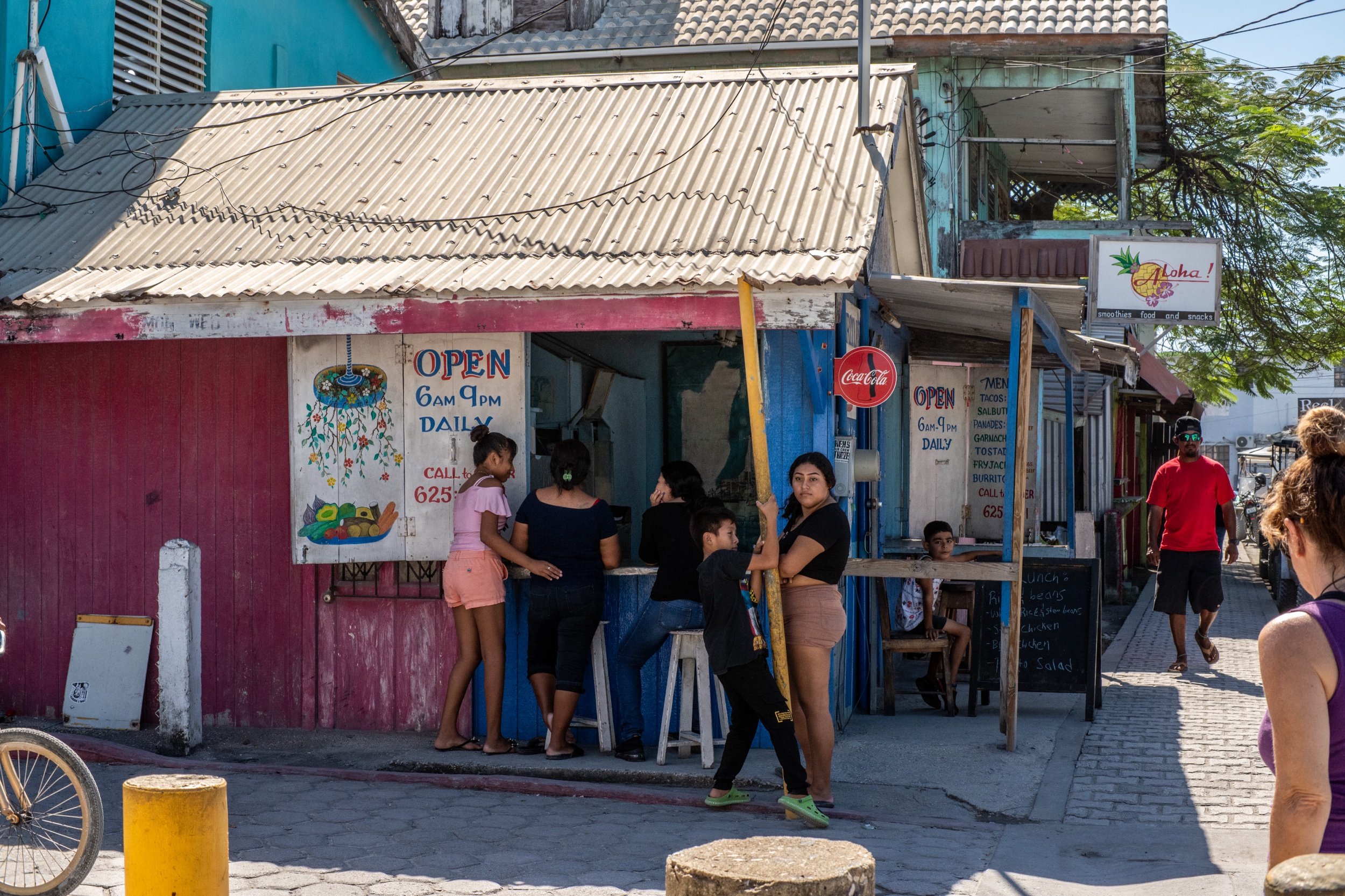
Rural southern Belize - traditional homes and local life on the way to Nim Li Punit ruins
We saddled up and headed first to the Mayan ruins (it is an active archaeological site) and we got a wonderful "tour" of the rural part of southern Belize on the way over including things like the main modes of transportation being motorcycles and buses as well as seeing many traditional homes made with thatch roof construction. Many of these homes had no electricity or water service to them that I could see while others did. It is always interesting to learn how other parts of the world live.
Why photographing rural areas matters: The journey to the ruins showed me more about Belizean life than any resort could. This is where real documentary photography happens—not in the polished tourist zones, but in the authentic spaces between destinations. Motorcycles and buses dominate the roads. Thatch-roof homes mix with more modern construction. It's this contrast that makes travel photography compelling.
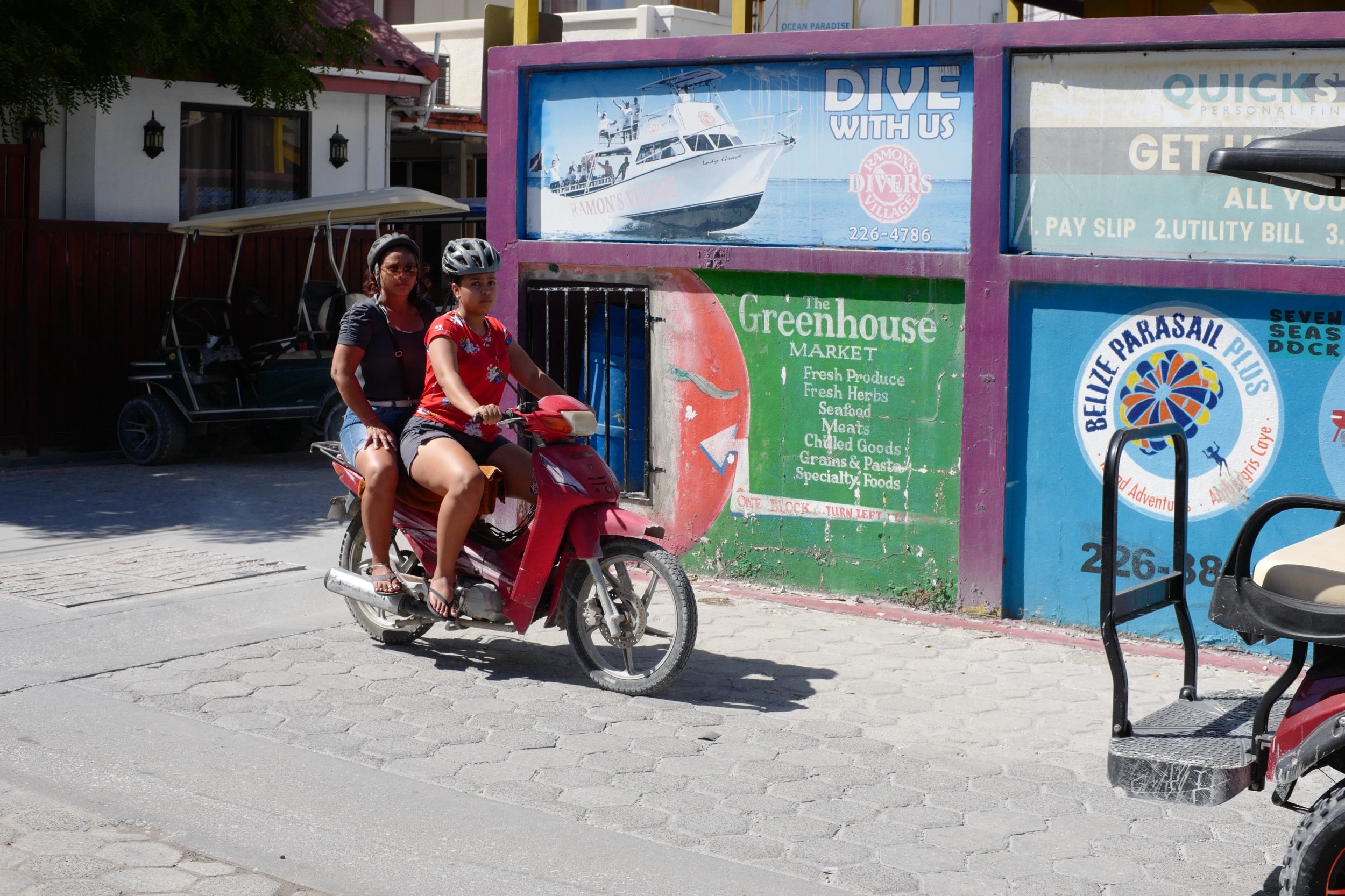
Motorcycles and buses dominate rural Belize transportation - a different world from the tourist zones
Nim Li Punit Mayan Ruins: A Photographer's Hidden Gem
We arrived at the ***Nim Li Punit*** site and get a class on decoding some of the Mayan glyphs that were carved into several stela that were found on the site. We learned how they counted and their numbering systems and how they marked their calendars as well. It was really awesome to see how all this worked on an actual artifact that you can touch.
This site is a smaller site that is easier to access with less crowds and therefore more freedom to navigate yourself without the pressures of large tour groups moving through. There were some tour groups but they were much smaller and didn't choke off the entire area while there.
Why Nim Li Punit beats the famous ruins for photography: Unlike Tikal or Chichen Itza, Nim Li Punit is uncrowded. You can take your time composing shots without tourists walking through your frame. You can touch the actual stelae. Small tour groups mean you can shoot freely without feeling rushed. For travel photographers who want authentic archaeological site photos without the crowds, this is a secret weapon.
I am not sure if the remains that were intact were original or if they were reconstructed for tourism, but it was really interesting to see it nonetheless. I know some was reconstructed as there was mortar in places holding a couple of stones together but the bulk looked original so I let my mind play that game.

Nim Li Punit - an uncrowded Mayan ruins site perfect for photographers who want freedom to shoot
Photography tip for ruins: Look for the details. The carved glyphs on the stelae tell stories. The weathered stone textures. The jungle encroaching on ancient structures. These details make compelling photographs that wide shots of the whole site can't capture.
The Spice Farm: Unexpected Photography Opportunities
On the return trip we stopped for lunch at a spice farm and toured the farm. It was incredibly interesting to see how many different spices they had at one place. Another thing that was interesting was seeing the spices in their natural form in nature. Things like black pepper vines and vanilla as well as other spices I had never heard of before. It was really informative as well as entertaining. After that it was a fairly long drive back to the accommodations for supper and a nap. Haha.

Spice farm tour - seeing vanilla, black pepper, and other spices in their natural form
Pseudo macro photography without a macro lens: The spice farm was perfect for close-up photography, and I only had my 17mm and 35mm primes. The lesson? You don't need specialized gear for every situation. Getting close and using creative framing can produce compelling images even with "normal" lenses.
Moving to San Pedro: A Different Side of Belize
After our stay in Placencia we traveled to another small community called San Pedro on an island. You can get there by plane or ferry.
Flying Tropic Air between Belizean destinations - 10-12 passenger planes flying at low altitude
We flew Tropic Air which uses this fleet of 10 or 12 passenger planes as seen in the photo above. Every plane they have is this particular make and model as well as their competitor, Mayan Air. It is kinda neat to do low altitude flights from town to town. You can see a lot of things normally not within your view. I also pack my camera gear in my pack for travel and stow all of it except my action camera in my pack for safe keeping. This way I don't leave something behind when changing locations. Another side effect though is that I get no high quality photos when the gear is in this condition so it isn't a perfect system by no means… Once on the ground in San Pedro, I will recover it for the evening. I have high hopes that San Pedro will have more photography opportunities than where we stayed in Placencia. Actually, there was a ton of things I wanted to photograph but didn't have time due to the schedule being so full. Lol.
San Pedro Reality Check: Tourist Trap or Photography Paradise?

San Pedro's tourist-focused atmosphere - beautiful but heavily commercialized
Well, I really dont care for San Pedro to be perfectly honest about it. The whole atmosphere is geared towards liberating money from tourist's wallets… this is not enjoyable at all to me. I dont mind paying a fair price for things that cost money but if you are not very careful, you will overpay significantly for the same activities offered just a few hundred meters away. I just want to be left alone to enjoy my time in peace. I really don't know how I feel about this yet to be honest… one thing is I am here in their country kind of in the way and on the other hand the infrastructure is literally being built to support that attendance… tough call to be honest.
Honest travel photography truth: Not every destination lives up to expectations. San Pedro is heavily commercialized, which can be frustrating if you're looking for authentic experiences. But this tension—between tourism infrastructure and local life—is itself worth documenting. The photography opportunities exist, but you have to work harder to find them.
Finding Authentic San Pedro: Early Morning Photography Walk
The first day we went into town for coffee as our villa doesn't have any means to make coffee in it…(not cool)… but it did afford us an opportunity to see some stuff in the early morning that we would not normally see. Like the "Central Park" of San Pedro which is where they put up all the big Christmas and New Year's decorations. It also has the giant sign at this park as well. It is common in Central American culture to have this kind of sign in each city for some reason. I kinda like it though as it is a cool photo opportunity.

San Pedro's Central Park - the classic Central American city sign photo opportunity
Best time for travel photography: Early morning. Before the tourist crowds. Before the heat. When locals are going about their daily routines. This is when you'll find the authentic moments worth photographing.
The sheer number of golf carts on this island is staggering to say the least. Golf carts are the primary means of transportation here and really are convenient to be honest about it. We have a golf cart too so l can't complain but wow, there are a lot of them. There are enough that they become a focal point of some photos.

Golf cart culture in San Pedro - they're everywhere and they're the main way to get around
Street Photography in San Pedro: Capturing Local Life
It was fairly interesting to me to see the Belizean people in their day to day lives more than to see all the tourists two streets over. I found them to be wonderful subjects for simple street photography and I saw several more that would have been great photos if I had been able to spend more time out with my camera.

Street life in San Pedro - shot at f/11 with zone focusing for fast, decisive moments

Street life in San Pedro - shot at f/11 with zone focusing for fast, decisive moments

Street life in San Pedro - shot at f/11 with zone focusing for fast, decisive moments
My street photography approach in San Pedro: I shot at f/11 with zone focusing. This means I pre-focused the lens at a certain distance, stopped down for depth of field, and simply composed and shot. Fast. Decisive. No chimping. This technique is perfect for street photography when you want to capture fleeting moments without missing the shot while fiddling with autofocus.
Above are some photos from our 3 mile photowalk that I was able to capture. The locals are so much more interesting to me than the tourists for some reason. Almost the whole photowalk was shot at f11 and range focus so I simply composed the photo and pressed the shutter. This makes for fast photos if you are attempting to capture a fleeting moment.
Another thing you will notice is how a lot of them are looking at me. This is the reason I don't do more street photography in Chattanooga, I stick out like a sore thumb due to my physical stature. Here though, I play the tourist card and get away with it. I just photograph all the things and sort it out later since my time here is limited.
Why manual focus beats autofocus for street photography: With zone focusing at f/11, everything from about 5 feet to infinity is sharp. No focus hunting. No missed moments. Just composition and timing. This is how street photographers worked for decades before autofocus existed, and it still works brilliantly today. For more on my street photography philosophy, check out my post on solo street photography with the Leica CL.
Night Photography in San Pedro: Central Park After Dark
Central Park at night - the decorations stayed up longer than they would in the US
This was taken in Central Park at night…obviously, but it was neat to find these displays still setup and under power a week later. Lots of municipalities in the USA would already be taking all this down.
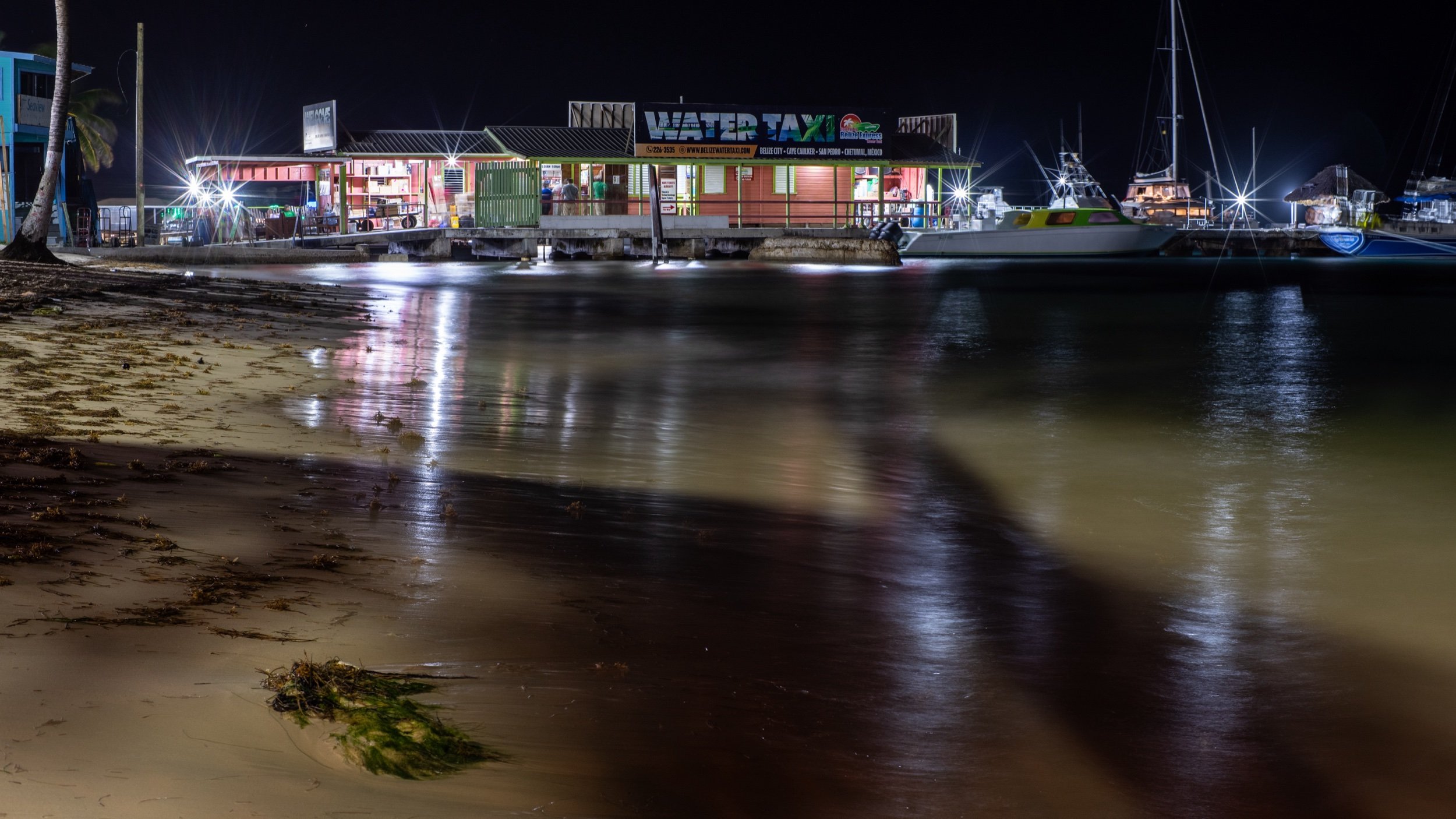
Below is a photo I captured while waiting on supper to come out of the kitchen at a beachside restaurant. I simply sat the camera on a rock wall and leveled it with my iPhone under one corner since it is a 20 second exposure. My goal here was to get ocean smoothed out some for a cool foreground element. I also had to level the image a little and also set it to 16:9 crop as there was a lot of black sky above the buildings. Would it be better at blue hour? Only if you wanted some color in the sky. I like what I got and I was there at this time too so it worked out well for me.

20-second exposure improvised with rock wall as tripod - sometimes you make do with what you have
Long exposure without a tripod: Sometimes you make do with what you have. A rock wall, an iPhone as a shim for leveling, and a 20-second exposure. This is the kind of creative problem-solving that travel photography demands when you're traveling light without a tripod.
Construction and Culture: Documenting Belizean Building Methods
On our last day we just rode around and looked at the island in general and I found many things that were really interesting to me. The first photo below was interesting to me since I am American and in the USA you would never see this on an official construction site. These poles are locally cut sapling trees and they are holding up the concrete forms for the second floor of this building that is under construction. It was crazy, just how many poles were inside this building like this.

Belizean construction methods - using local saplings as supports, something you'd never see in US construction
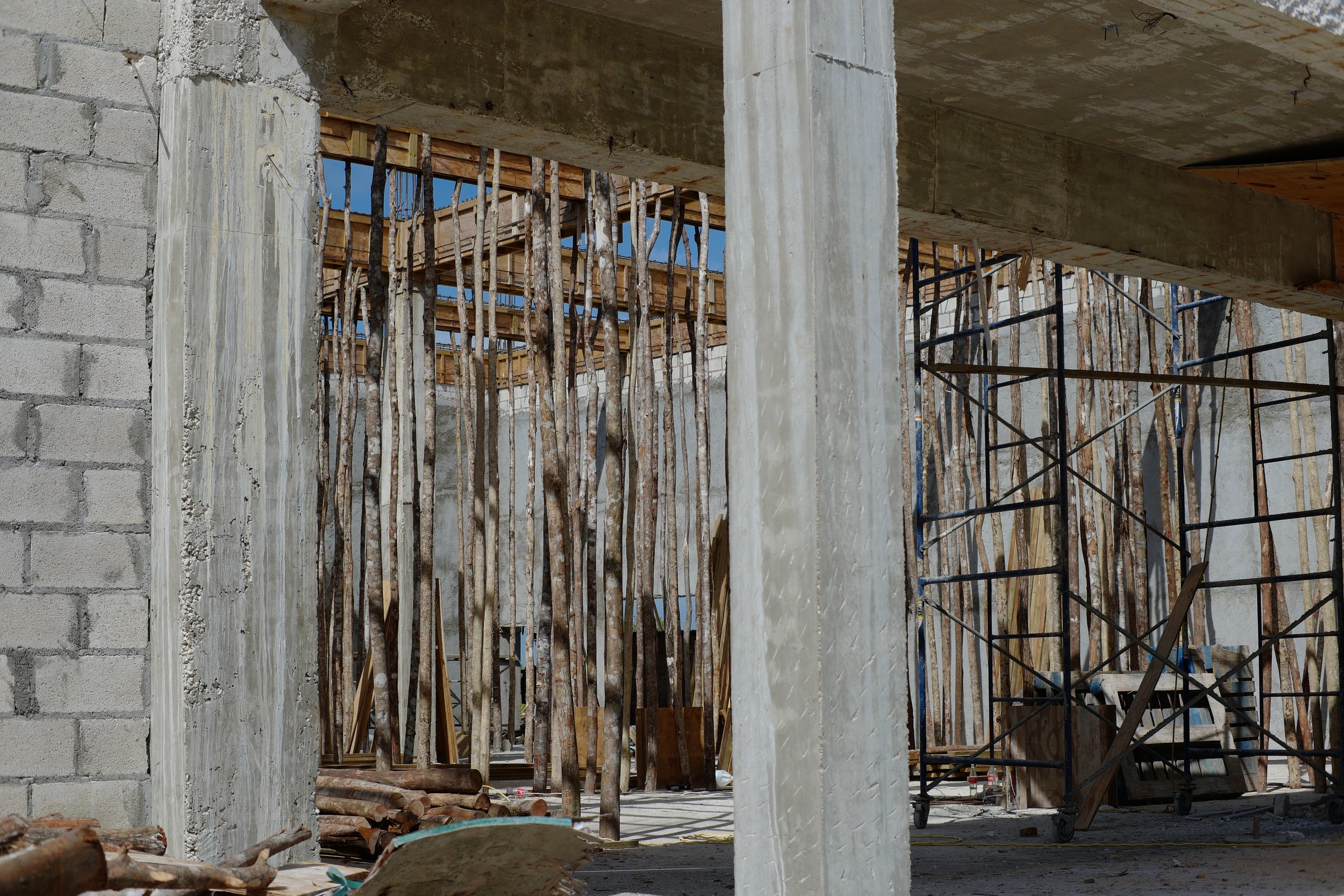
Belizean construction methods - using local saplings as supports, something you'd never see in US construction

Belizean construction methods - using local saplings as supports, something you'd never see in US construction
Documentary photography gold: This construction site shows how different building methods can be from country to country. In the US, this would never pass inspection. In Belize, it's standard practice. These cultural differences are exactly what makes travel photography compelling—you're documenting not just places, but different ways of living and working.
Final Thoughts: Real Talk About Belize Travel Photography
Thanks for tagging along here and I hope to share something new with you soon. Until then, get your camera out and take a picture with it.
Was Belize worth it for photography? Absolutely. But it's important to set realistic expectations. Placencia offered more authentic experiences than San Pedro. The ruins at Nim Li Punit were a highlight precisely because they were uncrowded. The street photography opportunities existed, but required effort to find them away from the tourist strips.
The gear worked perfectly. My minimalist Leica CL setup with just two prime lenses covered everything I needed. The 17mm for landscapes and architecture, the 35mm for street photography and portraits. Zone focusing at f/11 made street photography fast and reliable. Traveling with only a backpack eliminated stress and gave me freedom to move quickly.
Would I go back? Yes, but I'd skip San Pedro and spend more time in the rural areas and smaller sites like Nim Li Punit. The best photography in Belize happens away from the tourist infrastructure.
For more details on the camera gear I used on this trip, check out my minimalist Belize packing guide or see my current gear on my gear page
Frequently Asked Questions
Where are the best places to photograph in Belize?
The best Belize photography locations are Nim Li Punit Mayan ruins (uncrowded, accessible), rural areas between major destinations (authentic local life), early morning in San Pedro's Central Park (before tourist crowds), and Placencia (more laid-back than San Pedro). Skip the heavily touristy areas of San Pedro unless you're documenting commercialized travel culture.
What camera settings work best for street photography in Belize?
For Belize street photography, I used f/11 with zone focusing on my Leica CL and 35mm lens. This technique gives you 5 feet to infinity in sharp focus, eliminating autofocus lag. Pre-focus, compose quickly, and shoot. It's faster than autofocus for candid street moments and works in variable lighting without constant adjustment.
Is San Pedro Belize worth visiting for photographers?
San Pedro is heavily commercialized and tourist-focused, which can be frustrating if you want authentic experiences. The best photography happens early morning before crowds arrive, or by seeking out local neighborhoods away from the main tourist strips. Placencia offers better opportunities for authentic Belizean culture photography. If you do visit San Pedro, lower your expectations and focus on the contrast between tourism and local life.
How do you photograph Mayan ruins without crowds?
Visit lesser-known sites like Nim Li Punit instead of famous ruins like Tikal. Arrive early morning or late afternoon when tour groups are fewer. Nim Li Punit allows you to touch the actual stelae and photograph without constant interruptions. The trade-off is less dramatic architecture, but for photographers, the freedom and access more than compensate.
What's the best lens for travel photography in Central America?
For Belize and Central America, I recommend two focal lengths: a wide lens (17-24mm equivalent) for architecture, landscapes and environmental portraits, and a normal lens (35-50mm equivalent) for street photography and people. My Leica CL with 17mm f/1.4 and 35mm f/0.95 covered 95% of situations. Skip the zoom lenses—prime lenses are lighter, sharper, and force you to think more carefully about composition.
Can you do street photography in Belize safely?
Yes, Belize is generally safe for street photography. The locals in Placencia and San Pedro are accustomed to tourists with cameras. I photographed openly and never had issues. The "tourist card" works here—people expect tourists to take photos. That said, use common sense: avoid photographing in sketchy areas, ask permission when possible, and be respectful. Early morning photography sessions feel safer than late night.
Support this website by using these affiliate links to shop on Amazon:
Leica M11 Digital Rangefinder Camera
Nikon AF-S FX NIKKOR 105mm f/1.4E ED Lens
Voigtlander Nokton 35mm f/1.4 II
Sandisk 128GB Extreme Pro memory cards

Final street scene from San Pedro - capturing authentic moments before departure

Belize Travel Photography Guide: Minimalist Camera Gear and Packing Tips
Something we learned from the trip to England last year that was a basic revelation to us was that we don't need as much stuff as we think we do. This was because we had decided to hike the Canterbury trail in England. This forced us to leave everything behind that wasn't essential for the hike since we had to carry everything we wanted in our backpack.
When I started planning my Belize trip, I knew one thing for certain: I wasn't going to make the same mistake I'd made on countless other trips. No massive camera bag. No roller suitcase full of gear I'd never touch. This time, I was going minimalist.
This is a trip log of sorts, but it's also a lesson in how traveling light with your camera gear can actually improve your photography experience.
The Minimalist Travel Photography Philosophy
Something we learned from the trip to England last year that was a basic revelation to us was that we don't need as much stuff as we think we do. This was because we had decided to hike the Canterbury trail in England. This forced us to leave everything behind that wasn't essential for the hike since we had to carry everything we wanted in our backpack. Let me tell you, you can get brutally honest with yourself when it comes to hiking and weight in your pack. To the point of removing packaging from items to simply cull the dead weight.
This led me to also take a very hard look at my camera kit. I normally would take all sorts of lenses in the off chance I would get to do this or that kind of photography. I learned over the years though that I would end up carrying all this gear and never touch it.
The hard truth about travel photography gear: Most of what we think we "need" stays in the bag. Every extra lens is dead weight. Every "just in case" accessory is a burden you'll resent carrying. The Canterbury trail taught me this lesson through physical pain and exhaustion.
My Belize Camera Kit: Leica CL + Two Prime Lenses
Well, I looked at what we would be doing and what I figured I wanted to capture and I took just one camera and two small prime lenses. A crop sensor camera and a 17mm along with a 35mm lens is all I needed. This would cover 99% of what I would be shooting and I would be able to carry it easily in my backpack.
Now, I am on another trip out of the country and I am applying the same principle again. The kit is just as small as last time but with less charging gear. I only brought chargers for USB only this time. This may prove to have been a mistake but we will see. I am also carrying only the back pack again as well.
My complete Belize camera kit:
- Leica CL (crop sensor camera body)
- 17mm f/1.4 lens (for landscapes and general photography)
- 35mm f/0.95 lens (for street photography and low light)
- 3 spare batteries (I usually only use two per day)
- One USB charger and cable (works for both camera and action cam)
- DJI Osmo Action (for video/vlogging)
- Lume Cube Panel Mini (portable fill light)
- No lens cloths, no rocket air, no card wallet, no spare lens caps, no tripod
That's it. Everything fits in a small belt dump pouch that serves as my camera "bag." What doesn't fit goes in a ziplock bag. Total weight? Maybe 3-4 pounds including the action camera and accessories.

The complete Travel photography Camera Kit in one photo!
Why Backpack-Only Travel Changed Everything
The reason I like to travel with a backpack now is that there is no baggage to check or pickup…or lose, since I have it with me at all times. Plus the airport maneuverings is also much easier too. Much easier since you just go in and get your boarding passes (we still haven't transitioned to using our phones yet), pass through security (which you still do even if you check a bag) and go straight to your gate. Easy. Not to mention that I dont have to drag my roller bag around with me AND both of my hands are free as well.
Benefits of backpack-only travel photography:
- No checked baggage fees
- No waiting at baggage claim
- Zero risk of lost luggage with your expensive camera gear
- Both hands free for navigating airports
- Faster through security checkpoints
- More mobility when shooting on location
- Forces you to be selective about what you really need
You see, I despise airports and air travel to be quite honest about it. That is a blog post all it's own though... Haha.
The Journey: Chattanooga to Belize via Small Planes
Day 1 - We wake up at 4:30 and get ready to leave and pack the last few items we think we will need and head off to the airport.
Flying out of Chattanooga is also better to me since it is a smaller airport, the whole vibe is just lower key. This also gets me past the long lines at the big airports at check in as well as the long lines at the TSA checkpoint too. I don't normally bother with photos at the airport like others do but here are a couple for fun. All photos of travel are taken with my phone so I don't have to break out the camera. The below photo is of note though, this is what overcast skies looks like from the other side of the clouds. Looks almost looks like a desert somewhere, doesn't it?

Flying above the clouds - it almost looks like a desert from up here
Why I love small regional airports for travel photography: Chattanooga's airport lets you move through the whole process in minutes, not hours. Less stress means you arrive at your destination with more creative energy for photography. For more on my travel photography philosophy, check out my other photography insights on the blog.
The camera kit is shown below. I didn't bother with lots of items I normally carry to the point of probably a fault. Lol. No lens cloths, no rocket air, no card wallet, no spare lens caps, no tripod plates (or tripods either for that matter), not even a camera bag… officially. The bag you see is actually a lens "dump pouch" that goes on your belt. It happens to be big enough to hold almost all of the camera equipment I brought. What doesn't fit is in a ziplock bag, like the battery charger and cable and the DJI Osmo Action that I usually vlog with. I didn't even bring all of my spare batteries as I only used two a day at the most so I brought three. Lol…couldn't help myself.
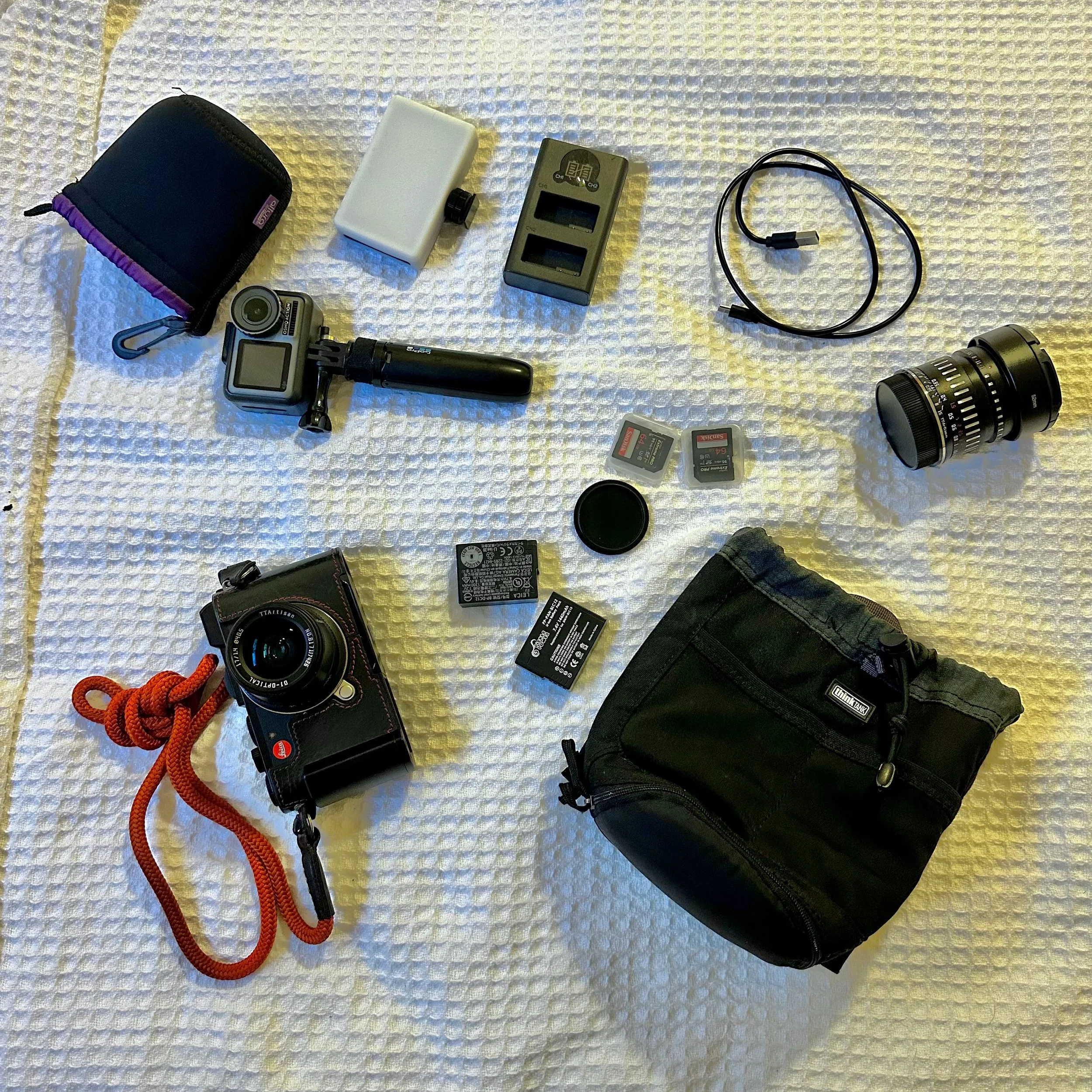
My entire Belize camera kit - Leica CL, 17mm f/1.4, 35mm f/0.95, and minimal accessories
I didn't bother with a spare battery for the Osmo as I never ran one down on my normal days anyways and it USB charges so the same cable will charge the action camera as my camera charger.
The inventory is longer than I had originally planned with me adding the DJI Osmo Action and the Lume Cube Panel Mini (fill light) was a couple of luxuries I really wanted for vlogging but fit in the pack easily enough. I have almost decided that I can vlog on my phone just about as good as the Osmo Action…almost.
Arriving in Belize: First Impressions and the Small Plane Experience
Once on the ground in Belize we pass through customs and then board a smaller plane to Placencia where we will be staying for a couple of days.

Flying Tropic Air's small planes down to Placencia - a completely different experience from commercial jets
You can also tell that they play by different rules in Belize. Notice how there is no copilot, I wonder what the protocol is for a incapacitated pilot? Makes you wonder… anyway, he did just fine and we arrived in fine order. It was actually kind of nice to take the little plane down to Placencia as it flies at a much lower altitude and I could see the towns along the way really well.

Notice something missing? No copilot. Welcome to small plane travel in Central America.
I also noticed that our plane had a copy of Microsoft Flight Simulator installed…haha. It is actually neat how technical the instruments have become but still display like the old ones did. It displayed EXACTLY like the old instruments but just on a digital display. I just thought it was really neat to see that.
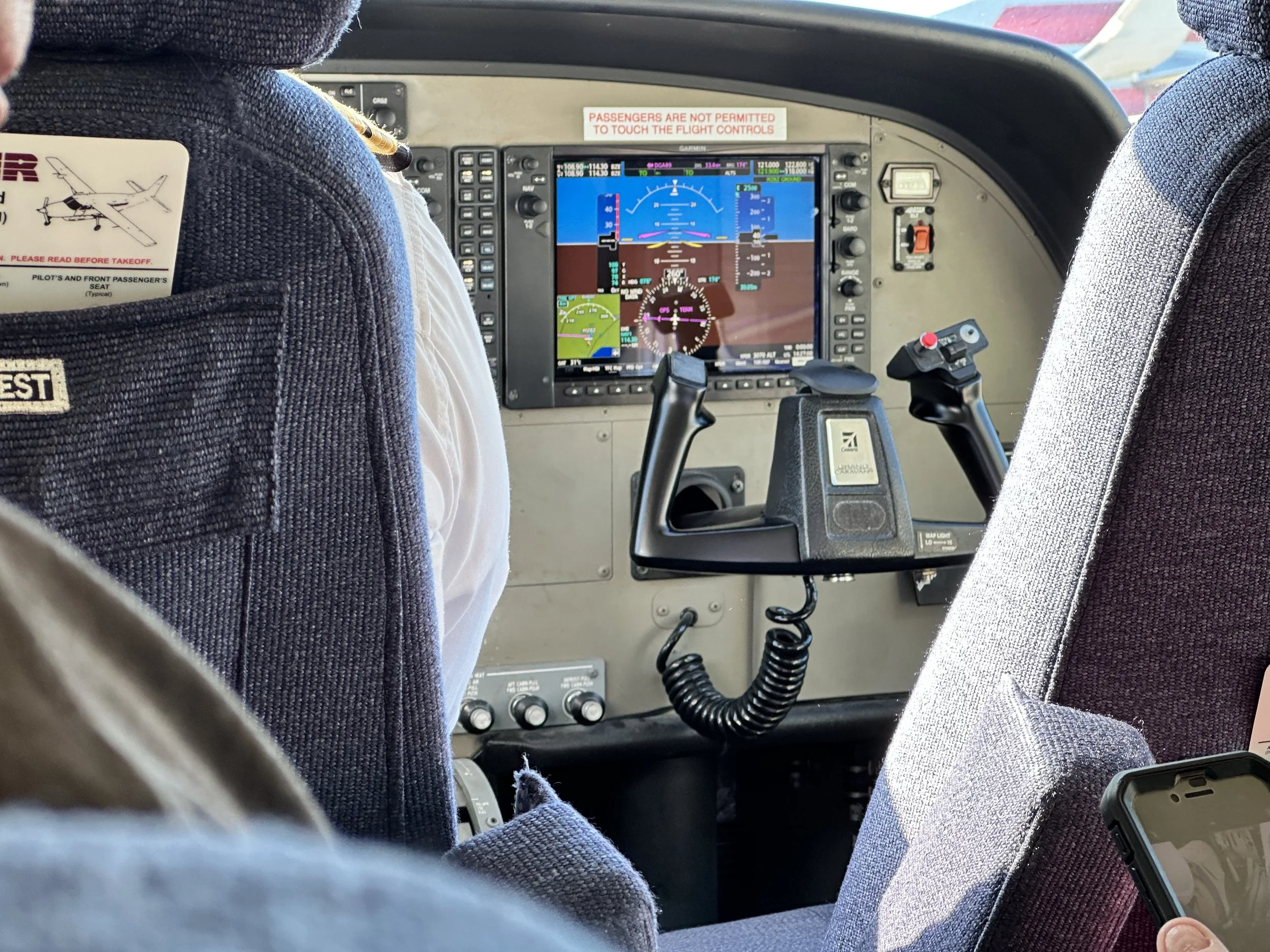
The instruments look like Microsoft Flight Simulator - modern digital displays mimicking traditional gauges
Small plane photography tip: These low-altitude flights offer incredible aerial photography opportunities. Keep your phone or camera ready for unique perspectives of coastlines and villages you can't get from commercial jets at 30,000 feet.
First Day in Placencia: Testing the 17mm f/1.4
After we arrived and got settled in, we went to the beach and walked in the ocean. It was really surreal to wake up and the outside temperature be 29 degrees and that evening it be almost 80 degrees.

First evening in Placencia - from 29°F at home to nearly 80°F at the beach
Once settled in, we went to the beach for a bit to relax a little and for this I took my 17mm f1.4 lens on the Leica CL. This is a great focal length for general photography as well as some landscapes. After our beach excursion it was time for some great food and fellowship.

First dinner in Belize - incredible local food and fellowship

Testing the 17mm f/1.4 at the beach - perfect focal length for landscapes and environmental shots
Successfully shooting at f/0.95 - the 35mm lens proved its worth in low light
We ate a wonderful meal for supper and hung out a while then it was off to bed. I used the 35mm at f0.95 for a change just to see if I could get some photos in focus at f0.95 and it was a success!
Shooting wide open at f/0.95: This was a test to see if I could nail focus at such a shallow depth of field while traveling. The answer? Yes. The Leica CL's focus peaking and magnification made it possible even in low light situations. This is why I love shooting with manual lenses—you stay engaged with every shot.
Living in the Moment: Day 2 Without a Camera
Day 2 was an off day from photo and video collection as I wanted to just be in the moment. This meant no camera gear of any kind. It was really nice to "unplug" for a while.
The best travel photography advice I can give: Not every day needs to be a photo day. Some experiences are better lived through your eyes instead of your viewfinder. This is something I learned through my photography evolution from gear-obsessed to minimalist, and it's transformed how I travel.
Next installment will be the "ruins"…I DID take my camera this time. Continue reading about my Belize photography adventures at Mayan ruins and San Pedro.
Frequently Asked Questions
What camera gear should I bring to Belize?
For Belize travel photography, I recommend a lightweight setup: one camera body and two prime lenses. A wide lens (17-24mm equivalent) for landscapes and beach scenes, and a normal to short telephoto (35-50mm equivalent) for street photography and portraits. The Leica CL with 17mm and 35mm lenses covered everything I needed. Skip the zoom lenses—the weight isn't worth it.
Is it safe to travel to Belize with expensive camera gear?
Yes, but be smart about it. I kept my Leica CL in a nondescript belt pouch rather than an obvious camera bag. In tourist areas like Placencia and San Pedro, camera gear is common and generally safe. Away from resorts, I was more discreet. The bigger risk is losing checked luggage—this is why I travel backpack-only with all my gear as carry-on.
Can you really travel with just a backpack for photography trips?
Absolutely. I did a week in Belize with just a backpack containing all my clothes and camera gear. The key is choosing versatile, lightweight equipment. My entire Leica CL kit (camera + 2 lenses + accessories) weighed less than 4 pounds. This left plenty of room for clothes and toiletries in a standard backpack. See my complete packing list in [my gear page](/my-gear-page).
What's the best focal length for travel photography?
For travel photography, I prefer two focal lengths: a wide lens (17-24mm equivalent) for environmental shots and landscapes, and a normal lens (35-50mm equivalent) for people and street scenes. This combination covers about 95% of travel situations. On my Belize trip, I used a 17mm f/1.4 and 35mm f/0.95 on a crop sensor camera, which gave me roughly 25mm and 52mm equivalent fields of view.
How do you pack camera gear for international travel?
Always pack your camera gear in carry-on luggage—never check it. I use a small belt dump pouch that fits my Leica CL and two lenses. It's nondescript and doesn't scream "expensive camera." Everything else (chargers, batteries, cables) goes in ziplock bags inside my backpack. This system has worked flawlessly for multiple international trips. The key is limiting yourself to what truly fits in a carry-on while staying under airline weight limits.
Support this website by using these affiliate links to shop on Amazon:
Leica M11 Digital Rangefinder Camera
Nikon AF-S FX NIKKOR 105mm f/1.4E ED Lens
Voigtlander Nokton 35mm f/1.4 II
Sandisk 128GB Extreme Pro memory cards