
Nikon Zf Review: Why I Switched from Leica CL for Travel Photography
When I got into the Leica cameras I use, I had built a kit around street photography, urban photography, urbex photography, and travel photography. The next thing I started doing was adapting vintage lenses to them. Then I started using TTArtisan glass on the Leica CL and loved it! My Leica SL2 now carries the 50mm APO Summicron L pretty much all the time as well. I love the SL2, but for a backpacking trip, it is probably not the best choice.
After years of using the Leica CL for travel photography, I finally switched to the Nikon Zf—and I should have done it sooner. The breaking point? Getting caught in English rain on the Pilgrims Way with my non-weather-sealed Leica CL. In this Nikon Zf review, I'll explain why I chose this retro-styled mirrorless camera over the Leica CL for hiking trips and travel photography, covering weather sealing, IBIS, battery life, and real-world performance.
Why I Needed a Weather Sealed Travel Camera
When I got into the Leica cameras I use, I had built a kit around street photography, urban photography, urbex photography, and travel photography. The next thing I started doing was adapting vintage lenses to them. Then I started using TTArtisan glass on the Leica CL and loved it! My Leica SL2 now carries the 50mm APO Summicron L pretty much all the time as well. I love the SL2, but for a backpacking trip, it is probably not the best choice.
That experience changed everything for me. I realized I was babying my camera instead of using it. Every time clouds rolled in, I'd pack it away. Every time I saw a stunning scene but it was drizzling, I'd pass on the shot. That's not why I bought a camera—I bought it to use it, to capture moments, to not miss opportunities because I'm worried about weather. That's when I knew I needed weather sealing as a non-negotiable feature in my next travel camera.

The Leica CL served me well for years, but lack of weather sealing was a deal-breaker for hiking trips in unpredictable weather.
Why the Leica CL Didn't Work for Hiking Trips
The Leica CL, while perfect in size for travel, is not weather sealed… I came to this realization while hiking the Pilgrims Way in England a while back. (I did a small series of videos on this trip if you are interested) and this is when I came to realize that while the Leica CL is really small and lightweight, it is also not my favorite for hiking trip travel. Rain is a real threat in England and I was fortunate that my camera did not get caught in a cloud burst.
So knowing all of this, I started down the path of finding a new travel camera to shoot with…
My Requirements for the Perfect Travel Photography Camera
So knowing all of this, I started down the path of finding a new travel camera to shoot with. I looked at several factors to guide my choice:
The first was it had to be weather sealed or it was a no go for me.
The next is it had to have IBIS as I love shooting with vintage glass and this allows me to shoot at much slower shutter speeds while handheld.
I also wanted a full frame, 24MP sensor if possible as these (in 2024) have much better low light performance due to the larger photo sites on the sensor.
It also needed good battery life as these Leica mirrorless cameras just don't have great battery life for me.
These weren't just nice-to-have features. These were requirements based on real frustrations I'd experienced in the field. Weather sealing because of England. IBIS because I shoot vintage glass and hate carrying a tripod on hikes. Full-frame 24MP for those low-light church interiors and evening shots. Battery life because running out of power halfway through a hiking day is unacceptable.
Nikon Zf Features That Changed My Travel Photography
After searching for a year or so with no luck, Nikon drops a bomb on me with the launch of the Nikon Zf retro styled camera. You could have just as easily called it the "Nikon Special Custom Built Camera For Dave" and the name would have been accurate. HaHa!
I immediately fell in love with it…before I even laid eyes on one in person. When I see a new camera that I am interested in, I will search all about it that I can and see if it will fit my needs and do that at a price point that I am comfortable with.
The Nikon Zf mirrorless camera is a camera that checks all those boxes and more. You see I am in love with the retro-style camera design aesthetic like the Fujifilm XT-3 and now the Nikon Zf (as well as to a lesser degree the Nikon Zfc too). I owned the Fujifilm XT-3 for several years and it had two main shortcomings that made me want to move away from it over the years.
The crop sensor had pretty bad low light performance (it was 26 mega pixels so it was doing a lot of work to get it all in there) and the lack of IBIS in a mirrorless camera. Cameras at this time were coming standard with IBIS (In Body Image Stabilization) and I felt this was a huge misstep for Fujifilm on this camera. I, none the less, used it for several years anyway and to great effect too, but the lack of these two features was a nagging thought at the back of my mind the whole time.
Then Nikon came out with the Zfc and I initially was in love with it, but upon closer inspection, it was simply an XT-3 in a Nikon shell. Yeah, it had a few things that were newer and (debatably) better, but it still lacked certain things I wanted. I had resigned myself at this point to wait for a replacement to the Nikon Df or maybe something by Leica that was closer to what I was wanting. Well as fate would have it, Nikon saw the demand for the retro camera design and came out with the Zf—a full frame, IBIS, 24 megapixel, mirrorless camera loaded with all the magic that they could cram into the beautiful Nikon retro shell.
Nikon Zf vs Leica CL: Key Differences for Travel Photography
Let me break down the key differences between these two cameras for anyone facing the same decision I did:
Weather Sealing: The Nikon Zf is fully weather sealed; the Leica CL is not. This was the deal-breaker for me. If you're hiking in unpredictable weather or traveling to places with rain, dust, or humidity, the Nikon Zf gives you peace of mind. The Leica CL requires constant babying in anything but perfect conditions.
IBIS: The Nikon Zf has 5-axis in-body image stabilization; the Leica CL does not. This makes a massive difference when shooting with vintage manual focus lenses or in low light. I can handhold shots at 1/15th second with the Nikon Zf that would be impossible with the Leica CL. For travel photography where you can't always use a tripod, IBIS is a game-changer.
Sensor Size: The Nikon Zf has a full-frame 24MP sensor; the Leica CL has an APS-C crop sensor. The full-frame sensor gives you better low-light performance (larger photosites), shallower depth of field control, and generally more flexibility. The crop sensor on the Leica CL is excellent, but the full-frame advantage is real when you're shooting in challenging light.
Battery Life: The Nikon Zf's battery lasts significantly longer than the Leica CL. With the Leica CL, I'd carry 3-4 batteries and still worry about running out. With the Nikon Zf, two batteries get me through a full day of shooting with power to spare.
Size and Weight: This is where the Leica CL wins. It's noticeably smaller and lighter, which matters on long hikes. The Nikon Zf is not a huge camera, but it's definitely more substantial. For me, the practical advantages of the Nikon Zf outweigh the size disadvantage, but this is a personal choice.
Price: The Leica CL (when it was still in production) was more expensive than the Nikon Zf. Now that it's discontinued, you'd be buying used. The Nikon Zf offers better value for the features you get.
The Nikon Zf's weather-sealed body and IBIS make it ideal for unpredictable travel conditions and hiking with vintage lenses.
Real World Nikon Zf Performance: Travel and Hiking
So to be honest, I was still skeptical that this would be the next camera for me. I have gotten really comfortable using my Leica cameras and the thought of learning a new camera was really not that appealing to me. But the more reviews I watched on YouTube and the more I just looked at the camera in general, the more I liked it.
Since getting the Nikon Zf, I've put it through its paces on several trips, and it's delivered every time. The weather sealing proved itself on a rainy morning shoot where I would have packed the Leica CL away. The IBIS let me shoot handheld in a dimly lit museum with a vintage 50mm f/1.4 lens at 1/15th second and still get sharp images. The battery lasted an entire day of hiking without needing the spare.
The retro physical dials are more than just aesthetic—they're genuinely useful in the field. Being able to glance down and see my shutter speed and ISO without turning on the screen saves battery and makes adjustments faster. On a hike, every second counts when you're trying to catch changing light or a fleeting moment.
The full-frame sensor's low-light performance is noticeably better than the Leica CL's crop sensor. I can comfortably shoot at ISO 3200 or even 6400 when needed, and the files are clean. With the Leica CL, I tried to stay under ISO 1600 whenever possible. That flexibility matters when you're traveling and can't always control the light.
So for now, this is my new travel/street machine. It has wonderful rendition and is a joy to shoot with. I look forward to taking it on outings now and I have the 50mm f1.8 S lens if I want auto focus and to be able to access all the special features that have to do with the auto focus system. So going forward, there will be more about this machine as well as the two Leica camras I use as well. You see, those two machines are also wonderful cameras and I still enjoy using them too, I use them for certain things as I have found. But I still love getting them out and using them.
Nikon Zf vs Leica CL: Which Should You Choose?
Choose the Nikon Zf if:
You need weather sealing for hiking, travel, or unpredictable conditions
You shoot with vintage manual focus lenses and want IBIS
You value battery life and don't want to carry multiple batteries
You want better low-light performance (full-frame advantage)
You're comfortable with a slightly larger/heavier camera for the features
Choose the Leica CL if:
Size and weight are your absolute top priorities
You primarily shoot in good weather or controlled conditions
You're already invested in the Leica L-mount ecosystem
You prefer the Leica color science and rendering
You can find one used at a good price (it's discontinued)
For me, the practical advantages of the Nikon Zf outweigh the size advantage of the Leica CL. But I still appreciate what the Leica CL offers for lightweight urban photography.
Recommended Gear for Travel Photography
Support this website by using these affiliate links to shop on Amazon:
Leica M11 Digital Rangefinder Camera because the Leica CL is out of production now.
Nikon AF-S FX NIKKOR 105mm f/1.4E ED Lens
Voigtlander Nokton 35mm f/1.4 II
Sandisk 128GB Extreme Pro memory cards
Nikon 50mm f1.8 S Lens for Z mount
Frequently Asked Questions About the Nikon Zf for Travel Photography
Is the Nikon Zf good for travel photography?
Yes, the Nikon Zf is excellent for travel photography. After switching from the Leica CL, I've found the Nikon Zf addresses all the key requirements for serious travel work: weather sealing protects it in rain and dust, IBIS (In-Body Image Stabilization) allows handheld shooting with vintage lenses and in low light, the full-frame 24MP sensor delivers outstanding image quality even at high ISOs, and the battery life is significantly better than my Leica mirrorless cameras. The retro design with physical dials makes it quick to adjust settings on the fly, which is crucial when you're hiking and need to shoot fast.
How does the Nikon Zf compare to the Leica CL for travel?
The Nikon Zf and Leica CL serve different needs. The Leica CL is smaller and lighter (perfect for ultralight backpacking), but lacks weather sealing and IBIS, which are deal-breakers for hiking trips where rain is a possibility. The Nikon Zf is heavier but offers weather sealing, IBIS, a full-frame sensor with better low-light performance, and much longer battery life. I switched from Leica CL to Nikon Zf specifically because I got caught in English rain on the Pilgrims Way and realized I needed weather protection. If you're doing casual city travel, the Leica CL's compact size is nice. For serious hiking and unpredictable weather, the Nikon Zf is the better choice.
Is the Nikon Zf weather sealed?
Yes, the Nikon Zf is weather sealed. This was one of my primary requirements when searching for a travel camera to replace the Leica CL. The weather sealing on the Nikon Zf protects against rain, dust, and moisture - essential for hiking trips and travel photography where you can't always control the conditions. After hiking the Pilgrims Way in England with my non-weather-sealed Leica CL and worrying about rain the entire time, having weather sealing gives me peace of mind to shoot in any conditions.
Does the Nikon Zf have IBIS?
Yes, the Nikon Zf has 5-axis In-Body Image Stabilization (IBIS). This was another critical requirement for me. IBIS allows me to shoot with vintage manual focus lenses at slower shutter speeds while still getting sharp handheld images. It's also invaluable for travel photography when you're shooting in low-light situations like churches, museums, or evening street scenes where you can't use a tripod. The Leica CL lacks IBIS, which was one of the main reasons I switched to the Nikon Zf.
What is the battery life like on the Nikon Zf?
The Nikon Zf has significantly better battery life than my Leica mirrorless cameras. While Leica mirrorless cameras have notoriously short battery life (I always carried 3-4 batteries), the Nikon Zf's EN-EL15c battery provides enough power for a full day of travel photography on a single charge. This is a huge advantage for hiking trips where you might not have access to power for recharging. I typically carry two batteries for the Nikon Zf and rarely need the second one, whereas with the Leica CL I'd go through multiple batteries in a day.
Can you use vintage lenses on the Nikon Zf?
Absolutely! The Nikon Zf is fantastic for vintage lenses, which is one reason I love it. With the FTZ II adapter, you can use Nikon F-mount lenses, and with various adapters you can mount Leica M, M42, Canon FD, and many other vintage lenses. The combination of focus peaking, IBIS, and the high-resolution EVF makes manual focusing a joy. I regularly shoot with vintage glass on my Nikon Zf when traveling, and the IBIS compensates for the lack of optical stabilization in older lenses. This was impossible with the Leica CL which lacks IBIS.
Is the Nikon Zf worth it over the Leica CL?
It depends on your priorities. The Nikon Zf is worth it if you need weather sealing, IBIS, better low-light performance (full-frame vs crop sensor), and longer battery life. These were all critical requirements for my hiking and travel photography. The Leica CL is worth considering if you prioritize extreme portability, the Leica color science, and compact size above all else. For me, the practical advantages of the Nikon Zf (weather sealing especially) outweighed the Leica CL's size advantage. After nearly losing my Leica CL to rain in England, the choice became clear.
What focal lengths work best for travel photography on the Nikon Zf?
For travel photography on the Nikon Zf, I primarily use the Nikon 50mm f/1.8 S lens because it's lightweight, sharp, and versatile. The full-frame sensor means you get the classic 50mm field of view, which works for everything from street scenes to portraits. I also adapt vintage lenses, particularly 35mm focal lengths, when I want a wider perspective for landscapes or architecture. The beauty of the Nikon Zf's IBIS is that I can handhold even at slower shutter speeds, so I'm not limited by the lack of stabilization in vintage glass. For hiking trips, I keep my kit minimal - usually just the 50mm f/1.8 S and maybe one adapted vintage lens.
So for now, this is my new travel and street machine. It has wonderful rendition and is a joy to shoot with. I look forward to taking it on outings now and I have the 50mm f1.8 S lens if I want auto focus and to be able to access all the special features that have to do with the auto focus system.
Going forward, there will be more about this machine as well as the two Leica cameras I use. You see, those two machines are also wonderful cameras and I still enjoy using them too—I use them for certain things as I have found. The Leica CL still comes with me on city trips where weight matters. The Leica SL2 is my studio and portrait camera. But for travel photography where weather and versatility matter? The Nikon Zf is now my go-to.
Are you considering the Nikon Zf for travel photography? Or have you made a similar switch from one camera system to another? I'd love to hear about your experiences in the comments below!
Want more honest camera reviews and travel photography tips? Subscribe to my photography blog for weekly posts about real-world gear testing, not just spec sheets and studio tests.
Support this website by using these affiliate links to shop on Amazon:
Leica M11 Digital Rangefinder Camera
Nikon AF-S FX NIKKOR 105mm f/1.4E ED Lens
Voigtlander Nokton 35mm f/1.4 II
Sandisk 128GB Extreme Pro memory cards

The Hanimex 28mm f2.8 lens is a really interesting little lens...
Sometimes I just throw the dice on a vintage lens and occasionally it comes out really good and sometimes it is a dud. The Hanimex 28mm f/2.8 I picked up for $20 at Ball Photo in Asheville? This time it's a winner.
Sometimes I just throw the dice on a vintage lens and occasionally it comes out really good and sometimes it is a dud. The Hanimex 28mm f/2.8 I picked up for $20 at Ball Photo in Asheville? This time it's a winner.
I paid something like $20 for this lens at Ball Photo. Twenty bucks. For that price, even if it turned out to be terrible, who cares? You're not risking much. But when it turns out to be actually good — sharp, solid build, nice colors, usable on a modern camera — that's when you feel like you found a hidden gem sitting in a used lens bin.
This is why I love digging through vintage gear at camera shops. Most people walk right past this stuff looking for autofocus lenses or the latest Sigma Art prime or whatever. Meanwhile there's a perfectly good 28mm sitting there for the price of lunch. Sure, it's got quirks (the sun flare is real), but it's also got character and it actually works. Can't beat that value.

The Hanimex 28mm f/2.8 on my Leica SL2 — not the prettiest combo, but it works.
Hunting for Glass at Ball Photo in Asheville
I went to Ashville NC on a small trip recently and on this trip I was doing photography. Well, when it is a photography trip I always make it a point to go to Ball Photo and just “go shopping” for something interesting. They have SO much vintage gear to choose from that it is almost overwhelming to be honest. It is not for the feint of heart to be honest about it. But today found me at Ball Photo and while there I started looking for some glass to pick out… Well I found some.
All-metal construction with nice silver accent rings. Built like lenses used to be built.
We all know how much I love to shoot with vintage glass and I am always on the hunt for a new lens to play with. I have Leica glass for the Leica SL2 and use it quite often but I still really enjoy adapting some older lens to the camera and then seeing what I can get with this lens and camera combination when I go out with it. It is almost a challenge to see if I can come away with something good using this old lens… What generally happens is that I slowly build a collection of lenses that I REALLY love to use and I am starting to collect a full set of these lenses. Some examples would be the 28mm f3.5 Asahi Optical M42 mount lens that I keep in the camera bag, this lens is literally one of my favorite lenses of all time for some reason. I just love the results I get with it on the Leica SL2 camera. Well today finds me using a lens that is 2/3 of s top faster and a little bigger too.
What Makes the Hanimex 28mm f/2.8 Special
The Hanimex 28mm f2.8 is a well made lens with the whole thing made of metal (probably brass from the way it feels but it could be anodized aluminum too I really am not sure) and has some really nice accents like the little silver bands around the focus ring which also has a faux leather appearance but I am almost certain is rubber. The range focus scale is graduated for every aperture marked (sans f4 for some reason) on the aperture ring, which is a nice touch for street photography. The detent clicks on the aperture ring are nice and pronounced as well as solid, no mushy aperture detents on this lens! All in all, it is a great little lens by design engineering standards. It is even a well designed attachment scheme as well with the M42 mount as it is easily adapted to about all mirrorless cameras on the market.

The M42 mount adapter — see those three tiny set screws? That's how you time the lens if you care about that kind of thing.
Adjusting M42 Adapters (If You Care About That Sort of Thing)
Many people also don’t realize that the M42 adapter can be adjusted to get the lens top dead center of the adapter too. There are three tiny set screws on the adapter that hold the threaded ring in place on the lens adapter to adjust this. To make this adjustment is simple, just screw the lens into the mount till it seats and snug it well so it wont work loose while in use. Next get the Allen key that came with the adapter and loosen the three set screws till the lens can spin in the mount and simply turn the lens till the center mark is top dead center of the adapter and then push in on the mount while tightening the set screws back down to make it hold the ring again and your done. It is that simple. Mine is slightly off center here and I have simple been too lazy to adjust it as it is close enough for me to be able to get out and shoot anyway. I don’t normally worry about it too much as once you set the adapter once, then all the lenses will time up and you don’t have to mess with it again. Installing lenses over the years on this adapter and tightening them has slipped the timing a little and this is why it is slightly off center. Once again, it is no big deal to me and i just go out and shoot…
Look, I know there are "better" lens mounts out there. But M42 is just so easy to adapt to basically anything. You can throw these lenses on Leica, Sony, Fuji, whatever — and they cost pennies compared to native glass. Plus there's something satisfying about the all-manual experience. No electronics, no autofocus hunting, just you and the glass trying to get the shot. It's photography the way it used to be, which sounds pretentious when I say it like that, but honestly it's just fun. There's a directness to it that I appreciate.
And here's the thing: M42 lenses were made by so many different manufacturers over the years that there are hundreds of options out there. Some are great, some are terrible, and part of the fun is just digging through used lens bins at places like Ball Photo to see what you find. It's like thrift shopping for camera gear.

First outing at Hamilton Place Mall in Chattanooga on Black Friday. The Hanimex handled it just fine.
Taking It to the Mall on Black Friday (Because Why Not)
So the first official outing with this lens was to go to the mall in Chattanooga TN with it and capture some Christmas spirit with it…on black Friday no less.
Well to be quite honest, it performed wonderfully. Now to be fair, the camera does have IBIS in it and this allows me to shoot at pretty slow shutter speeds without the need for a tripod. As long as you go into the camera settings and tell the camera it is a 28mm lens, the camera can compensate for movement really well allowing for incredibly slow shutter speeds like the last photo in this string from the mall where it was 1/10 of a second…hand held. Most of the other photos are shot at 1/250 second to freeze the people so that I can show the current clothing styles as well as the general appearance of the mall in 2023.
The Leica SL2's IBIS is genuinely a game-changer for vintage glass. Without it, that 1/10 second handheld shot at the mall would've been a blurry mess — the old "reciprocal rule" says you need at least 1/30 second for a 28mm lens, and that's being optimistic. But with IBIS doing its thing, I can get away with shutter speeds that should be impossible with a manual lens.
This is why I keep coming back to the SL2 for adapted lenses. It makes old glass way more usable than it has any right to be. You're essentially taking a lens from the 1960s or 70s and giving it capabilities it was never designed to have. Nikon didn't build this Hanimex thinking someone would hand-hold it at 1/10 second in a mall forty years later.

1/250 second to freeze the people and capture 2023 fashion in all its glory.
The Christmas decorations at the mall — shot handheld at 1/10 second thanks to the SL2's IBIS.
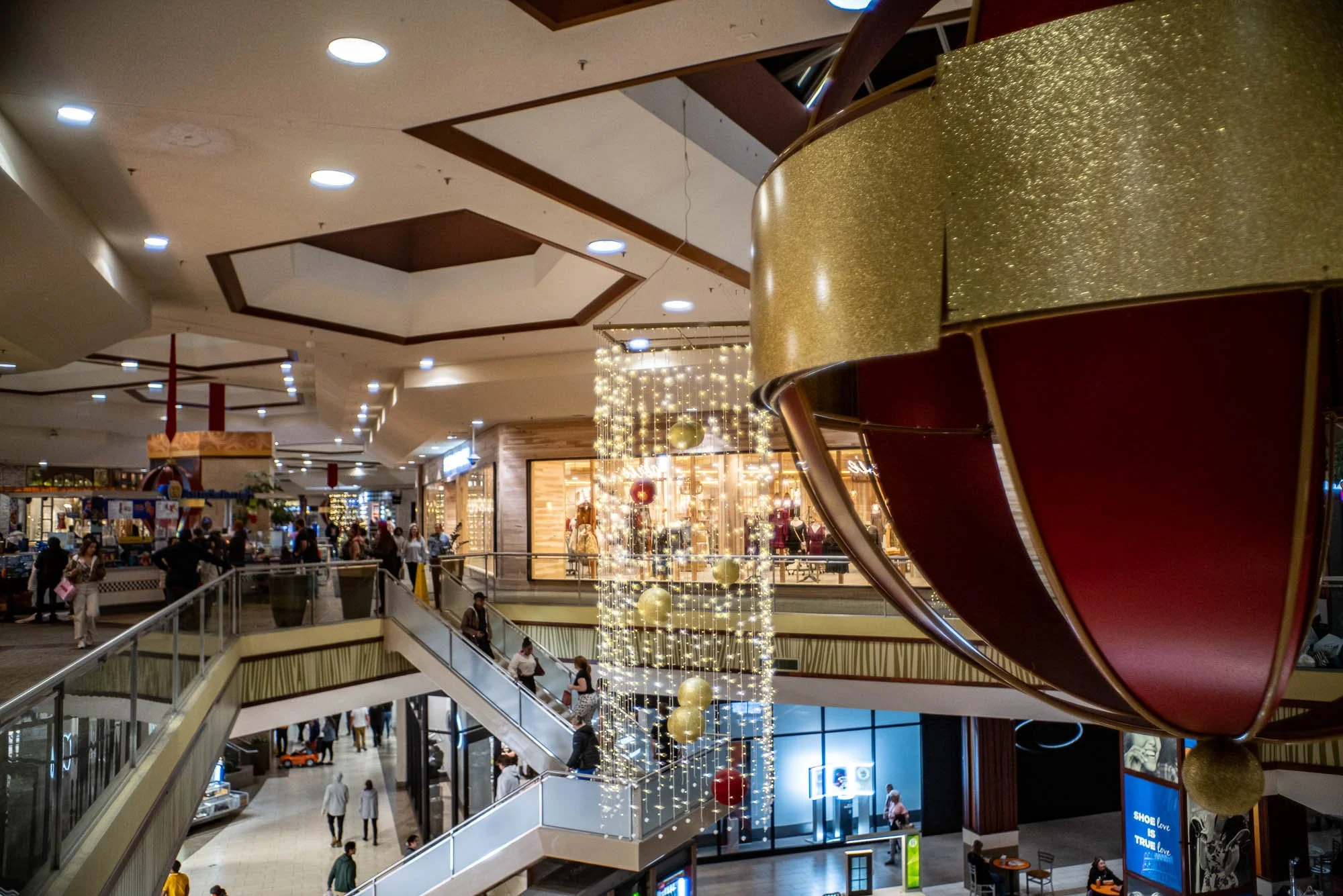
1/250 second to freeze the people and capture 2023 fashion in all its glory.
The Christmas decorations at the mall — shot handheld at 1/10 second thanks to the SL2's IBIS.

1/250 second to freeze the people and capture 2023 fashion in all its glory.
The Christmas decorations at the mall — shot handheld at 1/10 second thanks to the SL2's IBIS.

1/250 second to freeze the people and capture 2023 fashion in all its glory.
The Christmas decorations at the mall — shot handheld at 1/10 second thanks to the SL2's IBIS.
All in all, the Hanimex performed extremely well in this role. The images are sharp and the colors are easily adjusted in post processing to give any look you want. It also doesn’t hurt to have that Leica “look” from the camera processing the colors before saving the RAW file too, Leica does something special with their processing to give the colors a look that is unique to Leica cameras. It is hard to explain, but it is a thing.
The Sun Flare Problem — Yeah, It's Bad
In the next photos I didn’t show all the images as they just reflect what it is like to shoot indoors where there is controlled light and no sun to deal with. The following photos show what happens when you have the sun shining on the front element.

Same shot as the next one but the lens is shaded from the sun — clean and sharp.
Above is the same photo as the one right under this text except that I shaded the lens from the sun. This lens cant handle the sun shining on it from any angle without showing you that it was happening with some sort of sun flare in the image. In the below image there is geometric artifacts as well as a overall glare from the sun.

What happens when the sun hits the front element. Vintage lenses and coatings don't play nice with direct sunlight.
In the below photo you can also see the geometric glare in the center of frame, this could be used to your advantage in some applications like vintage style portraits where you position the subject to where the flare adds to the aesthetic of the image. Here the flare doesn’t do that though and is more of a nuisance that anything else. So this is something to keep in mind when using vintage glass, you will run into these kinds of problems from time to time like the older generation has to do…lol.

That geometric glare in the center? Classic vintage lens behavior. Could be useful for portraits if you position it right.
Can You Shoot Portraits with a 28mm? Actually, Yes
Lastly, can you make portraits with the 28mm lens? The answer is yes, you can as long as you are careful with the composition and keep the subject centered like I did here. The 28mm lens can distort toward the edges so it is imperative to keep the person in the center of the photo as much as humanly possible if you want the image to turn out like anything you want at all. Maria was gracious and allowed me to make her portrait at the mall using one of the advertising lights as a “studio light” to give us nice diffused side light and I think the image turned out really well for a 60 year old lens with improvised lighting.

Maria at the mall using an advertising light as improvised diffused side lighting. Not bad for a 60-year-old lens.
Now, shooting portraits with a 28mm isn't what most people would recommend. The conventional wisdom is 50mm or 85mm for portraits, and there's good reason for that — longer focal lengths are more flattering and don't distort faces. But if you keep your subject centered and don't get too close, a 28mm can work. The key is composition and knowing the lens's limitations.
Maria's portrait here is proof that it's doable. I kept her in the center of the frame where distortion is minimal, used the advertising light for nice diffused side lighting, and shot from a reasonable distance. If I'd moved her to the edge of the frame or gotten right up in her face, it would've looked weird. But treated carefully, a 28mm can give you a portrait with some environmental context in the background, which can be a nice look.
Just know what you're getting into. This isn't a portrait lens. But it can make portraits if you're intentional about it.
As well as this blog post, I also have a video sharing some of these points and showing more of the old Sitton’s mill location should you want to go check that out at the link below.
Thanks and if you are into vintage glass, this is a keeper in my book — and for pennies too. Twenty bucks for a solid 28mm that actually performs? I'll take that deal every time. Sure it doesn't like the sun and you probably won't shoot portraits with it every day, but as a walkaround lens for street photography or just messing around? It's great.
So with that, get your camera out and go take a picture with it. Maybe even throw the dice on some weird vintage lens you've never heard of. You might just find a winner.
Questions People Ask About the Hanimex 28mm f/2.8
Is the Hanimex 28mm f/2.8 any good?
Yeah, it's actually pretty good for the price. Sharp in the center, solid build quality, and it handles well on modern mirrorless cameras with IBIS. The biggest issue is sun flare — this lens does NOT like having the sun anywhere near the front element. You'll get geometric artifacts and overall loss of contrast if you're shooting with the sun in or near the frame. But for $20-30, it's absolutely worth picking up if you see one. I mean, at that price, even if it's just okay, who cares? But when it turns out to be actually good, you feel like you found a hidden gem.
What mount is the Hanimex 28mm f/2.8?
M42 screw mount, which is great because you can adapt it to basically any mirrorless camera. I use it on my Leica SL2 with an M42-to-L adapter, but it works just as well on Sony E-mount, Fuji X-mount, Canon RF, whatever you've got. M42 is one of those universal old-school mounts that just adapts to everything. Plus the adapters are cheap and plentiful, so you're not spending a fortune to use these lenses on modern cameras.
Can you use vintage lenses on the Leica SL2?
Absolutely. The Leica SL2's IBIS makes vintage glass way more usable than it used to be. You can hand-hold at slower shutter speeds that would normally require a tripod, and the camera's focus peaking makes manual focusing pretty straightforward once you get used to it. Plus the L-mount has a short flange distance so you can adapt almost anything — M42, Nikon F, Canon FD, Leica M, you name it. I actually prefer shooting with adapted vintage lenses on the SL2 sometimes because it's just more fun than using modern autofocus glass.
How do you deal with sun flare on vintage lenses?
Use a lens hood or just shade the lens with your hand when the sun is hitting the front element. Vintage lens coatings from the 60s and 70s aren't anywhere near as good as modern multi-coatings, so direct sunlight will give you all kinds of flare, ghost images, and loss of contrast. If you're shooting into the sun or with bright light hitting the lens at an angle, expect problems. It's just how old glass behaves. Sometimes you can use it creatively for that vintage look, but most of the time it's just annoying. I literally had to shade the lens with my hand at Sitton's Mill to get clean shots.
Is 28mm good for street photography?
It's a little wider than the classic 35mm or 50mm focal lengths most people use for street, but yeah, it works. You get more context in the frame, which is good for environmental portraits or showing a whole scene instead of isolating subjects. The trade-off is that 28mm has more distortion at the edges, so you need to be careful about composition. Keep important stuff — especially people's faces — toward the center of the frame. I shot a portrait of Maria at the mall with this lens and it turned out great, but I made sure to keep her centered. If I'd put her at the edge of the frame, her face would've looked stretched and weird.
Where can I buy a Hanimex 28mm f/2.8?
I got mine at Ball Photo in Asheville, North Carolina for about $20. They have an absolutely overwhelming amount of vintage gear if you're ever in the area. Otherwise, check eBay, KEH Camera, or local camera shops that carry used gear. These lenses aren't rare or collectible, so they're usually pretty cheap when you find them. Don't overpay — if someone's asking more than $30-40 for one, keep looking. There are plenty of them out there.
Support this website by using these affiliate links to shop on Amazon:
Leica SL2 Mirrorless Camera Body
K&F Concept Lens Mount Adapter M42-L Manual Focus
Actual Lens Adapter in this Blog Post
One of my favorite camera straps
Sandisk 128GB Extreme Pro memory cards
Nikon 50mm f1.8 S Lens for Z mount
Have you shot with the Hanimex 28mm or other obscure vintage glass? Drop a comment below — I'd love to hear what hidden gems you've found digging through used lens bins.