WK4DS Amateur Radio Blog
Search Posts
Cypress Creek Preserve K-7389
Cypress Creek Preserve is a new-to-me POTA park and I think that at this point, I have worked more Florida parks than Georgia parks! That is irony at it’s finest right there!


This is a really neat park as it has ponds with lily pads and hiking trails and all sorts of other stuff right from the outset. Most of the other parks I have been to in this area are not quite so enticing when you arrive with it being more of a parking lot and a simple trail into the under brush more than anything else. It took me a minute to confirm that the parking lot was within the park boundary, but I finally did and setup my radio accordingly.
Once I was parked and started to deploy the antenna, I found this little guy supervising the operation to make sure the antenna was in the proper position to be able to work Europe as well as the west coast. I am really grateful too as his efforts came in handy on this activation!


As you can see in the above photo as to why I wasn’t sure where the park boundary was as there was this huge fence between the parking area beside the road and the park itself, but after checking several maps, I was able to figure out that the parking area was in fact in the boundary.
Once again, to see what I could do at mid day on 15 meters, I decided this would be the only band I setup on.. I ran out the one 20 meter radial that seems to help the 15 meter band and used my 25’ coax as well and the SWR showed up at 1.1:1 which is great in my book so I immediately hop on FT8 to see what is happening while I setup the logbook on HAMRS and get my spot on the POTA site.
Well, it was doing great as I worked something like 6 stations before I had time to put the spot up on the POTA site! This is awesome! I was thinking this might be a day where. I work 50 or more contacts from the way it started…

The antenna system at this point is almost a joke to be honest about it. This radial works on several different bands really well and it is broken speaker wire! I have a spot in the wire where it is literally twisted together so that it is the right length and I am afraid to solder it as when I solder this wire, it breaks next to the solder joint. I have done all sorts of things to try to prevent this too, none of which have worked long term. So I have reserved myself to using it till the SWR readings start to show too much of a mismatch and then I will actually work on it. I use this radial on virtually every outing too, that is part of the comedy of it, the broken radial gets the most use…so is life I guess. Since I was backed up to the fence like you see below, I ran the radial over the fence and was able to lay it out in the grass behind the truck properly.

The activation did hit a few lulls, which was handy as it gave me time to catch up the log in HAMRS so that when I finished the activation I was able to email the log to myself so when I get back I can upload it to the POTA website. As you can see in the log below, FT8 produced a half a dozen DX contacts before I landed my first domestic contact! FT8 is a DX paradise to be honest about it. The weak signal capability of that mode is hard to grasp to be honest. I know this as when I switched to CW I heard nothing but Domestic stations for almost the entire time with the exception of two DX stations that were booming in. This is what I am used to doing to be honest, a sprinkling of DX with almost all domestic contacts.
Here is what is odd about FT8 though, when I went back to work some more while I finished up the logbook, I worked almost nothing other than Americans. It really is the luck of the draw it seems, but you could see on the waterfall that the band had some significant fading at this point and some stations would shift almost 20dB in signal from one cycle to the next, that is pretty drastic and makes me wonder if I had got on the air a little earlier if that would have made more of a difference…
Take a look at the CW portion of the activation and you will see a 10 minute period right in the middle where there is no contacts at all. This isn’t me leaving the station for some reason, I was calling CQ the whole time, there just wasn’t any takers. Then Julia (N1XV) answered me and it took another five full minutes to get another contact! This is unreal in my usual activations …albeit those usually happen on 20 meters and that seems to be the watering hole for POTA CW ops for some reason… Back to this activation, then I work Paul (KJ7DT) and then you can tell the band turned back on as I worked several contacts in a row without stopping as I can work about 1 per minute at the speed I like to use (17WPM to 22 WPM).
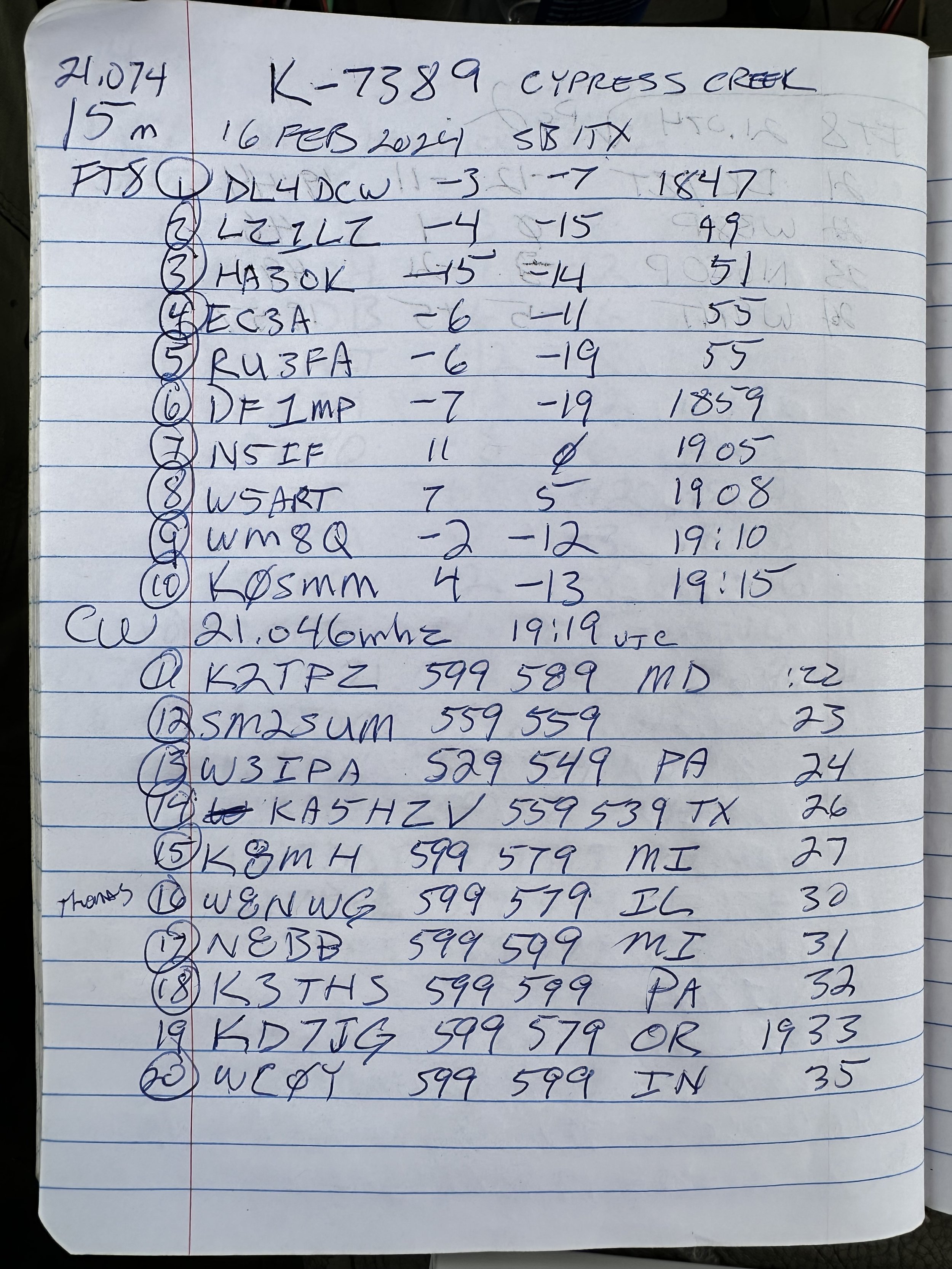

By the time I had the logbook caught up, I had worked over 35 QSOs so I wanted to see if I could get to 40 before I went QRT at 21:00 UTC as I had to leave about that time. I was able to get to 41 and go QRT wihtout any replys well before I ran out of time so all is good in the world!
What a day! 15 meters gave me a wonderful activation and I got a bunch of DX as well as cool domestic contacts! What more do you want?
73 - WK4DS
A 2 park…digital rove on New Years Day???
I wanted to activate two parks today so to add some challenge (for me that is) I decided today I would only use FT8 to get the activations. The bands looked good so I had high hopes.

FT8 was alive and well on 17 meters this morning.
The cool thing about the sBitx V3 (I did the software upgrade but have not changed my finals yet) is that you don’t need anything but the radio itself to do FT8. No keyboard or mouse or anything. So I setup at K-2169 and get started with my deployment and decided to start on 17 meters first to see what was going on as far as activity. To say the band was active would be an understatement. The FT8 portion was buried in activity so I looked around and found a spot to setup to transmit and got started. The first few were Americans and then I started getting DX stations! A lot of them too! I even got the DX-pedition to T32TT in the log! To work them on 17 meters and a hamstick with 20 watts, that is not bad in my book. The signal reports reflect it too lol, just look at the logbook in the photo. I think I netted equal numbers of dx stations compared to domestic stations this time out. That is pretty awesome for someone who rarely sees dx in his POTA log at all!

This is the display of the sBitx V3 running FT8. Everything you need and nothing you don’t. Since it is a touch screen radio, all the buttons are on the screen and if you want to dial something up, just touch the function and then turn the multifunction knob to adjust it. Just don’t forget that the knob is set to that function till you choose a new function or you will think you are about to turn the volume up and instead you will change something else… so to prevent problems, I just select the volume once done to lock the function and prevent accidental changes.

I ran out a pretty good radial field today with four radials, two for 20 meters and two for 17 meters. I simply spread them out behind the truck in the grass and checked the SWR with my nanoVNA (which showed about 1.6:1 SWR

This has become a permanent part of my field kit at this point, I literally check my antenna every time I go to the field now.
I have noticed over time that the SWR has slowly crept up as I have used the equipment. What was once 1.175:1 is now 1.6:1 so before I go out again I am going to do repairs to my antenna system. This is one of the reasons I like checking the system before each activation. Data tracking is an ongoing process. I suggest you get one of these little widgets and just keep it with your portable kit if for no other reason than what I have described here.
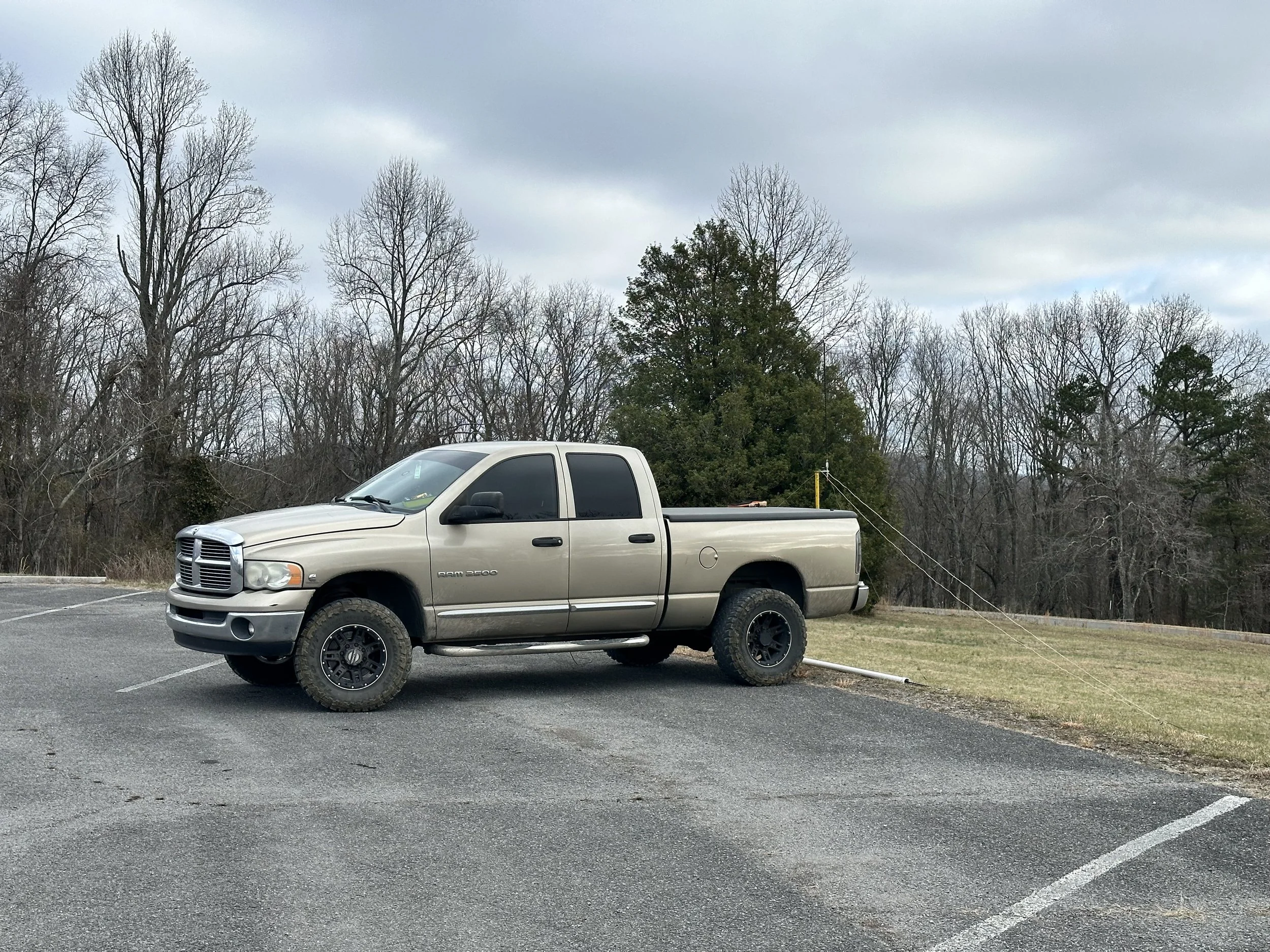
The spot, in the above photo, has kinda become my defacto POTA spot on days when I don’t have a lot of time to do radio, but I still want to. It is in a good spot, fairly remote from human activity noise (aside from the occasional frisbee golfer or two) and also has good elevation too. It is quite possibly the perfect location for POTA.

Today also saw the use of the keeper pin I made a while back too. This is for times, like now, where I plan to move between parks and simply remove the hamstick from the mount so things don’t break it off, like errant tree limbs on backroads, and keeps the mount secure for travel. I also didn’t bother to remove the radials either but stuck them in the truck bed to be pulled back out when I got to the other park. I disconnected the coax and just rolled it up in the back seat of the truck since it is so long that it drags the ground.


Once I had gotten setup at K-2169 and was going well, I thought about also running over to K-0716 and getting in an activation there too for the first day of the year. It is about an additional 30 minute drive from Cloudland to Chickamauga but I have a favorite spot there too that doesn’t seem to be a problem with the rangers so I packed up enough to drive and headed over there once I had the activation in the bag.
The main road between Ft Oglethorpe and Lafayette Georgia is Highway 27 and when I was a kid, this highway passed right through the military park, I can remember riding through the park and looking at all the monuments and wondering what they really meant… It meant a lot of people died terrible deaths for ideals… I don’t want to wander down that path here, the point was I have a lot of memories of this place from my childhood and it is interesting to see how it has changed. Now there is a bypass road that circumvents the park entirely, you actually have to take, what is now a side road to go through the park. Kinda surreal to me to be honest about it…

Once at the park and in my favorite spot, I pulled all the radials back out and this time, I put the 20 meter ham stick on the mount. I actually figured the SWR would be better on 20 meters and it was…marginally. Take a look at the chart below though to see how deep the FT8 area was with hams calling each other. It was pretty much saturated with signals. This is a level of saturation that I only see on 20 meters too for some reason, the other bands might be busy, but it is nothing like 20 meters for some reason. After watching it for a while, I finally found a spot to setup for transmit and got to work. What is odd now is that I didn’t get near as many DX stations in the log as I did on 17 meters. There were plenty out there with strong signals, but I only worked one DX station from this activation location and band. Just odd to me how that can happen.

Below is a tidbit I wanted to share with you about how I log. I use the HAMRS logbook app for iPhone, while it is connected to the POTA site it pulls all sorts of data from it apparently. Like the ham’s information if it is stored in the HAMDB database and auto populated the fields if it is there. If not, then that station doesn’t show up on the QSO map as there is no GRID info for them in the log, just remember that if you want the map to work right. I just go to QRZ and copy the grid info for the ham that doesn’t have it in HAMRS and then edit the QSO and add the GRID info and now that call will show up on the map. Another cool thing is that it pulls the RBN data for you if you show up and gives you these little green info graphics letting you know you have been spotted, that is cool as I can leave the log open for adding calls and still get the beacon reports, it will even show the ones manually uploaded by hams on the POTA site too…just to let you know.


In the left side of this photo, you can see the cars on the highway that I was talking about. This little pull off is right off the main road which is super convenient as this road passes right through the heart of the park. You can also see the radials in this photo going out and I don’t have them staked down but rather they are held in place with weights so there is no impact from me being there at all. This gets around the “no driving stakes in the ground” rule that a lot of parks have.

All in all, it was a great day of radio and I was able to complete both activations with plenty of time left over. Set some targets occasionally with your activations to give you something to do other than just make contacts if you want to spice up the whole thing. This was not too awful to pull off…it was actually easily doable without much fuss at all for the most part.
Until next time,
73
WK4DS
K-2169 POTA Activation at the very foot of a MOUNTAIN - AAR

So the last two days have been really strange. I tried to activate K-2169 last night to see if I could pull off a late shift activation and it was a miserable failure, zero contacts in 30 minutes straight of sending CQ, literally no replies at all.

The night before when I literally got zero contacts.
I actually swapped out the radio for a spare (the IC-705), it showed activity in the waterfall but no one was able to hear me. I was on top of the mountain at this point too. So I packed up and came back home having had zero luck. You win some, you lose some…
The next day was different though. I only had about an hour to setup, activate and breakdown as we had “family activities” to do later. So I figured this was the chance to test another location I had been looking at for awhile now. The Sitton’s Gulch Trail Head is at the bottom of the canyon and the parking lot is literally buttressed against the bottom of the mountain proper.
To compound the problems, I didn’t want to put my radials out in the way of others if they wanted to park next to me as this lot tends to fill up pretty quick in nice weather. So I ran them both off to the drivers side of the truck to keep them out of the way.

Welcome to the literal foot of Lookout mountain.

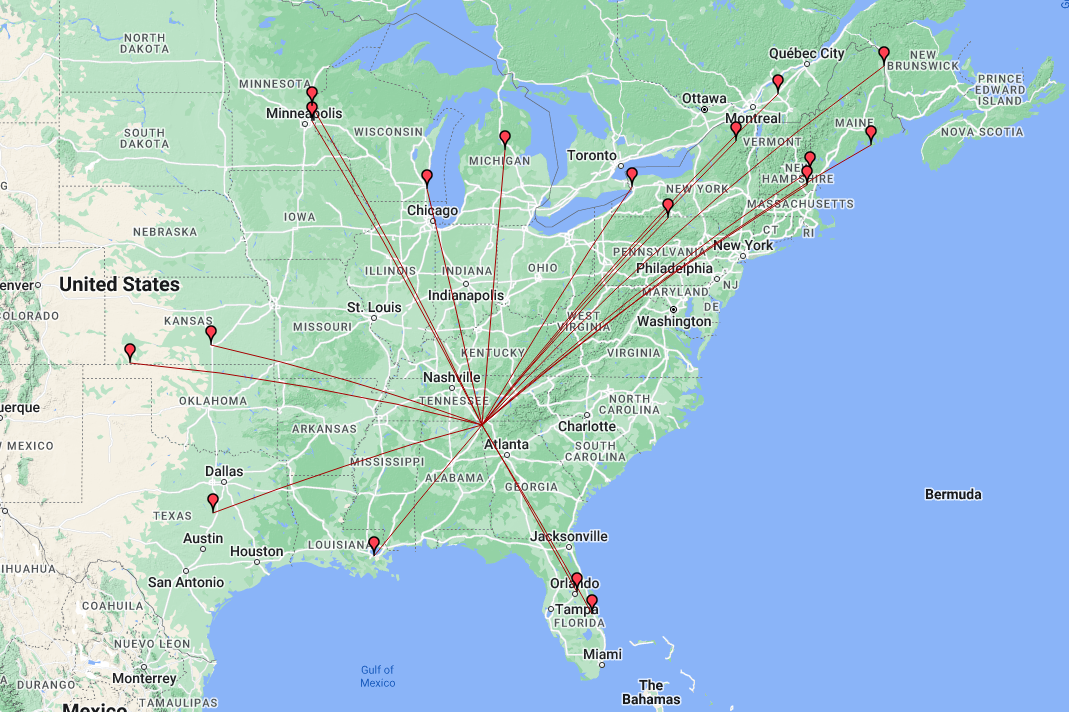
One of the counter poise radials is actually draped over the corner of the truck but it didn’t seem to cause a problem with propagation from what I can tell. The mountain is on the south side of the parking lot proper so I figured I wouldn’t hear anything to the south at all, but I was surprised to see the map showing some stations on the dark side of the operation position, these guys must have incredible stations to hear my QRP signal into a compromised antenna with a literal mountain blocking our signals! My hat goes off to these guys!
The bulk of the contacts are from a predictable direction though, since Lookout mtn is part of the Appalachian mountain chain, most of the contacts are to the north east which is the direction that is clear of the mountain. It has a decent clearing to the west as well from this location as Sand mtn is about 2 miles away and it is fairly short too, only about 700 feet tall, so I was able to get out to Kansas and Minnesota pretty easy too. As you can see in the photos, I am in the forest surrounded by trees too, so I am happy with my little activation considering all the limitations imposed on it today.
The radio for today’s adventure is the Penntek TR-35 and the more I use it, the better I like it. The RIT is for CW sidetone adjustment. This was a trick I found in a forum post and thought it was really clever. If the other station is low on tone, turn the RIT down till they sound like you want, if they are high turn it up till they sound good to you, it works REALLY well and I wished I could remember the HAM that gave me this idea as I would credit them with it…if they do I will edit the post and add it here. I am running 5 watts on 20 meters today because I am using the “Truck-tenna” for the sake of time.
When I got on the air to start with, I was the only POTA station on 20 meters, and there was only one other when I went QRT an half hour later. The band was open too as the RBN (Reverse Beacon Network) was spotting me regularly.


Those are not outhouses in the photo. This area is home to a local cave system called Case Cave and those are changing rooms for the cavers when they come out of the cave. It is a really huge cave system and if you want to explore it, you need to contact the park and line up a time when someone with the key, will meet you and open it for you, it is locked to protect the uninitiated from getting themselves killed…
I am pretty sure I have not shown the counter poise weights on the wires really well yet. This is a simple system that works super well for keeping the radials extended and not having to drive in stakes to do it, I simply straighten the wire at the end when it is taught and walk away, it is that simple, the wire keeper is simply a piece of plastic with three holes drilled in it to thread the speaker wire through, it doesn’t slip at all. The weights run about 2 pounds or so and that seems to be plenty to keep a 16’ radial in place so far. I have not tried heavy winds yet, so the jury is out on that one.


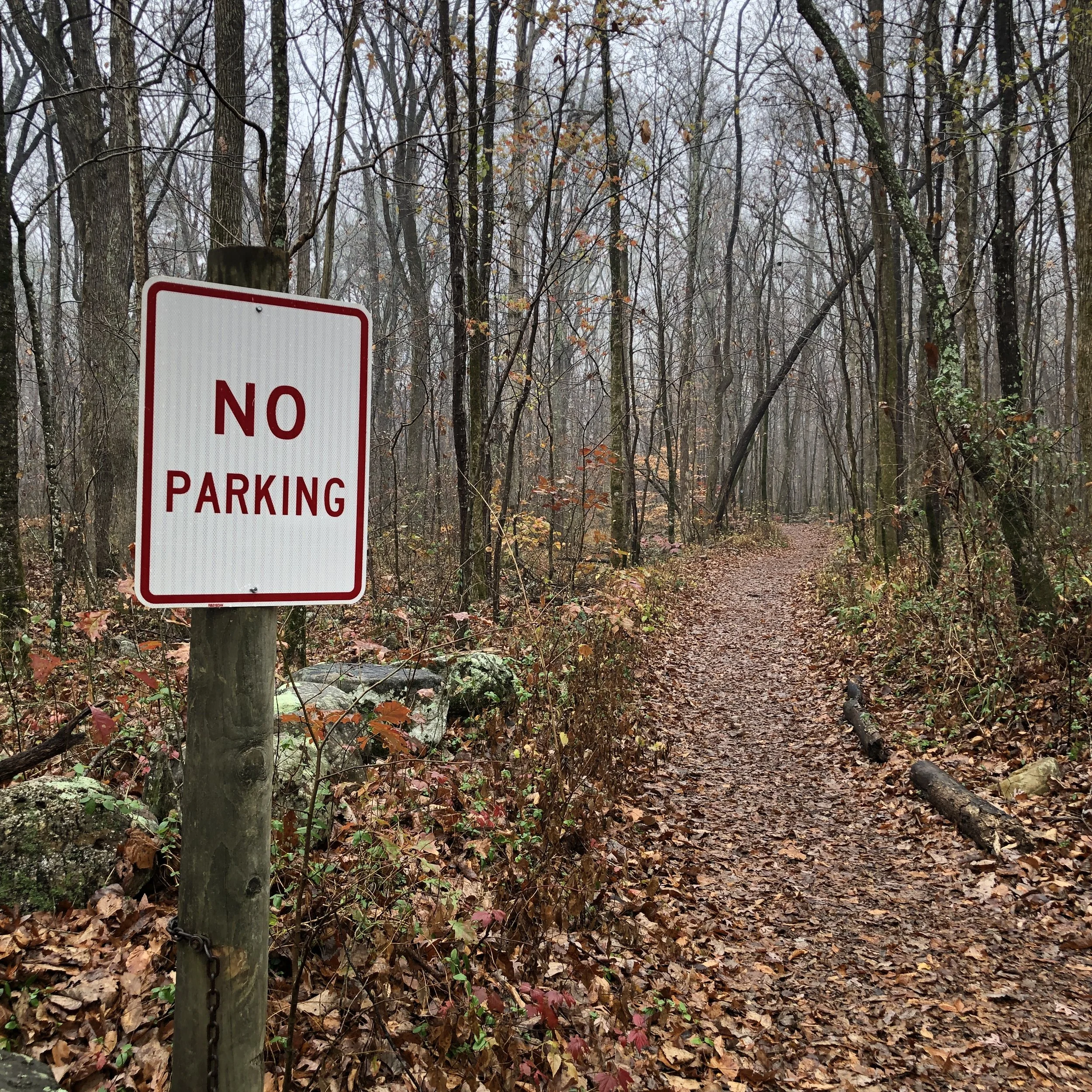
Not sure what is going on here, this is the hiking trail and just below the camera is a huge gate across the road… lol. I thought it was funny with the irony of it being in a spot where you literally cant park. Maybe it is from a time when you could drive up the trail to the cave? I don’t know…
If you enjoy the blog I would appreciate a like and a comment if you have one. Thank you for your time and get out there and warm up the ionosphere!
72
David
WK4DS
"Trucktenna" for winter POTA outings with some AAR info about how it works.

The mount is made out of ordinary tube steel, but the top plate is 304 stainless steel as is the counter poise stud and associative hardware so it wont rust if it does get deployed in the rain. Also note that I have added a PL259 to Male BNC so I can use this small QRP Coax cable as well. The cable is from Amazon and is 25’ long. I like it as my QRP transceivers are BNC out put for the most part.
I finally built a mount for my “winter time” antenna setup and have done some testing with it to find out how well it performs.
What I wanted for my winter ops was something that would be pretty simple to deploy as well as worked fairly well, all the while allowing me to stay inside my vehicle where there is a heater. Pretty tall order since all summer I had used a 40m EFHW wire and it had been producing wonderful results for me. Well if you scroll down through the blog you will find a post about the Huntsville Hamfest and at this hamfest, I picked up a 20m HamStick antenna and stuck it in the corner when I got home for a future project… Today I used that antenna.


QSO map showing the region this antenna works with on the 20m band and 5 watts of transmitter power in 2022…
I used it on 20 OCT 2022 to activate Chickamauga National Military Park. The beauty of this setup is that I specifically designed it for use in such parks where you are not allowed to use the trees for antenna supports and in some cases, the park doesn’t even allow spikes/tent stakes to be driven into the ground. I wanted this antenna to be compatible with all those rules should I decide to venture into one of these parks.

The counter poise wires don’t have to be taught, but keeping them pulled out as close to original as possible makes it work really well.
I keep the ends of the counter poise in location with a couple of custom stainless steel weights that I made in my machine shop. They are kept on the wire by a simple 3 hole keeper that the wire is threaded through. This makes everything easy to deploy, I dont currently leave the base in the trailer hitch, but rather store it inside the cab of the truck when not deployed. So assembly goes like this: 1) Insert the yellow mount into the receiver. 2) Screw the hamstick together and then screw it into the mount. 3) unrolled both counter poise wires and put them both under the ground lug on the antenna mount, spread out both counter poise weights to get them taught. 4) install the BNC coax and run it through the window of the truck door and get in the truck. Done. I like this deployment time, especially with the TR-35, as 20meters is a good band for me to get a decent signal out using just 5 watts of power. I have done several other activations with this setup before this day and after and it always performs really well. I am certain that my weights are interacting capacitively with the counter poise wires, but I don’t care because I tuned the system with them in place.

27 OCT trip to K-2169 showing how this setup pulled in almost 40 QSOs in less than 45 minutes at 5 watts!

QSO map for 27 OCT 2022. I like these kinds of days!!!
As evidenced by both QSO maps, this antenna is deaf inside of 500 miles on 20 meters. That one contact in Calhoun GA was most likely ground wave as you can see there is literally no one inside of this circle except for that one QSO. This is why I think a 40m version would be nice, at least I was getting NVIS on my wire antennas on 40 meters, I hope this antenna will too.

The height of the mount it literally just a piece of tube I found in the shop. I didn’t cut it to a certain length, but rather I just wanted it to be above the top of the truck bed…because I liked that idea. I also figured it would help with the ground plane if the antenna was not bedside the metal of the truck body too…
Since I opted to add a counter poise, it required me to tune the antenna. Below you can see the null is on 14040khz and the SWR is fine for me considering the setup. I found that the length of the counter poise is critical to a good SWR null , I settled on 16’ 4 3/4” on one (1/4 wavelength at this frequency) and the other is a little shorter due to a blunder on my part with reading the tape measure wrong… (I saw 164.75” and my mind converted the numbers to be 16’ 4 3/4” and I happily lopped off the wire this long (13’ 8 3/4”) and threw the cut piece over next to the other and noticed it looked MUCH longer… Then I realized what I did. Never to worry much about details like this, I checked and just needed to trim the antenna to get it to frequency. To be honest here, I noticed that the closer that I got the counter poise to 1/2 wavelength the deeper the null got on the SWR plot. When I make the counter poise for the next band I will cut them the same length and see what that does for the plot… Also take a close look at the counter poise wires where I connected them to the base. I have crimped ring tongue connectors on the wires, but then I also added heat shrink tubing as well, this is to reduce the stress on the wire where it meets the crimp connector and prevent the wire from breaking there. These counter poise wires are made from simple speaker wire.

Something I noticed while tuning the antenna, I could move the null up the band by shortening the counter poise wires…for a while. At a certain point though, the SWR null went up drastically and was un-waivered by anything I attempted to do…except adding back the counter poise wires. The length of the counterpoise wires is very important… So once I got that sorted out and the antenna tuned like you see, I was happy to test it with an outing. First test on each outing was to sweep it with the VNA to make sure nothing had changed from tuning it to setting it up in the field. I am happy to report that it worked perfectly. This antenna works so well that I am going to make a counter poise for 40 meters and another one for either 17 or 15 so I can switch bands. For now, I will just add the other counter poise to the mount and see how the SWR null looks on 20 meter to make sure it isnt causing too much trouble. If not, then I will also look into making a plate to hold more than one hamstick at once and we will see if the non-resonant antennas will cause a problem for the one that is matched to the band. I swept this 20m hamstick across the whole HF band and it only has one null…20 meters, there is no harmonics like the EFHW has…at all. So I am thinking this idea will work and will not require an antenna tuner to switch bands.

I am thinking that the 40 meter kit will be just two more 20 meter counter poise wires to add up to 1/2 wavelngth total… these 16’ wires are already LONG…
The upper lot at K-2169 has plenty of room now and I no longer need a tree to hold up my antenna. This is awesome on so many levels. Another wonderful thing is, if it is threatening rain, my radio will stay dry. If it is windy, I can get out of the wind and if it is cold, I can turn on the heater!!! I hope you like and leave a comment on this post and possibly subscribe to the RSS feed as well so you will always know when the next post drops.
Thank you and 72
de WK4DS (David)