WK4DS Amateur Radio Blog
Search Posts
Activating a park in bad conditions
POTA activating in bad conditions can be challenging… for some modes. Seems that FT8 doesn’t really care if the bands are crappy and will gleefully allow you to play radio anyway.
This was an experiment to see if the sBitx amateur radio could work in terrible space weather like you see below in the report.


The above and below photo show how fast the band conditions changed on me while activating on this day. The band noise could be seen on the display “walking” across the band segment at times. This band noise would pretty much wipe out what you could hear on the band, but the radio could still decode the FT8 signals so I was able to work almost 20 stations in about an hour even with this sort of noise coming into and out of the band.
I normally dont bother activating in bad band conditions, but this day I really wanted to see just how good FT8 was at extracting signals from the noise. I can honestly say that I was impressed by the performance of this mode. Digital modes have their place and this is very much one of those places. Weak signal in poor band conditions shows just how important it is to use all the modes available to the amateur radio operator. I was once a die hard CW only op and to be honest, it is still one of my favorite modes, but of late I have started getting into SSB more and now I am also dipping my toe into digital modes more and more and I am really liking it. Dont limit yourself out of a stigma like I did, you might just like what you find.

Below is a photo of the display that shows something that i had never seen before and that is the pulsing band noise. That was a new one for me. It too would come in waves and these would last much longer it seemed. The sBitx just kept chugging along though, I would sometimes pick calls and sometimes answer calls and this is what makes FT8 awesome. I couldn’t have possibly made SSB contacts in these conditions…


Here you can see the operating position for the day. Perfect blue skies and nice temps makes for a great day on the air at a park. I had to goto this spot as the lower lot was completely full since the weather was so nice, it was fall and a Saturday. Sometimes going to this spot has it’s perks like lower band noise from the campground inverters and such so I dont really mind it.
I had planned on using a battery and setting up on the picnic table I usually occupy down next to the canyon rim, but there just wasn’t anywhere to park and I didn’t want to wait on someone to leave just so I could park.


This radial is on it’s last leg. I have twisted this broken radial back together for months now and on top of that, the connector on the other end has also broken off. This is almost comical as this is the best performing radial in my set! That is why I am reluctant to repair it at this point…lol. It just works and if it ain’t broke (figuratively) then dont fix it.
I dont know when this bug (I think it is a jumping spider) decided to join in on the fun but here he was playing on the antenna mount. By the time I finished the activation, this little guy was long gone. Kinda fun to notice the little things like this when you are out in the park.


By the end of the activation, I had worked 18 unique contacts and garnered one dupe because I didn’t read my logbook very carefully and called one ham two times…then I decided to attempt to work some CW. This was pretty futile though as I only worked one contact out of about 15 minutes of calling as this is abysmal for me when I work CW. I can usually work about one call per minute even when I am running QRP power levels. So when I only work one…that is bad band conditions. The stations would literally just disappear then reappear and it was impossible to get complete calls so I called it quits after one.
All in all, it was still a great day in the field. Hope to work you soon!
WK4DS
A Frozen activation…

Today (Jan 20, 2024) was a nice day other than the temperature so I figured I would setup a simple POTA site at K-0716 Chickamauga Battlefield on the Tennessee side of the park. This location is called Eagles nest and is a rock quarry probably for road construction in the late 19th century or early 20th century if I had to guess.
To some people 19 degrees doesn’t sound too bad, but for a Georgia boy that is down right cold! I ran the heater as much as possible to “charge up” the cab with as much heat as I possibly could before I started. Haha.


Since I only had about an hour, I figured I would just work 20 meters to have the highest probability of success. As you can see in the photos, this was a fairly simple deployment since it only used the one antenna and a pair of tuned radials. I also ran the coax through the door jamb to keep more heat in the truck. This deployment style netted me an SWR of 1.2:1 which is really good for my uses.


Here is a photo showing the height of the antenna over the ground. I am 6’2” tall. I really think this helps with the take off angle and also allows better impedance matching by allowing the radials to angle down from the mount. At some point I need to do some experimenting with more shorter radials to see how that would work instead. Dave Casler - KE0OG on YouTube has a great video discussing counterpoise wires and it is worth watching if you are interested in this. It is embedded below…
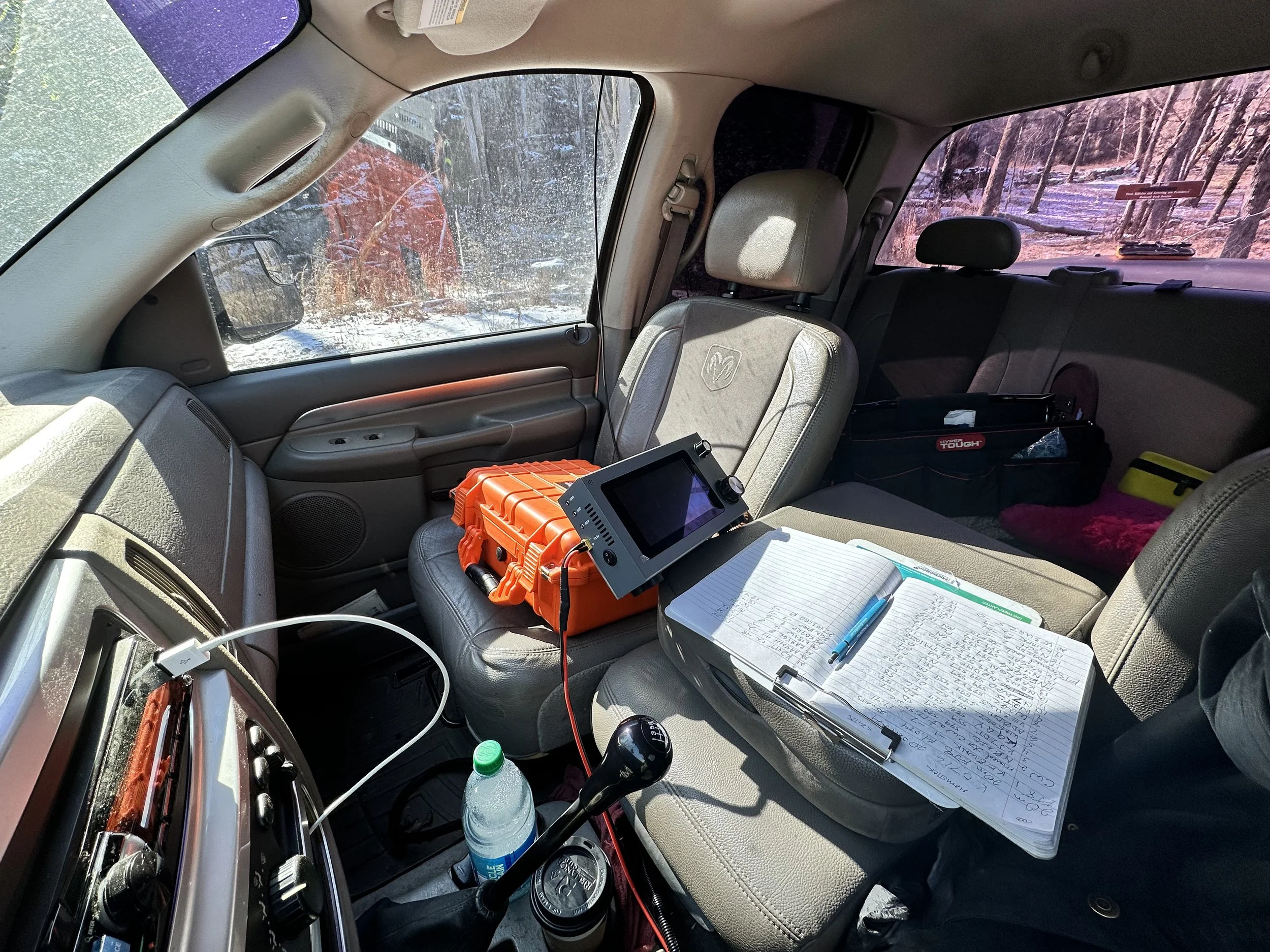
I did a wide angle shot of the operating position today to show how simple it can be if needed. I propped the radio on the storage case and simply used the armrest for my notebook. I operated both CW as well as FT8 today and it worked fine. If you look close, that water bottle in the console is frozen solid. Lol. I did shut down the truck to get rid of some RFI it is making locally as well so heating it up first was a good idea. The band was in great shape today without any fading that I could hear or see. The below photo is of the sBitx V3 software showing the FT8 portion of the band and how it is very busy with activity.

I am still using paper logging while operating in the field even for FT8 so that I don’t lose any of the contacts I make. The sBitx has automatic logging but it does contain some bugs at the time of this writing and will miss one on occasion so to prevent this, I paper log all the contacts during the activation. This is something that I obsess over for some reason, but I do like the peace of mind knowing that I have a hard copy of the activation should something electronic fail.


All in all, I had a really nice time activating on this frigid day and hope that if I get the opportunity, to work you someday as well. Until then, have some fun out there!

How well does 17 meters work?
I see a lot of people on 20 meters, but what about 17 meters? I take the sBitx v3 to Cloudland Canyon State Park (K-2169) for a little fun on 17 meters today… The combination of going to a park with your amateur radio gear and setting up an HF radio in a state park to activate as a POTA operator is a lot of fun.
I see a lot of people on 20 meters, but what about 17 meters? I take the sBitx v3 to Cloudland Canyon State Park (K-2169) for a little fun on 17 meters today… The combination of going to a park with your amateur radio gear and setting up an HF radio in a state park to activate as a POTA operator is a lot of fun.

sBitx V3 running FT8 natively on 17 meters.
What is the 17 meter band in ham radio?
The WARC (World Amateur Radio Conference) bands are nestled between the typical bands and everyone knows what they are because it is on the license tests. The ones I am referring to, in case you forgot for some reason, are 30 meters, 17 meters and 12 meters.
What the license test doesn’t teach though is that each band has unique characteristics that make it fun to use…at least that is how I see it. Since each of these WARC bands are stuffed between other typical ham bands, they seem to take on the characteristics of the two bands they sit between. Take 30 meters for instance, it will act like 40 meters with NVIS propagation on my hamstick to work hams just a couple hundred miles away and then I will work the west coast on the very next contact as if it were also a 20 meter contact.
Well, the higher the bands get the further they tend to reach more distant stations for me. I don’t have giant towers that have huge Yagi antennas on them for say 40 meters so my results are more of the typical ham who might have a dipole that is technically too low to the ground for textbook operation or a vertical with a couple of radials…you get the idea.
The 17 meter band has the same characteristics as 20 meters as well as 15 meters a lot of the time. For me the higher the band, the better the DX usually. I guess it has to do with the fact that the higher the frequency, the smaller the antenna and with a smaller antenna, the lower it can be to the ground and still have proper performance. Armed with this VERY basic knowledge of antenna theory, I usually expect some cool European stations on 15, 12 and 10 with the occasional DX on 17 meters, but today the sky was alive! Well, it would fade in and out and you can see it in my logbook reports. The signals reports over the time period of the activation go from 599 both ways to dismal 529 and 229 reports within an hour. This has been the norm as of late too, a lot of my activations lately have had events that would be described as cyclic in nature. I would hear a station call and reply to them with a 599 because they were booming in and then when I turn it over to them to reply, they will be a lot weaker and then you can literally hear them fade out while you watch and then fade back in by the time they turn it back over to me. It is really odd to hear that in real time for some reason.
17 meters covers a fairly small portion of band space as well with it only being from 18.068mhz to 18.168mhz. This is only 100khz of bandspace and yet there is room for a plethora of modes and operators. 18.100mhz is the watering hole for FT8 on the band and CW runs from the bottom of the band to about 18.090mhz for the most part. Voice operations will be above 18.100 usually and I have not made many contacts with SSB on 17 meters…

The POTA Activation on 17 meters
When I got to the spot I wanted to use for the activation, I was the only one there. So I setup in my usual spot and figured I would start on 17 meters to see how things were and if it wasn’t really happening, I could move down to 20 meters and get the activation easily there. I should have known things were going to be good when my first station of the day was VK3AWA!
Now you need to know something about me here. I thought this was a Canadian station since the call started with a “V”. I work so many Canadians that I have become accustomed to hearing the V callsigns and happily add them to the log. It wasn’t till I checked the QSO map that I realized that he was actually in Australia!!! They (it is an Australian club call) must have had a Yagi antenna pointed at me or something, along with a path opening as the signal reports were really good for a 12 watt transmitter running into a ham stick antenna on the back of a pickup truck. This contact was on FT8 and FT8 reads the signal strength in dB with the software to get the most accurate reading possible to send back. So it isn’t quite as subjective as something like CW where a lot of people (me included) will send signal reports based on how the op sounds to them and never reference a meter one time… So for my little radio to get a -8dB report from Australia had to have help from the atmosphere and probably a very good antenna on their end.

FT8 is a relatively new mode for me. I have normally not done anything other than the two original modes of CW and voice. For me to reach out into a new mode is a pretty big deal and this one works really well, which is why I like it. I am also looking to start messing around with PSK 31 some as well as possibly RTTY if I can figure out how to get the little radio to do it. I think PSK 31 will be pretty easy to master, so I will tackle it first.

What makes 17 meters so special?
The above map shows the performance you can normally expect from a band like 17 meters. Notice there is practically no contacts inside of about 600 miles other than two oddities here in Georgia? That is because of the antenna and the ability of 17 meters to have a pretty decent take off angle and also to reflect off the ionosphere easily. This garnered me a ton of contacts in the pacific northwest as well as the Atlantic north east and a scattering around the country to include Utah and southern California. Then there is the EU… I made several contacts with France and Germany today. That has been a little unusual lately for me and my system to be honest so I was stoked to see them in the log.
But this trip did something that I had not done before that I can remember… It netted 7 Canadian QSOs alone, combined with the other DX calls I technically activated today with only the DX contacts! That has to be a personal first.


I started with a DX call and finished with a DX call. How cool is that? It was a great day for radio and I really enjoyed using the sBitx with the new V3 firmware. The radio works so much better than the previous firmware and the FT8 is a breeze in the native radio setup. It you are into smaller radios and smaller companies and the idea of help from a collective of literal geniuses that willingly share their information with you, then this just might be a radio you will like. It is for me, I have had so much fun with it that it is hard to understand how I got along without it before…and the people over at HFSignals dont even know who I am…haha.
You can help support this website by using these Amazon Affiliate Links:
QRP/Portable Radios:
Antennas & Tuning:
CW Equipment:
Power & Accessories:
Organization & Transport:
BONUS ITEMS (Optional 16-20):
Hope you enjoyed this little diversion into the 17 meter band and inspires you to go out and setup your radio in a POTA park at some point!
73
David - WK4DS
I used Modern Digital Modes and I have mixed feelings.

Well, it finally happened. KV9L helped me setup my computer at home to work some digital modes with my IC-705. It turns out that all I needed to connect my IC-705 to my desktop PC was a simple USB cable! It also took a significant amount of “know how” from my buddy Aaron to get them talking to each other as well. The two modes that I have played with so far as FT4 and FT8. These seem to be the current hotness in digital modes with FT8 clearly winning in popularity as the “watering hole” for it on 20 meters has dozens of stations on the air pretty much 24/7. The FT4 area can go long periods of time with no one there at all. Just to see if I like this idea, I have just wired the 705 up temporary on the shack bench with wires running this way and that… Once I decide if I want to keep this up or not, I will put all those pesky wires away…but till then!

All I needed was a USB cable that was in the storage bin 3 feet away…lol.
I will be honest though, I am kind of stuck in the past. I really like the kinesthetic feel of working with my gear and once setup, these new digital modes are pretty hands off. I was blown away at how far I could hear stations that are not even perceptible to the ear when using the “main two” modes (SSB & CW).
I was hearing stations from all over the world on my simple vertical antenna. Here comes some of the problems though. They either wouldn’t answer or couldn’t hear me when I would click on them. That isn’t to say that I didn’t make any contacts but it is not as easy as I was thinking it would be. Often I would choose a station to answer just to have them continue to call CQ.
Another thing I learned was that there is a good bit of waiting… Actually, there is a lot of waiting… it takes 15 seconds on FT8 to send one message, in one direction, and another 15 to send the reply. A typical QSO is 4 messages(as best as I can figure) from each person so a full two minutes to finish one QSO. This doesn’t sound like a long time till you are sitting there watching the QSO happen in real time. It goes a little as follows: they call CQ, you call them for a QSO, they don’t hear you the first time as you started transmitting in the middle of a cycle, so they call CQ again, then your message is repeated, they accept your call and send signal report, you send signal report back, they acknowledge and 73, you close with 73…all automatically. Each one of these is a full 15 seconds of waiting since the computer is handling everything for you. If the band is crowded and noisy or you are like me, running QRP power, the exchange can take multiple attempts to complete each stage (all of this is also automated), running the total time up even further.

Here is an example of a QSO I had with KP4PUA in Puerto Rico and notice we had to send signal reports twice to complete the QSO, This took a full 2 minutes to exchange this simple contact.
Another thing that happens is they give up after three of four attempts at the QSO. Burning a full 5 minutes or more just ATTEMPTING to complete a QSO. So I tried several times and made maybe a dozen QSO contacts over the past couple of days. This ends up being very frustrating and to be honest…boring… for a CW op who is used to things happening differently. I found myself picking a callsign for my computer to attempt to call and then leaving it to make the QSO and going for snacks, water, or even a bathroom call and just checking for the complete QSO window when I returned. It is a fully automated process and requires nothing from you other than to click the ok button and choose another callsign.

A typical window layout for FT8 (pictured) or FT4. Click on the screenshot to goto the WSJT-x webstie to learn more about it.
I can see the value in It though, as it takes very little energy and lots of stations can fill the same bandspace as a single SSB QSO. I mean a lot, like dozens or maybe more as shown in the waterfall above. All of those little yellow squares are exchanges happening and they are taking about 100hz of bandspace and they can also duplex and share the bandspace at the same time…from what I can tell. So it has merit, just not for an old CW op like myself.
Now to be honest, FT4 is more my speed as it took half the time to send each message. Waiting 7 1/2 seconds seems like a trivial amount of time difference, but it does seem to pass be faster than the 15 seconds of FT8 for some reason… Like disproportionately faster. Even though there is only 7 1/2 seconds difference, it just seems like it is 4 times faster for some reason, it must be a mental block or something, but that is how I see it. I have been letting it run on FT4 while I typed up this blog post and actually made a few QSOs while I have been here. Not many as FT4 is not as popular as FT8 for some reason and there are not as many people using this mode.
So who do I think this mode of operation is for? That is a great question. I would guide the new ham to it, as once setup, it is very simple to operate and you don’t have to worry about “mic fright” as it is literally point and click. Another group that would be well served right away is the younger generation as they are accustomed to this type of interface and for them, it would “just make sense” for them as they are used to using computers all their lives. Another group would be the person that has been injured or incapacitated in some way that prevents them from using the usual modes, as long as they can drive a mouse, they can get on the air. Shoot, if you just like using digital modes, then it is there for you! There are others of course, my point is that I am not bashing digital modes here, I have just found it wasn’t what I expected and that it isn’t really for me…at this time. I hope to be able to add a computer to my activation gear list at some point and that should enable me to add digital modes to my activation tool kit. I carry a microphone now, but rarely use it, and that needs to change… I really enjoy quietly sitting in the park working CW though, so I am torn… lol. Anyway, till then I will keep using my little QRP radios and having a grand ole time. If you have not gotten out and activated a park, I highly recommend it. I am going to write up what I pack for an activation, and that is my style, and share that with you soon.
If you want to learn more about Parks on the Air. Click this link or the photo below.

Me working the OG digital mode…CW on my tiny N6ARA paddles